

UK Gambling License: Costs & Requirements 2026

UK Gambling License: Costs & Requirements 2026

The UK holds the world’s most respected gambling license — opening doors to 2,000+ active operators in the world’s largest regulated gambling market by GGY. Learn the full UKGC application process, fees, timelines, and 2025–2026 regulatory changes.

Fintech Simple has helped over 500 businesses obtain licenses across 40+ jurisdictions since 2016. Our licensing team guides you through every stage of the UK Gambling Commission application — from corporate structuring and compliance framework design to UKGC submission and post-license operational setup. Whether you’re launching a remote casino, sportsbook, or B2B platform, we provide fixed-fee packages with no hidden costs.

Patrik Asevicius — UK gambling licensing expert at Fintech Simple
Patrik Asevicius
Head of Licensing Department, UK & international jurisdictions

What Is a UK Gambling License?

Regulator

UK Gambling Commission (UKGC)

UKGC review

12–16 weeks

Annual fee from

£2,400

License validity

Indefinite

A UK gambling license is an authorisation issued by the UK Gambling Commission (UKGC) under the Gambling Act 2005. The Act created a single licensing regime covering all commercial gambling in Great Britain — from online casinos and sportsbooks to poker rooms and lotteries. Without a valid UKGC license, no operator may advertise to or accept bets from consumers located in Great Britain, regardless of where the operator is incorporated.

The UKGC operates on three statutory objectives: keeping gambling crime-free, ensuring it is conducted fairly and openly, and protecting children and vulnerable people. Operators who hold a UKGC license — or the UK remote gambling license specifically — carry regulatory credibility that payment processors, affiliate networks, and B2B partners treat as a baseline requirement.

Types of Operating Licenses

The UKGC operating license framework divides all commercial gambling into categories based on where and how the gambling facilities are provided (UKGC operating licence guide):

License CategoryWho Needs ItTypical ActivitiesPlayer Location Requirement
Remote Online operators serving GB players via internet, phone, or TV Online casino, online sportsbook, online poker, online bingo, remote lottery Player or equipment must be in Great Britain
Non-remote Land-based operators with physical premises in GB Casinos, betting shops, bingo halls, arcades, racetracks Premises located in Great Britain
Ancillary remote Non-remote operators who also offer limited remote facilities on their premises Touch-bet terminals linked to live tables, on-premises remote gaming equipment, society lotteries accepting remote payments (up to £250,000/year) Equipment and player must be on the same licensed premises
Gambling software Businesses that manufacture, supply, install, or adapt gambling software Software supply, white-label platform provision, game development, RNG systems Separate remote and non-remote variants available

Within each category, the Gambling Act 2005 specifies distinct activity codes covering the exact type of gambling being offered. A casino operator, for example, must hold a casino operating license; a sportsbook must hold a betting (general) operating license. Operators running multiple product verticals need a separate license code for each vertical — a single license does not cover all activities by default. Most international operators entering the GB market apply for one or more UK remote gambling licenses, since remote licenses carry no requirement to maintain physical premises in the UK.

Personal Licenses (PML & PFL)

Beyond the company-level operating license, the Gambling Act 2005 requires certain individuals within a licensed business to hold personal licenses issued directly to them by the UKGC. Two types exist:

  • Personal Management License (PML) — Required for individuals who occupy one or more of the specified management offices defined in LCCP condition 1.2.1 within a licensed operator, including directors, C-suite officers, and senior managers overseeing regulated activities. The license is tied to the individual, not the employer.
  • Personal Functional License (PFL) — Required for customer-facing staff at land-based premises. Not required for remote (online) operations.

The UKGC assesses personal licenses independently of the operating license application, evaluating each applicant’s integrity, competence, and criminal or regulatory history. An operating license application that lists key personnel without confirmed PML eligibility will stall — prepare individual applicants in parallel with the company application.

Comparison infographic of Personal Management License (PML) versus Personal Functional License (PFL), showing differences in who needs each, scope of application, and fees.

Practical note

Most online operators need PMLs for at least the CEO, CFO, Compliance Officer, and Head of Marketing before they can go live under a UK remote gambling license. Waiting until after the operating license is granted to start PML applications adds three to six months to launch timelines.

Packages & Pricing for UK Gambling License

Three fixed-fee packages covering the full UKGC engagement from eligibility review through to licence grant. All tiers include application preparation, key personnel vetting, and a dedicated account manager — the differences are in ongoing compliance support and post-licence infrastructure. Compare what each tier delivers below.

Basic £9,500
Advanced £18,000
Premium £30,000
Full preparation of documentation required for the Gambling Commission
Legal compliance check
AML / CTF policy formation Core policies Customised AML/KYC policies & internal procedures Full AML/KYC compliance systems & integration support
Representation & handling of all administrative procedures until licence issuance
Dedicated customer support throughout the process
Company registration in the United Kingdom
Comprehensive business plan & risk assessments
Professional management training on compliance & gambling regulations
Ongoing support & regulatory updates 12 months 18 months (unlimited)
Priority application processing & expedited document handling
Provision of premises address for regulatory documentation
Preparation & submission of audits, financial projections & internal documentation
International taxation advice & strategy incorporating double taxation treaties
Basic £9,500
  • Full preparation of documentation required for the Gambling Commission
  • Legal compliance check
  • AML/CTF policy formation
  • Representation & handling of all administrative procedures until issuance of the licence
  • Dedicated customer support throughout the process
Advanced £18,000
  • All-inclusive gambling licence application and follow-up
  • Company registration in the United Kingdom
  • Development of a comprehensive business plan and risk assessments
  • Customised AML/KYC policies and internal procedures
  • Professional management training on compliance and gambling regulations
  • Ongoing support and regulatory updates for 12 months
Premium £30,000
  • Priority application processing and expedited document handling
  • Complete UK gambling and company licence handling
  • Provision of premises address for regulatory documentation serving purposes
  • Preparation and submission of audits, financial projections, and internal documentation
  • AML/KYC compliance systems and integration support
  • In-depth consulting, training, and unlimited regulatory and administrative assistance (18 months)
  • International taxation advice and strategy incorporating double taxation treaties

Our Experts

Our in-house regulatory lawyers handle your UK gambling license application from initial assessment to UKGC approval. With 500+ license approvals across 40+ jurisdictions since 2016, here is the team that will work on your case.

Patrik Asevičius
Patrik Asevičius Lawyer, UK gambling licensing specialist
Ilya Nikiforov
Ilya Nikiforov International Corporate Law Attorney
Anastassia Rumjantseva
Anastassia Rumjantseva Lawyer

Why Choose the UK for Your Gambling Business

The UK gambling market is the largest regulated market in Europe by gross gambling yield. If your target audience includes British players — or if you want a licence that carries weight with payment processors, banking partners, and white-label platform providers — the UK Gambling Commission (UKGC) licence is the benchmark. But the market rewards operators who are prepared for its compliance demands. Here is what the numbers show on both sides of the ledger.

Key Advantages

  • Market depth — The UK gambling market generated a gross gambling yield (GGY) of £16.8 billion in the year to March 2025, with the most recent quarterly data (Q2 FY 2025/26) showing £4.3 billion for July–September 2025 alone, with over 2,000 active licensees operating across remote and non-remote categories. UKGC Industry Statistics
  • Licence credibility — A UKGC remote operating licence is accepted as a trust signal by Visa, Mastercard, and most major acquiring banks. Platform providers, affiliate networks, and software suppliers routinely require UKGC authorisation before entering commercial agreements.
  • Ease of doing business — The UK offers a straightforward business environment with well-established corporate infrastructure. Company formation takes 24–48 hours online via Companies House, and there is no requirement to use a local director for the operating company (though the licence application requires demonstrating a qualifying management structure).
  • Double Taxation Agreements — The UK has concluded more than 130 Double Taxation Agreements (DTAs) — one of the largest DTA networks in the world. For operators structuring international payments or repatriating profits from multiple jurisdictions, this reduces withholding tax exposure materially.
  • Indefinite licence validity — A UKGC operating licence does not have a fixed expiry date. It remains valid as long as you meet ongoing compliance obligations.
  • Mature regulatory framework — The Gambling Act 2005 and subsequent UKGC codes of practice have been tested through litigation, enforcement action, and parliamentary scrutiny. You know exactly what the rules require.

Challenges to Consider

The UK gambling market is not the right fit for every operator. The compliance obligations are real, ongoing, and resource-intensive. Underestimating them is the most common reason licence applications stall or existing licences face review.

  • Compliance costs — Ongoing compliance — AML programme maintenance, responsible gambling controls, regulatory reporting, internal audit, and external legal review — typically runs £50,000–£100,000 per year for a mid-size remote operator. This figure does not include the initial application cost or the investment in technical systems required to meet UKGC technical standards.
  • GAMSTOP mandatory enrolment — All remote gambling operators holding a UKGC licence must enrol with GAMSTOP, the national self-exclusion scheme. Any customer who has registered for self-exclusion must be blocked from opening or using an account on your platform. Failure to identify and exclude GAMSTOP-registered players is one of the most common sources of enforcement action.
  • Gambling levy — Following the 2023 Gambling Act review, the UK government introduced a mandatory statutory levy on licensed operators, replacing the previous voluntary Research, Education and Treatment (RET) contributions. The levy is calculated as a percentage of GGY and is non-negotiable — it adds to the effective cost of operating in the market.
  • Financial vulnerability checks — The UKGC now requires operators to conduct financial vulnerability checks at defined spend thresholds. Customers showing indicators of financial difficulty must be identified and, where appropriate, subject to enhanced interaction. This requires ongoing monitoring systems and trained safer gambling teams, not a one-time process.
  • Affordability and enhanced due diligence — Beyond vulnerability checks, high-spend customers are subject to enhanced due diligence (EDD) requirements, including source of funds verification. Operators must have documented policies, trained staff, and technology infrastructure to manage this at scale.
  • No grandfathering for new applicants — Every new applicant is assessed against current standards, not the standards in place when competitors originally received their licences. Regulatory expectations have increased significantly since 2019, and the UKGC has signalled further changes following the Gambling Act review white paper.

Bottom line

The UK gambling market rewards operators with strong compliance infrastructure and a genuine commitment to player protection. If your business model depends on minimal oversight or low operating costs, a different jurisdiction will serve you better. If you are building a long-term, player-focused operation and want the credibility that comes with a UKGC licence, the compliance burden is manageable — with the right team in place.

UK Gambling Regulatory Framework

The UK operates one of the most detailed gambling regulatory systems in the world. The Gambling Act 2005 established the UK Gambling Commission (UKGC) and remains the cornerstone of UK gambling regulation, but the framework has expanded significantly since. The Licence Conditions and Codes of Practice (LCCP) translates that statute into day-to-day obligations for every licensee. Together with the Proceeds of Crime Act 2002, the National Lottery Act 1993, and successive UKGC updates, these instruments define what you must do — and avoid — to stay licensed.

2025–2026 Regulatory Changes

The 2023 White Paper on gambling reform has translated into binding requirements on a rolling timetable. The changes below are already in force or take effect later in 2025.

Change Detail
Financial vulnerability checks — £150/month threshold
Effective 28 February 2025
Operators must conduct light-touch financial vulnerability checks on customers whose net losses reach £150 in a rolling 30-day period or £500 in a rolling 365-day period. Checks draw on publicly available data (e.g. credit reference agency markers for County Court Judgments, bankruptcy, or high credit utilisation). If markers are present, the operator must take action — typically a friction point or spending limit — before allowing further play. This replaces the previous voluntary approach and is now a licence condition.
Gambling levy — 1.1% (online) / 0.1–0.5% (land-based)
Effective 6 April 2025
A statutory levy replaced the previous voluntary research, education and treatment (RET) contributions. Online operators pay 1.1% of gross gambling yield (GGY); land-based rates vary by sector — 0.5% for casinos and betting shops, 0.2% for adult gaming centres and bingo halls, and 0.1% for lotteries and other categories. Funds flow to gambling harm charities and research bodies designated by the Secretary of State. Operators must report GGY and remit the levy quarterly. Non-payment is treated as a licence breach, not merely a civil debt.
Marketing opt-in rules
Effective 1 May 2025
Customers must actively opt in to receive gambling marketing by direct channel (email, SMS, push notification, telephone). Pre-ticked boxes and bundled consent are prohibited. Operators must maintain auditable records of consent, including the date, channel, and wording presented to the customer. Existing marketing lists must be re-confirmed under the new standard unless consent was already captured in a compliant form.
Financial penalties framework — up to 15%+ of GGY
Effective 10 October 2025
The UKGC’s revised Statement of Principles for Determining Financial Penalties introduces a structured five-tier system based on breach severity. The most serious tier uses 15% of the relevant licensee’s annual GGY as a starting point, but fines can exceed this threshold in exceptional circumstances. Previously, penalties were assessed case-by-case with no structured framework. The new approach signals that large operators can no longer treat enforcement fines as a manageable cost of doing business. The UKGC has stated it will apply this power to social responsibility and AML failures.
Remote Gaming Duty increase — 21% → 40%
Effective 1 April 2026
Remote Gaming Duty on online casino and slot gross gaming yield nearly doubles from 21% to 40%, the most significant change in the tax burden on remote operators in years. General Betting Duty remains at 15% for now, though HM Treasury consultations on raising it to 25% from 2027 are ongoing. Operators should re-model margins, bonus spend, and affiliate economics against the new RGD rate well before the effective date.

Compliance note

The vulnerability check and levy obligations apply to all existing licensees, not just new applicants. If your operation was already live before 28 February 2025, you were required to implement the £150/month check from that date. The UKGC has confirmed it will assess compliance through its standard assurance programme, which includes remote audits and mystery shopping.

Key Legislation

UK gambling regulation draws on several statutes, each imposing distinct obligations you must comply with simultaneously.

  • Gambling Act 2005 — The primary statute. Establishes the UKGC, defines licensable activities (remote and non-remote gambling, betting, gaming, lotteries), sets the three licensing objectives (preventing harm, keeping gambling crime-free, protecting children and vulnerable people), and confers enforcement powers including licence revocation and criminal prosecution.
  • Licence Conditions and Codes of Practice (LCCP) — The UKGC’s operational rulebook. Licence conditions are mandatory; ordinary codes represent good practice that licensees should follow unless they can demonstrate an equivalent alternative. The LCCP is updated regularly — UKGC news releases announce amendments, and operators are responsible for monitoring changes.
  • Proceeds of Crime Act 2002 (POCA) — Makes gambling operators “relevant businesses” under the Money Laundering Regulations. Non-compliance is a criminal offence, independent of UKGC enforcement. See the AML & KYC section for detailed obligations.
  • National Lottery Act 1993 — Governs the National Lottery and society lotteries. Relevant if you plan to run large-scale prize draws — confirm your promotions fall outside the Act’s scope.
  • Financial Conduct Authority (FCA) oversight — The FCA regulates payment services used by gambling operators and, where operators offer financial products (spread bets on sporting events are regulated as financial instruments), FCA authorisation applies alongside the UKGC licence. Note that gambling on credit is prohibited: the UKGC banned credit card use for gambling in April 2020, and this ban extends to buy-now-pay-later services and credit-funded e-wallet deposits.

Eligibility & Fit-and-Proper Criteria

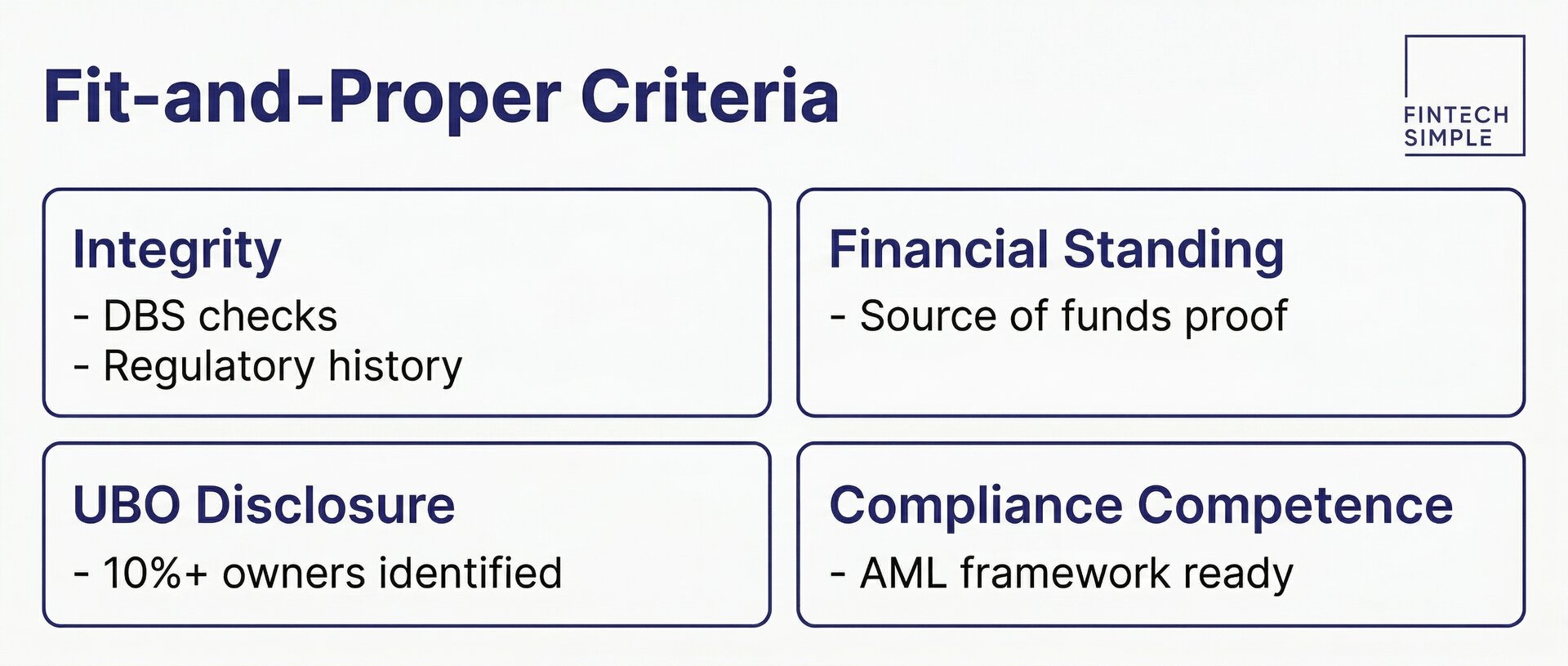
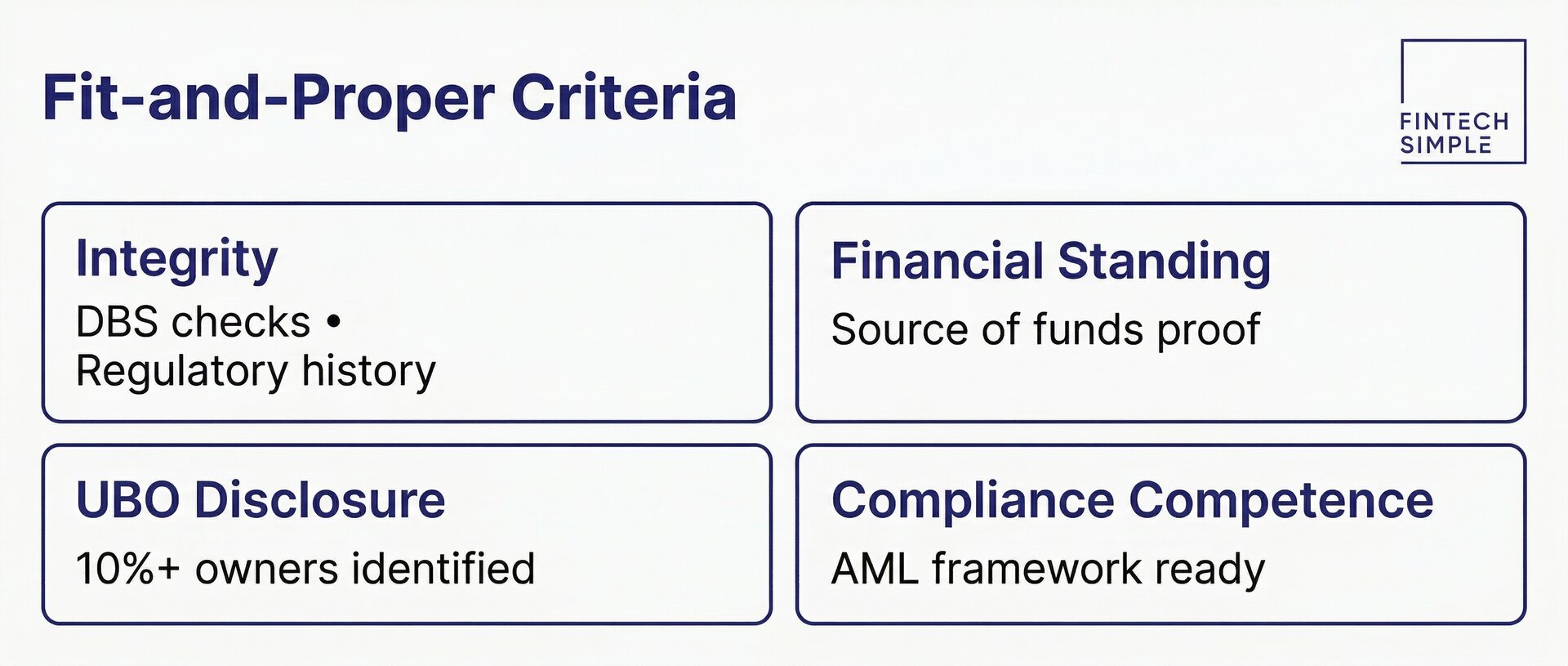
The Gambling Commission does not license businesses — it licenses people and entities it trusts to run gambling operations fairly and lawfully. Before reviewing your application, the UKGC evaluates everyone with significant influence over the business: directors, beneficial owners, senior managers, and anyone holding 10% or more of the shares. Each person must pass the fit-and-proper assessment set out under the Gambling Act 2005. Passing that assessment means satisfying four broad criteria: integrity, financial standing, identity transparency, and compliance competence.

Breakdown infographic of UKGC fit-and-proper assessment criteria: Integrity with DBS checks, Financial Standing with source of funds, UBO Disclosure for 10%+ owners, and Compliance Competence with AML framework.

Integrity

The UKGC requires a Disclosure and Barring Service (DBS) check — or an equivalent overseas criminal record certificate — for every key individual named in the application. The Commission is looking for convictions or cautions involving fraud, money laundering, bribery, corruption, or any offence suggesting dishonesty. A conviction does not automatically disqualify an applicant, but the Commission weighs the nature of the offence, how recent it was, and whether full disclosure was made. Concealing a conviction is treated more seriously than the conviction itself.

Regulatory history also forms part of the integrity picture. If a director or UBO has previously had a licence revoked, been subject to enforcement action in another jurisdiction, or is a disqualified company director, that information must be declared. The UKGC cross-references declarations against public registries and its own database of regulatory decisions.

Financial Standing

You must demonstrate sufficient funds to cover both start-up costs and ongoing liabilities to players — including the ability to pay winning bets and refund player balances if the business fails. The Commission requires evidence of source of funds: where the money originated and whether it can be traced through legitimate activity. Bank statements, audited accounts, investment records, or a letter from a regulated financial institution are the standard supporting documents.

The UKGC does not publish a fixed minimum capital figure for most licence types, but it expects the level of funding to be proportionate to the scale of operations planned. Undercapitalised applications — where projected turnover clearly outstrips available funds — are routinely questioned or refused.

UBO Disclosure

Every person who ultimately owns or controls 10% or more of the applicant entity must be identified and individually assessed. Corporate ownership structures with multiple layers of holding companies are permitted, but each layer must be documented and the final beneficial owner must be a named natural person. Nominee arrangements that conceal the true owner are grounds for refusal. Where ownership is held through a trust, the Commission requires details of the settlor, trustees, and beneficiaries.

Common Rejection Reasons

Most UK gambling licence rejections trace back to a predictable set of problems.

  1. Incomplete or inconsistent documentation — Missing DBS certificates, unsigned declarations, or discrepancies between the application form and supporting documents are the most common reason for applications being returned without a decision. The Commission expects every named individual to submit their own set of documents; a single missing form stalls the entire application.
  2. Unverifiable source of funds — If the Commission cannot trace funds back to a legitimate origin through documentation — salary records, sale proceeds, loan agreements — it will treat the capital as unexplained. Crypto-sourced funds require particular care: the UKGC expects a clear audit trail converting digital assets to fiat, along with exchange records and wallet transaction histories.
  3. Criminal history without adequate mitigation — Undisclosed convictions result in automatic refusal. Disclosed convictions without a mitigation statement — explaining the circumstances, elapsed time, and steps taken since — leave the Commission with no basis to exercise discretion in the applicant’s favour.
  4. Inadequate AML policies and procedures — The UKGC requires applicants to demonstrate — not just assert — that they have a functioning anti-money laundering framework. Applications that submit generic template policies without tailoring them to the specific product type, customer base, and risk profile are routinely challenged. The Commission expects a named Money Laundering Reporting Officer with relevant experience.
  5. Non-transparent or complex ownership structures — Layered corporate structures that obscure the beneficial owner, missing documentation for intermediate holding entities, or offshore structures where UBO information is not publicly available trigger additional scrutiny. Applications that cannot resolve ownership transparency within the UKGC’s specified timeframe are typically refused.

Practical note

The UKGC fitness assessment is ongoing — not a one-time gateway. If a key individual’s circumstances change after a licence is granted (a criminal charge, a change in beneficial ownership, insolvency proceedings), the licensee must notify the Commission promptly under the key event reporting obligation. Failure to do so can result in licence review or revocation even if the original application was clean.

Document Requirements for a UK Gambling License

The Gambling Commission’s online application portal requires you to upload a substantial document pack before your application can be assessed. Missing or incomplete documents are among the most common reasons applications stall. The list below covers all three categories the UKGC reviews: corporate structure, personal fitness of licence holders, and compliance frameworks. Preparing these in parallel — rather than sequentially — cuts weeks off your timeline.

Submit AML policies before you apply

The Gambling Commission will not accept an application that lacks a complete, implemented Anti-Money Laundering and Know Your Customer policy. “In draft” or “under review” does not meet the standard. Your AML/KYC framework must be signed off, version-controlled, and ready for scrutiny on day one of the application — not finalised after submission.

Corporate Documents

Every document must be in English or accompanied by a certified translation.

  • Certificate of Incorporation — current, certified copy confirming the company is validly constituted in its home jurisdiction.
  • Articles of Association (or equivalent constitutional document) — the full, up-to-date version showing the objects clause and share structure.
  • Shareholder Register — a complete record showing all direct and indirect beneficial owners holding 10% or more, with ownership percentages. The Commission traces ultimate beneficial ownership, so intermediate holding layers must be documented in full.
  • Business Plan — covering your target market, product verticals, revenue projections for at least three years, customer acquisition strategy, and the technical and operational resources supporting each activity type on your licence.
  • Organisational Chart — showing corporate hierarchy, all group entities, and the reporting lines between key management functions (compliance, operations, technology, finance).
  • Source of Funds declaration — evidence that the capital used to establish and fund the business is legitimate, typically supported by audited accounts, bank statements, or investor documentation.

Personal Documents (for PML/PFL Holders)

Every individual who requires a Personal Management Licence (PML) or a Personal Functional Licence (PFL) must submit a separate personal pack.

  • DBS Enhanced Disclosure (or equivalent overseas criminal record check) — must be dated within three months of submission. Overseas nationals require equivalent disclosure from each country of residence in the past five years.
  • Curriculum Vitae — a full employment history for at least the past ten years, with explanations for any gaps. The CV must demonstrate relevant competence for the function the individual will perform.
  • Financial Declarations — a statement of personal financial position covering assets, liabilities, and any history of insolvency, county court judgements, or disqualification as a company director.
  • Proof of Identity and Address — certified copies of a valid passport or national ID, plus a utility bill or bank statement confirming current residential address (dated within three months).
  • Character references — typically two professional references who can attest to the individual’s integrity and suitability for a regulated role.

Compliance Documents

The compliance document pack is where most applications run into difficulty. The UKGC expects polished, operational policies — not templates adapted from another jurisdiction. Each document must reflect the specific products, markets, and customer types your business will serve.

  • AML and KYC Policy — a full written policy covering customer due diligence, enhanced due diligence triggers, ongoing monitoring, politically exposed persons (PEPs) and sanctions screening, record-keeping periods, and the escalation path for suspicious activity reports (SARs). Must name a nominated officer with MLRO responsibilities.
  • Responsible Gambling (RG) Policies — covering self-exclusion integration with GAMSTOP, deposit limits, reality checks, cooling-off periods, and the process for identifying customers showing signs of harm. The UKGC benchmarks these against its Licence Conditions and Codes of Practice (LCCP).
  • Customer Interaction Guidance (CIG) Procedures — detailed internal procedures describing how staff identify, record, and act on markers of harm during customer interactions. This is now a mandatory requirement following updated LCCP provisions and must cover both automated alerts and human review workflows.
  • GDPR and Data Protection Documentation — a privacy notice aligned with UK GDPR, a record of processing activities (RoPA), and a data retention schedule. If you transfer personal data outside the UK, you need a data transfer impact assessment.
  • IT and Security Specifications — technical documentation covering platform architecture, hosting arrangements, data security controls, penetration testing results, and disaster recovery procedures. Remote gambling software must be either certified by a UKGC-approved tester or hosted with a licensed B2B supplier.
  • Anti-Fraud Policy — procedures for detecting and preventing bonus abuse, collusion, and payment fraud, including controls applied at registration, deposit, and withdrawal stages.

Step-by-Step: How to Get a UK Gambling License

The UKGC scrutinises your corporate structure, compliance systems, software, and key personnel before issuing any licence. Total elapsed time runs 4–6 months from kick-off to licence issuance. Submit your operating licence application via the UKGC portal only after completing the groundwork in Steps 1–3.

Step 1 Weeks 1–2

Initial Assessment & Corporate Structuring

What we do: We map your existing business against UKGC requirements and identify structural gaps before any application work begins. This prevents costly restructuring mid-process.

  • Licence type selection — we determine which operating licence categories you need: remote casino, betting, bingo, poker, or a combination, and whether a personal management licence is required immediately or can follow
  • Corporate structure review — we assess your holding company, shareholders, and UBO chain against UKGC fit-and-proper standards. Non-EEA structures often require additional disclosure layers
  • Source of funds mapping — we document the provenance of capitalisation funds, which the UKGC checks against AML red flags from day one of review
  • Gap analysis report — you receive a written list of missing documents, structural changes needed, and estimated costs before work proceeds
Step 2 Weeks 2–6

Document Preparation & Compliance Framework

What we do: We build the compliance infrastructure the UKGC expects to see operating on day one of your licence — not promised for the future. Applications that submit policies as drafts or “to be finalised” receive requests for further information that set timelines back by weeks.

  • AML/CTF policy and procedures — written to the standards of the Money Laundering, Terrorist Financing and Transfer of Funds (Information on the Payer) Regulations 2017 (MLR 2017), covering customer due diligence, enhanced due diligence triggers, and suspicious activity reporting
  • Safer gambling framework — GamStop self-exclusion integration, affordability check thresholds, deposit/time limits, reality checks, cooling-off functionality, and interaction procedures for at-risk customers
  • Corporate governance documents — board resolutions, ownership charts, director CVs, DBS checks, and financial statements for the past three years
  • Business plan and financial projections — three-year forecast with assumptions the UKGC can stress-test
Step 3 Weeks 3–8

Platform & Software Certification

What we do: We coordinate technical testing with a UKGC-approved test house to certify your gaming system before submission.

  • Test house selection — we engage an approved laboratory (BMM, GLI, eCOGRA, or equivalent) and submit your RNG certification requirements
  • RNG and game mathematics testing — the test house verifies that stated return-to-player percentages are accurate and that outcomes are genuinely random
  • Technical standards compliance — your platform is checked against the UKGC’s Technical Standards for Remote Gambling, covering game integrity, player account management, and data security
  • Certification documentation — once testing passes, we compile test reports as appendices to the application. These run 30–200 pages depending on the breadth of your game catalogue
Step 4 Week 8

Submit UKGC Application

What we do: We prepare and submit your complete application package through the UKGC’s online service, paying the application fee and ensuring every mandatory field and document is present before submission.

  • Application fee payment — fees are calculated on projected gross gambling yield; a typical remote casino application runs £4,224–£16,235 for the initial licence fee depending on projected GGY band, with a separate annual fee thereafter
  • Online portal submission — all forms completed via the UKGC service, with supporting documents uploaded in the required format and order
  • Confirmation and reference number — once submitted, the UKGC issues a case reference; we track this and maintain communication with your assigned case officer throughout the review
Step 5 Weeks 8–24

UKGC Review & Due Diligence

What we do: We act as your single point of contact during the Commission’s review, responding to requests for further information (RFIs) promptly and accurately. RFIs are normal — every application receives at least one.

  • Regulatory background checks — the UKGC contacts licensing authorities in every jurisdiction where your business or its principals hold or have held licences. We prepare those authorities in advance where possible
  • Financial due diligence — bank references and financial strength evidence are verified. We ensure your liquidity documentation demonstrates player funds are protected
  • RFI management — we draft and coordinate responses to any supplementary information requests within the UKGC’s stated timeframes, avoiding delays caused by incomplete replies
  • Interview preparation — if the UKGC requests a meeting with key personnel, we brief your team on the questions typically raised and the level of detail expected
Step 6 Weeks 8–16

Personal Licence Applications — Parallel Track

What we do: We run personal management licence (PML) applications for your key executives in parallel with the operating licence review, so approvals arrive close together and do not delay your go-live date.

  • PML identification — we confirm which of your executives require a PML based on the fit-and-proper criteria and prepare each individual application pack
  • Disclosure and Barring Service (DBS) coordination — UK-resident applicants need an enhanced DBS check; non-UK residents require a certificate of good conduct from their country of residence. We coordinate both
  • Timeline alignment — PML processing takes up to 8 weeks according to the UKGC. Submitting at Week 8 means PMLs are usually in hand before the operating licence issues
Step 7 Week 24+

Licence Issuance & Go-Live

What we do: We oversee the final steps from licence grant to operational launch, ensuring your systems, player-facing disclosures, and reporting obligations are in place before you accept the first real-money wager.

  • Licence conditions review — every UKGC licence attaches standard and non-standard conditions. We review them with you and flag any conditions requiring immediate action before trading
  • LCCP compliance checklist — we run through the Licence Conditions and Codes of Practice requirements relevant to your licence type, covering advertising, bonus terms, and customer interaction obligations
  • GamStop self-exclusion integration — GamStop connectivity must be live before you open to UK players. We verify integration and test the flow end-to-end
  • Regulatory reporting setup — the UKGC requires quarterly compliance submissions and annual returns. We configure your reporting calendar and template documents so obligations are met from day one
  • Soft launch and go-live — we recommend a controlled soft launch to verify all licence condition systems operate correctly under real traffic before full marketing begins

Ready to Apply for Your UK Gambling License?

Our licensing team handles the entire UKGC application — from corporate structuring to post-approval setup. Fixed-fee packages, no hidden costs, 4–6 month timeline.

UK Gambling License Fees & Costs

The Gambling Commission publishes its full fee schedule openly, and the numbers scale with your Gross Gambling Yield (GGY) — the revenue retained after paying out winnings. You pay less at lower GGY bands, but the regulatory obligations are identical regardless of band.

First-year total cost estimate

A new remote casino operator entering the lowest GGY band (< £550k) should budget at least £94,000 for year one on a single licence category, with costs reaching £200,000+ for operators launching multiple verticals with in-house compliance (roughly £98,000–£203,000 when applying for two categories such as casino + betting). This covers the application fee (£4,224 per licence category; ~£8,448 for two), the first annual fee due within 30 days of grant (£4,199 × 0.75 = £3,149 after the standard 25% first-year discount), personal licences for five managers (£370 × 5 = £1,850 in PML fees), platform integration (£15,000–£50,000), compliance infrastructure (£50,000–£100,000), and initial legal counsel (£20,000–£40,000). Payment processing costs add further depending on deposit volumes.

Note: The UK government has published a consultation on raising UKGC licence fees by around 30%, with the increase planned to take effect from 1 October 2026. The figures above reflect fees in force at the time of writing; operators applying in late 2026 or later should assume materially higher UKGC fees.

UKGC Application Fees

Application fees are paid once, at submission, and are non-refundable regardless of outcome. The UKGC determines which fee band applies based on your declared projected GGY for the first 12 months of operation. If your actual GGY exceeds the band you applied under, the Commission may require a top-up payment before issuing the licence. New operators with no trading history should use conservative but realistic projections — understating GGY is treated as a material misrepresentation.

Projected GGY BandApplication FeeTypical Applicant Profile
Under £550,000 £4,224 Early-stage or niche operator
£550,000 – £5.5M £10,323 Small-to-mid online operator
£5.5M – £25M £16,235 Established mid-market operator
£25M – £100M £23,834 Large-scale operator
£100M+ £38,363 – £91,686 Major multi-product operator

The fee shown covers the operating licence application itself. If you are applying for multiple licence categories simultaneously — for example, casino and betting — each category carries its own fee. Most online platforms require at least two categories, so double the applicable band fee when planning your initial budget.

Annual License Fees

Annual fees are payable each year to keep the licence active. The first annual fee falls due within 30 days of licence issue and is reduced by 25% — this catches many operators off-guard, since it means the first-year cost is both the application fee and the first annual fee, not the application fee alone. Fees escalate steeply at higher GGY bands.

The table below uses casino licence rates. Betting-only licences sit at broadly similar levels within each band; the Commission publishes the full matrix by activity type on its website.

GGY BandAnnual Fee (Casino)Monthly Equivalent
Under £550,000 £4,199 ≅ £350
£550,000 – £2M £10,056 ≅ £838
£2M – £5.5M £14,694 ≅ £1,225
£5.5M – £25M £20,626 ≅ £1,719
£25M – £100M £55,089 ≅ £4,591
£100M+ £105,626 – £793,729+ Varies by band

Operators moving between bands mid-year do not receive a partial refund for the period at the lower rate. Plan for one full year at whichever band your growth trajectory suggests you will reach during the licence period.

Personal License Fees

Anyone occupying a key management position — CEO, CFO, compliance officer, head of marketing — must hold a personal licence issued by the UKGC. There are two tiers:

  • Personal Management Licence (PML) — required for directors and senior managers who influence how the gambling business is run. Fee: £370 per applicant.
  • Personal Functional Licence (PFL) — required for employees in roles that directly engage with customers or handle gambling-related functions. Fee: £185 per applicant.

Processing typically takes up to 8 weeks, though complex backgrounds or applicants from outside the UK can extend this. All personal licence applications require a Disclosure and Barring Service (DBS) check plus a full disclosure of financial history. Factor in the time and cost for DBS checks (£21.50 basic, £49.50 enhanced) separately from the UKGC fee. A company with five senior managers will spend roughly £1,850 in PML fees alone before any operational spending begins.

Operational Costs

Regulatory fees are the smallest line item in a UK gambling operation’s budget. The bigger costs are the infrastructure and compliance functions the UKGC requires you to maintain continuously.

  • Gaming platform and software — licensed RNG-certified software from a UKGC-approved supplier costs between £15,000 and £50,000 upfront in integration fees, plus ongoing revenue-share or monthly SaaS charges. The lower end applies to operators integrating a single white-label provider; the higher end reflects multi-supplier setups with a custom front-end.
  • Compliance programme — AML framework, KYC processes, staff training, and responsible gambling tooling (GAMSTOP self-exclusion integration, deposit limits, time-out tools, affordability checks) cost £50,000 to £100,000 per year for a small-to-mid operator. A lean team with outsourced AML monitoring sits closer to £50k; an in-house compliance officer plus a dedicated safer gambling team pushes toward £100k. This also includes the statutory gambling levy (introduced April 2025 at rates from 0.1% to 1.1% of GGY depending on sector).
  • Payment processing — UK gambling merchant category codes attract elevated processor risk fees. Expect blended rates of 2.5% to 4% of transaction value, plus setup fees and rolling reserves typically held at 5–10% for 90–180 days.
  • Legal and advisory — ongoing legal counsel for licence conditions, advertising compliance (ASA rules apply), and dispute handling typically runs £20,000 to £40,000 per year for a lean operation.

Tax Obligations for UK Gambling Operators

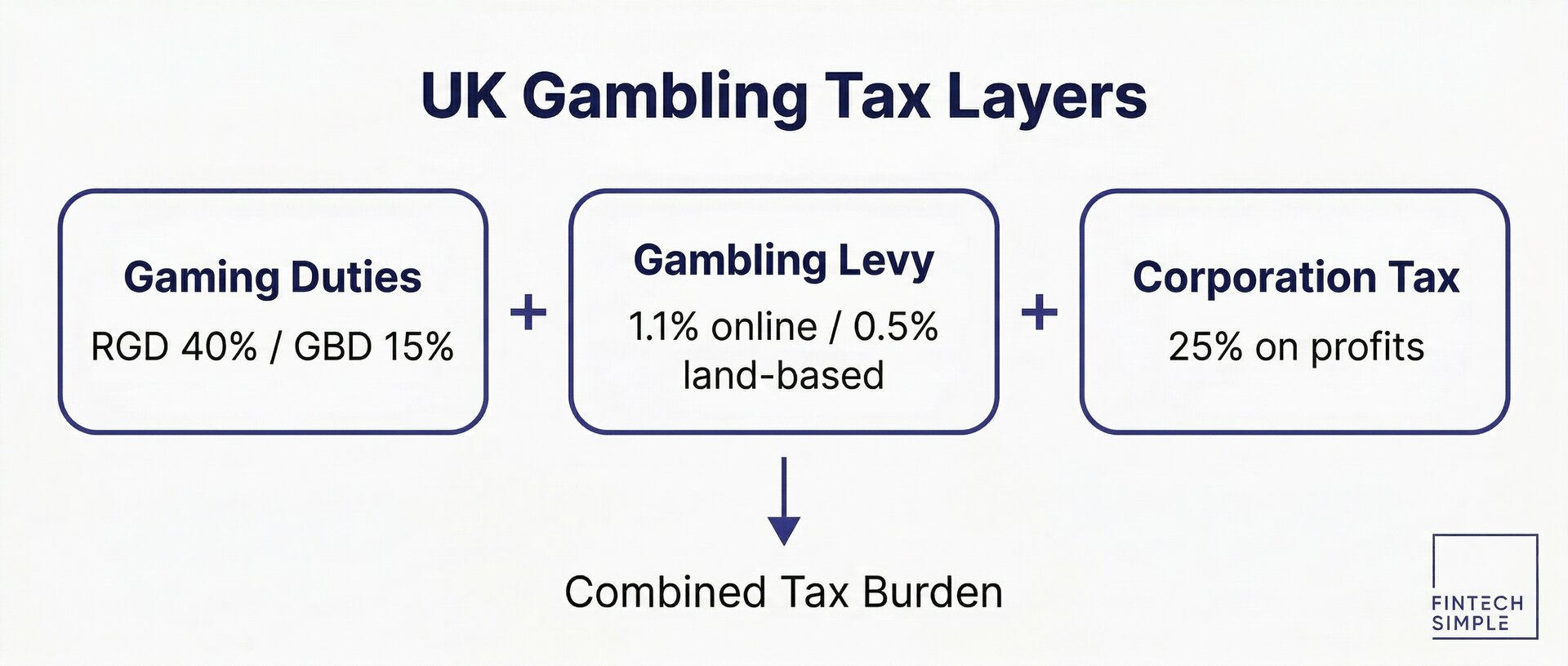
Running a licensed gambling business in the UK means dealing with three distinct tax layers: gambling-specific duties calculated on your gross profits, a new statutory levy introduced in April 2025, and standard corporate tax on your overall company profits. Each applies differently depending on whether you operate online or in venues, and which products you offer.

Breakdown infographic of three UK gambling tax layers: Gaming Duties at 40% RGD and 15% GBD, Gambling Levy at 1.1% for online operators, and Corporation Tax at 25% on profits.

Gaming Duties

UK gambling duties are set by HMRC and charged on Gross Gambling Yield (GGY) — the stakes you receive minus the winnings you pay out. The rate depends on your product type. Point of Consumption Tax (POCT) means that if your customers are in Great Britain, you owe UK duty regardless of where your servers or company are based. Operating from Gibraltar, Malta, or anywhere else does not remove this obligation.

Tax Rate Applies To
Remote Gaming Duty (RGD) 40% Online casino games, slots, live dealer — any remote gaming product (increased from 21% on 1 April 2026)
General Betting Duty (GBD) 15% Fixed-odds sports betting offered remotely or on-premises (a new 25% remote rate takes effect from April 2027)
Pool Betting Duty 15% Totalisator and pool betting products (e.g. football pools, tote wagering)
Lottery Duty 12% Society lotteries and certain prize competitions with a lottery element
Amusement Machine Licence Duty (AMLD) Fixed annual fee by machine category Category B, C, and D amusement machines in land-based venues

RGD at 40% is the rate that affects most operators entering the UK market today — this rate took effect on 1 April 2026, replacing the previous 21% rate. Spread betting is taxed separately at 3% (financial) or 10% (sports). If you run a mixed platform offering both sports betting and casino games, you will account for GBD and RGD separately on the relevant GGY for each product vertical. HMRC requires quarterly returns for most duties, with payment due at the same time.

Gambling Levy (from April 2025)

The statutory gambling levy replaced the voluntary Research, Education and Treatment (RET) contributions from 1 April 2025. It is a mandatory charge payable to HMRC and ringfenced for gambling harm research, education, and treatment programmes. The rate is tiered by operator type and GGY band, with the headline figures as follows:

Levy rates from April 2025

Online operators (holding a remote operating licence) pay 1.1% of GGY. Land-based casino and betting operators (non-remote licences) pay 0.5% of GGY, while adult gaming centres and bingo premises pay 0.2%. Smaller operators below specified GGY thresholds pay lower rates within each band — confirm your exact band with HMRC or a specialist adviser once your first full trading quarter is complete. For the latest levy guidance and rate tables, see the Gambling Commission news and updates.

The levy is assessed on the same GGY base as your gambling duties, so the accounting infrastructure you already have for RGD or GBD feeds directly into your levy calculation. It does not replace your duty liability — both apply simultaneously. Budget for the levy from day one: it is not deductible against your gambling duty liability, though it is deductible as a business expense for corporate tax purposes.

Corporate Tax

UK-licensed operators with a UK-resident company pay Corporation Tax on their taxable profits at the standard rate — currently 25% for companies with profits above £250,000 (a 19% small profits rate applies below £50,000, with marginal relief in between). Gambling duties and the statutory levy are allowable deductions when calculating taxable profit, which partially offsets their combined cost.

The UK has signed over 130 Double Taxation Agreements (DTAs), covering most major jurisdictions from which shareholders or group entities may be located. These treaties reduce or eliminate withholding tax on dividends, interest, and royalties flowing between a UK company and treaty-partner countries. For international groups structuring their UK gambling subsidiary, the DTA network reduces withholding tax when you repatriate profits or charge inter-company fees for technology and intellectual property.

A few corporate tax points worth planning around early:

  • Transfer pricing — if your UK entity pays software licensing fees or management charges to a related offshore entity, HMRC will scrutinise whether those charges are at arm’s length. Document the basis from the outset.
  • Controlled Foreign Company (CFC) rules — profits artificially diverted from the UK to low-tax subsidiaries can be attributed back to the UK parent and taxed here. Get advice before setting up a group structure that routes income offshore.
  • R&D relief — operators developing proprietary platform technology may qualify for R&D tax credits, reducing the effective corporate tax rate on qualifying expenditure.

In practice, the combined tax load for a UK-licensed online casino operator — 40% RGD on GGY (from April 2026), 1.1% gambling levy on GGY, and 25% Corporation Tax on net profit — makes the UK one of the highest-tax jurisdictions in Europe for gambling.

AML, KYC & Responsible Gambling Compliance

As a UK licence holder, you must maintain live, documented systems covering anti-money laundering, customer due diligence, responsible gambling, and the financial protection of player funds. Gaps in any one of these areas have resulted in licence suspensions and fines exceeding £19 million in recent enforcement actions. The Licence Conditions and Codes of Practice (LCCP) sets the baseline for all four areas.

AML/KYC Requirements

UK gambling AML obligations flow from two sources: the LCCP and the Proceeds of Crime Act 2002 (POCA). You are a “relevant business” under POCA, meaning you carry full criminal liability for facilitating money laundering, even unknowingly.

Your AML programme must cover four practical obligations:

  • Customer Due Diligence (CDD) — Verify identity before a customer deposits or withdraws. In practice, most operators set an automated trigger at £2,000 cumulative spend or £500 in a single transaction, though the correct threshold is risk-based and must be documented in your risk assessment.
  • Enhanced Due Diligence (EDD) — Apply to customers identified as higher risk: politically exposed persons (PEPs), customers from high-risk third countries, and those whose transaction patterns are inconsistent with stated income. EDD means verifying the source of funds — a bank statement showing salary credit, not just a verbal explanation.
  • Suspicious Activity Reports (SARs) — Where you know, suspect, or have reasonable grounds to suspect money laundering, you must submit a SAR to the National Crime Agency (NCA) before proceeding with the transaction (“consent SAR”) or as soon as practicable thereafter. Failure to file is a criminal offence under POCA s.330.
  • Source of Funds verification — The Commission expects you to understand where a customer’s gambling funds originate. For high-value players, this means payslips, tax returns, or evidence of an asset sale — not just a statement that funds come from “savings.”

Your AML policy must be reviewed annually, approved by a nominated officer (typically your Money Laundering Reporting Officer), and made available to Commission inspectors on request.

Customer Interaction Guidance

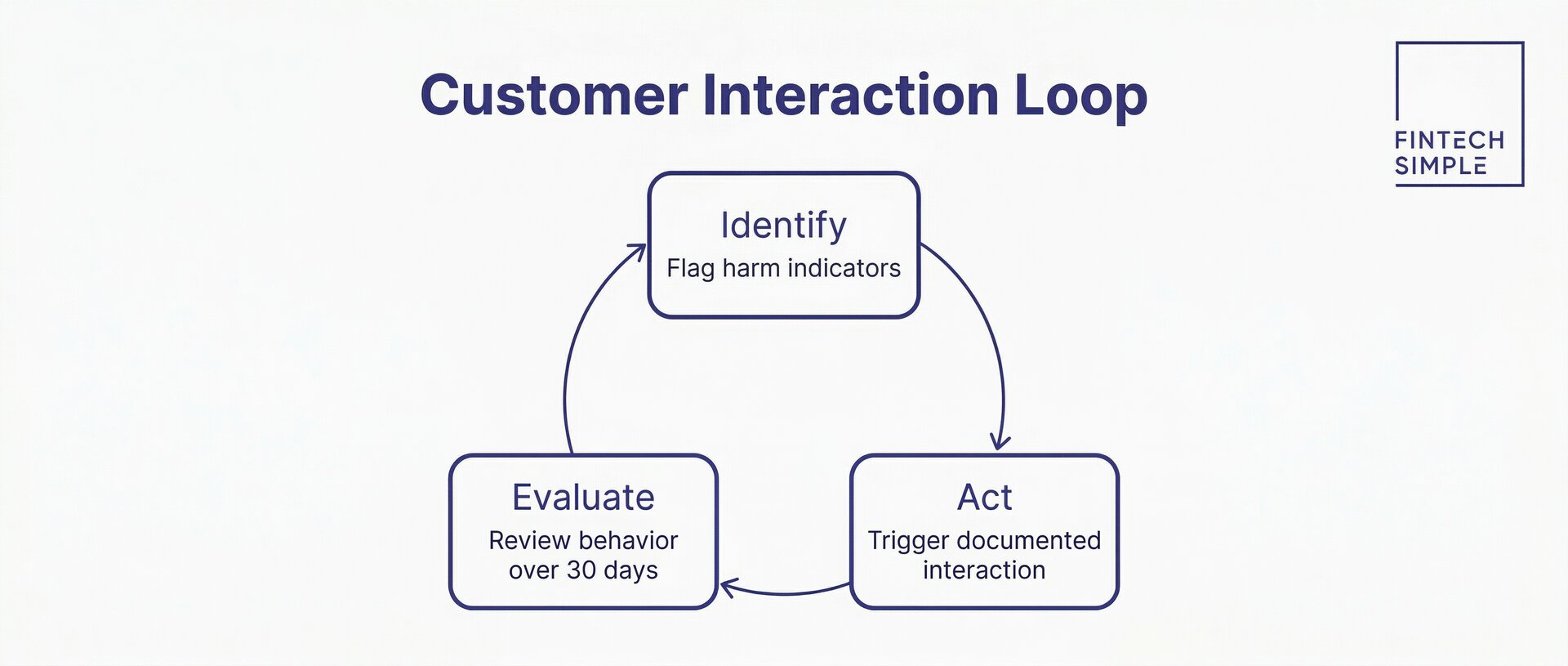
Under SR Code 3.4.3 of the LCCP — with requirements phased in from September 2022 and full formal guidance effective from 31 October 2023 — all remote operators must implement a structured customer interaction system. Most operators build the process in-house, documented against the three-step framework the Commission publishes, though third-party compliance platforms such as IDnow offer automated tools that align with the requirements.

Your system must follow a sequential loop:

  1. Identify (ongoing) — Set automated data markers that flag potential harm indicators — session length over 60 minutes, three or more consecutive losing sessions, deposit reversal attempts, or a shift to higher-stake products. Define these markers in your responsible gambling policy and calibrate them to your customer base.
  2. Act (within defined timeframe) — Trigger a documented interaction when markers are met: an in-session pop-up, an email within 24 hours, or a telephone call for high-risk cases. Log every interaction with the date, channel, staff member, and customer response. The Commission expects you to escalate — not simply note and move on — when behaviour worsens.
  3. Evaluate (post-interaction) — Review whether the interaction changed the customer’s behaviour over the following 30 days. If markers persist or worsen, a second interaction must follow at a shorter interval. Record the evaluation outcome and feed it back into your risk-scoring model so thresholds improve over time.

The Commission reviews interaction logs during compliance assessments. A single undocumented interaction — or evidence that interactions were sent but outcomes never evaluated — has been cited in multiple enforcement decisions as a standalone breach.

Flowchart infographic showing the three-step customer interaction loop: Identify harm indicators, Act by triggering documented interaction, and Evaluate behavior over 30 days in a continuous cycle.

Responsible Gambling Obligations

The LCCP sets minimum responsible gambling standards that apply from day one of operating:

  • GAMSTOP registration — Mandatory for all remote operators. You must sign up to the National Online Self-Exclusion Scheme and screen every new registration against the GAMSTOP database before allowing play. Onboarding a self-excluded customer is an automatic licence breach.
  • GamCare integration — Your platform must display the GamCare logo with a live link on every page where gambling takes place. GamCare is the Commission’s designated support body for problem gambling in Great Britain.
  • Self-exclusion tools — Customers must be able to self-exclude for a minimum of six months, with no marketing contact during that period. Once excluded, a customer can only return after a cooling-off period of at least one day following their positive request to re-join.
  • Session limits and reality checks — Players must be able to set deposit limits, loss limits, and session time limits. Reality check notifications — reminders showing time and money spent — must be available and cannot be disabled by the operator once a customer activates them.
  • Marketing restrictions — Bonus offers and promotions cannot target customers with an open or recently closed responsible gambling dialogue, or those with active deposit limits. See Marketing & Advertising Rules for full requirements.

Customer Fund Segregation

You must protect customer funds held in player accounts. The LCCP defines three segregation levels — you choose one, implement it operationally, and display the level publicly on your website. Misrepresenting the level or failing to display it is a licence breach.

Level Description
BasicNot protected Customer funds are held in the operator’s general business account. In insolvency, customers rank as unsecured creditors alongside suppliers and lenders — recovery is unlikely. Operators must display: “Customer funds are not protected in the event of insolvency.”
MediumProtected Customer funds are held in a separate bank account, distinct from operational funds. The account must be designated as holding customer money and cannot be used to meet business expenses. In insolvency, funds in this account are ring-fenced, though legal recovery can still take time.
HighFully protected Customer funds are held with an independent trustee or in a trust account structured so that, in insolvency, the funds fall outside the operator’s estate entirely. This is the only level that gives customers a direct legal claim to their balance. Required for operators targeting high-value players or offering significant stored balances.

Most new licensees start at Basic or Medium and upgrade when their player base grows. The Commission requires the displayed level to match the actual banking arrangement at all times — auditors check bank account documentation against the stated level during compliance reviews.

Practical note

If you hold customer funds in a currency other than sterling, the segregation obligation still applies. Funds must be converted to sterling for the purposes of reporting your aggregate exposure to the Commission — and the segregated account must cover that sterling equivalent at all times.

Marketing & Advertising Rules for UK Gambling Operators

UK gambling advertising is governed by three overlapping bodies: the UK Gambling Commission (UKGC), the Advertising Standards Authority (ASA), and the Committee of Advertising Practice (CAP). The UKGC sets the licence conditions that make compliant marketing a legal obligation. The ASA investigates complaints and can force ads off air. CAP writes the codes that define what your ads must and must not say.

CAP Code and ASA Enforcement

The CAP Code (for non-broadcast ads) and the BCAP Code (for broadcast ads) set the content standards for all gambling advertising in the UK. The ASA enforces both codes and publishes its rulings publicly — a named advertiser appearing in an upheld ruling faces reputational damage as well as the requirement to withdraw or amend the ad. Key content rules include:

  • No appeal to under-18s — Ads must not use imagery, language, themes, or personalities with strong appeal to children or young people. The ASA applies a strict “particular appeal” test — placement on an adult channel alone is not sufficient.
  • No irresponsible portrayal of gambling — Ads must not suggest gambling is a solution to financial problems, link gambling to toughness or sexual success, or portray problem gambling behaviour as socially acceptable.
  • No misleading bonus terms — Material conditions on a promotional offer (wagering requirements, game restrictions, time limits) must be clearly stated or signposted. The ASA has upheld complaints against “headline” bonus figures that buried restrictive terms in small print or behind a hyperlink.
  • Responsible gambling message — Gambling ads must include a responsible gambling message and direct consumers to GambleAware or an equivalent service. The message must be legible and not obscured by other content.
  • Affiliate and partner ads — You are responsible for marketing carried out on your behalf, including affiliate sites. If an affiliate breaches the CAP Code, the UKGC may hold you liable. Your affiliate contracts must include compliance obligations, and you must monitor affiliate output.

2025 Direct Marketing Opt-In Changes

2025 rule change

From 1 May 2025, UKGC licence conditions (SR Code 5.1.12) require customers to actively opt in to receive gambling marketing on a granular per-product (casino, betting, bingo) and per-channel (email, SMS, push notification, telephone) basis before you can contact them. Pre-ticked boxes, bundled consent (e.g. accepting terms covering both account communications and marketing), and inferred consent are all prohibited. You must store auditable records showing the date consent was given, the channel covered, and the exact wording of the consent request. Existing marketing lists must be re-confirmed under this standard unless prior consent was already captured in a fully compliant form.

In practice, you need a consent management layer in your CRM that tracks opt-in per channel. A customer who withdraws consent must be removed from that channel “as soon as reasonably practicable” under PECR.

Social Media and Influencer Restrictions

Social media platforms impose their own gambling ad policies on top of the CAP Code and UKGC rules. You must satisfy both. The ASA and UKGC apply additional standards to social-media-specific formats:

  • Age-gating on social platforms — Paid gambling ads on social media must use the platform’s age and interest targeting to restrict delivery to adults. Broad-reach campaigns without age filtering breach the CAP Code’s child-protection rules.
  • Influencer and streamer posts — Content from influencers, brand ambassadors, and streamers promoting a gambling brand is treated as gambling advertising under the CAP Code. It must be labelled as an ad, comply with content rules, and the influencer must not have a substantial under-18 audience. The UKGC has explicitly named influencer marketing as an area of active monitoring.
  • Free-play and demo promotions — Promoting free-to-play versions of casino games on social media is subject to the same rules as real-money advertising if the post includes a call to register or deposit.

Get Expert Help with UK Gambling Compliance

UKGC compliance spans AML, responsible gambling, marketing rules, and customer fund segregation. We build your compliance framework from scratch and keep it current as regulations change.

UK Banking & Payment Processing for Gambling Operators

Holding a UK Gambling Commission licence does not automatically open doors to banking. You must maintain a dedicated UK gambling bank account — most banks treat gambling as a high-risk sector and require sight of your licence, AML policy, and source-of-funds documentation before opening an account. Plan for a 3–8 week banking onboarding timeline and approach several institutions simultaneously.

Bank Account Requirements

The UKGC requires you to segregate player funds from operational funds (see fund segregation levels in the compliance section). You typically need at least two accounts: one for player funds and one for business operations.

  • Specialist gambling banks — Clearbank, Prepay Technologies, and certain EMIs specifically serve licensed gambling businesses. High-street banks frequently decline gambling accounts.
  • Documentation required — Licence copy, business plan, AML/KYC policy, ownership structure, projected transaction volumes, and details of all UBOs.
  • Ongoing monitoring — Banks may conduct periodic reviews; sudden volume spikes or new game verticals can trigger account reviews or restrictions.

Payment Processing — What Is and Is Not Permitted

Gambling payment processing UK involves card payments (Visa, Mastercard), bank transfers, and regulated e-wallets. The major card schemes impose their own rules on top of the UKGC licence requirements, including merchant category codes (MCC 7995) that flag gambling transactions to issuing banks.

  • Credit card deposits — banned — Since April 2020 the UKGC prohibits credit card use for gambling deposits. Only debit cards are permitted.
  • Crypto deposits — not permitted — You cannot accept Bitcoin, Ether, or any other digital asset as a deposit method under a UKGC licence. Doing so risks licence revocation.
  • Accepted methods — Debit cards (Visa Debit, Mastercard Debit), bank transfers, PayPal, and other FCA-authorised e-wallets where the provider permits gambling transactions.
  • Payment processor contracts — Processors such as Paysafe, Worldpay (FIS), and Nuvei offer dedicated gambling merchant accounts but apply enhanced due diligence, reserve requirements (typically 5–10% of monthly volume held in reserve), and rolling settlement periods of up to 7 days.

PCI DSS Compliance

If you store, process, or transmit cardholder data, you must comply with PCI DSS (Payment Card Industry Data Security Standard). The compliance level depends on annual transaction volume — most new licensees qualify as Level 4 (<20,000 Visa/Mastercard e-commerce transactions per year) and can self-assess via a SAQ (Self-Assessment Questionnaire). Once you cross the Level 1 threshold (>6 million transactions per year), you must engage a Qualified Security Assessor (QSA) for an annual on-site audit. Level 2 merchants (1–6 million transactions) can still self-assess, though acquirers may require additional validation.

Practical note

Using a PCI-compliant hosted payment page from your processor shifts most card-data liability away from your platform. This is the standard approach for early-stage operators and significantly reduces the scope of your own PCI assessment.

License Renewal & Ongoing Obligations

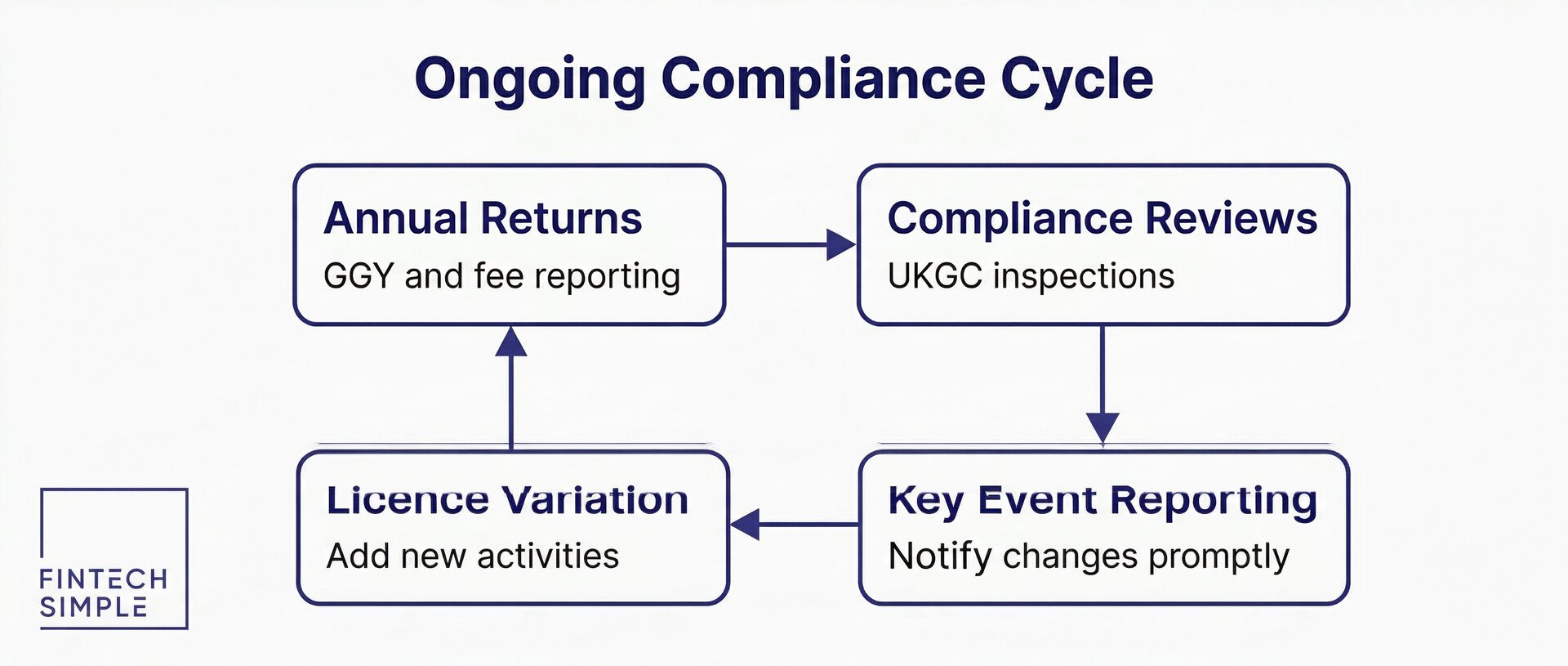
Instead of periodic renewal, you face a continuous cycle of regulatory obligations: annual returns, financial reporting, inspections, and the requirement to notify the UKGC before making material changes to your business.

Flowchart infographic showing the ongoing compliance cycle for UK gambling licensees: Annual Returns, Compliance Reviews, Key Event Reporting, and Licence Variation in a continuous loop.

No expiry date

Your UK gambling operating license is indefinite. The UKGC does not require periodic renewal applications. The license continues as long as you meet your ongoing compliance obligations and pay the applicable annual fees. Failure to comply — not the passage of time — is what puts a license at risk.

Annual Returns and Regulatory Reporting

You must submit an annual return to the UKGC each year covering gross gambling yield (GGY) by activity, customer numbers, and compliance declarations. The return determines your annual licence fee for the coming year, calculated as a percentage of GGY. Missing the deadline or submitting an incomplete return can result in a licence review or financial penalty.

Beyond the annual return, you must notify the UKGC of changes to key personnel, business structure, ownership, and any material change in your licensed activities. You must also report compliance incidents — for example, significant AML failures or system outages affecting game integrity — without waiting for an inspection. The UKGC publishes full reporting requirements in its Regulatory Returns Guidance.

UKGC Inspections and Compliance Reviews

The Gambling Commission conducts licence reviews and inspections (on-site or remote) on a risk-assessed basis. If you have a history of complaints, high GGY, or activity in higher-risk product categories, expect more frequent inspections. During a review, the UKGC examines AML procedures, safer gambling controls, technical compliance, advertising practices, and complaints handling. You must cooperate fully and produce requested records within specified timeframes.

Licence Variation for New Activities

If you want to add a gambling activity not covered by your current licence — for example, expanding from remote casino to remote betting — you must apply for a licence variation before commencing that activity. Operating outside the scope of the existing licence is treated as unlicensed gambling, which carries the same consequences as having no licence at all. Variation applications require supporting documentation and attract an application fee.

Enforcement: Fines and Revocation

The UKGC has broad enforcement powers. From October 2025, financial penalties for licence breaches can reach up to 15% of gross gambling yield, removing any practical cap that previously limited the deterrent effect of fines. The Commission can also impose licence conditions, suspend a licence pending investigation, or revoke it entirely for serious or repeated failures.

Revocation follows a formal process: the UKGC issues a notice of intention, setting out the grounds and giving you an opportunity to make representations. If the Commission proceeds, you can appeal to the First-tier Tribunal (General Regulatory Chamber). Tribunal proceedings can take several months, and your licence may be suspended during that period.

UK Gambling License Comparison with Other Jurisdictions

Choosing the right gambling jurisdiction comes down to your target markets, risk tolerance, and operating budget. The UK Gambling Commission license sits at one end of the spectrum — the most demanding and most respected option globally. Malta, Isle of Man, Gibraltar, and Curaçao each occupy a different position on the cost-versus-credibility axis. The table below puts the key variables side by side so you can compare with real numbers.

Jurisdiction Setup Cost Timeline Main Tax Rate Player Trust Level International Recognition License Validity
UK UKGC £50k–200k+ 4–6 months 40% RGD / 15% GBD Highest Global gold standard Indefinite
Malta MGA €25k–60k 3–6 months 5% gaming tax (min €4,200/month) Very High EU-wide 10 years
Isle of Man GSC £35k–80k 3–5 months 0.1–1.5% of GGY (tiered) High Commonwealth Annual renewal
Gibraltar GRA £30k–70k 3–4 months 0.15% of GGY (max £425k) High UK-adjacent Annual renewal
Curaçao CGA $50k–80k 2–4 months 2% corporate + licence fees Medium Caribbean / emerging 5 years (LOK framework)

Reading the Table: Where the UK Wins and Where It Costs You

Three columns favour the UK outright. No other license on this list carries the same weight with payment processors, banks, and B2B software suppliers — they treat the UKGC stamp as the lowest-risk credential when onboarding gambling clients. The indefinite license validity also matters operationally: Isle of Man and Gibraltar require annual renewals, adding recurring compliance overhead and uncertainty. UK players show the highest deposit-to-registration conversion rates among regulated markets, which directly affects your revenue per acquisition.

The trade-offs are equally concrete. Setup costs run two to four times higher than Malta or Gibraltar. The tax burden is the steepest in the comparison — 40% Remote Gaming Duty applies to your B2C gross profits from UK customers (increased from 21% in April 2026). Compliance is not a one-time exercise: the UKGC runs ongoing audits, mandates responsible gambling tools, and can issue fines for process failures long after licence grant. The 4–6 month timeline is mid-range, but the pre-application preparation typically adds another two to three months of internal work.

When the UK license is the right choice: you are targeting UK customers directly; your banking and payment partners require UKGC licensing; you are building a B2B platform that needs to sign contracts with other UKGC licensees; or you are seeking institutional investment and need the credibility that comes with the world’s most scrutinised regulator.

When an alternative makes more sense: your player base is outside the UK and EU; you are in early-stage testing and need to reach market quickly at lower cost (Curaçao’s 2–4 month timeline under the new LOK framework is still relatively fast); or your operating model benefits from Isle of Man’s near-zero GGY tax while still serving Commonwealth markets. Malta remains the strongest alternative for operators who want EU passporting and a regulator that banks and payment networks respect — at roughly a third of the UK’s setup cost.

Frequently Asked Questions about UK Gambling Licenses

How much does a UK gambling license cost?

UKGC fees depend on the license category and projected annual gross gambling yield (GGY). Application fees range from £938 for a small remote pool-betting licence up to £91,686 for the largest operators, and annual fees run from £2,406 up to £793,729+ for operators with GGY exceeding £1 billion. Software and ancillary licenses carry lower fees. On top of regulatory fees, expect costs for compliance consultancy, legal review, AML systems, responsible gambling tools, and the mandatory gambling levy — budget at least £50,000–£100,000 in total first-year outgoings for a mid-size remote operator.

How long does it take to obtain a UK gambling license?

The UKGC targets a 16-week determination period for new operating license applications once the submission is accepted as complete. In practice, timelines stretch to 6–12 months when the Commission requests additional information or when personal management license (PML) reviews are running concurrently. Preparing a thorough application — including business plans, financial projections, AML policies, and key-person disclosures — reduces the risk of information requests.

Can a foreign company apply for a UK gambling license?

Yes. The UKGC licenses companies incorporated outside the UK, provided they demonstrate that operations targeting GB consumers will be managed and controlled to the same standard required of domestic operators. The applicant must have a UK-accessible registered address for correspondence, and key personnel holding PMLs may be based overseas. Many operators use a UK-incorporated subsidiary to simplify compliance, but it is not a legal requirement for the operating license itself.

What is the difference between a remote and non-remote license?

A remote operating license covers gambling offered over the internet, telephone, or any other electronic means — this is what most online casinos, sportsbooks, and poker rooms require. A non-remote operating license covers land-based premises such as casinos, betting shops, and bingo halls. The two are distinct license types with separate fee schedules, compliance frameworks, and premises requirements. An operator running both an online platform and physical venues needs both license types.

Do I need a Personal Management License (PML) or Personal Functional License (PFL)?

Senior individuals who exercise certain management functions within a licensed operator must hold a Personal Management License (PML). Covered roles include those responsible for overall strategy, financial management, marketing, regulatory compliance, and technical operation of gambling systems. A Personal Functional License (PFL) is required for employees in lower-level but compliance-sensitive roles at non-remote premises (e.g., gaming floor staff). For remote operators, PMLs for relevant senior managers are the primary personal-license obligation.

Is the UK gambling license indefinite, or does it need to be renewed?

Operating licenses granted by the UKGC do not have a fixed expiry date — they remain valid until surrendered, suspended, or revoked. However, operators must pay annual fees, submit compliance reports, and engage with ongoing regulatory reviews. The UKGC can revoke or suspend a license at any point for compliance failures.

What is the gambling levy and how much do operators pay?

From April 2025, the UK government replaced the voluntary system of research, education, and treatment (RET) contributions with a statutory gambling levy. You pay a mandatory levy calculated as a percentage of GGY — 1.1% for online operators, 0.5% for land-based casinos and betting shops. The funds are directed to the Gambling Commission and NHS to finance problem gambling research and treatment.

What are the tax rates for UK-licensed gambling operators?

UK gambling taxes are levied by HMRC on a point-of-consumption basis, so GGY from UK customers is taxable regardless of where the operator is based. The main rates are: Remote Gaming Duty (RGD) at 40% on online casino GGY (increased from 21% on 1 April 2026); General Betting Duty (GBD) at 15% on fixed-odds betting GGY (spread betting is taxed separately at lower rates); and Pool Betting Duty at 15%. Lottery operators and bingo operators face separate duty regimes. These rates apply to net GGY after deducting player winnings — not to gross stakes.

Is GAMSTOP integration mandatory for UK-licensed operators?

Yes. All remote gambling operators licensed by the UKGC must integrate with GAMSTOP, the national online self-exclusion scheme. When a player self-excludes via GAMSTOP, the operator must block that player across all its brands and platforms within the mandated timeframe. Failure to honor a GAMSTOP exclusion is treated as a serious social responsibility breach and can result in regulatory action, fines, or license suspension. Integration must be tested and verified before you go live with UK customers.

What are the consequences of failing a UKGC compliance check?

The UKGC has wide enforcement powers. Minor failings may result in a formal warning or a requirement to implement a corrective action plan. More serious breaches — such as AML failures, social responsibility shortcomings, or misrepresentation in the application — attract financial penalties that have reached tens of millions of pounds for major operators. The Commission can also suspend a license pending investigation or revoke it entirely. Since 2017, the UKGC has publicly named operators subject to enforcement action, making compliance failures a reputational risk as well as a financial one.

Can I run a crypto casino under a UK gambling license?

As of April 2026, UKGC-licensed operators are not permitted to accept cryptocurrency deposits or withdrawals. The Gambling Commission is exploring the possibility of allowing crypto payments in the future, but any change is tied to the FCA’s forthcoming cryptoasset regulatory regime (expected October 2027). Operators accepting crypto from UK customers through offshore platforms risk enforcement action. If and when crypto is permitted, operators will need to comply with the UK’s AML rules for cryptoasset businesses, including FCA registration as a cryptoasset exchange or custodian wallet provider. Take specific legal advice before planning a crypto-enabled product under a UKGC licence.

How does a UK gambling license compare to Malta (MGA) or Gibraltar?

All three are respected regulators, but they differ significantly in cost, compliance burden, and market access. The UKGC is the most demanding and most expensive, but it grants direct access to the high-value UK market — you cannot legally advertise to UK players without it. The Malta Gaming Authority (MGA) offers access to EU markets at lower cost and is widely accepted by payment processors and software suppliers; it does not grant UK access. Gibraltar historically served UK-facing operators as a low-tax base, but post-Brexit its operators still require a UKGC license to serve UK customers. Most serious operators targeting the UK hold a UKGC license as primary and supplement it with an MGA license for other markets.

Your Privacy

By clicking "Accept", you consent to the use of cookies and similar technologies on your device to improve site navigation, analyze usage, provide specific functionalities, and support our marketing initiatives. Cookies that are strictly necessary will always be active with this link.