Vanuatu Crypto License 2026: Complete Guide to VASP Licensing

Vanuatu Crypto License 2026: Complete Guide to VASP Licensing

Vanuatu's VASP Act No. 3 of 2025 created a dedicated licensing framework for crypto businesses, with 0% corporate tax, FATF-aligned regulation through the VFSC, and a 6–8 month licensing timeline. Our licensing team handles the entire process from company formation to license issuance.

Fintech Simple has helped over 500 businesses obtain financial licenses since 2016. Our Vanuatu desk works directly with the VFSC and local counsel through every stage of the VASP licensing process, from initial company registration through application, compliance setup, and ongoing regulatory reporting.

Patrik Asevicius — Vanuatu licensing expert at Fintech Simple
Patrik Asevicius
Head of Licensing Department, Vanuatu & offshore jurisdictions

TL;DR for decision-makers

Vanuatu’s VASP Act No. 3 of 2025 offers an indefinite crypto license through the VFSC with 0% corporate, capital gains, and dividend tax. Minimum capital is ~$1.68M (VT 200M). Government fees start at ~$165K (application) + ~$830K (license) per class, with ~$420K annual renewal. You need a physical office in Vanuatu and three resident key personnel (manager, director, CTO) — each must live in-country for 12 consecutive months. Realistic timeline: 6–8 months end-to-end. Annual obligations include a financial audit, a DLT technology audit, and monthly/quarterly reporting. All VASP licensees must carry PI and cybercrime insurance. In current VFSC practice, holding FDL classes A–D is expected before a VASP license is issued.

What Is a Vanuatu Crypto License?

Regulatory body

VFSC

Setup timeline

6–8 months

Minimum capital

~$1,680,000 (VT 200M)

Corporate tax

0%

A Vanuatu crypto license is a Virtual Asset Service Provider (VASP) license issued by the Vanuatu Financial Services Commission (VFSC) under the Virtual Asset Service Providers Act No. 3 of 2025, passed on 26 March 2025. The Act replaced a patchwork approach (crypto businesses previously operated under a general Financial Dealers License Class D) with a dedicated regulatory framework built specifically for virtual asset activities. The VFSC is the sole licensing and supervisory authority for non-banking financial services in Vanuatu, including all VASP applicants.

VASP License Classes and Permitted Activities

The VASP Act No. 3 of 2025 introduced five distinct VASP license classes, plus a separate ITO license for token issuers. Each class covers a defined scope of virtual asset activity. You must apply for every class that matches your intended operations (holding a Class D license does not automatically permit custody or token issuance). The table below sets out what each class authorises:

License ClassPermitted Activities
Class D Exchange of virtual assets for fiat currency or other virtual assets (spot trading, OTC desks, crypto-to-fiat conversions)
Class D.1 Transfer of virtual assets — executing transactions that move virtual assets from one address or account to another on behalf of clients
Class D.2 Safekeeping of virtual assets or enabling control over virtual assets (wallet custody, key management)
Class D.3 Participation in and provision of financial businesses related to an issuer’s offer and sale of virtual assets — including organising, advising on, or facilitating token sales
Class D.4 Banking VASP license — authorises a licensed bank to combine virtual asset exchange (Class D) and safekeeping (Class D.2) services; requires prior Reserve Bank approval
ITO Directly issuing tokens to the public — applies to the entity conducting its own Initial Token Offering

Regardless of class, you must meet the VFSC’s prudential requirements: minimum unimpaired capital of VT 200,000,000 (~USD 1,680,000), at least one director who resides in Vanuatu for 12 consecutive months, a Chief Technology Officer (CTO) who must also reside in Vanuatu for 12 consecutive months, a physical office in the country with at least three resident staff (Manager, Director, and CTO), and an AML/CTF Compliance Officer. The VFSC enforces these through ongoing supervision and audits under the AML/CFT Act No. 13 of 2014.

How the VASP Act Replaced the Old FDL Class D Framework

Before 26 March 2025, crypto businesses in Vanuatu operated under the Financial Dealers License (FDL) framework. The FDL Amendment Act No. 9 of 2021 (in force 22 July 2021) introduced Class D as a digital asset sub-category within the existing four-class FDL structure. Classes A through D were cumulative, so a company wishing to hold Class D had to first obtain Classes A, B, and C, each carrying its own capital and compliance requirements.

This structure had two practical drawbacks. FDL licenses were designed for conventional financial dealers, not virtual asset businesses. The cumulative class requirement also increased setup costs and complexity for applicants whose only interest was crypto activity.

The VASP Act No. 3 of 2025 resolved this by creating purpose-built VASP license classes (D through D.4 and ITO) for virtual asset activities specifically. The FDL Class D remains valid for existing licensees, but the VASP license is now the primary route for any new business seeking to operate a crypto exchange, custody service, or token issuance platform in Vanuatu. In current VFSC practice, applicants are typically expected to also hold FDL Classes A through D before a VASP license is issued.

Key distinction

If your business holds an existing FDL Class D, that license remains valid under the FDL Amendment Act No. 5 of 2024, which restructured FDL licenses under a revised four-class framework (gazetted 4 December 2024, compliance deadline April 2025). New applicants, however, should apply directly for the VASP license rather than the FDL Class D route. Contact us if you are unsure which track applies to your situation.

Sources:

Vanuatu Financial Services Commission (VFSC)

Virtual Asset Service Providers Act No. 3 of 2025

Financial Dealers License (FDL)

VASP Act No. 3 of 2025

Why Choose Vanuatu for Your Crypto License?

Vanuatu combines a zero-tax environment with dedicated crypto legislation and an indefinite VASP license (maintained through annual renewal fees), a package that few jurisdictions match at comparable cost. The country enacted the Virtual Asset Service Providers (VASP) Act No. 3 of 2025 on 26 March 2025, complementing the existing Financial Dealers License framework with a purpose-built VASP regulatory layer. The VFSC supervises all VASPs, conducts audits, and enforces AML/CFT compliance. For a crypto business targeting Asia-Pacific markets, Vanuatu offers a realistic licensing timeline of 6–8 months.

Tax Advantages for Crypto Businesses

You pay 0% corporate income tax, 0% capital gains tax, 0% withholding tax, and 0% dividend tax. IBCs incorporated in Vanuatu receive a statutory tax exemption for up to 20 years. The only applicable tax is 15% VAT on taxable supplies within Vanuatu, which typically does not apply to cross-border digital asset services. See the full tax breakdown below.

International Compliance Standards

Vanuatu is a member of the Asia/Pacific Group on Money Laundering (APG), the FATF’s regional body for the Asia-Pacific region. APG membership means Vanuatu undergoes mutual evaluation reviews against FATF recommendations, aligning its AML/CFT framework with EU and OECD standards. The Financial Intelligence Unit (FIU) receives suspicious transaction reports from all regulated entities including VASPs.

The VASP Act introduced substance requirements (physical office, resident key personnel, AML/CTF Compliance Officer, ~$1,680,000 USD minimum capital) that go beyond brass-plate registration. The VFSC conducts on-site audits and can revoke licenses for non-compliance. Full eligibility requirements are detailed below.

A Vanuatu VASP license is not equivalent to an EU authorization under MiCA, but it provides documented regulatory status from a FATF-aligned regulator. That is the baseline for opening correspondent banking relationships and onboarding compliant payment processors in the Asia-Pacific region.

Jurisdiction Comparison Table

The table below compares Vanuatu against three jurisdictions crypto businesses commonly evaluate. Green cells indicate where Vanuatu offers a material advantage.

CriterionVanuatu (VFSC)Dubai (VARA)Lithuania (FNTT)El Salvador (CNAD)
Corporate income tax 0% 0% (free zone) / 9% (mainland) 17% 30%
Capital gains tax 0% 0% 17% 0% on Bitcoin (legal tender)
Withholding / dividend tax 0% / 0% 0% / 0% 17% / 15% 0% / 0%
IBC / entity exemption Up to 20-year tax exemption Free zone 50-year exemption (renewable) None None
Minimum capital (crypto) ~$1,680,000 USD $136,000–$13.6M USD (varies by activity) €50K–€150K (varies by CASP class) Not publicly specified
Typical licensing timeline 6–8 months 6–12 months 3–6 months (registration) 3–6 months
License term Indefinite (annual renewal ~$420K per class) Annual renewal required Annual renewal required Annual renewal required
Regulator / framework VFSC, VASP Act No. 3 of 2025; APG/FATF-aligned VARA, dedicated virtual assets regulator (2022) Bank of Lithuania, MiCA-licensed CASP regime (since Jan 2026) CNAD, Bitcoin Law 2021; LEAD framework (2023)

Vanuatu’s primary advantage is the zero-tax stack (no corporate, capital gains, withholding, or dividend tax) combined with lower capital requirements than Dubai. Dubai VARA matches the zero withholding and dividend tax profile but carries minimum capital requirements up to $13.6M USD for full exchange activities. Lithuania offers EU regulatory standing but imposes 17% corporate income tax and 15% dividend tax. El Salvador offers a low-cost entry point, though its regulatory framework is less established for institutional counterparties outside the Bitcoin ecosystem.

Vanuatu VASP License Packages & Pricing

Under the VASP Act No. 3 of 2025, obtaining a Vanuatu VASP license carries mandatory government fees established by regulation and administered by the VFSC. Before choosing a service tier, account for these fixed costs:

VFSC Government Fee Breakdown

FeeAmount (USD approx.)When Due
Application fee (per class) ~$165,000 (VT 20,000,000) On submission; non-refundable
License fee (Classes D/D.1/D.2/D.3) ~$830,000 (VT 100,000,000) On approval
License fee (Class D.4) ~$415,000 (VT 50,000,000) On approval
Annual renewal (Classes D/D.1/D.2/D.3) ~$420,000 (VT 50,000,000) Due annually
Annual renewal (Class D.4) ~$210,000 (VT 25,000,000) Due annually
Minimum unimpaired capital ~$1,680,000 (VT 200,000,000) Must be maintained

Source: VFSC VASP Application Guidelines (June 2025), Sections 4–5. Government fees are additional to Fintech Simple service fees listed below.

Our service packages cover the professional work required to prepare, submit, and support your application. All three tiers include IBC registration, document preparation in English, and VFSC application filing. The tiers differ in compliance infrastructure, personnel sourcing, and post-license support, which is where applications most commonly stall or fail.

Standard On Request
Premium On Request
Enterprise On Request
Vanuatu IBC registration
VASP application drafting & VFSC submission
Full corporate document pack
AML/KYC policy development
Compliance infrastructure setup
VFSC liaison & query responses
Resident director sourcing
Physical office setup in Vanuatu
Ongoing compliance support (12 months post-license)
Standard On Request
  • Vanuatu IBC registration
  • VASP application drafting & VFSC submission
  • Full corporate document pack
  • AML/KYC policy development
  • Compliance infrastructure setup
  • VFSC liaison & query responses
  • Resident director sourcing
  • Physical office setup in Vanuatu
  • Ongoing compliance support (12 months post-license)
Premium On Request
  • Vanuatu IBC registration
  • VASP application drafting & VFSC submission
  • Full corporate document pack
  • AML/KYC policy development
  • Compliance infrastructure setup
  • VFSC liaison & query responses
  • Resident director sourcing
  • Physical office setup in Vanuatu
  • Ongoing compliance support (12 months post-license)
Enterprise On Request
  • Vanuatu IBC registration
  • VASP application drafting & VFSC submission
  • Full corporate document pack
  • AML/KYC policy development
  • Compliance infrastructure setup
  • VFSC liaison & query responses
  • Resident director sourcing
  • Physical office setup in Vanuatu
  • Ongoing compliance support (12 months post-license)

Note on resident director and CTO

Under the VASP Act No. 3 of 2025, at least one director must reside in Vanuatu for a minimum of 12 consecutive months. The CTO must also meet the same 12-month residency requirement. If you do not have local candidates, the Enterprise tier includes resident director sourcing and office setup to satisfy this economic substance requirement.

Our Experts

Our in-house team of crypto licensing lawyers has been guiding businesses through VASP registration and licensing since 2016. With 500+ license approvals across Vanuatu, EU, and offshore jurisdictions, we know exactly what the VFSC requires and how to get your application through without delays.

Patrik Asevičius
Patrik Asevičius Lawyer, Vanuatu VASP licensing
Ilya Nikiforov
Ilya Nikiforov International Corporate Law Attorney
Anastassia Rumjantseva
Anastassia Rumjantseva Lawyer

Requirements for a Vanuatu Crypto License

The VFSC VASP Application Requirements (revised January 2026) set a demanding bar. The VASP Act No. 3 of 2025 introduced a dedicated VASP license layered on top of the existing Financial Dealers License framework and raised the thresholds, most notably the minimum capital, the residency requirement for directors, and the substance rules for staff.

RequirementSpecification
Corporate vehicle International Business Company (IBC) registered in Vanuatu
Minimum shareholders 1 (corporate or individual)
Company secretary Standard for Vanuatu IBCs — CV submitted to VFSC at application
Resident director At least 1 director must reside in Vanuatu for ≥12 consecutive months
CTO / technical lead Required — must reside in Vanuatu for ≥12 consecutive months; must demonstrate VA (virtual asset) expertise
AML/CTF Compliance Officer Required — dedicated role under AML/CFT Act No. 13 of 2014
Minimum employees Multiple — single-person operations are rejected
VFSC prior approval (key persons) All key persons must receive VFSC approval before appointment
Minimum capital VT 200,000,000 (~$1,680,000 USD) unimpaired
Capital certification Certified by an external auditor
Capital custody Held at VFSC or a VFSC-recognized financial institution
Physical office Manned office in Vanuatu — virtual addresses rejected
AML/KYC framework Full compliance with AML/CFT Act No. 13 of 2014
Transaction monitoring Automated systems required; suspicious transactions reported to FIU

Company Formation & Structure

A Vanuatu VASP license is issued only to an entity incorporated as an International Business Company (IBC) in Vanuatu. In current VFSC practice, applicants are typically expected to also hold all four FDL classes (A through D). You cannot apply through a foreign-registered entity. The IBC must be in good standing with the VFSC before the VASP application is submitted.

Structurally, the minimum requirements are:

  • 1 shareholder minimum — may be a corporate entity or a natural person, resident anywhere. Full disclosure of shareholders and beneficial owners is mandatory to the VFSC, even though shareholder information is kept off the public register.
  • Company secretary — standard for Vanuatu IBCs. The VFSC application forms call for a full CV for each secretary.
  • Registered office — must be a physical, manned address in Vanuatu. Virtual offices and mail-forwarding addresses are explicitly rejected.

The corporate structure must reflect genuine economic substance. The VASP Act 2025, read together with the proposed Resident Entity (Economic Substance) Bill of 2024, requires that the company actually operates from Vanuatu, not merely appears to.

Personnel & Residency Requirements

The VASP Act 2025 overhauled the personnel rules. The old claim that “no local director is required” no longer holds; that applied to the pre-2025 FDL Class D framework. Under the current rules:

  • Resident director — at least one director must reside in Vanuatu for a minimum of 12 consecutive months. Proof of residency is required at application and must be maintained throughout the license period.
  • CTO or technical lead — must reside in Vanuatu for a minimum of 12 consecutive months (same as the director requirement) and have demonstrated virtual asset expertise. The VFSC reviews qualifications and experience; a generic IT background is insufficient.
  • AML/CTF Compliance Officer — a dedicated compliance officer is required under the AML/CFT Act No. 13 of 2014. This role cannot be shared with operational functions.
  • Multiple employees — the VFSC rejects single-person operations. The application must demonstrate that the business has adequate staffing to deliver its stated VASP activities.

All key persons (directors, the compliance officer, the technical lead, and other senior management) must obtain prior VFSC approval before taking up their roles. VFSC reviews each individual’s fitness, competence, and probity. Submitting an application with unapproved key persons is a common cause of delay.

Capital & Financial Requirements

The capital threshold under the VASP Act 2025 is the single biggest change from the old regime. The $10,000 minimum capital figure that still appears on some websites reflected the pre-2025 IBC rules and has no bearing on the current VASP license.

Under the VFSC VASP Requirements (January 2026), the current thresholds are:

  • Minimum unimpaired capital — VT 200,000,000 (approximately $1,680,000 USD at prevailing exchange rates). “Unimpaired” means the capital must be free of any prior claims or encumbrances.
  • External auditor certification — the capital must be verified and certified by an independent, qualified external auditor. Self-certification is not accepted.
  • Approved custody — the capital must be held at the VFSC or at a financial institution recognized by the VFSC. Holding funds in offshore accounts or unrecognized institutions does not satisfy this requirement.

Applicants should budget for the capital requirement on top of application fees, incorporation costs, physical office setup, and local payroll. The total upfront investment to get a Vanuatu VASP license to the point of approval is materially higher than under the old FDL framework.

AML/KYC Compliance Obligations

Vanuatu’s AML/CTF framework is set by the AML/CFT Act No. 13 of 2014. The Financial Intelligence Unit (FIU) receives suspicious transaction reports from VASPs and conducts financial intelligence analysis under this Act.

Every VASP licensee must build and maintain a compliance framework covering:

  • KYC / customer due diligence — full identity verification at onboarding, including beneficial ownership for corporate clients and enhanced due diligence for PEPs.
  • Transaction monitoring — automated sanctions screening and real-time flagging of unusual patterns.
  • Suspicious transaction reporting — mandatory STR filing with the FIU regardless of transaction size.
  • Record retention — customer records and transaction data retained for the prescribed period, available to VFSC and FIU on request.
  • Staff training — regular AML/CTF training with documented records (audited by VFSC and FIU).
  • Written policies — AML/CTF policies must be in place and submitted as part of the application. VFSC reviews these before granting the license.

The VFSC conducts on-site and off-site inspections of licensed VASPs. Non-compliance can result in license suspension, financial penalties, or referral to the FIU for criminal investigation.

Step-by-Step Process to Obtain a Vanuatu Crypto License

Obtaining a VASP license in Vanuatu under the Virtual Asset Service Providers Act No. 3 of 2025 is a structured process regulated by the VFSC. The realistic end-to-end timeline is 6–8 months from initial engagement to license issuance. Applicants who also need Financial Dealers License (FDL) classes A–D should plan for additional time, as FDL Classes A, B, and C can typically be applied for simultaneously, but Class D requires holding all three lower classes first, and the VASP license requires all four FDL classes. Below is how we guide clients through each stage. For the full application requirements, see the VFSC VASP Application Guidelines.

Step 1 Weeks 1–2

Initial Consultation & Eligibility Review

What we do: We assess your business model against VASP Act 2025 requirements and identify the exact license scope you need. We review your corporate structure, the jurisdictions you plan to serve, and whether your activities (exchange, custody, transfer, or issuance) trigger additional regulatory obligations.

  • Activity mapping — map your services to the VASP Act activity definitions
  • Capital requirements — identify capital requirements (~$1,680,000 USD / VT 200,000,000 minimum unimpaired capital)
  • FDL dependency check — flag whether FDL classes A–D are a prerequisite for your structure
  • Timeline & cost estimate — provide a clear timeline and cost estimate before any commitment
Step 2 Weeks 2–4

Company Incorporation in Vanuatu

What we do: We incorporate your International Business Company (IBC) with the VFSC and set up the mandatory physical presence in Vanuatu. Under the VASP Act 2025, economic substance is not optional: you must have a registered office and key personnel resident in-country.

  • IBC incorporation — prepare and file all incorporation documents with the VFSC
  • Registered office — arrange a registered Vanuatu office address
  • Resident director — confirm at least one director who will reside in Vanuatu for a minimum of 12 consecutive months
  • Company secretary — appoint a company secretary (standard for Vanuatu IBC filings)
  • CTO appointment — appoint a CTO who will reside in Vanuatu for a minimum of 12 consecutive months
  • Annual IBC fee — $300 annual maintenance fee confirmed and scheduled
Step 3 Weeks 4–8

Compliance Infrastructure Setup

What we do: We build your AML/CTF compliance framework to satisfy both the VFSC and the Financial Intelligence Unit (FIU) requirements under AML/CFT Act No. 13 of 2014. VFSC will scrutinize your compliance program closely during the application review.

  • AML/CTF policies — draft AML/CTF policies, procedures, and a risk-based compliance manual
  • Compliance Officer — structure the appointment of a dedicated AML/CTF Compliance Officer
  • KYC/CDD procedures — set up KYC/CDD and transaction monitoring procedures
  • STR framework — prepare the suspicious transaction reporting framework for submission to the FIU
  • Internal controls — document internal controls and record-keeping policies
Step 4 Weeks 8–10

VASP License Application to VFSC

What we do: We compile and submit the complete VASP license application to the VFSC. Every document in the package is prepared to the standard set out in the VFSC VASP Application Guidelines, reducing back-and-forth with the regulator.

  • Corporate documents — assemble certificate of incorporation, memorandum and articles, register of shareholders and directors
  • Due diligence packs — submit CVs, background declarations, and source-of-funds evidence for all directors, shareholders, and key officers
  • Business plan & financials — include business plan, financial projections, and technology overview
  • Capital proof — submit proof of minimum unimpaired capital (~$1,680,000 USD / VT 200,000,000)
  • Compliance documentation — file the complete compliance program documentation alongside the application
Step 5 Months 3–6

VFSC Review & Due Diligence

What we do: We manage all correspondence with the VFSC during their review period. The regulator conducts due diligence on the applicant company, its directors, shareholders, and beneficial owners. We respond to queries promptly and track the application status throughout.

  • Information requests — respond to VFSC information requests and clarifications within agreed timeframes
  • Background checks — coordinate any additional background checks or document requests
  • FIU liaison — liaise with the FIU where AML/CTF questions arise
  • Progress updates — keep you updated on review progress at each stage
Step 6 Months 6–8

License Approval & Issuance

What we do: Once the VFSC approves the application, we handle all final steps to get the license issued and your operations ready to launch. Under the VASP Act 2025, a license remains in force until it is revoked or surrendered, but an annual renewal fee (~$420,000 USD for classes D/D.1/D.2/D.3, or ~$210,000 for class D.4) must be paid each year to maintain it.

  • License certificate — confirm approval, pay any outstanding VFSC fees, and receive the VASP license certificate
  • Post-licensing setup — ensure all post-licensing obligations are in place: annual reporting, AML/CTF filings, suspicious transaction reporting to FIU
  • Team briefing — brief your team on ongoing VFSC supervisory requirements and audit readiness
  • Compliance calendar — provide a compliance calendar for the first year of operations

FDL prerequisites

FDL Classes A, B, and C can typically be applied for simultaneously, but Class D can only be issued to holders of all three lower classes. If all four classes are needed, plan for a total timeline beyond 8 months. We identify this dependency in Step 1.

Ready to Start Your Vanuatu Crypto License Application?

Our licensing team handles every step, from company formation to VFSC approval.

Vanuatu Crypto License Costs Breakdown

Getting a VASP license in Vanuatu involves two distinct cost categories: government fees paid to the VFSC and operational costs required to run a compliant entity. The figures below reflect the fee structure under the VASP Act No. 3 of 2025 and the revised VFSC application requirements (January 2026). Budget both categories before you begin, as underestimating operational spend is where most applicants fall short.

VFSC Regulatory Fees

The VFSC charges government fees at the application stage and annually thereafter. Fee amounts vary by license class and are denominated in Vanuatu Vatu (VT). Key person changes carry their own per-person charge. All USD amounts are approximate at prevailing exchange rates (~VT 1 = $0.0083 USD).

Fee ItemAmountNotes
VFSC application fee (per class)~$165,000 USD (VT 20,000,000)Paid at submission; non-refundable if application is declined
VASP license fee (D/D.1/D.2/D.3)~$830,000 USD (VT 100,000,000)Paid upon approval before the license is issued
VASP license fee (D.4)~$415,000 USD (VT 50,000,000)Paid upon approval; lower threshold for banking VASP class
Annual renewal (D/D.1/D.2/D.3)~$420,000 USD (VT 50,000,000)Due each year to maintain the license in good standing
Annual renewal (D.4)~$210,000 USD (VT 25,000,000)Due each year to maintain the license in good standing
Key person changeVT 200,000 per personCharged each time a director, manager, or compliance officer is replaced
Annual IBC fee$300 USDAnnual maintenance fee for the International Business Company; confirmed by VFSC annual fees schedule
Minimum unimpaired capital~$1,680,000 USD (VT 200,000,000)Must be maintained on the balance sheet at all times; not a fee but a capital adequacy requirement under the VASP Act 2025

Capital note

The ~$1,680,000 minimum capital figure replaces the old $10,000 authorized capital and ~$40,000 security bond that applied under the previous Financial Dealers License regime. If your projections are based on competitor pages citing those older figures, your budget is materially understated.

Ongoing Operational Costs

The VASP Act 2025 requires genuine economic substance in Vanuatu: a physical office, resident key personnel, and an active compliance function. The VFSC checks substance during supervision and audits. The estimates below represent typical annual outlays for a small VASP operation.

Cost ItemEstimated Annual CostNotes
Annual audit fees$15,000–$40,000 USDIndependent external audit required; scope and price vary by auditor and entity complexity
AML/CTF Compliance Officer salary$30,000–$60,000 USDA qualified Compliance Officer is mandatory under the AML/CFT Act No. 13 of 2014; must be resident in Vanuatu
Local office lease$6,000–$18,000 USDPhysical Vanuatu office required for economic substance; Port Vila commercial rents vary by size and location
Compliance software & transaction monitoring$5,000–$20,000 USDAML screening, transaction monitoring, and KYC tooling; costs depend on transaction volumes and vendor
Registered agent / company secretarial$2,000–$5,000 USDCompany secretary is standard for Vanuatu IBCs; typically provided by a local registered agent
VAT on local services15% on applicable suppliesStandard VAT rate in Vanuatu is 15% (in force since 1 January 2018); confirmed by Vanuatu Customs & Inland Revenue. Some competitor pages cite 12.3% or 12.5%, both incorrect.

First-year total cost of ownership (government fees, capital requirement, and operational spend combined) typically sits in the $2,800,000–$3,100,000 USD range for a lean operation (including the ~$1,680,000 minimum capital requirement, ~$165,000 application fee, and ~$830,000 license fee for a single class). From year two onward, recurrent government fees (~$420,300 for a single D-class renewal plus IBC fee) plus operational costs (~$60,000–$140,000) bring the annual run rate to roughly $480,000–$560,000 USD before staff salaries beyond the compliance function.

These figures do not account for Vanuatu’s 0% corporate and capital gains tax on IBC income, which materially improves net returns compared to taxed jurisdictions. See the full tax breakdown below.

Regulatory Framework and Legislation

Vanuatu’s crypto regulation has moved through three distinct phases: initial hostility, a transitional class-based licensing system under the Financial Dealers Licensing Act, and finally a dedicated VASP framework enacted in March 2025. The current regime is built on two pillars: the VASP Act No. 3 of 2025 administered by the VFSC, and AML/CFT obligations enforced alongside the FIU.

Key Legislation: VASP Act No. 3 of 2025

The Virtual Asset Service Providers Act No. 3 of 2025 was passed on 26 March 2025. It is the primary legislation governing crypto licensing in Vanuatu and introduced a dedicated regulatory framework alongside the Financial Dealers Licensing Act for digital asset businesses. The VASP Act creates a standalone licensing regime with dedicated requirements for capital, governance, AML/CFT, and economic substance.

Two earlier instruments remain relevant as context:

InstrumentDate in ForceKey Effect
FDL (Amendment) Act No. 9 of 2021 22 July 2021 Amended the Financial Dealers Licensing Act (originally 1971) to introduce Class D, the first formal digital asset license category. Required holding Classes A, B, and C first.
FDL (Amendment) Act No. 5 of 2024 Gazetted 4 Dec 2024; effective April 2025 Restructured FDL licensing under a revised four-class framework with updated cumulative requirements.
VASP Act No. 3 of 2025 26 March 2025 Creates a dedicated VASP license as the primary crypto licensing pathway, with its own capital, residency, substance, and enforcement rules.
AML/CFT Act No. 13 of 2014 2014 Governs anti-money laundering and counter-terrorism financing obligations, including the Travel Rule for transfers exceeding $1,000 USD and the requirement to appoint an AML/CTF Compliance Officer.

The VASP Act sets hard penalties for breaches. Operating without a VASP license carries up to VT 200,000,000 (approximately USD 1.7 million) and 30 years imprisonment for individuals, or VT 300,000,000 for a body corporate. Operating without an ITO license carries VT 25,000,000 and up to 15 years imprisonment for individuals, or VT 250,000,000 for a body corporate.

VFSC Powers and Enforcement

The Vanuatu Financial Services Commission (VFSC), established in 1993, licenses, supervises, and audits all non-banking financial services in Vanuatu, including VASPs. Under the VASP Act 2025, the VFSC holds broad investigative and enforcement authority: it can conduct on-site inspections, require document production, suspend or revoke licenses, and refer cases for prosecution.

The VFSC also enforces AML/CFT compliance for licensees, a function it carries out alongside the FIU. You deal with the VFSC as the primary point of contact for:

  • License applications and renewals — submission, assessment, and approval of VASP license applications under the Act
  • Ongoing supervision — periodic audits of AML/CFT programs, capital adequacy, and economic substance requirements
  • Enforcement actions — warnings, fines, license suspension, or license revocation for non-compliance
  • Criminal referrals — referral to prosecutors where breaches meet the threshold for criminal penalties under the VASP Act

The Financial Intelligence Unit (FIU) operates separately under the AML/CFT Act No. 13 of 2014. It receives Suspicious Transaction Reports (STRs) from VASPs and analyzes financial intelligence. You must report suspicious activity directly to the FIU and maintain records in line with AML/CFT requirements.

Historical Context: From Crypto Ban to Dedicated Framework

Vanuatu’s relationship with crypto began with outright hostility. Under the original Financial Dealers Licensing Act, the VFSC treated cryptocurrency as outside the permitted scope of licensed activity. When licensees referenced crypto in their business activities, the VFSC forfeited their security bonds (approximately VT 5,000,000 / USD 40,000–44,000 per licensee). This effectively banned crypto businesses from operating legally.

The first formal opening came with the FDL (Amendment) Act No. 9 of 2021, which introduced Class D licenses for digital asset businesses. The Class D pathway was constrained (applicants first had to hold Classes A, B, and C) but it created the first legitimate route for crypto firms. Between 2021 and 2025, Class D served as a stopgap not purpose-built for crypto.

The VASP Act No. 3 of 2025, passed on 26 March 2025, replaced that stopgap with a dedicated VASP licensing regime aligned with FATF recommendations. The minimum capital requirement rose from the old bond-based system to approximately VT 200,000,000 (approximately USD 1,680,000), signaling that Vanuatu now targets established operators rather than shell structures.

Note on competitor pages

Most third-party guides still describe the FDL Class D framework as the active crypto licensing route and cite outdated capital figures (USD 10,000–40,000) and annual renewal requirements. The VASP Act 2025 changed both. If you are comparing options, verify that any guide references Act No. 3 of 2025 and the current VFSC requirements.

Tax Regime for Crypto Companies in Vanuatu

Vanuatu levies no corporate income tax, no capital gains tax, no withholding tax, and no tax on dividends. This applies to both domestic and foreign-sourced income. The Vanuatu Customs & Inland Revenue confirms the zero-rate structure, and Invest Vanuatu lists it among the jurisdiction’s core advantages. For crypto businesses structured as International Business Companies (IBCs), a statutory tax exemption of up to 20 years reinforces that position.

Tax Summary Table

The table below covers the taxes most relevant to a crypto company operating through a Vanuatu IBC or VASP-licensed entity.

Tax TypeRateNotes
Corporate income tax0%No tax on profits, domestic or foreign-sourced
Capital gains tax0%Gains on disposal of assets — not taxed
Withholding tax0%No withholding on payments to non-residents
Dividend tax0%Distributions to shareholders are not taxed
Value Added Tax (VAT)15%In force since 1 January 2018. Financial services may qualify for exemption — confirm with a local adviser.
IBC exemption periodUp to 20 yearsStatutory exemption from future taxes for qualifying IBCs

Correct the record on VAT

Several competitor pages quote VAT at 12.3% or 12.5%. Both figures are wrong. The 12.5% rate was repealed on 1 January 2018; the current rate is 15%, confirmed by the Vanuatu Customs & Inland Revenue. The 12.3% figure has no basis in law. Plan your cost model on 15%.

IBC Tax Exemption Benefits

Companies incorporated in Vanuatu as IBCs can lock in a tax exemption for up to 20 years at the time of registration. During that period, any tax introduced after incorporation does not apply to the company. A crypto business starting today could operate through the mid-2040s with statutory protection against new direct taxes, even if Vanuatu introduces corporate tax in the future.

What this means for your operations:

  • No retained earnings drag — profits are not reduced by corporate tax before reinvestment or distribution
  • No exit tax — selling the company or its assets does not trigger a capital gains event
  • No dividend leakage — shareholders in any jurisdiction receive distributions gross of Vanuatu tax
  • No withholding on service payments — fees paid to foreign contractors, technology providers, or group entities leave Vanuatu without deduction
  • Statutory certainty — the 20-year exemption is written into the IBC framework, not dependent on annual rulings or administrative discretion

By comparison, Gibraltar charges 15% corporate tax (increased from 12.5% on 1 July 2024) and the Cayman Islands has no corporate tax and offers its own codified Tax Exemption Undertaking (up to 30 years) for exempted companies, comparable to Vanuatu’s IBC framework.

Vanuatu’s 15% VAT applies to taxable supplies of goods and services, but financial services (including certain payment and intermediation activities) may qualify as exempt supplies under the VAT legislation. This could remove VAT exposure on core crypto intermediation fees. Confirm the VAT treatment of your specific activities with a Vanuatu tax adviser before structuring revenue flows.

Post-Licensing Obligations in Vanuatu

Once the VFSC issues your VASP license, ongoing compliance under the VASP Act No. 3 of 2025 begins immediately. You face financial, operational, and AML/CFT obligations every year. Failure to comply risks suspension or revocation.

Flowchart showing the ongoing post-licensing compliance cycle: annual audit, quarterly reports, STR monitoring, annual renewal fee, and VFSC inspections

Reporting and Audit Requirements

You must submit regular financial, operational, and technology documentation to the VFSC. These filings are how the regulator monitors whether you remain solvent, compliant, and operationally sound. Late filings carry a penalty of VT 100,000 per day for each overdue report.

  • Annual audited financial statements — due within 3 months after the end of each financial year. The auditor must have more than 5 years’ experience in the VASP sector and be approved by the VFSC Commissioner. Self-certification and auditors without demonstrated VASP expertise are not accepted.
  • Annual technology (DLT) audit — a separate annual audit of your technological infrastructure by an independent DLT auditor, covering smart contract integrity, protocol scalability, interoperability, and code security. This is required from the first year of the license and runs alongside the financial audit.
  • Quarterly report — a single quarterly filing to the VFSC covering AML/CFT compliance, transaction activity, staffing, infrastructure status, and any material operational changes. This report confirms you continue to operate from your registered Vanuatu office with resident personnel in place.
  • Annual renewal fee — the VASP license renewal fee is ~$420,000 USD per year (VT 50,000,000) for classes D/D.1/D.2/D.3, or ~$210,000 (VT 25,000,000) for class D.4, payable to the VFSC. Late payment triggers a penalty of 10% of the license fee per day of delay.

The reporting framework is set out in Sections 54–55 of the VASP Act and the VFSC VASP Application Guidelines (June 2025), Section 8. The VFSC Requirements (Jan 2026) provide additional supervisory guidance.

Ongoing Compliance Obligations

Beyond reporting, Vanuatu law requires you to maintain continuous compliance across AML/CFT, physical presence, personnel, and insurance. These are standing obligations, not one-time setup tasks (see full requirements for initial setup details).

  • Transaction monitoring and STR reporting — you must operate real-time or post-event transaction monitoring and report suspicious activity to the Financial Intelligence Unit (FIU). Under the AML/CFT Act, suspicious transaction reports must be filed no later than 2 working days after a suspicion is formed.
  • Physical office and resident personnel — you must maintain a staffed office in Vanuatu with at least three key personnel (manager, director, and CTO) residing in-country for at least 12 consecutive months on an ongoing basis throughout the life of the license.
  • Key person change approval — any change to directors, managers, or other key persons requires prior VFSC approval before the change takes effect. Start the approval process well in advance, as it is not instant.
  • Insurance — all VASP licensees (not only exchanges) must hold Professional Indemnity (PI) Insurance and Cybercrime Insurance. Both policies are a condition of license maintenance across all license classes.
  • AML/CTF Compliance Officer — a designated Compliance Officer must remain in post at all times. Any vacancy is a compliance breach under the AML&CTF Act No. 13 of 2014.

Sections 54–55 of the VASP Act

VFSC VASP Application Guidelines (June 2025)

VFSC Requirements (Jan 2026)

Financial Intelligence Unit (FIU)

Vanuatu Fintech Sandbox for Crypto Startups

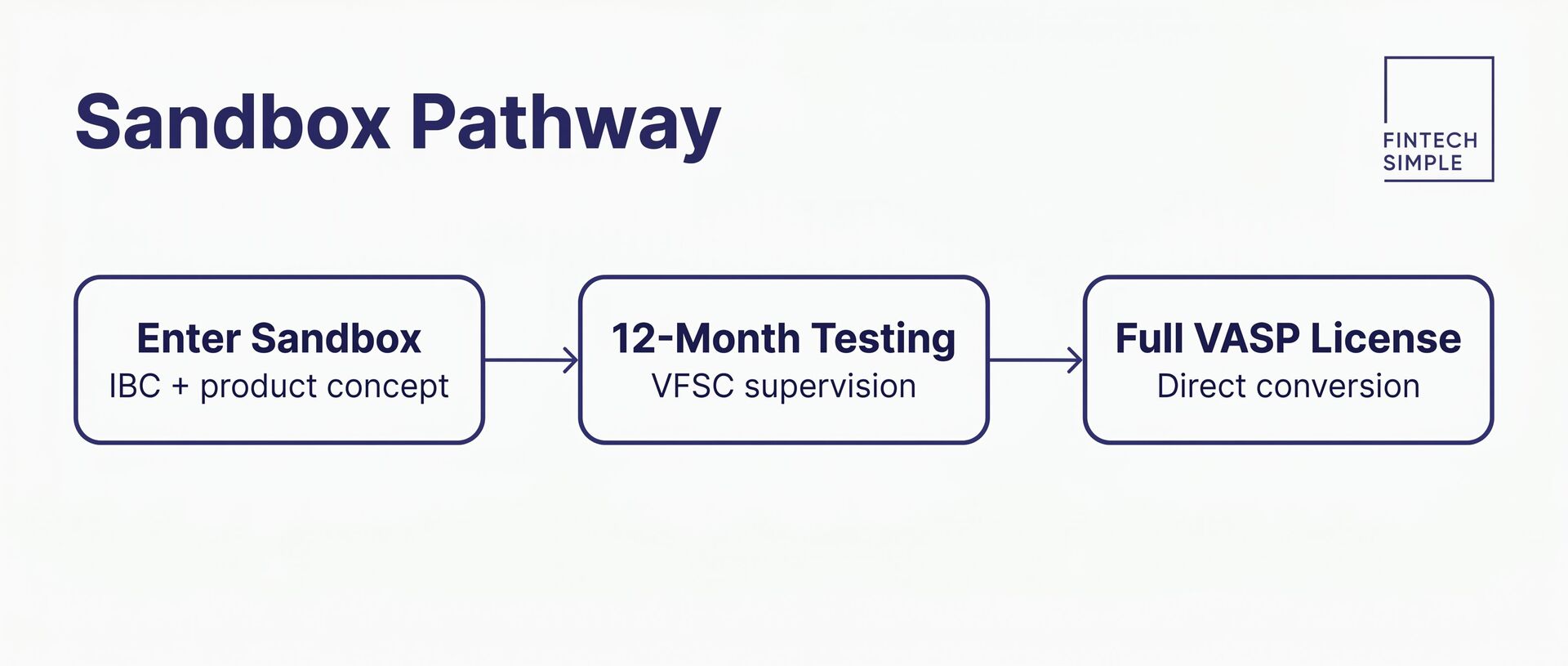
The VASP Act No. 3 of 2025 introduced a supervised testing regime that lets early-stage businesses operate under VFSC oversight for up to 12 months before committing to a full VASP license.

Who qualifies. To enter the sandbox, a company must be incorporated in Vanuatu, have a defined crypto product or service under active development, and demonstrate that it needs a controlled environment to test its technology or business model. The sandbox is primarily oriented toward early-stage businesses testing novel products, but established VASP licensees may also use the sandbox to test new products, delivery channels, or supervisory technology under separate sandbox permissions.

How it works. The VFSC supervises the sandbox period. You operate under a restricted authorization, limited by transaction volume, user numbers, or permitted activity type as set by the VFSC. Monthly reporting to the VFSC is required throughout (or as otherwise agreed in licence conditions). The initial 12-month window can be extended, but renewal is not automatic.

Pathway to a full license. Sandbox participants who complete the testing period and meet all capital, personnel, and compliance requirements can apply for a full VASP license. The VFSC factors sandbox performance into the full licensing assessment, though the sandbox does not constitute a formal fast-track and participants must submit a standard application.

For startups that cannot yet capitalize at the ~$1,680,000 minimum required for a full VASP license, the sandbox provides a regulated path to market while the business scales toward full licensure.


Get Your Personalized Licensing Roadmap

Whether you need a full VASP license or want to start with the Fintech Sandbox, we’ll map out your best path forward.

Frequently Asked Questions about Vanuatu Crypto License

What is the VASP Act No. 3 of 2025?

The Virtual Asset Service Providers (VASP) Act No. 3 of 2025 is Vanuatu’s dedicated crypto licensing law, passed on 26 March 2025. It creates a standalone regulatory framework for virtual asset service providers, separate from the older Financial Dealers License (FDL) regime. The VFSC supervises all licensed VASPs, conducts audits, and enforces AML/CFT compliance under the Act. The VASP Act is now the primary pathway for crypto businesses. The FDL Class D route predates it but remains in force.

How much does a Vanuatu crypto license cost?

VFSC government fees under the VASP Act are denominated in Vanuatu Vatu: the application fee is ~$165,000 USD (VT 20,000,000) per class, and the license issuance fee is ~$830,000 USD (VT 100,000,000) for classes D/D.1/D.2/D.3, or ~$415,000 (VT 50,000,000) for class D.4. An annual renewal fee of ~$420,000 (VT 50,000,000) for classes D/D.1/D.2/D.3, or ~$210,000 (VT 25,000,000) for D.4, is required each year. On top of the regulatory fees, applicants must maintain minimum unimpaired capital of approximately VT 200,000,000 (roughly $1,680,000 USD at current exchange rates), certified by an external auditor. You should also budget for company formation, local office setup, compliance staffing, and professional service fees.

How long does it take to get a Vanuatu crypto license?

The realistic end-to-end timeline from company formation to license issuance is 6–8 months, and complex applications can take up to 12 months. This covers incorporating the IBC, preparing the full application package (business plan, AML/KYC policies, audited capital confirmation, director background checks), and VFSC review. Marketing claims of 7–11 weeks reflect neither the VASP Act requirements nor current VFSC workload. Plan for 6 months as a minimum working estimate.

What are the capital requirements for a Vanuatu VASP license?

The VASP Act 2025 requires minimum unimpaired capital of approximately VT 200,000,000, equivalent to roughly $1,680,000 USD at current exchange rates. This capital must be certified by an external auditor and held at the VFSC or a recognized financial institution. The old figures cited by competitor pages ($10,000 or ~$40,000) applied to the pre-2025 FDL regime and are no longer valid for VASP licensees. Capital requirements may also vary by license class and the scope of services offered.

Do I need a physical office in Vanuatu?

Yes. The VASP Act 2025 mandates a genuine physical, manned office in Vanuatu; virtual addresses are not accepted. This is part of the economic substance requirement introduced alongside the Act and reinforced by Vanuatu’s proposed Resident Entity (Economic Substance) Bill of 2024. The VFSC expects key personnel to be physically present, which means staffing the office with local employees or resident personnel.

Do I need a local director?

Yes. Under the VASP Act 2025, at least one director must reside in Vanuatu for a minimum of 12 consecutive months. The CTO must also meet the same 12-month residency requirement. Earlier FDL guidance allowed directors of any residency, but that is no longer the case for VASP licensees. The resident director requirement is part of the broader economic substance framework. The regulator wants demonstrable management presence in the country, not a nominal appointment. This means either relocating an existing director or engaging a qualified local resident director.

What activities can I perform with a Vanuatu VASP license?

The VASP Act 2025 created five distinct VASP license classes plus a separate ITO licence regime. Class D covers crypto exchange services; Class D.1 covers virtual asset transfer services; Class D.2 covers custody and safekeeping of virtual assets; Class D.3 covers participation in and provision of financial businesses related to an issuer’s offer and sale of virtual assets; Class D.4 authorises a licensed bank (with Reserve Bank approval) to combine virtual asset exchange and safekeeping services; and the ITO regime covers token issuance. In current VFSC practice, applicants are typically expected to also hold FDL classes A through D. The specific class you apply for determines the permitted scope of your operations.

Is there corporate tax on crypto businesses in Vanuatu?

No. Vanuatu imposes 0% corporate income tax, 0% capital gains tax, 0% withholding tax, and 0% dividend tax, confirmed by the Vanuatu Customs & Inland Revenue. International Business Companies (IBCs) can also obtain a formal tax exemption for up to 20 years. The only indirect tax is VAT at 15% (in force since 1 January 2018), which applies to domestic transactions rather than international business operations. For most crypto businesses operating cross-border, the effective tax burden is close to zero.

What is the difference between the VASP license and the old FDL Class D?

The Financial Dealers License (FDL) Class D was introduced by Amendment Act No. 9 of 2021 as the first formal pathway for crypto businesses in Vanuatu. The VASP Act No. 3 of 2025 created an entirely separate, purpose-built framework specifically for virtual asset service providers. The VASP license is now the primary route and carries higher capital requirements (~$1,680,000 USD / VT 200,000,000), a resident director requirement, a physical office mandate, and dedicated AML/CFT obligations. In current VFSC practice, applicants are typically expected to also hold FDL classes A through D, so the FDL serves as a practical prerequisite rather than an alternative.

What AML/KYC requirements apply to Vanuatu VASP licensees?

You must comply fully with the AML/CFT Act No. 13 of 2014, which requires documented KYC procedures, ongoing transaction monitoring, and suspicious transaction reporting to the Financial Intelligence Unit (FIU). The FATF Travel Rule applies to virtual asset transfers above $1,000, meaning originator and beneficiary information must accompany the transfer. You must appoint a designated AML/CTF Compliance Officer. The VFSC conducts audits and can enforce penalties for non-compliance, so your AML infrastructure must be operational before the license is issued, not after.

Is the Vanuatu crypto license permanent?

Yes. Under Section 16(1) of the VASP Act No. 3 of 2025, a VASP license remains in force until it is revoked or surrendered. It does not expire after a fixed term. However, an annual renewal fee must be paid each year (~$420,000 USD for classes D/D.1/D.2/D.3, or ~$210,000 for class D.4), and ongoing compliance obligations must be met. Failure to pay the renewal fee or maintain compliance can lead to suspension or revocation. The FDL Amendment Act No. 5 of 2024 (gazetted 4 December 2024, compliance deadline April 2025) also restructured the underlying FDL licensing framework.

What is the Vanuatu Fintech Sandbox?

The Vanuatu Fintech Sandbox is a 12-month supervised testing environment operated by the VFSC for early-stage companies. It allows businesses to develop and test crypto or fintech products under regulatory oversight before committing to the full VASP license application process. You operate under relaxed conditions while the regulator monitors your systems, compliance controls, and business model. Completing the sandbox does not automatically result in a license, but it provides a structured path toward one and gives you proof of operational readiness when you proceed to the full application.

Your Privacy

By clicking "Accept", you consent to the use of cookies and similar technologies on your device to improve site navigation, analyze usage, provide specific functionalities, and support our marketing initiatives. Cookies that are strictly necessary will always be active with this link.