Crypto License in El Salvador

Crypto License in El Salvador: BSP & DASP Registration Guide 2026

El Salvador charges 0% tax on digital asset income, requires just $2,000 in minimum capital, and offers a streamlined CNAD registration process. Here is everything you need to get your BSP or DASP license in 2026.

Fintech Simple has guided hundreds of crypto businesses through licensing across Latin America and beyond. Our team understands the El Salvador digital asset landscape, from CNAD registration to the nuances of the 2025 Bitcoin Law reform, and provides end-to-end support from company formation and banking setup through to post-licensing compliance.

Ilya Nikiforov — International Corporate Law Attorney
Ilya Nikiforov
International Corporate Law Attorney

What Is a Crypto License in El Salvador?

Registration Fee

$5,475

Processing Time

3–6 Months

Crypto Tax

0%

Min. Capital

$2,000

El Salvador regulates digital asset businesses under the Ley de Emisión de Activos Digitales (LEAD), the Digital Assets Issuance Law passed in 2023 and in force since 1 February 2023, administered by the National Digital Assets Commission (CNAD). LEAD creates two distinct license categories: the BSP (Bitcoin Service Provider) and the DASP (Digital Asset Service Provider). Which one you need depends on which assets your business handles.

BSP vs. DASP: Which License Do You Need?

The two license types cover non-overlapping asset classes. A BSP license covers Bitcoin-only operations. A DASP license covers all other digital assets: altcoins, stablecoins, tokenized securities, and utility tokens. The table below shows the key differences:

Criteria BSP License DASP License
Assets covered Bitcoin (BTC) only All digital assets except BTC
Minimum capital $2,000 USD $2,000 USD
Permitted activities BTC exchange, custody, payments, ATMs Exchange, custody, issuance, brokerage of non-BTC assets

If your platform supports only BTC wallets or a BTC payment gateway, the BSP license covers your operations. If you list ETH, USDT, SOL, or any asset other than Bitcoin, you need a DASP license, regardless of whether you also handle Bitcoin.

When You Need Both Licenses

LEAD does not create a combined license tier. If your exchange lists both Bitcoin and other digital assets, CNAD requires you to hold both a BSP and a DASP license simultaneously. This applies to:

  • Multi-asset exchanges — any platform that trades BTC alongside ETH, stablecoins, or other tokens
  • Custodians serving mixed portfolios — custody providers holding BTC and non-BTC assets for the same clients
  • Payment processors — businesses that settle in BTC but also accept or convert stablecoins

Holding both licenses doubles the regulatory touch-points but does not double the minimum capital requirement. CNAD currently assesses capital adequacy on a consolidated basis. You file two separate applications, but a single compliance officer and a single AML/CFT policy framework can satisfy both.

Practical note

Most crypto exchange startups targeting El Salvador file for the DASP license first, then add the BSP if they expand to Bitcoin-only products. If you launch with a multi-asset product from day one, applying for both licenses simultaneously saves 4–6 weeks compared to sequential filings.

2025 Bitcoin Law Reform: What Changed

In January 2025, El Salvador amended its Bitcoin Law and removed Bitcoin’s status as mandatory legal tender. Businesses are no longer required to accept BTC as payment. The reform was passed on 29 January 2025 as part of a broader IMF deal, published in the Official Gazette on 30 January 2025, and entered into force on 30 April 2025.

For licensees, the practical impact is limited but real:

  • BSP license still exists — the LEAD framework and the BSP category remain in force. CNAD continues to register and supervise Bitcoin service providers. The 2025 reform did not repeal LEAD.
  • No mandatory acceptance obligation — you no longer need to engineer your platform to accept BTC from customers who demand it. This removes one compliance constraint for merchants and payment processors.
  • Chivo Wallet government operations — the state-run Chivo Wallet was wound down as part of the same reform. This removes a state-subsidised competitor from the market, not a regulatory constraint on your business.
  • Tax treatment unchanged — digital asset income remains exempt from income tax for LEAD-licensed entities under Article 36 of the law. The 2025 reform did not alter LEAD’s tax provisions.

The GFI analysis of the 2025 LEAD amendments confirms that the core licensing architecture remained intact after the reform. If you were already planning a BSP or DASP application, the 2025 reform (passed January, effective April 2025) does not affect your eligibility or the application process.

What does change is the narrative you present to banking partners and institutional clients: El Salvador is no longer positioned as a “Bitcoin-only” economy. The LEAD framework positions it as a regulated multi-asset jurisdiction with FATF-compliant supervision, which is an easier sell to correspondent banks than the pre-2025 setup.

Packages & Pricing for El Salvador Crypto License

El Salvador regulates crypto service providers under the Banco Central de Reserva (BCR) and the Comisión Nacional de Activos Digitales (CNAD), which was established under the Digital Assets Issuance Law (2023). We offer two packages: BSP for Bitcoin-only operations and DASP + BSP Extended for full digital asset coverage. Both include company incorporation, a registered address in El Salvador, and preparation of the full CNAD licence application. Government fees are billed separately and not included in the service prices shown (see breakdown below the table).

BSP Package €25,900
Bitcoin-only license — company setup + BSP registration
DASP + BSP Extended €38,900
Full digital asset coverage + compliance infrastructure
El Salvador company incorporation (S.A. de C.V. or S.R.L.)
Registered legal address in El Salvador (1 year)
Registration as a Bitcoin Service Provider (BSP) with CNAD
Trade registration with the Commercial Registry (Registro de Comercio)
Full documentation preparation — apostille coordination, notarization, Spanish translations
Tax identification number (NIT) and VAT registration
Registration as a Digital Asset Service Provider (DASP) with CNAD
Personalized AML/KYC policies — customer due diligence, suspicious transaction reporting, record-keeping protocols
Local MLRO search and employment — designated compliance officer in El Salvador
Assistance with local bank account opening — introductions to banks, application preparation
Nominee local director (12 months)
BSP Package €25,900
  • El Salvador company incorporation (S.A. de C.V. or S.R.L.)
  • Registered legal address in El Salvador (1 year)
  • Registration as a Bitcoin Service Provider (BSP) with CNAD
  • Trade registration with the Commercial Registry (Registro de Comercio)
  • Full documentation preparation — apostille coordination, notarization, Spanish translations
  • Tax identification number (NIT) and VAT registration
  • Registration as a Digital Asset Service Provider (DASP) with CNAD
  • Personalized AML/KYC policies — customer due diligence, suspicious transaction reporting, record-keeping protocols
  • Local MLRO search and employment — designated compliance officer in El Salvador
  • Assistance with local bank account opening — introductions to banks, application preparation
  • Nominee local director (12 months)
DASP + BSP Extended €38,900
  • El Salvador company incorporation (S.A. de C.V. or S.R.L.)
  • Registered legal address in El Salvador (1 year)
  • Registration as a Bitcoin Service Provider (BSP) with CNAD
  • Trade registration with the Commercial Registry (Registro de Comercio)
  • Full documentation preparation — apostille coordination, notarization, Spanish translations
  • Tax identification number (NIT) and VAT registration
  • Registration as a Digital Asset Service Provider (DASP) with CNAD
  • Personalized AML/KYC policies — customer due diligence, suspicious transaction reporting, record-keeping protocols
  • Local MLRO search and employment — designated compliance officer in El Salvador
  • Assistance with local bank account opening — introductions to banks, application preparation
  • Nominee local director (12 months)

Government fees (not included)

CNAD charges a one-time application fee of $5,475 and an annual renewal fee of $3,650. These are payable directly to the regulator and are separate from the service prices above. The CNAD publishes the current fee schedule on its official site.

Our Experts

Our team has secured 500+ VASP license approvals across more than 40 jurisdictions since 2016, including hands-on experience guiding crypto businesses through El Salvador’s CNAD registration and Digital Assets Issuance License framework.

Patrik Asevičius
Patrik Asevičius Head of Licensing Department, El Salvador & offshore jurisdictions
Ilya Nikiforov
Ilya Nikiforov International Corporate Law Attorney
Anastassia Rumjantseva
Anastassia Rumjantseva Lawyer, CNAD compliance

Why El Salvador for Your Crypto Business?

El Salvador passed the Bitcoin Law in June 2021, becoming the first country to give Bitcoin legal tender status, and followed it with the Digital Assets Issuance Law (2023), which created a formal licensing framework for virtual asset service providers. For operators who want a low-cost, dollar-denominated base with a credible regulatory foundation and 0% tax on crypto gains, El Salvador is worth evaluating alongside the usual offshore options.

Key Advantages

  • Zero tax on crypto capital gains — El Salvador imposes no capital gains tax on Bitcoin or other digital asset profits. Foreign-sourced income is not taxed at the personal or corporate level.
  • Low minimum capital requirement — The Digital Assets Issuance Law sets a minimum capital threshold of $2,000 for DASP and BSP registration. See the comparison table below for how this compares to other jurisdictions.
  • USD as functional currency — El Salvador has used the US dollar as its primary currency since 2001. You hold, report, and remit in USD. There is no FX conversion layer, no currency risk on operating capital, and straightforward accounting for international clients.
  • Purpose-built crypto law — The regulatory body is the Comisión Nacional de Activos Digitales (CNAD), a dedicated digital assets regulator rather than a traditional financial authority adapting existing rules. Licensing timelines and requirements are defined specifically for crypto businesses.
  • Remittance and financial inclusion market — Remittances exceeded $10 billion in 2025, representing over 27% of GDP (The Central American Group, 2025). Approximately 64% of the adult population remains unbanked (World Bank Global Findex), creating a large addressable market for crypto payment, wallet, and remittance products that are structurally difficult to serve through traditional banking channels.
  • No travel or residency requirement for directors — Entity formation and licensing do not require physical presence or local directors, though having a registered agent in-country is required.

Potential Challenges

These advantages come with real operational constraints.

  • Banking access is limited — Opening a corporate bank account in El Salvador remains difficult. Most international banks remain cautious toward crypto-licensed entities, and domestic banking infrastructure is limited. Operators typically rely on EMI accounts or neobank solutions while local banking relationships develop. This is the most common operational friction point cited by licensed entities.
  • Spanish-language bureaucracy — All regulatory submissions, filings, and correspondence with CNAD are conducted in Spanish. If your team does not have Spanish-language legal capacity, you will need local counsel for every stage of the licensing process and ongoing compliance filings.
  • Regulatory track record is short — The CNAD framework has been operational since 2023. There is limited precedent for how the regulator handles enforcement, license renewals, or cross-border disputes. Operators who rely on demonstrated regulatory predictability may find this uncertainty uncomfortable in the short term.
  • Limited international recognition — An El Salvador VASP license does not provide passporting rights into the EU, UK, or other major markets. You can operate globally under the license, but counterparties in regulated jurisdictions may require you to hold local authorizations regardless.
  • Country risk premium — Some institutional counterparties and banking partners apply heightened due diligence to El Salvador-licensed entities due to the country’s historical credit ratings and the novel nature of its crypto policy. This does not prevent business but can lengthen onboarding processes with larger partners.

El Salvador vs. Other Jurisdictions

The table below compares El Salvador against four commonly used crypto licensing jurisdictions on the criteria that most affect cost and operational structure. All figures reflect 2026 requirements.

Feature El Salvador Panama UAE EU (MiCA)
Crypto capital gains tax 0% 0% (offshore) 0% Up to 25%+ (varies by member state)
Minimum capital $2,000 No statutory minimum AED 150,000–4M+ €50,000–€150,000 (varies by service class)
Dedicated crypto regulator Yes (CNAD) No (general FSC) Yes (VARA / FSRA) Yes (per-state NCA under EBA)
Operating currency USD USD AED
EU market passporting No No No Yes
Typical licensing timeline 3–6 months 4–8 months 6–12 months 12–18 months
Physical presence required Registered agent only Registered agent only Local office required Substance in member state
Bitcoin legal tender No (removed Apr 2025) No No No

El Salvador leads on cost and speed. The UAE and EU offer stronger banking access and international credibility, but at significantly higher capital and operational cost. Panama has no statutory capital requirement but also lacks a crypto-specific regulatory framework, which increasingly matters for institutional counterparties conducting due diligence on your license. If your primary markets are outside the EU and you are optimizing for cost-efficient licensing with a credible legal basis, El Salvador is competitive with any of these options.

Regulatory Framework for Crypto in El Salvador

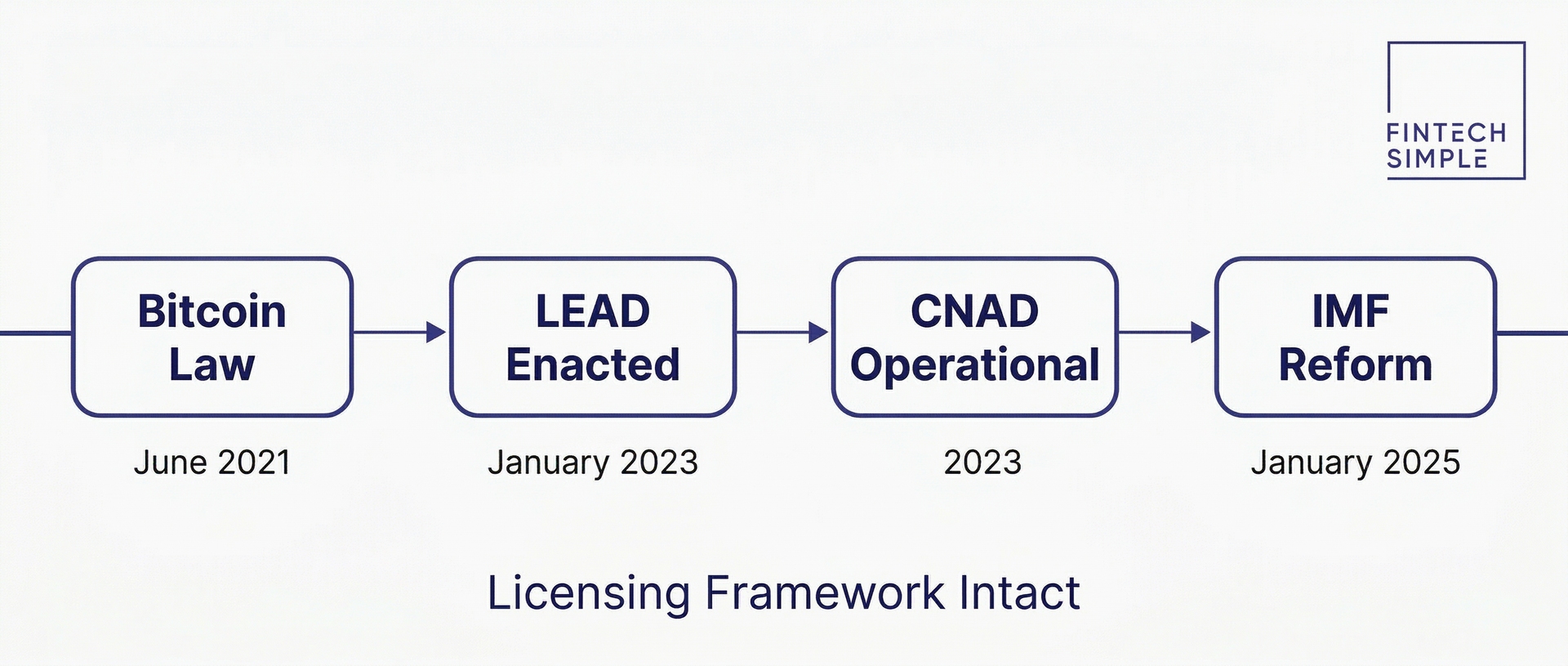
El Salvador built its crypto legal framework in two steps: the Bitcoin Law of 2021 established legal tender status and introduced mandatory merchant acceptance, while the Digital Asset Issuance Law (LEAD) of 2023 created a full licensing regime for virtual asset service providers. A dedicated regulator, the Comisión Nacional de Activos Digitales (CNAD), now centralizes supervision. In early 2025, El Salvador amended both laws as part of an IMF loan agreement, dialing back the mandatory acceptance provisions and narrowing Bitcoin’s legal tender scope. The licensing framework remains crypto-permissive, but the changes affect how you should read the current compliance requirements.

Timeline showing El Salvador's crypto regulation evolution from Bitcoin Law in 2021 through LEAD enactment in 2023 to IMF reform in 2025

Bitcoin Law (2021) and the LEAD (2023)

El Salvador passed the Bitcoin Law in June 2021, requiring all businesses to accept Bitcoin for payment and obligating the government to provide a digital wallet (Chivo). The law put the jurisdiction on the map but offered no licensing framework for VASP operators.

The gap was filled by the Ley de Emisión de Activos Digitales (LEAD), passed in 2023 and in force since 1 February 2023, which the government published in full in English. The LEAD does several things the Bitcoin Law did not:

  • VASP registration mandate — any entity offering exchange, custody, transfer, or issuance of digital assets in or from El Salvador must register with the regulator before operating.
  • Token issuance rules — companies wishing to issue digital tokens (including security tokens) must file an issuance prospectus and obtain approval.
  • AML/CFT obligations — registered VASPs are subject to the Financial Investigation Unit (FIU) standards aligned with FATF Recommendation 15, including travel rule compliance.
  • Investor protection provisions — disclosure requirements for issuers, mandatory custody segregation, and complaint-handling procedures.

The full English text of the LEAD is available directly from CNAD: Ley de Activos Digitales 2023, English translation (CNAD). A supplementary issuance regulation is published by InvestInElSalvador: Ley de Emisión de Activos Digitales (PDF).

CNAD: The Digital Asset Regulator

The Comisión Nacional de Activos Digitales (CNAD) was created by the LEAD as the single competent authority for digital assets in El Salvador. Before CNAD existed, oversight was fragmented across three bodies with overlapping mandates:

Three-body structure before CNAD

The Banco Central de Reserva (BCR) held monetary policy authority and oversaw payment systems; the Superintendencia del Sistema Financiero (SSF) supervised banks and financial intermediaries; and there was no dedicated crypto body at all. Post-LEAD, CNAD takes primary jurisdiction over VASPs and digital asset issuers, while BCR retains monetary oversight and SSF continues to supervise traditional financial institutions. VASPs that also hold banking or payment institution licenses remain subject to SSF in those capacities.

CNAD’s core supervisory functions under the LEAD include:

  • VASP registration — reviewing and approving applications, setting fit-and-proper standards for directors and beneficial owners.
  • Ongoing supervision — periodic reporting obligations, on-site inspections, and the power to impose sanctions or revoke registration.
  • Token issuance approvals — prospectus review for public token offerings.
  • AML/CFT oversight — coordinating with the FIU on suspicious transaction reports and travel rule enforcement.

CNAD publishes its regulatory guidelines and the VASP register on its official site: CNAD (cnad.gob.sv). Operators should also monitor SSF publications, as secondary regulations for specific activity types continue to be issued.

2025 Reform and IMF Agreement

In December 2024, El Salvador reached a staff-level agreement with the IMF on a $1.4 billion Extended Fund Facility, formally approved by the IMF Executive Board in February 2025. The IMF conditioned the arrangement on scaling back the Bitcoin Law’s most expansive provisions. The National Assembly passed the required amendments on 29 January 2025, with the reform entering into force on 30 April 2025 (90 days after publication in the Official Gazette).

The practical effect of the 2025 amendments:

  • Mandatory acceptance removed — private businesses are no longer legally required to accept Bitcoin as payment. Acceptance is now voluntary.
  • Legal tender scope narrowed — Bitcoin retains a status recognized by law, but the obligation on the state to guarantee Bitcoin-denominated transactions through the Chivo wallet system was reduced.
  • LEAD framework intact — the VASP licensing regime, CNAD’s authority, AML/CFT obligations, and token issuance rules were not amended. The 2025 reforms addressed the Bitcoin Law only.
  • Chivo wallet operations curtailed — the government-operated Chivo wallet reduced its active role, with the state stepping back from direct retail crypto infrastructure.

What this means for license applicants in 2026

The LEAD licensing regime is unaffected by the 2025 IMF-driven reforms. CNAD remains the competent authority, registration requirements are unchanged, and El Salvador continues to accept VASP applications from foreign-owned entities. The removal of mandatory merchant acceptance does not affect the validity or scope of a VASP registration. Businesses evaluating El Salvador as a licensing jurisdiction should assess the LEAD framework on its own terms. The Bitcoin Law amendments are a monetary policy matter, not a VASP regulatory matter.

The IMF agreement commits El Salvador to further fiscal and financial sector reforms through 2028, so track secondary regulatory updates from CNAD throughout your license term.

Requirements for Crypto License in El Salvador

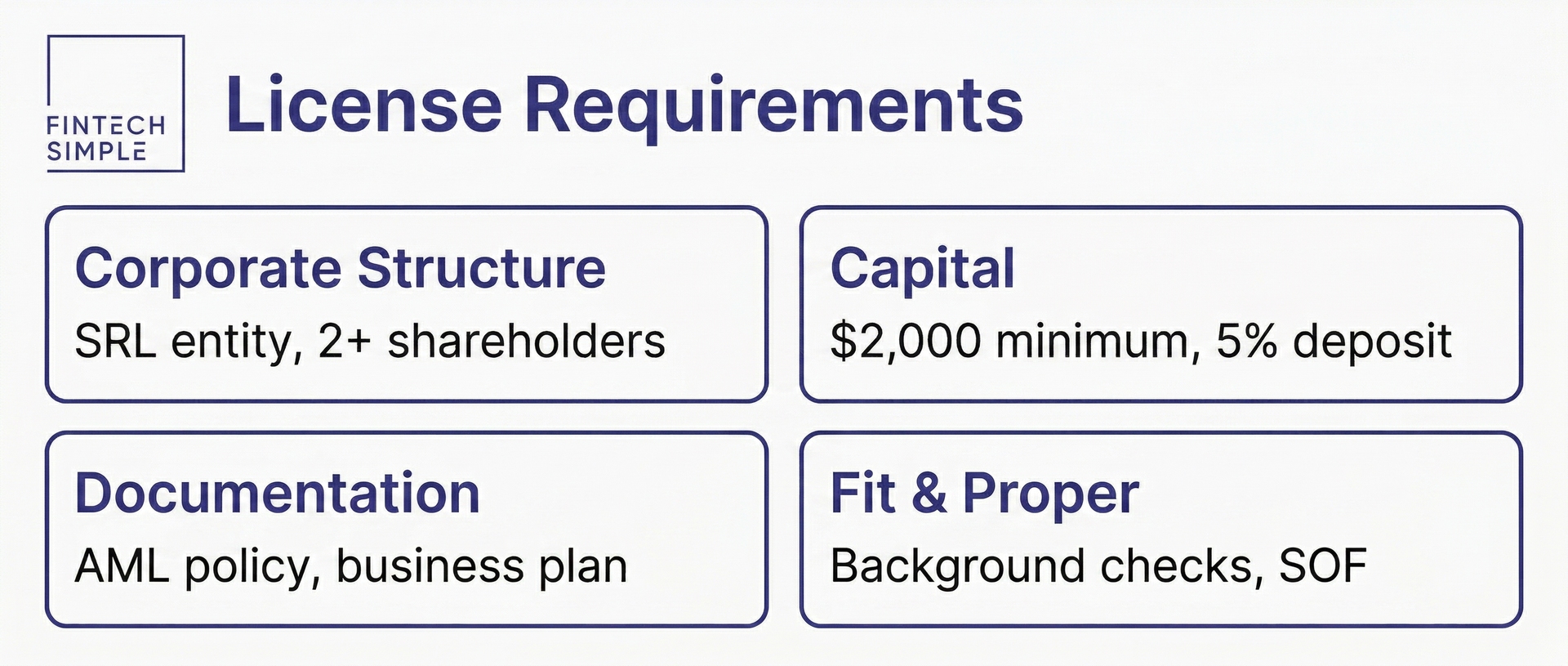
El Salvador regulates crypto service providers under the Digital Asset Service Provider (DASP) framework, administered by the National Digital Assets Commission (CNAD). The requirements are structured around four pillars: company setup, minimum capital, documentary proof, and fit-and-proper vetting of the people behind the business. Meeting all four before you submit avoids the back-and-forth that delays most applications.

Breakdown of four requirement categories for El Salvador crypto license: corporate structure, capital, documentation, and fit-and-proper criteria

Corporate Structure Requirements

Your operating entity must be incorporated in El Salvador. The Sociedad de Responsabilidad Limitada (SRL), the local equivalent of an LLC, is the structure most applicants use. It offers limited liability, straightforward profit repatriation, and is accepted by CNAD.

  • Minimum shareholders — at least 2 shareholders are required. Shareholders may be individuals or corporate entities; foreign ownership is permitted at 100%.
  • Entity type — SRL (recommended) or Sociedad Anónima (SA). Foreign companies applying as branches face additional compliance steps and are generally slower to approve.
  • Local legal representative — you must appoint a resident legal representative in El Salvador. This person acts as the registered point of contact for CNAD and bears formal responsibility for regulatory communications. The representative does not need to be a director or shareholder.
  • Registered address — a physical registered office address in El Salvador is required. A virtual office address accepted by the commercial registry is sufficient at application stage.
  • Corporate governance documents — articles of incorporation, shareholder registry, and internal regulations must be notarized and in Spanish or accompanied by a certified translation.

Practical note

If you do not yet have a local entity, CNAD will not accept an application. Incorporating the SRL first (2–4 weeks) is a prerequisite, not a parallel step. Plan accordingly.

Capital & Financial Requirements

El Salvador sets a low capital threshold for the DASP (BSP) license.

  • Minimum authorized capital$2,000 USD. This is the statutory floor for an SRL in El Salvador and is accepted as sufficient capital for DASP registration.
  • Deposit at registration5% of authorized capital ($100 on a $2,000 capital base) must be deposited to a bank account at the time of company registration and evidenced in the application.
  • Ongoing capital adequacy — CNAD may impose additional capital or liquidity requirements depending on the specific activities licensed (e.g., custody of client assets requires higher reserves). Confirm the applicable threshold for your specific service category before filing.
  • Bank account — proof that the entity holds an active business bank account, either in El Salvador or with a correspondent bank that services Salvadoran entities, is required as part of the financial documentation bundle.

Required Documents Checklist

Every document originating outside El Salvador must be apostilled or notarized and, where applicable, translated into Spanish by a certified translator. Prepare these before submitting to CNAD. Incomplete packages are returned without review.

  • Passports — notarized and apostilled copies for all directors, beneficial owners, and shareholders holding 10% or more.
  • Proof of address — utility bill or bank statement dated within the last 3 months for each director and significant shareholder.
  • Corporate incorporation documents — notarized articles of incorporation, shareholder registry, and certificate of good standing for the El Salvador entity.
  • Business plan — a detailed narrative covering the services to be offered, target markets, revenue model, and projected transaction volumes for the first 24 months.
  • AML/KYC policies — written Anti-Money Laundering and Know Your Customer procedures aligned with El Salvador’s AML Law and FATF recommendations. Must name a designated Compliance Officer.
  • Power of attorney — notarized power of attorney authorizing your local legal representative to act on behalf of the company before CNAD and other Salvadoran authorities.
  • Proof of technical infrastructure — description of the technology platform, hosting arrangements (including data residency), cybersecurity controls, and wallet or custody architecture. Third-party security audit reports strengthen the application.
  • Financial statements or capitalization proof — evidence of the deposited capital and, for established companies, audited accounts for the prior year.
  • CVs and professional backgrounds — detailed résumés for all directors and key management, including prior roles in financial services or technology.

Fit-and-Proper Criteria

CNAD applies fit-and-proper vetting to everyone who controls or manages the licensed entity: directors, beneficial owners, and shareholders with significant holdings. The assessment covers three areas: honesty, financial soundness, and competence.

  • Criminal record — no convictions for fraud, money laundering, terrorist financing, or financial crime. Criminal background checks from each country of residence in the past 5 years are required.
  • Regulatory history — no prior license revocations, prohibitions, or disciplinary actions by a financial regulator in any jurisdiction. Disclose any past regulatory proceedings even if resolved favorably.
  • Financial integrity — no personal insolvency, undischarged bankruptcy, or unsatisfied court judgments relating to financial obligations. A credit reference or solvency declaration may be requested.
  • Professional competence — at least one director or key officer must have demonstrable experience in financial services, compliance, or technology relevant to crypto asset services. This is assessed through CVs and references, not a formal exam.
  • Source of funds — directors and significant shareholders must be able to explain the origin of the capital invested in the business. Bank statements, investment records, or a notarized declaration of source of wealth are acceptable.

Important

Fit-and-proper failures are the most common reason CNAD rejects applications. Conduct an internal review of each person’s background against these criteria before filing. Disclosures made proactively are treated more favorably than issues discovered during the review. Contact us if you need a pre-application due diligence assessment.

Step-by-Step: How to Get a Crypto License in El Salvador

Obtaining a crypto license in El Salvador involves five distinct stages managed across two regulatory bodies, the Comisión Nacional de Activos Digitales (CNAD) and the commercial registry, plus a parallel banking track. The full process runs 3–6 months depending on document readiness, banking timelines, and CNAD workload. We coordinate all tracks simultaneously to avoid sequential delays.

Step 1 Weeks 1–2

Prepare Corporate Documents

What we do: We collect, draft, and notarize the complete documentation package required for both company registration and the CNAD license application.

  • Founding documents — articles of incorporation, shareholder registry, and corporate bylaws drafted to meet CNAD requirements for digital asset service providers
  • Identity documents — certified copies of passports and proof of address for all directors, shareholders, and beneficial owners (UBO declaration required)
  • Business plan — detailed description of the services to be offered (BSP or DASP classification), target markets, revenue model, and technical infrastructure
  • AML/KYC policy package — written policies covering customer due diligence, suspicious transaction reporting, record-keeping, and the designated compliance officer role
  • Source of funds evidence — bank statements or audited financials demonstrating the origin of capital to be invested
Step 2 ~15 business days

Register Your Company in El Salvador

What we do: We incorporate the operating entity as a Sociedad de Responsabilidad Limitada (SRL) under Salvadoran law, obtain the NIT tax identification number, and complete registration with the Centro Nacional de Registros (CNR). CNAD requires the applicant to be a company incorporated in El Salvador or a foreign branch registered under Salvadoran law (LEAD Article 18).

  • SRL formation — minimum two shareholders; minimum authorized capital of $2,000 USD with 5% ($100) deposited at incorporation via certified check
  • NIT registration — tax ID issued by the Ministerio de Hacienda, typically within 5–7 business days of filing
  • CNR commercial registry entry — the entity becomes a legal person capable of entering contracts, opening bank accounts, and applying for licenses
  • Local registered address — a physical address in El Salvador is required; we can arrange a registered office if you do not have premises yet
Step 3 4–6 weeks (parallel)

Open a Bank or EMI Account

What we do: We initiate the corporate banking track in parallel with company registration so you have an operational account ready before the license is granted. This step runs concurrently with Steps 2 and 4. Waiting until after CNAD approval would add two months of delay.

  • Local Salvadoran bank — preferred for CNAD compliance purposes; account denominated in USD (El Salvador’s official currency) or BTC under the Bitcoin Law
  • EMI alternative — if a local bank account proves difficult to obtain quickly, a licensed European or LATAM EMI account is accepted as an interim solution
  • Minimum deposit evidence — banks require proof of the company’s operational capital and a summary of expected transaction volumes
  • Timeline note — local banks typically take 4–6 weeks for due diligence on crypto entities; we prepare the application package to reduce back-and-forth
Step 4 Days 1–5 of filing window

Submit License Application to CNAD

What we do: We compile the complete application dossier and submit it to CNAD through the official portal. An incomplete submission resets the review clock, so we run a pre-submission checklist against the current CNAD requirements before filing.

  • License type selection — BSP (Bitcoin Service Provider) for Bitcoin-native businesses, or DASP (Digital Asset Service Provider) for multi-asset exchanges, custodians, and brokers
  • Compliance framework submission — the full AML/KYC policy, internal audit plan, and compliance officer appointment letter filed as supporting exhibits
  • Technical documentation — system architecture, cybersecurity controls, and wallet custody procedures included where applicable to the service category
  • Application fee — government fees paid at time of submission; fee amount varies by license type and is confirmed at the time of filing
Step 5 Up to 20 business days

CNAD Review and Approval

What we do: We monitor the CNAD review process, respond to any requests for additional information (RFIs) within the shortest possible timeframe, and confirm receipt of the issued license. The statutory review period is up to 20 business days from the date CNAD acknowledges a complete application.

  • Completeness check — CNAD first confirms the dossier is complete; any missing items are flagged and must be resubmitted before the 20-day clock starts
  • Substantive review — CNAD assesses the entity’s AML framework, beneficial ownership structure, and technical safeguards against the Digital Assets Issuance Law requirements
  • RFI handling — if CNAD requests clarification, we draft responses and supplementary documents and resubmit promptly to avoid interrupting the review timeline
  • License issuance — upon approval, the license is issued in the company’s name and registered in the CNAD public registry; the company may commence licensed operations immediately

Need Help with CNAD Registration?

We handle the entire process, from company formation and document preparation to CNAD submission and bank account opening. 500+ licenses issued since 2016.

Costs, Fees & Financial Obligations

Getting an El Salvador cryptocurrency license involves three distinct cost layers: government registration fees paid to CNAD, company formation costs, and ongoing professional service fees. These layers are frequently conflated in online summaries, which is why you’ll see different totals cited across sources. Here is what each layer actually costs.

Government & Regulatory Fees

CNAD sets these fees by regulation. They are non-negotiable and payable directly to the regulator. The figures below apply to a single Digital Asset Service Provider (DASP) license type.

Fee Item Amount (USD) Timing
Initial registration fee $5,475 At application
Annual renewal fee $3,650 Each year
Certification fee $50 At registration
Minimum share capital deposit $2,000 (5% = $100 at registration) $100 upfront; balance before operations

Why some sources cite $6,270 instead of $5,475

The $6,270 figure likely reflects a combined BSP (Bitcoin Service Provider) and DASP dual registration, or it includes the $795 certification and administrative surcharges applied when registering under multiple service categories simultaneously. The base CNAD registration fee for a single license type is $5,475. If your business model spans both Bitcoin payment processing and broader digital asset services, you may be required to register under both frameworks, at which point the $6,270 total is accurate for your situation. Confirm which registration category applies to your specific activities before budgeting.

Company Setup Costs

You must incorporate a Salvadoran legal entity before applying to CNAD. These are one-time costs paid to lawyers, notaries, and the commercial registry.

Cost Item Typical Range (USD) Notes
Company incorporation $1,500 – $3,000 Notarial deed, registry fees, tax registration
Legal & advisory fees $8,500 – $25,000+ Application preparation, AML/CFT policy drafting, CNAD liaison

The wide range in advisory fees reflects the complexity of your business model. A straightforward single-activity DASP application with clean ownership structure sits toward the lower end. Multi-jurisdictional structures, complex beneficial ownership chains, or applications requiring multiple CNAD meetings push costs higher.

Ongoing Compliance Costs

CNAD requires licensed DASPs to maintain active AML/CFT compliance, a designated compliance officer, and audited financials. These are recurring annual obligations.

Ongoing Cost Item Annual Cost (USD)
CNAD annual renewal fee $3,650
Compliance officer (local or outsourced) $6,000 – $15,000
Local registered agent $2,000 – $4,000
Accounting & audit $3,000 – $6,000

The compliance officer cost depends on whether you hire locally or use an outsourced service provider. A full-time local hire in San Salvador will typically cost more than $15,000 per year inclusive of employment taxes; an outsourced compliance service covers the regulatory requirement at the lower end of the range.

Total Cost Estimate

The table below separates first-year costs (which include one-time setup fees) from the recurring annual run-rate once you are operational.

Cost Category Year 1 (USD) Annual Run-Rate (USD)
Government registration & certification $5,525 $3,650
Minimum share capital $2,000
Company formation $1,500 – $3,000
Legal & advisory (application) $8,500 – $25,000+
Ongoing compliance (officer, agent, accounting) $11,000 – $25,000 $11,000 – $25,000
Total estimate $28,525 – $60,525+ $14,650 – $28,650

For context, Malta’s VFA license application fees range from €6,000 to €24,000 depending on license class, and Lithuania requires €50,000–€150,000 in minimum capital under MiCA CASP authorization. The bulk of your first-year costs are professional fees, which you can control by building compliance infrastructure in-house rather than outsourcing it. Operators with existing AML/CFT frameworks from other jurisdictions typically land toward the lower end of the advisory fee range.

Taxation for Crypto Businesses in El Salvador

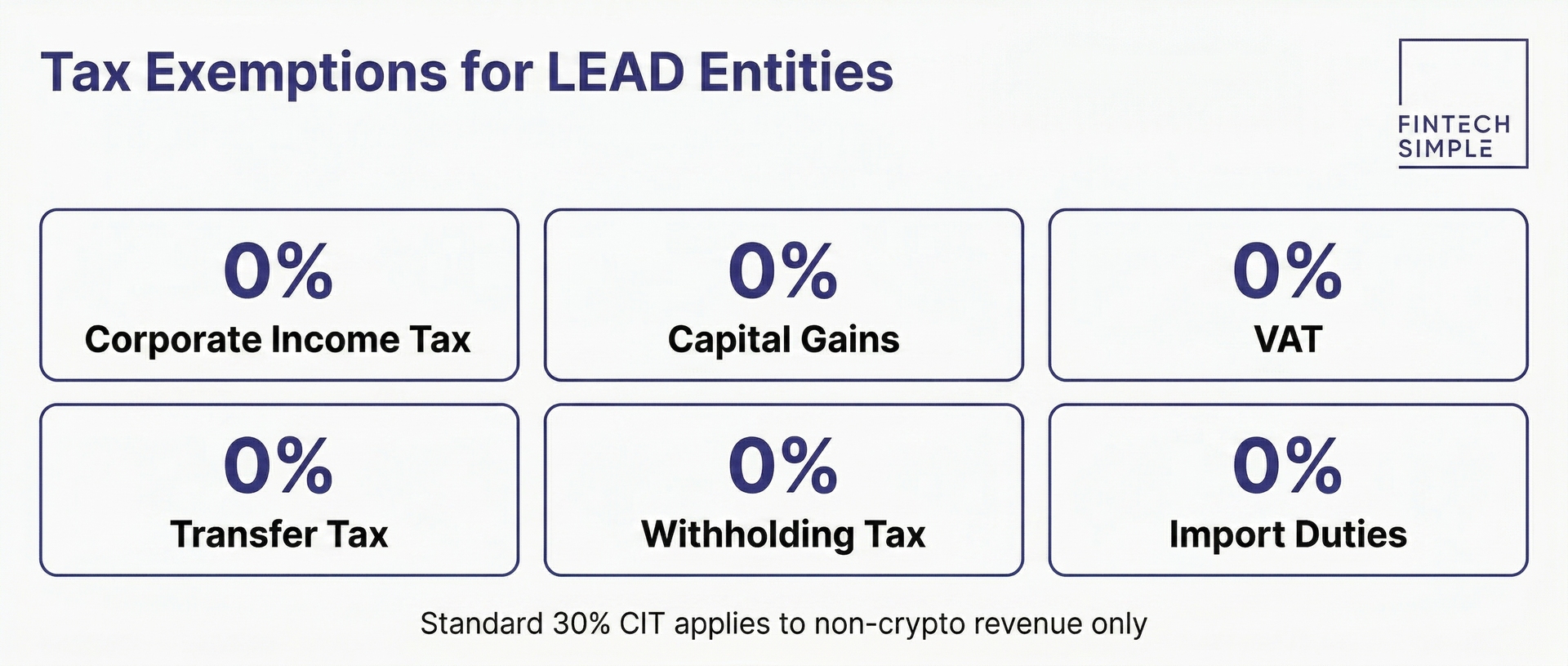
El Salvador's Bitcoin Law (2021) and the Digital Assets Issuance Law (2023) introduced a specific tax regime for licensed crypto businesses. If your company holds a CNAD license and registers under the LEAD framework, you pay 0% tax on crypto-derived income, capital gains, VAT on digital asset services, and withholding tax on crypto dividends. Standard corporate income tax of 30% applies only to non-crypto revenue streams, so a pure-play exchange, wallet provider, or token issuer with no conventional income line pays nothing to the Salvadoran treasury.

Grid showing six tax exemptions at zero percent for LEAD-registered crypto entities in El Salvador: corporate income, capital gains, VAT, transfer, withholding, and import duties

Crypto-Specific Tax Exemptions

The exemptions below apply to entities that hold a valid CNAD license and maintain LEAD registration. “Crypto income” means revenue directly derived from trading, exchange, custody, issuance, or transfer of digital assets as defined by the Digital Assets Issuance Law.

Tax Type Rate for LEAD-Registered Entities Notes
Corporate income tax on crypto revenue 0% Applies to all income classified as digital asset income under the 2023 law
Capital gains on digital assets 0% Gains on sale, exchange, or redemption of digital assets are exempt
VAT on digital asset services 0% Exchange, custody, and transfer services are outside the VAT base
Transfer tax 0% No tax on transfers of digital assets between parties
Withholding tax on crypto dividends 0% Distributions of crypto profits to shareholders are not withheld at source
Municipal taxes 0% LEAD registration confers full exemption from municipal-level business taxes
Import duties on crypto equipment 0% Mining hardware, server racks, and related equipment imported duty-free under LEAD

The LEAD exemption on municipal taxes and import duties matters most for infrastructure-heavy operations. A mining company or a data center running node infrastructure can import equipment and operate within a municipality without paying local levies that would otherwise apply to commercial entities in El Salvador.

Standard Tax Obligations

Not every revenue line qualifies for the crypto exemption. If your licensed entity also earns from conventional business activities (consulting fees, SaaS subscriptions unrelated to digital assets, or Salvadoran real estate), that income is subject to the standard corporate income tax rate of 30%. You need to keep clean accounting separation between exempt crypto income and taxable non-crypto income. Mixing them without clear allocation creates audit exposure.

Employee payroll taxes apply normally regardless of LEAD status. Social security contributions and income tax withholding on staff salaries follow standard Salvadoran labor and tax law. If you hire locally, budget for those obligations. Most licensed crypto businesses operating in El Salvador maintain a lean local presence (one or two compliance officers) and keep the bulk of staff in other jurisdictions, which keeps the payroll exposure small.

Practical note

El Salvador uses a territorial tax system for non-crypto income. Income earned entirely outside El Salvador by a resident company is generally not taxed locally. For a business whose crypto revenue is exempt and whose remaining income originates abroad, the effective tax liability in El Salvador is close to zero across the board.

El Salvador vs. Other Tax-Free Jurisdictions

Several jurisdictions market themselves as zero-tax destinations for crypto businesses. The differences lie in what the zero rate actually covers, what license or substance you need to qualify, and what corporate tax applies once your revenue crosses a threshold. The table below compares El Salvador with the UAE, Panama, and BVI on the metrics that matter most.

Jurisdiction Crypto income tax Capital gains Standard corporate tax Crypto license required
El Salvador (LEAD) 0% 0% 30% (non-crypto only) Yes, CNAD license + LEAD registration
UAE (VARA) 0% personal 0% 9% on taxable profit ≥AED 375,000 Yes, VARA license mandatory for VASP activity
Panama 0% on foreign-source income 0% on foreign assets 25% on locally-sourced income No specific crypto license; operates under general commercial law
BVI 0% 0% 0% No dedicated crypto license; limited regulatory recognition

El Salvador and the UAE both offer a regulated path with a zero rate on crypto income, but the UAE introduces a 9% corporate tax once taxable profit passes AED 375,000 (roughly USD 102,000). Panama's territorial system is attractive but provides no formal crypto licensing framework, which creates correspondent banking and institutional counterparty problems. BVI offers zero tax across the board and no license requirement, but that same lack of regulatory infrastructure means BVI-registered crypto firms are increasingly excluded from banking relationships and institutional deals. El Salvador's CNAD license gives you documented regulatory standing while preserving the full zero-rate benefit on crypto income.

AML/KYC Compliance Obligations

Every entity registered with the CNAD (Comisión Nacional de Activos Digitales) under El Salvador’s Bitcoin Law and Digital Assets Issuance Law must maintain an active AML/KYC program aligned with FATF Recommendations and the 2024 FATF targeted update on virtual assets and VASPs. CNAD reviewers assess your AML/KYC framework as part of the application itself. Gaps identified after licensing can result in remediation orders, fines, or suspension.

Customer Due Diligence (CDD & EDD)

Standard CDD applies to all customers at onboarding. At minimum, you must collect and verify: full legal name, date of birth, nationality, residential address, and a government-issued photo ID. For corporate customers, verification extends to UBOs (ultimate beneficial owners) holding 25% or more of shares or voting rights.

Source-of-funds verification is required for VASP/digital-asset transactions exceeding $1,000 (cumulative or single), aligned with the GAFILAT-recommended threshold for virtual asset transfers. Customers must document the origin of funds (payslips, business income statements, or equivalent) before processing the transaction. Note: the general Salvadoran AML cash-reporting threshold is $10,000; the $1,000 limit applies specifically to digital-asset and Travel-Rule-covered transactions.

Enhanced Due Diligence (EDD) is mandatory for three categories:

  • Politically Exposed Persons (PEPs) — current or former senior public officials, their immediate family members, and known close associates. EDD requires senior management sign-off and annual review of the relationship.
  • High-risk jurisdictions — customers or counterparties connected to FATF grey-list or black-list countries. Transactions require documented risk assessment and, where appropriate, enhanced monitoring or outright refusal.
  • Unusual transaction patterns — structuring, rapid layering across wallets, transactions inconsistent with the customer’s stated business or risk profile. These trigger EDD review and, where suspicion cannot be resolved, STR filing.

All CDD and EDD records must be retained for a minimum of 15 years from the end of the customer relationship or the date of the transaction, whichever is later, as required by El Salvador’s AML framework — currently the Special Law for the Prevention, Control, and Sanction of Money Laundering (Legislative Decree No. 426, October 2025) and FIU Instructions of November 2021 that remain in force until new regulations are issued. Records must be retrievable and producible to CNAD or the FIU within a defined timeframe upon request.

Travel Rule & Transaction Reporting

El Salvador has implemented the FATF Travel Rule for virtual asset transfers. Any transfer of $1,000 or more requires the originating VASP to transmit the following information to the beneficiary VASP:

  • Originator data — full name, account number (wallet address), and either physical address, national ID number, date and place of birth, or customer identification number.
  • Beneficiary data — full name and account number (wallet address).

The receiving VASP must screen the incoming data against sanctions lists and take risk-based action where a match is identified. Travel Rule compliance requires integration with a compliant Travel Rule solution (e.g., TRISA, OpenVASP, or a commercial provider) before processing cross-VASP transfers.

Suspicious Transaction Reports (STRs) must be filed with El Salvador’s FIU (Financial Investigation Unit — Unidad de Investigación Financiera) within 24 hours of the compliance team determining that a transaction or attempted transaction is suspicious. The 24-hour window runs from the point of determination, not from when the transaction was first identified as unusual. This is a strict deadline: late filing is itself a violation. STRs are filed confidentially; tipping off the subject of the report is prohibited.

MLRO & Compliance Officer Requirements

El Salvador applies a risk-tiered approach to the appointment of a Money Laundering Reporting Officer (MLRO). The tier that applies to your entity depends on the nature and risk level of the activities covered by your CNAD registration.

Risk-tiered MLRO structure

Entities conducting high-risk activities (spot exchange services, custody of customer assets, OTC dealing) must appoint an MLRO who is physically resident in El Salvador and available to regulators and the FIU without delay. Entities conducting lower-risk activities (software infrastructure providers, consultancy services to VASPs) may appoint a non-resident MLRO, provided they also designate a local legal representative in El Salvador who can receive regulatory correspondence and liaise with authorities. The activity scope in your application determines which tier applies, so classify your activities accurately at the outset.

Regardless of tier, the MLRO must:

  • Hold a position of sufficient seniority — the MLRO must have the authority to refuse or halt transactions and to escalate to the board without obstruction.
  • Be accessible to the FIU — able to receive and respond to information requests, including during STR investigations.
  • Oversee annual AML/KYC training — all staff who handle customer onboarding, transactions, or compliance functions must complete documented AML/KYC training each calendar year. Training records are subject to inspection.
  • Maintain and review the AML/KYC policy — the written policy must reflect current FATF standards and be updated whenever material regulatory changes occur.

Penalties for Non-Compliance

CNAD and the FIU have enforcement authority over registered entities. The penalty framework is graduated based on severity and recurrence:

  • Administrative fines — up to 1,200 monthly minimum wages in the commerce sector per violation for legal entities (approximately $490,000 at current rates). Fines can be cumulative where multiple breaches are identified in a single investigation cycle. Common triggers include late STR filing, incomplete CDD records, and failure to apply Travel Rule procedures.
  • License suspension — CNAD may suspend a registration pending remediation where systemic compliance failures are identified. Suspension prevents the entity from conducting regulated activities until the deficiency is corrected and CNAD issues a reinstatement.
  • License revocation — available for repeat violations or material breaches. Revoked entities are prohibited from re-applying for a defined period and are listed publicly.
  • Criminal referral — serious violations (willful non-filing of STRs, deliberate falsification of CDD records, or active facilitation of money laundering) are referred to the Attorney General’s office for criminal prosecution under El Salvador’s AML law. Individuals, including the MLRO and senior management, face personal liability.

The practical implication: the 15-year record retention requirement and 24-hour STR deadline are the two areas where enforcement actions are most frequently triggered in comparable VASP jurisdictions. Building automated monitoring and a documented escalation workflow is the most effective way to stay within both requirements.

Post-Licensing: Ongoing Obligations & Reporting

Your license comes with ongoing obligations. The Comisión Nacional de Activos Digitales (CNAD) enforces a continuous compliance framework covering annual renewals, quarterly reporting, external audits, and unannounced on-site inspections. Missing any of these can result in suspension or revocation.

Annual Renewal & Reporting

Your CNAD license must be renewed each year before the expiration date. The renewal fee is $3,650 per year. Submit the renewal application to CNAD in advance; late submissions risk a lapse in authorization, which requires a full re-application.

Beyond the annual renewal, licensed entities must meet a quarterly reporting cadence:

  • Financial statements — audited profit-and-loss, balance sheet, and cash flow figures for each quarter, filed within 30 days of quarter close.
  • Transaction volumes — aggregate counts and values broken down by asset type and service category (exchange, custody, transfer, etc.).
  • Compliance incidents — any AML/CFT alerts triggered, suspicious transaction reports (STRs) filed, and remediation actions taken during the quarter.
  • Annual external audit — all licensed entities must commission an independent external audit of financial records and compliance controls once per calendar year. The audit report must be submitted to CNAD as part of the renewal package.

Operational Requirements

CNAD may conduct unannounced inspections at any time. You must keep records in a format that can be produced immediately on request. Key operational requirements include:

  • Inspection-ready records — transaction logs, KYC/KYB files, wallet addresses, counterparty data, and internal audit trails must be accessible and current at all times.
  • Qualified compliance staff — at least one dedicated compliance officer with demonstrable AML/CFT expertise must remain on staff throughout the license term. Personnel changes require notification to CNAD (see License Modification below).
  • Secure technology infrastructure — systems handling customer assets or data must meet minimum cybersecurity standards. Annual penetration testing by a qualified third party is required, with results made available to CNAD on request.
  • Business continuity plan — a documented disaster recovery plan covering system outages, data loss scenarios, and key-person dependencies must be maintained and tested at least once per year.

Practical note

CNAD inspections are unannounced by design. Build your record-keeping and monitoring workflows from day one, not at year-end.

License Modification & Surrender

Not every operational change requires a new license, but CNAD must be notified at least 30 days before any of the following:

  • Changes to business activities — adding or removing a service category (e.g., expanding from exchange to custody services).
  • Ownership changes — any transfer of shares or beneficial ownership exceeding the threshold specified in your license conditions.
  • Key personnel changes — replacing the compliance officer, CEO, or other individuals named in the original application.

CNAD reviews modification requests before the change takes effect. Operating with unapproved modifications constitutes a breach of license conditions.

Surrendering the license requires a formal application to CNAD rather than simply ceasing operations. The surrender process involves a 90-day wind-down period during which the entity must:

  • Notify all active clients in writing that services will be discontinued, giving them sufficient time to transfer assets or migrate to another provider.
  • Close or transfer open positions and return customer funds in accordance with the terms agreed at account opening.
  • Submit a final compliance report to CNAD covering the wind-down period, including any incidents or STRs filed during that time.
  • Retain all transaction and KYC records for the minimum statutory retention period (15 years per current AML law) after the surrender is confirmed.

Entities that walk away without following the surrender process face regulatory sanctions that can affect the principals personally and bar them from future CNAD applications.

Why Choose Fintech Simple for El Salvador

Since 2016, Fintech Simple has obtained over 500 crypto licenses across more than 40 jurisdictions, including El Salvador. We have handled CNAD registrations and local company formations directly, and we know which documents reviewers scrutinize, which banking partners accept newly licensed VASPs, and where applications stall. That experience shortens your timeline and reduces back-and-forth with regulators.

Our team works across the Latin American region and maintains active relationships with crypto-friendly banks and EMI providers, so you are not left searching for a payment account after your license is issued. We handle the full process, from entity incorporation to post-licensing compliance, under one engagement with a single point of contact.

  • Direct CNAD experience — we know the current application requirements and common rejection triggers
  • Banking and EMI onboarding support — we maintain relationships with crypto-friendly institutions and assist with account opening after licensing
  • End-to-end service — company formation, CNAD registration, AML/CFT compliance framework, and ongoing post-licensing support in one engagement
  • Dedicated project manager — one person tracks your application, coordinates document requests, and keeps you updated at every stage
  • Transparent pricing — fixed-fee packages with no hidden costs; you see the full scope before signing

Talk to Our Licensing Experts

Whether you need a BSP license, DASP registration, or both, our team walks you through every step, from document preparation to CNAD approval.

Frequently Asked Questions about Crypto License in El Salvador

Is crypto legal in El Salvador?

Yes. El Salvador adopted Bitcoin as legal tender under the Bitcoin Law of 2021. The Digital Assets Issuance Law (LEAD), enacted in 2023, extended that framework to regulate all digital assets under a formal licensing regime. In early 2025, a reform (passed 29 January, effective 30 April 2025) removed Bitcoin’s mandatory legal tender status following an agreement with the IMF, but crypto activities remain fully legal and are regulated by the Comisión Nacional de Activos Digitales (CNAD).

What types of crypto licenses exist in El Salvador?

There are two distinct license categories under the LEAD framework. The Bitcoin Service Provider (BSP) license covers businesses that provide services specifically related to Bitcoin, such as wallets, exchanges, and payment processors handling BTC. The Digital Asset Service Provider (DASP) license applies to operators dealing with non-Bitcoin digital assets, including stablecoins, utility tokens, security tokens, and NFTs. If your activities span both categories, you need both licenses; if you focus on a single asset class, you apply for the relevant license alone.

How much does a crypto license in El Salvador cost?

Government fees are straightforward: the initial registration fee is $5,475 and the annual renewal fee is $3,650. The minimum paid-up capital requirement is just $2,000, with 5% ($100) deposited at the time of registration. Our BSP Package (Bitcoin-only license) starts at €25,900, while the DASP + BSP Extended Package (full digital asset coverage with compliance infrastructure) is €38,900. Government fees are billed separately.

How long does it take to get licensed in El Salvador?

The total timeline from initial engagement to receiving your CNAD license is typically 3 to 6 months. Document preparation and due diligence take about two weeks; company registration with the Salvadoran registry takes around 15 business days; and once your full application is submitted to CNAD, the regulator has up to 20 business days to complete its review. Timelines may extend if the regulator requests additional information or clarification.

Do I need a local office or staff in El Salvador?

No. There is no requirement to maintain a physical office or employ local staff. You do need a local legal representative (a natural person or legal entity resident in El Salvador) who acts as your point of contact with CNAD and accepts official correspondence, as well as a registered address within the country. Both can be fulfilled by a local service firm or law office, so you can complete the process remotely.

What is the minimum capital requirement for a crypto license in El Salvador?

The minimum capital requirement for both the BSP and DASP licenses is $2,000. Of this amount, 5% ($100) must be deposited at the time of registration as a reserve contribution. The remaining balance can be maintained as working capital within the company.

What are the tax benefits of a crypto license in El Salvador?

LEAD-registered entities pay 0% tax on corporate income derived from digital asset activities, 0% capital gains tax, 0% VAT, 0% transfer tax, and 0% withholding tax on qualifying transactions. CNAD-registered entities are also exempt from municipal taxes and import duties on technology and equipment used in the business.

Who regulates crypto in El Salvador?

Since the enactment of the LEAD in 2023, the Comisión Nacional de Activos Digitales (CNAD) has been the sole regulatory authority responsible for all digital asset activities in El Salvador. CNAD handles licensing applications, ongoing supervision of licensed entities, enforcement actions, and policy development. Official guidance, regulatory updates, and licensing information are available on the CNAD website.

Can foreign companies and entrepreneurs get a crypto license in El Salvador?

Yes. Foreign entrepreneurs can incorporate a Salvadoran Sociedad de Responsabilidad Limitada (SRL/LLC), the recommended entity structure, and submit their CNAD application without traveling to the country, provided they have a local legal representative and registered address in place. There are no nationality restrictions on shareholders or directors.

What AML and compliance requirements apply to licensed crypto businesses?

Licensed entities must implement an AML/KYC program meeting international standards. This includes Customer Due Diligence (CDD) and Enhanced Due Diligence (EDD) for higher-risk clients, full Travel Rule compliance for transfers above the applicable threshold, and 24-hour suspicious transaction reporting to CNAD and the Financial Intelligence Unit (UIF). You must retain transaction and compliance records for a minimum of 15 years (per current AML law) and appoint a dedicated Money Laundering Reporting Officer (MLRO), who must be locally resident for higher-risk business activities. Annual AML audits and staff training are also required.

Do I need both a BSP and DASP license?

It depends on the scope of your business. If your platform deals exclusively with Bitcoin (for example, a Bitcoin-only wallet or BTC payment gateway), you only need the BSP license. If you operate with non-Bitcoin digital assets such as stablecoins, ERC-20 tokens, or NFTs, you need the DASP license. If your business handles both Bitcoin and other digital assets, you must hold both licenses. Applications for both can be submitted to CNAD, though they may be processed sequentially.

What happens after I receive my crypto license in El Salvador?

Your license comes with ongoing obligations. You must pay the annual renewal fee of $3,650 to maintain your license in good standing and submit periodic compliance reports to the regulator. CNAD conducts routine and ad hoc supervisory inspections, so your AML/KYC policies, transaction records, and internal controls must always be audit-ready. Any material changes to your business (new services, ownership changes, or key personnel appointments) must be reported promptly.

Your Privacy

By clicking "Accept", you consent to the use of cookies and similar technologies on your device to improve site navigation, analyze usage, provide specific functionalities, and support our marketing initiatives. Cookies that are strictly necessary will always be active with this link.