Crypto License in Estonia

Crypto License in Estonia

Get CASP authorization in Estonia under the new MiCA framework. Expert guidance through FSA application, compliance setup, and EU-wide passporting, from company formation to licensed operations.

Fintech Simple has guided crypto businesses through Estonia's regulatory process since the early days of VASP licensing. With 500+ licenses issued across jurisdictions since 2016, our team covers MiCA compliance, FSA application procedures, and the practical challenges of launching a licensed crypto business in Estonia.

Patrik Asevicius — Estonia licensing expert at Fintech Simple
Patrik Asevicius
Head of Licensing Department

TL;DR for Decision-Makers

Estonia now issues CASP authorizations under the EU’s MiCA regulation — the old VASP regime is gone. The licence is granted by the FSA (Finantsinspektsioon), costs €3,000 in state fees, and requires paid-in capital of €50k–€150k depending on your service class. Expect 6–8 months from incorporation to licence grant. Once authorised, you can passport into all 27 EU member states plus the EEA without separate national licences. Estonia taxes 0% on retained profits and 22% only on distributions, making it structurally efficient for companies that reinvest. If you hold an existing VASP licence, you must migrate to CASP before 1 July 2026 or shut down. The FSA expects a local office, at least two management board members, and a resident AML compliance officer.

What Is a Crypto License in Estonia?

State Fee

€3,000

Min. Capital

From €50,000

Timeline

6–8 months

EU Passporting

Yes (MiCA)

Estonia no longer issues VASP licenses. Since the Crypto-Asset Market Act (CMA, Estonian: Krüptovaraturu seadus) took effect on 1 July 2024, Estonia has aligned with the EU’s MiCA regulation and replaced the old Virtual Asset Service Provider regime with a new CASP authorization framework. If you hold a legacy VASP license, or plan to operate in Estonia, MiCA compliance is now the baseline. The Estonian Financial Supervision and Resolution Authority (FSA, Finantsinspektsioon) is the sole authority that issues CASP authorization in Estonia.

VASP to CASP Transition

Between 2017 and early 2022, Estonia ran one of Europe’s most accessible VASP licensing regimes: just €12,000 in share capital, no fit-and-proper tests, and a simple FIU registry model. That attracted over 2,000 licensees — but also drew regulatory scrutiny. In March 2022, a major amendment to the Money Laundering and Terrorist Financing Prevention Act raised capital to €100,000–€250,000, introduced mandatory audits and fit-and-proper requirements, and imposed supervision fees. By September 2024, only ~45 licensed entities remained. The CMA, which took effect in July 2024, completed the overhaul by transferring supervisory authority from the FIU to the FSA and introducing full MiCA-aligned requirements across capital adequacy, governance, and ongoing obligations.

Existing VASP license holders have until 1 July 2026 to obtain a CASP authorization or wind down EU crypto operations. After that deadline, operating under a legacy VASP license is unlawful. The public register still shows legacy entries, but registration there no longer grants any right to provide crypto-asset services after the cutoff.

Transition deadline

Companies holding a legacy VASP license in Estonia must submit a CASP authorization application to the FSA well before 1 July 2026. The FSA takes up to 25 working days for a completeness check and up to 40 working days for a substantive review (extendable by 20 working days). A last-minute submission in June 2026 means your application will still be under review past the deadline — and you must cease operations until authorization is granted. Plan to submit no later than Q1 2026 to avoid a forced service interruption.

Crypto Activities Requiring Authorization

Under MiCA and the CMA, you need a crypto license in Estonia (CASP authorization) before providing any of the following services commercially:

ActivityMiCA ReferenceNotes
Custody & administration of crypto-assets Art. 75 Holding private keys on behalf of clients
Operation of a trading platform Art. 76 Spot exchanges, order-book or AMM models
Exchange of crypto-assets for fiat Art. 77 Buying and selling against legal tender
Exchange of crypto-assets for other crypto-assets Art. 77 Crypto-to-crypto swaps on a proprietary basis
Execution of orders Art. 78 Acting on client instructions to buy or sell
Placing of crypto-assets Art. 79 Distribution without a firm commitment
Reception & transmission of orders Art. 80 Passing client orders to another CASP
Providing advice on crypto-assets Art. 81 Personalised recommendations to clients
Portfolio management Art. 81 Discretionary management of client portfolios
Transfer services for crypto-assets Art. 82 Moving assets on behalf of clients

Activities not on this list (such as mining, running a node without custody, or developing non-custodial software) do not require CASP authorization Estonia. If your business model sits at the boundary, the FSA accepts pre-application queries before you file a formal submission.

One CASP authorization covers all the activities above that you apply for. You do not need separate licenses per service type, but each activity you intend to provide must be declared in your application and reviewed individually against MiCA’s prudential and conduct requirements.

Packages & Pricing for Crypto License in Estonia

The total Estonia crypto license cost has two fixed components that apply to every applicant: the €3,000 state fee payable to Finantsinspektsioon (the FSA), and minimum share capital of €50,000–€150,000 under MiCA Annex IV depending on your service scope (see Capital Requirements for the full breakdown). These costs are mandatory regardless of which service package you choose.

Our service packages cover the professional work required to prepare, submit, and manage your FSA application. All three tiers include document preparation, FSA communication, AML/KYC policy drafting, and company formation support. The tiers differ in how much of the ongoing local presence we provide, which is the main compliance burden for a crypto license in Estonia.

Basic €21,000
For founders who already have local staff or a nominee arrangement in place
Extended On request
Adds corporate banking setup and a dedicated local AML officer for 12 months
Full On request
Turnkey solution including local management board member and physical office address
Estonian company formation (OÜ)
FSA application preparation & submission
AML/KYC/CFT policy package
Business plan & financial model (2-year)
FSA information request responses
Corporate bank / PSP account introduction
Local AML officer (12 months)
DORA ICT risk framework documentation
Local registered office address
Local management board member
External auditor coordination (year 1)
Basic €21,000
  • Estonian company formation (OÜ)
  • FSA application preparation & submission
  • AML/KYC/CFT policy package
  • Business plan & financial model (2-year)
  • FSA information request responses
  • Corporate bank / PSP account introduction
  • Local AML officer (12 months)
  • DORA ICT risk framework documentation
  • Local registered office address
  • Local management board member
  • External auditor coordination (year 1)
Extended On request
  • Estonian company formation (OÜ)
  • FSA application preparation & submission
  • AML/KYC/CFT policy package
  • Business plan & financial model (2-year)
  • FSA information request responses
  • Corporate bank / PSP account introduction
  • Local AML officer (12 months)
  • DORA ICT risk framework documentation
  • Local registered office address
  • Local management board member
  • External auditor coordination (year 1)
Full On request
  • Estonian company formation (OÜ)
  • FSA application preparation & submission
  • AML/KYC/CFT policy package
  • Business plan & financial model (2-year)
  • FSA information request responses
  • Corporate bank / PSP account introduction
  • Local AML officer (12 months)
  • DORA ICT risk framework documentation
  • Local registered office address
  • Local management board member
  • External auditor coordination (year 1)

Government Fees Breakdown

These costs are set by EU law (MiCA) and Estonian law and apply regardless of which service provider you use:

  • €3,000 state fee — one-time processing fee paid to Finantsinspektsioon (the Estonian Financial Supervision and Resolution Authority) at the time of CASP application. Non-refundable if the application is withdrawn or rejected.
  • Minimum capital under MiCA Annex IV — set at one of three tiers depending on the scope of services applied for:
    • €50,000 (Class 1) — advice, reception/transmission of orders, execution of orders, placing, transfer services, and portfolio management.
    • €125,000 (Class 2) — custody and administration of crypto-assets and exchange services (crypto-to-fiat or crypto-to-crypto), in addition to all Class 1 services.
    • €150,000 (Class 3) — operation of a trading platform, in addition to all Class 1 and Class 2 services.
  • Prudential safeguards floor (ongoing) — at all times, a CASP must hold own funds equal to the higher of (a) the Annex IV minimum above or (b) one quarter of the prior year’s fixed overheads (¼ FOH). For fast-growing businesses, ¼ FOH typically overtakes Annex IV within the first one to two years — budget for this.
  • Annual supervision fee — set annually by Finantsinspektsioon in accordance with the Financial Supervision Authority Act. The fee is calculated as the sum of a capital-based share and an asset-based share. Specific CASP rates are published by the FSA each year — contact us for the current applicable rate based on your projected balance sheet.

Plan your first-year outlay around: state fee (€3,000) + Annex IV capital (€50k–€150k, kept on the balance sheet) + ongoing operating costs (registered office in Estonia, MLRO/AML officer, external audit, DORA/ICT compliance) + first-year supervision fee + professional service fees. Contact us for a tailored cost projection.

Our Experts

Our team has handled over 500 VASP and CASP license applications across Europe since 2016, including Estonia’s FSA authorization process before and after its 2024 legislative overhaul.

Patrik Asevičius
Patrik Asevičius Lawyer, Estonia & EU licensing
Marcin Mostowski
Marcin Mostowski Lawyer, MiCA & Baltic jurisdictions
Anastassia Rumjantseva
Anastassia Rumjantseva Lawyer

Ready to Start Your Crypto License Application?

We have guided 500+ companies through crypto licensing since 2016. Let’s get your Estonia CASP authorization moving.

Regulatory Framework for Crypto in Estonia

Estonia regulates crypto asset service providers through a layered stack of national and EU law. The Crypto-Asset Market Act (CMA, Krüptovaraturu seadus) implements MiCA at the national level and supplements it with Estonia-specific procedural and supervisory rules. The substantive licensing requirements come directly from MiCA (Regulation (EU) 2023/1114), which is binding in Estonia without further national legislation. The Estonian Financial Supervision and Resolution Authority (Finantsinspektsioon, or FSA) sits at the centre of this system: it issues CASP authorisations, conducts supervisory reviews, and enforces compliance.

Key Legislation

Six instruments govern crypto businesses operating in or from Estonia. The table below maps each law to the activity it covers and its current status.

InstrumentAdministered byStatus
MLTFPA — VCSP licensing (legacy regime)
Exchange, transfer, and custodial wallet services under the AML Act
FIU (Financial Intelligence Unit) Closed to new applications from 30 Dec 2024; existing VCSP licenses valid until 1 Jul 2026 (transitional regime)
Crypto-Asset Market Act (CMA)
Estonian implementation of MiCA: CASP licensing procedure, supervisory rules, transitional provisions, sanctions, corporate transformations
FSA (Finantsinspektsioon) In force from 1 Jul 2024; CASP licensing applicable from 30 Dec 2024
Markets in Crypto-Assets Regulation (MiCA)
Issuance of crypto assets (ARTs, EMTs, other CATs) and provision of crypto asset services across the EU/EEA
ESMA / EBA (with national NCAs enforcing) CASP rules fully applicable from 30 Dec 2024; ART/EMT rules from 30 Jun 2024
Money Laundering and Terrorist Financing Prevention Act (MLTFPA)
AML/CFT obligations: customer due diligence, transaction monitoring, suspicious transaction reporting, beneficial ownership registration
FIU (primary); FSA (AML/CFT for entities under FSA licensing) In force; amended repeatedly since 2020 to close loopholes exploited before the licensing reset
Digital Operational Resilience Act (DORA)
ICT risk management, incident reporting, third-party provider oversight for regulated financial entities including MiCA-licensed CASPs
FSA (national NCA) Applicable from 17 Jan 2025
International Sanctions Act
Implementation of EU and UN sanctions; obligates VCSPs and CASPs to screen transactions and counterparties against sanctions lists
FSA & Ministry of Foreign Affairs In force; enforcement tightened following 2022 Russia sanctions packages

Estonian VCSPs licensed by the FIU under the MLTFPA before 30 December 2024 may continue providing services under transitional provisions until 1 July 2026, or until the FSA grants or refuses their CASP authorisation, whichever is sooner. If a complete CASP application is filed before 1 July 2026 and remains under FSA review past that date, the VCSP’s activities are not deemed unauthorised — but new client contracts may not be concluded after 1 July 2026 until the decision is made. New applicants after 30 December 2024 must apply directly under MiCA.

FSA role

The FSA acts as Estonia’s National Competent Authority (NCA) under MiCA. It processes CASP authorisation applications, supervises ongoing compliance, and can withdraw authorisation if an operator breaches capital, AML, or governance requirements. FSA-issued CASP authorisations carry passporting rights across all EEA member states under MiCA Article 65, allowing licensed entities to provide services cross-border on the basis of a single home-state authorisation.

The 2020 Regulatory Reset

Estonia’s current regulatory stringency is a direct response to a licensing crisis that peaked in 2020.

Between 2017 and 2019, the application process was straightforward, fees were low, and physical presence was not strictly enforced. The result: over 1,300 virtual currency service provider licenses were issued (per the FIU’s own 2020 sectoral survey), the vast majority to shell or nominee companies with no genuine business operations in Estonia.

The consequences were severe. Estonian-registered entities appeared in financial crime investigations across multiple jurisdictions. International AML standard-setters — most notably the FATF, whose June 2019 updated guidance for a risk-based approach to virtual assets and VASPs explicitly required jurisdictions to license or register VASPs and apply full AML/CFT measures — increased global scrutiny of lightly regulated VASP jurisdictions. The Council of Europe’s MONEYVAL later confirmed the diagnosis in its 2022 5th-round Mutual Evaluation Report on Estonia. Separately, the Danske Bank scandal (roughly €200 billion in suspicious flows through its Tallinn branch between 2007 and 2015) had already made Estonia’s AML reputation a political liability.

In March 2020, the MLTFPA was amended to introduce substantive fit-and-proper requirements: mandatory local management, minimum share capital of €12,000 (later raised), comprehensive AML/CFT policies, and proof of genuine economic activity in Estonia. The FIU then audited the existing VCSP register and revoked licenses that failed the new standards. Over 1,000 licenses were cancelled in 2020, reducing the registry from more than 1,300 entities at the end of 2019 to roughly 400 by the end of 2020.

For applicants today, Estonia issues fewer licenses than it did in 2017–2019, but those it does issue carry genuine regulatory weight and EU passporting value under MiCA. A license granted after the 2020 reset, and especially one under MiCA from December 2024, signals to banks, partners, and counterparties that the operator has cleared a meaningful compliance bar.

Capital Requirements for Crypto Companies in Estonia

Estonia uses the tiered capital structure set out in MiCA Article 67 and Annex IV, applicable directly across the EU. The Crypto-Asset Market Act (CMA) provides the national supervisory and procedural framework for verifying compliance. The applicable Annex IV tier (€50k / €125k / €150k) sets a floor based on the services you intend to offer. The actual prudential safeguard you must hold is the higher of (a) the Annex IV tier or (b) one quarter of your preceding year’s fixed overheads (¼ FOH). For new applicants, the calculation uses projected fixed overheads for the first 12 months, included with the authorisation application. Once your operating costs grow beyond approximately €600,000 per year, ¼ FOH overtakes Class 3’s €150,000 floor. Before applying, you need to have the required capital fully paid up and reflected in your company’s accounts. The FSA verifies this during the application review.

Capital Tiers by Service Type

Three Annex IV capital thresholds exist. Each threshold covers a specific set of crypto-asset services. Tiers are cumulative: Class 2 includes all Class 1 services; Class 3 includes all Class 1 and Class 2 services. If your business model spans more than one tier, you meet the highest threshold that applies to any of your intended services.

ClassMinimum CapitalServices Covered
Class 1 €50,000 Advice, portfolio management, reception & transmission of orders, execution of orders, placing of crypto-assets, and transfer services
Class 2 €125,000 Custody & administration of crypto-assets, exchange of crypto-assets for fiat currency, and exchange of crypto-assets for other crypto-assets
Class 3 €150,000 Operating a crypto-asset trading platform (order-book or other matching systems connecting buyers and sellers)

Capital can be held in two forms under MiCA Article 67(4): (a) own funds — primarily paid-up share capital and retained earnings, plus other Common Equity Tier 1 (CET1) items defined under CRR Articles 26–30. Loans, shareholder pledges, undrawn credit facilities, and intangibles do not count. (b) An insurance policy meeting MiCA Article 67(4)(b) requirements, covering specific risks (acts/errors/omissions, breach of legal obligations, conflicts of interest, business disruption, gross negligence in safeguarding client assets) across the EU territories where services are provided. Most CASPs use own funds; insurance-based capital is rare in practice but legally available. The FSA routinely requests bank statements and certified accounts to verify that the funds are genuinely available.

Combination licences

If your Estonia crypto license cost calculations assume a combined exchange-plus-platform model, budget for the €150,000 Class 3 threshold from day one. Attempting to add a trading platform after initial licensing requires a licence amendment and a capital top-up, which adds several months to your timeline.

Ongoing Capital Maintenance

Estonia requires you to maintain the minimum capital continuously, not just at the time of application. The FSA can request updated financial statements at any time and cross-references annual filings against capital thresholds during routine supervision.

  • Annual accounts filing — Estonian companies must file audited or unaudited accounts with the Business Register within six months of the financial year end. The FSA cross-references these against the capital threshold for your licence class.
  • Capital erosion triggers a review — If losses reduce your net assets below the required threshold, you must notify the FSA promptly and submit a remediation plan. Operating below the threshold without disclosure is grounds for licence suspension.
  • Capital increases for service expansion — Adding a new crypto-asset service category mid-licence requires a formal amendment application. You must demonstrate that capital meets the new, higher threshold before the FSA approves the expanded scope.
  • FSA enforcement discretion — Estonia's framework gives the FSA broad supervisory discretion. The FSA typically issues a precept (a binding written order) with a remediation deadline before escalating to suspension or revocation. Operating below the threshold without disclosure significantly weakens any defence. Proactive disclosure and a credible top-up plan are the most reliable ways to avoid enforcement escalation.

We typically recommend that operators hold a buffer of 15–20% above the applicable threshold to absorb ordinary operating losses without triggering the disclosure obligations described above. If you are running lean, the FSA's scrutiny of your accounts will be heavier. They treat thin capitalisation as a risk indicator during routine supervision.

Planning tip

The maintenance obligation is permanent, not a snapshot at licence grant. Build the minimum capital into your working capital model as a permanent floor, not a one-time cost to get licensed. Boards that treat it as sunk cost tend to breach the threshold within 18 months when early-stage losses accumulate.

Requirements for a Crypto License in Estonia

To obtain a CASP authorization in Estonia, your firm must satisfy the Financial Supervision and Resolution Authority (FSA) on three fronts simultaneously: governance structure, AML/KYC/CFT controls, and IT security. The FSA reviews all three in parallel. Weakness in any one area will stall or sink the application.

Governance & Staffing

The FSA evaluates whether the people running your firm can control its risks.

  • Management board (juhatus) — at least 2 members for every CASP, regardless of services. A sole director will not satisfy the FSA. At least one management board member must be an Estonian tax resident with effective presence in the country — this is a hard local-substance requirement; remote-only or nominee arrangements will not satisfy the FSA.
  • Relevant experience — each management board member must demonstrate at least 2 years of verifiable experience in finance, law, IT, or a closely related field. CVs, employment records, and reference letters are required.
  • Supervisory board (nõukogu) — required for any CASP providing custody and administration of crypto-assets (MiCA Article 75) or operation of a trading platform (MiCA Article 76). The supervisory board must have at least 3 members and is independent from the management board. CASPs that provide only Class 1 services (advice, transfers, execution, placing, portfolio management) are not required to have a supervisory board.
  • Fit-and-proper tests — all board members, ultimate beneficial owners (UBOs), and key function holders undergo fit-and-proper screening. Criminal records, insolvency history, and prior regulatory sanctions are all checked. Any adverse finding requires a written explanation and may disqualify the individual.
  • Internal auditor — an internal audit function must be established and documented. For smaller firms this can be a designated individual rather than a separate department, provided the role is operationally independent.
  • External auditor — annual financial statements must be reviewed by a licensed external auditor. The auditor’s appointment should be confirmed before the application is submitted.

Note on UBO disclosure

The FSA requires full beneficial ownership transparency down to the natural person holding ≥25% of shares or voting rights. Nominee arrangements are permitted but every layer of ownership must be documented and verifiable.

AML/KYC/CFT Compliance

Estonia’s AML framework is among the most scrutinized in the EU. Requirements were progressively tightened by the FIU between 2020 and 2022, and the FSA inherited and now enforces this regime alongside MiCA-level controls. The FSA continues to update its AML guidelines and legislation. You must demonstrate a working compliance program before authorization is granted.

  • Estonia-based AML officer — the MLRO must be physically based in Estonia. Remote-only arrangements are rejected. The MLRO must have documented AML/KYC training and cannot simultaneously serve as a board member in a conflicted role.
  • KYC procedures — written customer due diligence (CDD) and enhanced due diligence (EDD) procedures must be included in the application.
  • Risk-based approach (RBA) — a documented business-wide risk assessment covering customer types, geographies, products, and channels is mandatory.
  • Travel Rule compliance — Estonia applies the FATF Travel Rule with no minimum threshold.
  • Client asset segregation — client funds and crypto assets must be held separately from the firm’s own assets.
  • Transaction monitoring — automated or manual systems for identifying suspicious activity must be in place.
  • Record retention — KYC records, transaction data, and correspondence must be retained for at least 5 years.

DORA & IT Security Requirements

The EU Digital Operational Resilience Act (DORA) applies to CASPs authorized under MiCA. Estonia-registered CASPs must comply with DORA from the date of authorization. The FSA assesses IT risk governance during the licensing review.

  • ICT risk management framework — a written ICT risk management policy, reviewed and approved by the board.
  • Incident reporting — major ICT incidents must be reported through a multi-stage process: initial notification within 4 hours, intermediate report within 72 hours, final report within one month.
  • Penetration testing & vulnerability management — regular penetration tests of internet-facing systems are required.
  • Third-party ICT risk — all critical technology vendors must be listed in an ICT third-party risk register.
  • Business continuity & disaster recovery — documented BCP and DRP must cover crypto-specific scenarios.

DORA gap analysis

Most applicants underestimate DORA’s scope. Standard IT security audits do not produce DORA-compliant output. We work with specialist DORA audit partners (such as Hacken) who offer DORA-specific audit methodologies tailored to crypto firms.

Step-by-Step: How to Get a Crypto License in Estonia

Getting a crypto license in Estonia means navigating a structured government process run by the Financial Supervision and Resolution Authority (FSA). The typical end-to-end timeline runs 6–8 months from company formation to receiving your license. The two most common causes of delay are incomplete documentation submitted at Step 2 and AML/CFT frameworks that don’t meet FSA standards. Addressing both before you submit is the single most effective way to keep the process on schedule.

Step 1 Days 1–3

Company Formation

What we do: We incorporate an Estonian company on your behalf — typically a private limited company (OÜ), which is the standard legal vehicle for CASP authorization (a public limited company, AS, is also eligible). Branches of foreign companies are not eligible because they are not separate legal entities. If you cannot travel to Estonia, we use the e-Residency program, which lets you sign the incorporation documents digitally. The entire setup completes in roughly one business day.

  • Legal form required — Estonian private limited company (OÜ) or public limited company (AS); OÜ is the standard choice. Branches of foreign companies are not eligible.
  • Registered address — a physical Estonian address is mandatory; virtual office services qualify
  • Share capital — €50,000 to €150,000 depending on service class under MiCA Annex IV (paid-in before application)
  • e-Residency option — non-residents can complete formation without visiting Estonia; digital ID card typically issued within 6–10 weeks (30-day processing plus 2–5 weeks delivery)
  • Management board — at least two board members required for CASP authorization (at least one must be an Estonian tax resident), all of whom must meet FSA fit-and-proper criteria; we assess suitability before filing
Step 2 Weeks 2–5

Prepare Documentation

What we do: We compile and draft the full application package, which is the most time-intensive phase. The application must be submitted in Estonian; supporting documents may be submitted in English if this is clearly stated in the application.

  • Business plan — detailed description of services, target markets, technology infrastructure, and revenue model
  • Ownership structure — qualifying-holdings disclosure for all shareholders holding ≥10%, plus UBO declaration for beneficial owners holding ≥25% of shares or voting rights
  • Board member CVs & fit-and-proper declarations — clean criminal record extracts (≤3 months old) from every country of residence over the past 5 years
  • Internal control procedures — documented policies covering transaction monitoring, sanctions screening, customer due diligence, and record-keeping
  • IT security overview — description of custodial architecture, key management, and cybersecurity controls
  • Financial forecasts — 2-year business plan with financial forecast showing path to capital adequacy
Step 3 Weeks 3–6

Develop Compliance Framework

What we do: We draft or review your AML/CFT program to meet Estonia’s Anti-Money Laundering Act requirements, which are among the most detailed in the EU. This step runs in parallel with document preparation to avoid adding time to the overall schedule.

  • AML officer appointment — a qualified AML officer (AMLCO) must be named; we advise on qualification requirements and can recommend vetted candidates
  • Risk assessment — written assessment covering customer, product, geographic, and channel risks specific to your business model
  • KYC/CDD procedures — step-by-step onboarding procedures including enhanced due diligence triggers for high-risk customers
  • Transaction monitoring rules — rule sets and thresholds for flagging suspicious activity; manual review escalation paths
  • Sanctions screening process — real-time screening against EU and UN sanctions lists at onboarding and on an ongoing basis; OFAC screening is also recommended for institutions with U.S. banking or counterparty exposure
  • Staff training plan — documented training schedule; industry practice is to complete AML training within 30 days of hire
Step 4 Day 1 of FSA clock

Submit Application to FSA

What we do: We submit the complete application package through the FSA’s electronic channel, in line with the ESMA ITS templates. The FSA runs a 25 working-day completeness check from the date of submission. If any documents are missing or deficient, the FSA sets a deadline for the applicant to supply the missing information; failure to comply within that deadline can lead to the application being refused for review.

  • Submission channel — submissions are made through the FSA’s electronic channel, in line with the ESMA ITS templates
  • State fee — €3,000 non-refundable processing fee payable to Finantsinspektsioon at submission
  • Completeness check — FSA has 25 working days to confirm the application is complete; if information is missing, the FSA sets a deadline for the applicant to respond
  • Common deficiency triggers — criminal record extracts older than 3 months, a business plan that omits required service descriptions, or missing supporting documents
Step 5 40 working days (+20 suspension)

FSA Review & Information Requests

What we do: Once the application passes the completeness check, the FSA begins substantive review. We manage all FSA correspondence, respond to information requests, and track the statutory deadlines on your behalf.

  • Review window — FSA has 40 working days to reach a decision; this clock starts after the completeness confirmation
  • 20-day suspension — the 40-day clock is suspended (paused) for up to 20 working days while the applicant responds to an FSA request for missing information. The clock resumes when the FSA receives the response.
  • Information requests (RFIs) — FSA examiners commonly request clarifications on AML procedures, IT security, or UBO documentation; we aim to respond within 5 business days to minimise the suspension period
  • Management interviews — FSA may request to interview board members or the AMLCO; we prepare briefing materials and attend where permitted
  • Most common delay trigger — AML framework gaps, particularly missing escalation procedures or insufficient transaction monitoring rule documentation
Step 6 Month 6–8

License Issuance & Launch

What we do: Once the FSA issues the license, we support the operational launch, ensuring your live systems, public disclosures, and ongoing reporting obligations are in place before you onboard your first customer.

  • License register — the FSA publishes all active CASP authorizations on its public register; your company name and license scope appear within days of issuance
  • Ongoing reporting — licensed entities submit annual activity reports to the FSA and file suspicious transaction reports (STRs) to the Financial Intelligence Unit (FIU)
  • Bank account opening — we advise on Estonian and EU banking options; in our experience, crypto-friendly accounts typically take 4–8 weeks to open after license issuance, depending on the institution
  • Regulatory calendar — we set up reminders for annual AML risk assessment updates, FSA reporting deadlines, and renewal obligations
  • License scope — confirm that your live service offering matches the licensed activities exactly; any new activity requires a license amendment application

Let Us Handle the Application Process

From company formation to FSA approval, our team manages your entire CASP authorization in Estonia.

Taxation for Crypto Companies in Estonia

Estonia’s tax system is built around a single principle: profits you keep inside the company are not taxed. You pay only when money leaves, whether as dividends, wages above market rate, or fringe benefits. For a crypto company reinvesting into growth, your operating cash stays intact until you choose to distribute.

Corporate Tax Structure

You pay 0% corporate income tax on retained profits. There is no annual corporation tax filing on net income, no deferred tax liability, and no minimum tax on undistributed earnings. The tax event is the distribution itself.

When you distribute profits (as dividends or deemed dividends), the 22% rate applies under Estonia’s standard corporate income tax on distributions (raised from 20% to 22% on 1 January 2025; the planned increase to 24% in 2026 was cancelled by the Riigikogu in December 2025). Estonia calculates this on a 22/78 gross-up formula: if you want the shareholder to receive €78,000 net, the gross taxable distribution is €100,000 and you remit €22,000 to the Tax and Customs Board. The effective rate on the net amount paid out is approximately 28.2%, not 22%, a distinction that matters when modeling returns.

For founders and employees drawing salary, individual income tax is a flat 22%. The first €8,400 per year (2026 threshold; €700/month) is tax-free for all residents regardless of income level, following the abolition of the regressive “tax hump” from 1 January 2026. Social tax adds 33% on top of gross wages, paid by the employer. If you structure compensation through dividends rather than salary, you sidestep social tax entirely, though the Estonian Tax Authority scrutinizes arrangements where founders draw no market-rate salary.

Estonia does not levy any withholding tax on outbound dividends to any non-resident (corporate or individual) under domestic law — the only tax on a distribution is the 22/78 corporate income tax paid at company level. An extensive network of over 60 double taxation treaties provides additional protection against double taxation with non-EU jurisdictions.

VAT on Crypto Services

Estonia applies the EU VAT Directive rules to crypto services. The standard VAT rate is 24% (raised from 20% to 22% in January 2024, then to 24% on 1 July 2025). However, not all crypto activities carry this burden.

Crypto exchange services (converting fiat to crypto or crypto to crypto) are VAT-exempt under the financial services exemption, consistent with the CJEU Hedqvist ruling (C-264/14) that EU courts have uniformly applied. You do not charge VAT on exchange transactions, and correspondingly you cannot reclaim input VAT on costs directly attributable to exempt services.

Wallet storage and custody services are taxable at the standard 24% rate. If your business model includes both exchange and custody, you need to apportion input VAT between taxable and exempt supplies. This affects how you recover VAT on office costs, software licences, and professional fees.

Companies with taxable turnover above €40,000 per year must register for VAT in Estonia. The registration threshold applies only to taxable supplies, so a pure exchange operator may not reach it. Mixed-model operators (combining taxable custody with exempt exchange services) typically do.

Ongoing Supervision Fees

The supervision fee directly affects your P&L every year you hold the license.

The Estonian Financial Supervision and Resolution Authority (FSA) charges an annual supervision fee calculated as the sum of a capital-based share (a percentage of own funds) and an asset-based share (a percentage of assets), in accordance with the Financial Supervision Authority Act. The specific CASP rates are set annually by ministerial regulation based on the FSA’s budget. The percentages for supervised financial entities under the Act generally fall in the 0.005%–1% range. Budget conservatively until the annual rate applicable to your entity is published. This fee is separate from your licensing, compliance staffing, and AML software costs.

Under Estonia’s Money Laundering and Terrorist Financing Prevention Act, cash currency-exchange transactions over €32,000 with non-business-relationship clients, and any unusual transactions over €32,000 with no apparent lawful purpose, must be reported to the FIU within two working days. This is in addition to the general obligation to report suspicious transactions of any size. Failure to report is a compliance breach that can trigger supervisory action or license suspension.

Build both the supervision fee and the reporting infrastructure into your year-one budget. Operators who calculate only the one-time application cost routinely underestimate the total cost of holding an Estonian crypto license.

Estonia Crypto Tax: Summary

The table below consolidates the key rates and thresholds for quick reference.

Tax / Fee Rate or Threshold Notes
Corporate tax — retained profits 0% No tax until distribution
Corporate tax — distributed profits 22% (22/78 gross-up) Effective rate on net payout is ≈28.2%; rate raised from 20% on 1 Jan 2025
Individual income tax 22% flat First €8,400/yr exempt for all residents (2026); €700/month flat
Employer social tax 33% on gross wages Paid by employer on top of gross salary
VAT — standard rate 24% Raised from 22% on 1 July 2025; previously 20% until Jan 2024
VAT — crypto exchange services Exempt Fiat–crypto and crypto–crypto conversions; no input VAT recovery on exempt supplies
VAT — wallet / custody services 24% Standard rate applies; input VAT recoverable
VAT registration threshold €40,000 taxable turnover/yr Exempt exchange turnover does not count toward threshold
FSA annual supervision fee Capital-based + asset-based shares Rates set annually by ministerial regulation per the FSA Act
FIU reporting threshold €32,000 Cash currency-exchange (non-business-relationship) and unusual transactions with no apparent lawful purpose; suspicious transactions of any size also reportable

Banking & Payment Solutions for Crypto Businesses in Estonia

Holding an Estonian CASP authorization does not guarantee a bank account. This is the most common operational bottleneck founders hit after registration. Traditional banks in Estonia (LHV, Swedbank, SEB, and Luminor) assess crypto businesses as high-risk clients under their own internal policies, regardless of your FSA authorization. Expect enhanced due diligence, a lengthy onboarding process, and, frequently, a refusal.

Bank Account Challenges

Estonian banks operate under Finantsinspektsioon supervision and apply their own risk appetite frameworks on top of EU AML rules. For crypto companies, this typically means:

  • Prolonged review timelines — onboarding reviews for crypto businesses can take 3–6 months, and banks may request the full AML/KYC policy, transaction flow diagrams, and beneficial ownership structures going back several layers.
  • Volume and counterparty restrictions — even when a bank accepts you, it may impose monthly transaction caps or block payments to certain exchanges and custodians.
  • SWIFT vs. SEPA access — SEPA credit transfers and SEPA Instant (SCT Inst) are the relevant rails for euro-denominated operations within the EU. SWIFT access is available but depends on correspondent banking relationships; some Estonian banks limit SWIFT for crypto clients to reduce correspondent bank risk.
  • Account termination risk — banks periodically review their crypto client portfolios. A change in internal policy or a compliance incident elsewhere in the sector can result in account closure with as little as 30 days’ notice.

LHV has historically been the most crypto-receptive of the Estonian banks and has served the largest share of the country’s licensed crypto clients. However, following the mass licence revocations in 2020–2022, LHV tightened its own acceptance criteria. A well-documented application with a clear business model, realistic transaction forecasts, and a credible compliance officer improves your odds.

Client fund segregation

Under MiCA Article 70 (fully applicable since 30 December 2024), CASPs must legally and operationally segregate client crypto-assets from their own assets. Client fiat funds must be deposited with a credit institution or central bank in a segregated account no later than the end of the business day following receipt. This regime is in many respects stricter than PSD2 safeguarding for payment institutions. Commingling client funds or crypto assets with operating funds is a compliance breach that can trigger supervisory action.

Payment Service Alternatives

When a traditional bank account is unavailable or while your bank application is pending, licensed Payment Service Providers (PSPs) and Electronic Money Institutions (EMIs) are the practical alternative. Several EU-licensed EMIs actively serve crypto businesses and offer SEPA access through their own payment institution licences.

  • SEPA access via EMI — EMIs authorised under the EU Payment Services Directive 2 (PSD2) can issue IBANs and process SEPA credit transfers. This gives your crypto business a functional euro account without going through a commercial bank. Processing fees are typically flat per transaction (€0.20–€3 depending on provider), compared with €1–€5 per outgoing SEPA transfer at many traditional banks for business accounts.
  • Multi-currency accounts — providers such as Mistertango (licensed in Lithuania), Nexpay, and several others operating in the Baltic region offer multi-currency accounts designed for fintech and crypto clients. They will conduct their own KYB review, but their risk tolerance for licensed crypto firms is higher than retail banks.
  • Safeguarding requirements — EMIs holding client funds are required under PSD2 Article 10 to safeguard those funds either in a segregated bank account or through an insurance policy. This provides a layer of protection that a standard current account does not.
  • Crypto-native banking rails — some infrastructure providers offer direct blockchain settlement combined with SEPA off-ramp capability, removing the need for a traditional IBAN entirely for crypto-to-crypto flows. These are not substitutes for fiat banking but can reduce reliance on it.

The practical approach for most Estonian CASP licence holders is to open an EMI account first to cover operational needs, then pursue a bank account in parallel. Having an active business with documented transaction history strengthens your bank application. If you need introductions to vetted PSPs and EMIs that currently accept Estonian CASP clients, reach out to our licensing team.

Jurisdiction note

Some Estonian CASP operators open their operational bank account in a neighbouring EU jurisdiction (Latvia or Lithuania) while maintaining their licence in Estonia. This is legally permissible. Lietuvos bankas and the Latvijas Banka oversee a number of EMIs in those markets that maintain a higher appetite for crypto business clients than some Estonian institutions.

EU Passporting Under MiCA

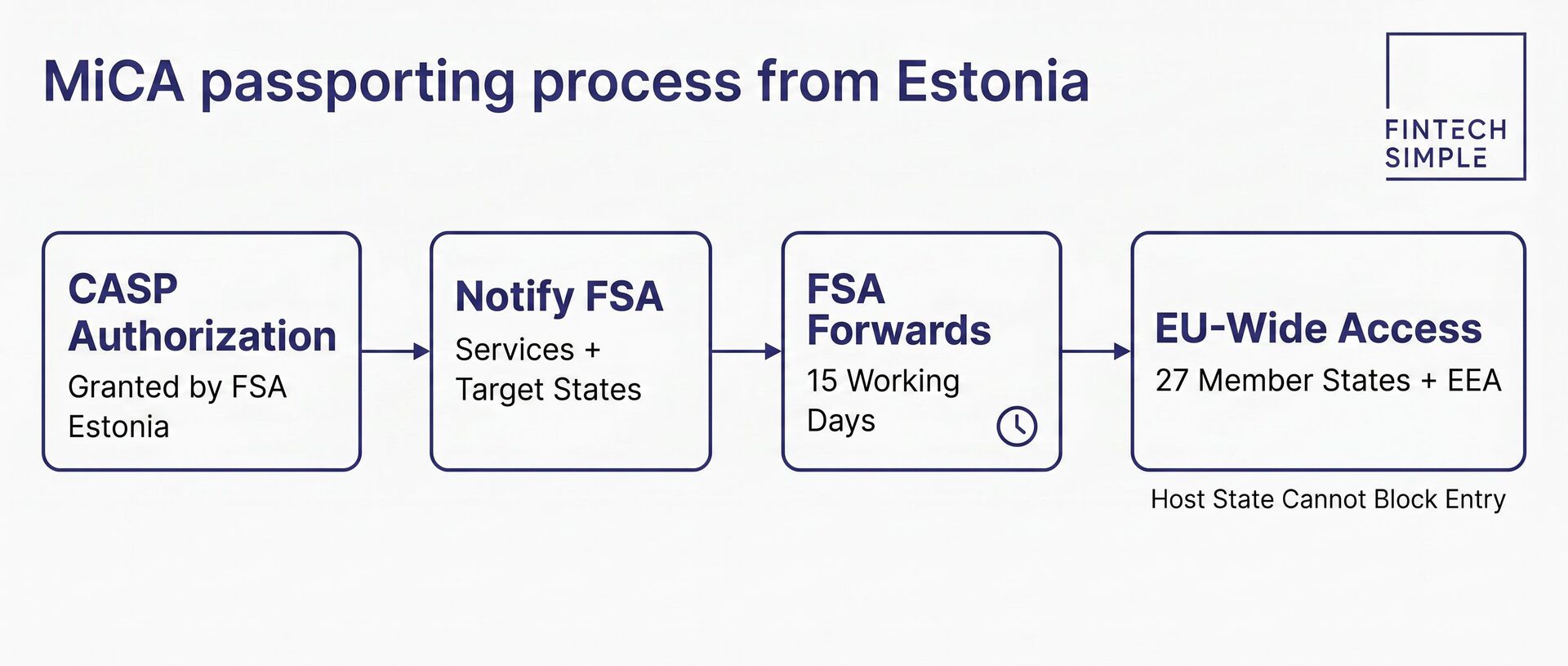
An Estonian CASP authorization under MiCA (Regulation (EU) 2023/1114) grants you the right to operate across all 27 EU member states without obtaining a separate license in each country. That right is called a passport, and the mechanism behind it is a formal notification procedure under MiCA Article 65 — not an automatic entry. Understanding how it works determines how fast you can open in a new market and what obligations follow you there.

Once Finantsinspektsioon (FSA Estonia) grants your CASP authorization, you notify the FSA in writing of your intention to provide crypto-asset services in one or more host member states. Your notification must specify the services you intend to offer, the target member states, and a start date. Under Article 65(4) of MiCA, the FSA then forwards that notification to the relevant host-state competent authorities. The host-state authority cannot refuse entry — it receives the notification for information purposes only, not for approval.

Notification mechanics

Under MiCA Art. 65(4), the FSA must transmit your cross-border notification to the host-state competent authority within 15 calendar days of receiving a complete notification. You may begin providing the notified services in the host state once the notification has been transmitted. ESMA maintains a public register of all passported CASPs, making your authorization status verifiable by counterparties and clients across the EU. The host-state regulator monitors your conduct once you operate in its territory but cannot block your entry based on the notification alone. You must notify separately for each additional service type or each new jurisdiction — a single blanket notification does not cover future expansions.

The services that can be passported are exactly those listed in your CASP authorization: operating a trading platform for crypto-assets, exchanging crypto-assets for funds or other crypto-assets, executing orders, placing crypto-assets, receiving and transmitting orders, providing portfolio management, providing advice, and providing transfer services. Your passport covers only the services your home-state authorization specifies — if your Estonian license covers exchange and custody but not portfolio management, you cannot passport portfolio management into Germany or France without first expanding your home authorization.

For businesses targeting multiple EU markets, this structure has a concrete operational advantage over non-EU licensing. A company licensed in, say, the British Virgin Islands or the Cayman Islands must negotiate bilateral arrangements or obtain fresh licenses country by country in Europe — a process that can take 12–24 months per jurisdiction and cost €50,000–€200,000 per market. The MiCA passporting route from Estonia compresses that entire EU-wide expansion into a single administrative step triggered by a 15-calendar-day notification window. The CASP authorization Estonia process under MiCA crypto regulation Estonia thus functions as a single entry point to a market of roughly 450 million people.

One practical point: host-state regulators retain supervisory authority over how you conduct business within their borders. Anti-money-laundering requirements, local marketing rules, and consumer-protection obligations in each host state still apply. The passport removes the licensing barrier; it does not create a regulatory vacuum. Build your compliance program to reflect the rules of every jurisdiction you passport into, not just Estonia’s.

Flowchart of MiCA passporting process showing Estonian CASP authorization leading to FSA notification, 15-calendar-day transmission to host-state regulators, ESMA register entry, and cross-border service provision across all 27 EU member states

Penalties & Enforcement

Estonia’s Financial Supervision and Resolution Authority (FSA) enforces CASP obligations under the Crypto-Asset Market Act and MiCA, while the European Securities and Markets Authority framework applies on top at the EU level. Non-compliance carries financial penalties calibrated to the severity of the breach. Estonia’s enforcement record on crypto businesses is among the most active in the EU: the Financial Intelligence Unit (FIU) revoked roughly 1,000 VASP licences between 2020 and 2022, and the FSA has continued an active supervisory posture since assuming the regime in January 2025 alongside MiCA-level enforcement powers.

Violation category Individual / natural person Legal entity
General AML / CASP breaches Up to €700,000 (or up to 2× the profit gained, if higher) Up to €5,000,000 or 3% of total annual turnover — whichever is higher
Severe ART / EMT breaches (MiCA Title III–IV) Up to €700,000 Up to €15,000,000 or 12.5% of total annual turnover — whichever is higher
Market abuse (insider dealing, manipulation) Up to €5,000,000 Up to €15,000,000 or 15% of total annual turnover — whichever is higher
Disgorgement Where illegal profits exceed the fixed cap, regulators may impose a fine equal to at least 2× those profits regardless of the cap, rising to 3× for market abuse breaches

Fines are imposed per violation, not per investigation. A single audit uncovering deficient customer due diligence, inadequate transaction monitoring, and missing suspicious activity reports can generate three separate penalty decisions. The FSA also publishes enforcement decisions publicly, which creates reputational exposure beyond the financial penalty itself.

Beyond fines, the FSA holds authority to suspend operations, restrict specific activities, and — in the most serious cases — revoke the licence entirely. Licence revocation is not reserved only for fraud or deliberate misconduct. Procedural triggers exist that can end your authorisation without any allegation of criminal intent.

Licence revocation triggers

The FSA may revoke an Estonian CASP authorization if the holder does not commence regulated activity within 12 months of the grant date, ceases to operate for more than 9 consecutive months, obtained the authorization through false statements or misleading documentation, is declared bankrupt by a court, or fails to meet the ongoing fit-and-proper requirements for management and beneficial owners.

Build your compliance programme around these penalty thresholds before you apply, not after the FSA sends its first supervisory letter.

Why Choose Fintech Simple for Your Crypto License in Estonia

Since 2016, Fintech Simple has secured more than 500 licenses for crypto and fintech businesses across Europe and beyond. Our Estonia licensing team handles every stage, from incorporation to FSA approval to ongoing compliance. You deal with one team throughout; there are no handoffs to third-party lawyers mid-process.

  • 500+ licenses obtained since 2016 — across multiple EU and non-EU jurisdictions, including Estonia’s FSA-regulated CASP framework.
  • Dedicated Estonia licensing team — specialists who stay current with FSA guidance, MiCA implementation, and AML/CFT rule changes.
  • End-to-end service — we handle company formation, UBO and director due diligence, AML policy drafting, and the full FSA application.
  • Defined timelines — we give you a realistic project schedule up front and flag any FSA queries within 24 hours so delays stay minimal.
  • Post-license compliance support — our compliance team assists with ongoing AML monitoring, suspicious transaction reporting, and FSA annual reporting.
  • Fixed-fee packages — no open-ended hourly billing. You know the cost before we start.

If you are evaluating whether an Estonia crypto license fits your business model, book a free consultation. We will walk through the FSA requirements, capital expectations, and realistic timelines with you.

Get Expert Guidance on Your Estonia Crypto License

Book a free consultation with our licensing team. We’ll review your business model, outline the CASP authorization process, and provide a tailored timeline and cost estimate.

Frequently Asked Questions about Crypto License in Estonia

How much does a crypto license in Estonia cost?

The state fee for a CASP authorization in Estonia is €3,000, payable to Finantsinspektsioon at the time of application. On top of the fee, applicants must demonstrate paid-in share capital aligned with MiCA Annex IV: €50,000 for Class 1 (advice, order transmission, transfer services), €125,000 for Class 2 (custody, exchange services), or €150,000 for Class 3 (operating a trading platform). An annual supervision fee is set by the FSA each year based on a capital-based share and an asset-based share. Professional service fees for preparation, compliance buildout, and ongoing support are additional.

How long does it take to get a crypto license in Estonia?

The total timeline from company incorporation to license grant is 6–8 months. The FSA conducts its review in two stages: an initial completeness check of up to 25 working days, followed by a substantive assessment of up to 40 working days. These statutory review periods do not begin until the application is accepted as complete, so preparation quality directly affects the overall timeline. Corporate registration, AML/KYC policy drafting, and capital deposit typically take 4–8 weeks before submission.

What is the difference between VASP and CASP in Estonia?

VASP (Virtual Asset Service Provider) was Estonia’s domestic licensing regime under the Money Laundering and Terrorist Financing Prevention Act. It used a registration-based model with relatively low capital thresholds and no EU-wide passporting. CASP (Crypto-Asset Service Provider) is the MiCA-aligned authorization framework that replaces it from July 2026. CASP authorization carries stricter capital requirements, fit-and-proper tests for management, and the right to passport services across all EU member states via host-state notification. Existing VASP registrants must migrate to CASP before the July 2026 deadline or cease operations.

What are the capital requirements for a crypto license in Estonia?

Capital requirements under Estonia’s MiCA-aligned CASP framework depend on the service class. Class 1 (advice, portfolio management, order reception/transmission, execution, placing, and transfer services) requires €50,000. Class 2 (custody and administration, exchange of crypto-assets for funds or other crypto-assets) requires €125,000. Class 3 (operating a crypto-asset trading platform) requires €150,000. These Annex IV tiers set a floor; the actual prudential safeguard must be the higher of the Annex IV amount or one quarter of the preceding year’s fixed overheads (¼ FOH). Capital must be held as own funds (CET1 items per CRR); it cannot be offset against operational liabilities. The FSA verifies capital adequacy at both the authorisation stage and on an ongoing basis.

Can I operate in other EU countries with an Estonian crypto license?

Yes. MiCA grants CASP-authorized firms EU-wide passporting rights. To offer services in another member state, the Estonian CASP notifies the FSA, which forwards the notification to the host-state regulator. The host state cannot block the passported activity beyond its own consumer protection rules. This means a single Estonian CASP authorization can cover all 27 EU member states plus EEA countries, removing the need for separate national licenses. Passporting does not, however, exempt the firm from local marketing rules, tax obligations, or GDPR compliance in each jurisdiction.

Do I need a physical office in Estonia?

Yes. The FSA requires a registered place of business in Estonia. A virtual office address does not satisfy this requirement. At minimum, the company must maintain a functioning registered office and have an AML Compliance Officer physically based in Estonia. Board members or senior managers with substance in Estonia strengthen the application. A fully remote structure where all management operates from abroad is unlikely to pass the FSA’s substance test, which has tightened since the 2022 VASP registry cleanup.

What is the corporate tax rate for crypto companies in Estonia?

Estonia applies a 0% corporate income tax on retained and reinvested profits. Tax is triggered only when profits are distributed, for example as dividends. From 2025, the standard rate on distributed profits is 22% (up from 20%). This deferred-tax model is codified in the Income Tax Act and makes Estonia structurally efficient for companies that reinvest earnings into growth. Crypto-to-crypto transactions within the company generally do not create a taxable event until distribution; however, specific treatment depends on the company’s accounting classification of digital assets.

What is the annual supervision fee?

Licensed crypto companies in Estonia pay an annual supervision fee to Finantsinspektsioon, calculated as the sum of a capital-based share and an asset-based share in accordance with the Financial Supervision Authority Act. The specific CASP rates are set annually by ministerial regulation. The fee is calculated on the basis of the preceding year’s audited financials and submitted alongside the annual activity report. Contact the FSA or a licensing advisor for the current applicable rate based on your projected balance sheet.

What AML requirements apply to crypto companies in Estonia?

Estonian crypto companies operate under the full AML/CFT framework set out in the Money Laundering and Terrorist Financing Prevention Act and the EU’s Transfer of Funds Regulation. This includes mandatory KYC for all customers, enhanced due diligence for high-risk clients, and ongoing transaction monitoring. Estonia applies the Travel Rule with no minimum threshold (originator and beneficiary data must accompany all crypto transfers), stricter than the €1,000 floor in some jurisdictions. Suspicious transactions must be reported to the Financial Intelligence Unit (FIU). Annual AML risk assessments and documented internal controls are required.

Can I use e-Residency to set up a crypto company in Estonia?

Yes. Estonia’s e-Residency programme allows non-residents to incorporate a company remotely using a digital ID card. Company registration through the e-Business Register takes approximately one business day after the application is approved. e-Residency covers company formation, digital signing of documents, and banking setup, but it does not replace the physical presence requirement for a CASP license. You can register the company remotely, but you will still need an AML officer and a functioning registered office on Estonian soil to satisfy the FSA’s substance requirements.

What happens if I don’t comply with licensing requirements?

Non-compliance with CASP authorization or ongoing obligations triggers enforcement action under MiCA and Estonian law. The FSA can impose fines of up to €5,000,000 or 3% of the legal entity’s total annual turnover, whichever is higher, for general CASP breaches — rising to €15,000,000 or 15% of turnover for market abuse. Operating as a crypto-asset service provider without authorization is a criminal offence. The FSA can also suspend or revoke the license, issue public warnings, and ban individuals from management positions. Under the 2020–2022 VASP reforms, the FIU cancelled over 1,000 registrations for failure to meet minimum requirements.

What is DORA and does it apply to crypto companies in Estonia?

DORA (the Digital Operational Resilience Act, EU 2022/2554) is an EU regulation that sets binding requirements for ICT risk management, incident reporting, and third-party technology oversight across financial entities. It applies to all CASP-authorized firms operating in the EU, including those licensed in Estonia. Under DORA, companies must maintain ICT risk frameworks, test digital resilience annually (including penetration tests for significant firms), and report major ICT-related incidents to the FSA within prescribed timelines. DORA became applicable from January 2025, so any applicant targeting CASP authorization must have a DORA-compliant ICT governance structure in place at the time of authorization.

Your Privacy

By clicking "Accept", you consent to the use of cookies and similar technologies on your device to improve site navigation, analyze usage, provide specific functionalities, and support our marketing initiatives. Cookies that are strictly necessary will always be active with this link.