Crypto License in Poland

Crypto License in Poland: MiCA Requirements, Cost & Timeline 2026

Poland is the EU’s largest Central & Eastern European market and your gateway to 27 member states via MiCA passporting. Get through the VASP-to-CASP transition with expert guidance, from company formation to KNF authorization.

Fintech Simple has guided 500+ crypto businesses through licensing since 2016. As Poland transitions from its legacy VASP register to full MiCA-compliant CASP authorization, our licensing team handles every step: entity setup, AML policy development, KNF application, and post-authorization compliance. Whether you’re entering the Polish market fresh or converting an existing VASP registration, we deliver fixed-fee packages with clear timelines.

Marcin Mostowski — Poland licensing expert at Fintech Simple
Marcin Mostowski
Lawyer, Poland & EU MiCA licensing

What Is a Crypto License in Poland?

Regulatory Authority

KNF

License Type

CASP (MiCA)

Capital Requirement

€50,000–150,000

CIT Rate

9–19%

If you want to operate a crypto exchange, custody service, or token-issuance platform targeting Polish or EU customers, you need a formal registration or authorization from Polish regulators. Until 2024, that meant a VASP entry in the national virtual currency register, a relatively light-touch regime. From 30 December 2024, the EU’s Markets in Crypto-Assets Regulation (MiCA) became fully applicable, introducing a heavier CASP authorization that grants an EU-wide passport. Poland sits at the intersection of both regimes right now: MiCA is live, but the national legislation needed to designate a competent authority and open CASP applications (Sejm Bill 1424) has not yet entered into force.

VASP Registration vs. CASP Authorization

Poland’s pre-MiCA framework required virtual currency businesses to register with the Head of Katowice Tax Administration Chamber, which maintained the national VASP register. As of early 2025, that register held 1,298 active entries. MiCA replaces that framework entirely with a single EU authorization called a CASP (Crypto-Asset Service Provider) license. The two regimes differ on nearly every dimension that matters to an operator:

CriterionVASP Registration (legacy)CASP Authorization (MiCA)
Regulator Head of Katowice Tax Administration Chamber Polish Financial Supervision Authority (KNF) — once Bill 1424 designates it
Minimum capital No statutory minimum €50,000 – €150,000 depending on service scope
Services covered Exchange and custody of “virtual currencies” as defined in Polish AML law 10 crypto-asset services under MiCA Art. 3, including trading, portfolio management, token issuance
EU passporting None — Poland only Full single-market passport across all 27 EU member states
Ongoing supervision AML/CFT reporting; light prudential oversight Continuous KNF supervision; annual reports; capital adequacy; conflicts-of-interest rules
Application timeline Typically 2–4 weeks for a complete file Up to 60 working days for KNF assessment (once applications open)

CASP authorization adds a whitepaper regime, governance requirements, insurance or capital buffers, and ongoing reporting obligations. In return, you get the right to passport services across all 27 EU member states without setting up a local entity in each country.

Poland’s Legislative Timeline

MiCA entered into force across the EU on 30 December 2024, but each member state must pass domestic implementation legislation to designate a national competent authority and set out procedural rules for CASP applications. Poland’s vehicle for this was Bill 1424, which has had a turbulent journey through the Sejm. The bill was passed by parliament but vetoed by President Nawrocki on 1 December 2025, who cited threats to “the freedoms of Poles” and excessive KNF powers. A resubmitted version (Bill 2050, 8 December 2025) was followed by a revised Bill 2064 that reduced the proposed KNF supervisory fee from 0.4% to 0.1% of revenue — the President vetoed it again on 12 February 2026. On 18 April 2026 parliament attempted to override the veto but fell short of the required three-fifths majority (243 of 263 votes needed). As of late April 2026, the legislation remains blocked and KNF has not formally opened a CASP application window.

This leaves every crypto operator in Poland facing a regulatory gap:

  • 30 Dec 2024 — MiCA fully applicable; VASP registrations no longer sufficient for new services covered by MiCA.
  • 30 Dec 2024 — VASP register closed to new entries; no fresh VASP registrations accepted from this date (coinciding with full MiCA applicability).
  • 1 Dec 2025 — Bill 1424 vetoed by President Nawrocki.
  • 8 Dec 2025 — Bill 2050 resubmitted (same text as Bill 1424).
  • 12 Feb 2026 — Revised Bill 2064 (supervisory fee reduced from 0.4% to 0.1%) vetoed by the President a second time.
  • 18 Apr 2026 — Parliament’s attempt to override the veto fails (243 of 263 votes needed).
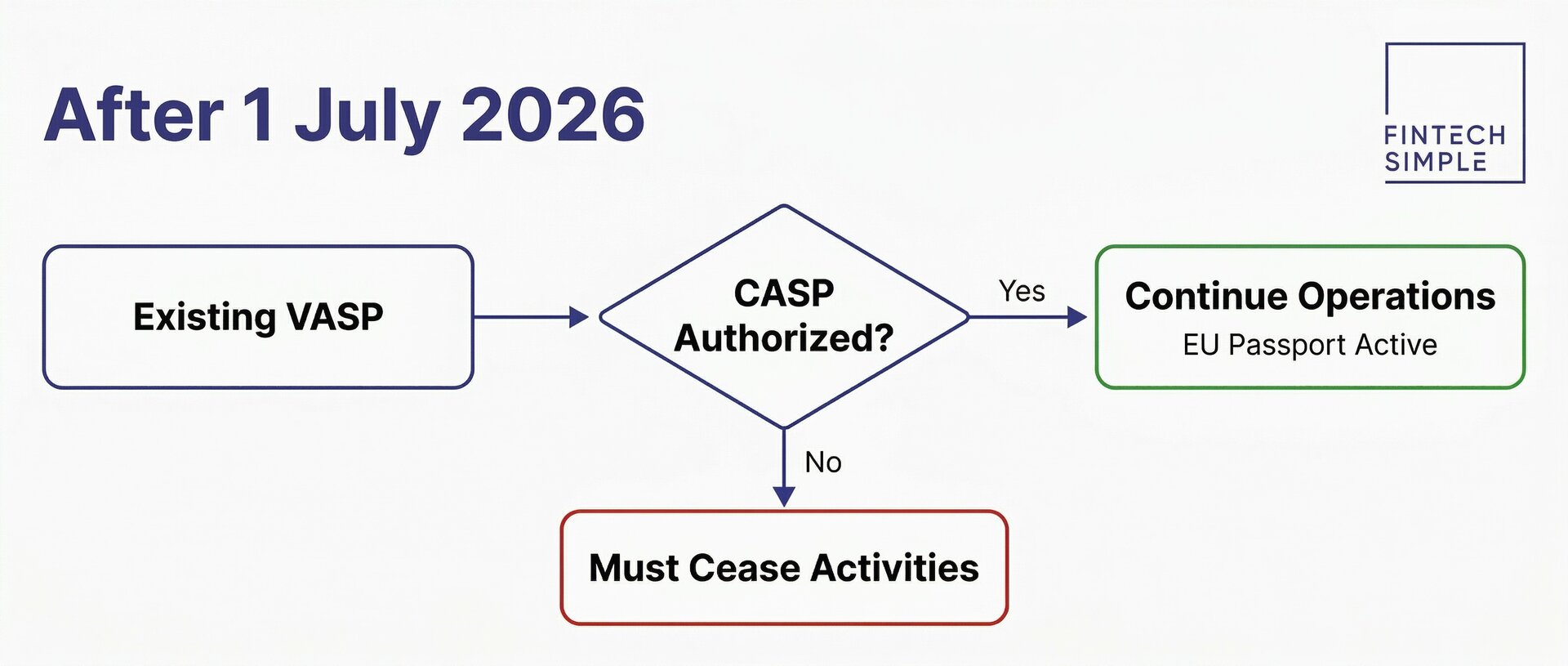
  • 1 Jul 2026 — MiCA transitional period expires. Businesses operating under existing VASP registrations must hold a full CASP authorization by this date or cease regulated crypto activities in Poland.

For the 1,298 businesses currently listed in the VASP register, the 1 July 2026 deadline is the operative constraint. Any operator that has not converted its registration into a CASP authorization, or that cannot demonstrate an application is pending, risks forced suspension. Businesses entering the Polish market now face a parallel challenge: they cannot obtain a new VASP entry and must wait for CASP applications to open under new implementing legislation.

Current position

The override vote failed on 18 April 2026 and a fresh bill has not yet been introduced. Fintech Simple tracks the legislative calendar weekly. If you are planning a market entry or need to convert an existing VASP registration, book a call to get a current read on the application timeline before committing resources.

Packages & Pricing for Crypto License in Poland

We offer two fixed-fee packages for businesses entering the Polish crypto market or converting an existing VASP registration to CASP authorization under MiCA. Each package covers end-to-end support with clear deliverables and no hidden fees.

VASP to CASP Adaptation €9,000
Company Registration + CASP License €19,500
General consultation
Verify the legal status of an existing company
Company formation or purchase procedure
Preparation of all documents for MiCA licensing
Complete documentation in both English and Polish
Review of documents, rules, and policies
Submission of application to the Financial Supervision Authority
Continuous regulatory support and communication
Legal address for 1 year
State and other fees included
VASP to CASP Adaptation €9,000
  • General consultation
  • Verify the legal status of an existing company
  • Company formation or purchase procedure
  • Preparation of all documents for MiCA licensing
  • Complete documentation in both English and Polish
  • Review of documents, rules, and policies
  • Submission of application to the Financial Supervision Authority
  • Continuous regulatory support and communication
  • Legal address for 1 year
  • State and other fees included
  • Updated corporate documentation in both Polish and English
Company Registration + CASP License €19,500
  • General consultation
  • Verify the legal status of an existing company
  • Company formation or purchase procedure
  • Preparation of all documents for MiCA licensing
  • Complete documentation in both English and Polish
  • Review of documents, rules, and policies
  • Submission of application to the Financial Supervision Authority
  • Continuous regulatory support and communication
  • Legal address for 1 year
  • State and other fees included
  • Corporate documentation in both Polish and English

Our Experts

Our in-house team of EU regulatory lawyers has guided 500+ crypto businesses through VASP and CASP licensing since 2016, including dozens of applications to KNF and other Central European regulators.

Marcin Mostowski
Marcin Mostowski Lawyer, Poland & EU MiCA licensing
Ivo S.
Ivo S. Lawyer, EU regulatory compliance
Anastassia Rumjantseva
Anastassia Rumjantseva Lawyer

Why Poland for Your Crypto Business

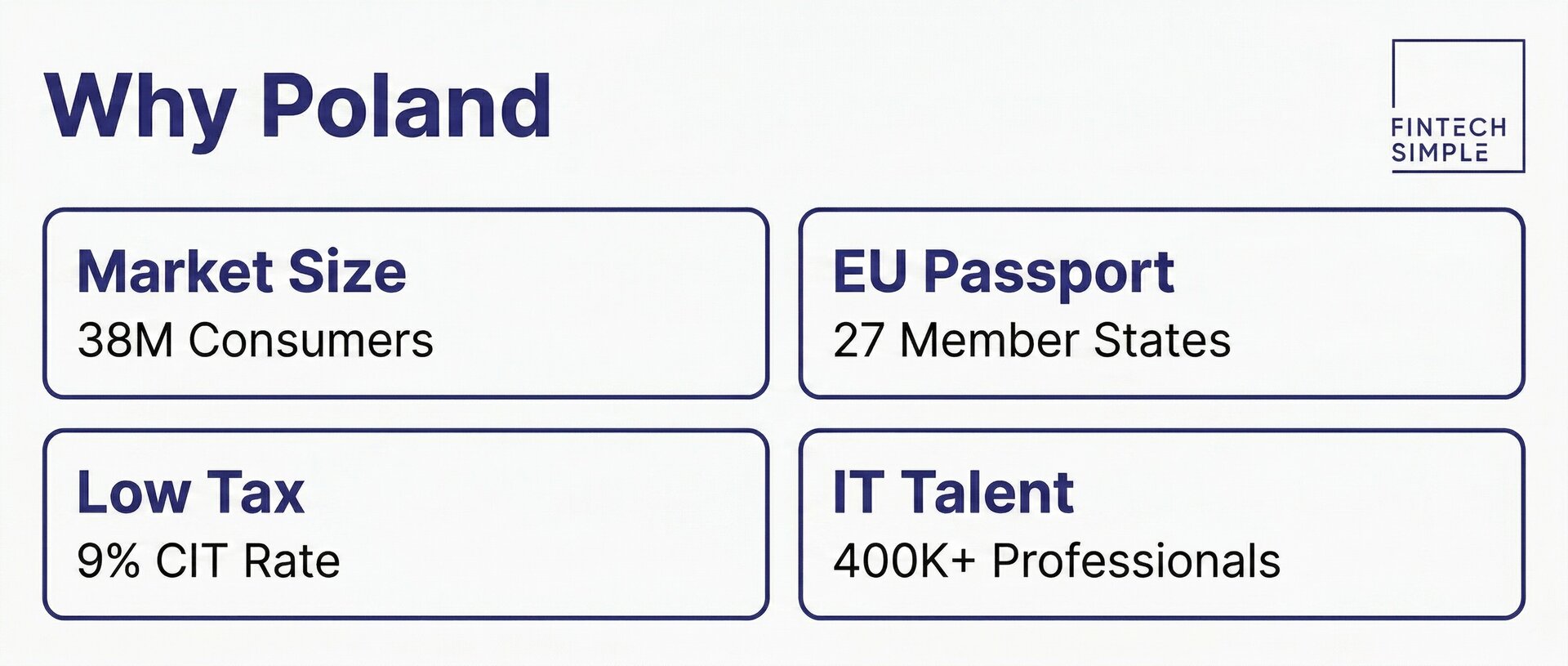
Poland is the largest economy in Central and Eastern Europe, home to 37 million consumers and nearly 400 active fintech companies. Regulators here are well acquainted with crypto businesses, and the licensing process is a known quantity. If you are evaluating EU jurisdictions for your poland crypto license, the fundamentals are hard to beat.

Why Poland for Your Crypto Business

Largest Market in Central & Eastern Europe

Poland's GDP reached around €840 billion in 2024 (World Bank: $915 billion), ranking it sixth in the EU. The domestic consumer base of 37 million people spends actively online: e-commerce penetration exceeded 70% in 2023, and crypto adoption surveys place Poland among the leading EU markets by retail participation. For businesses targeting CEE clients, a Polish entity puts you close to the region's largest market, geographically, linguistically, and regulatorily. The 400+ fintech companies already operating here have built banking integrations, payment rails, and compliance infrastructure you can plug into from day one.

EU Passporting to 27 Member States

Poland is a full EU member state. Under MiCA, a single CASP license issued by the Polish Financial Supervision Authority (KNF) lets you passport services across all 27 EU countries without obtaining separate national licenses. That is a combined market of 450 million+ consumers reached through one regulatory process. Poland operates under MiCA's general transitional period (Article 143(2)) until 1 July 2026, allowing existing VASP-registered entities to continue services. National implementing legislation remains blocked due to repeated presidential vetoes, so KNF has not yet opened a CASP application window — a critical timing constraint to factor into market entry plans.

Competitive Tax Regime

Poland applies a 9% Corporate Income Tax (CIT) rate to companies with annual revenue below €2 million, one of the lowest headline rates in the EU for qualifying businesses. Above that threshold, the standard rate is 19%, still below the EU average of roughly 21.5%. There is no withholding tax on dividends paid between EU-resident parent and subsidiary companies under the EU Parent-Subsidiary Directive. VAT on crypto exchange services follows EU rules (generally exempt for exchange of currency, including crypto). If your projected revenue sits below the €2 million threshold in the first years of operation, you pay 9% CIT rather than the 25–35% rates typical in Western European jurisdictions.

Deep IT Talent Pool

Poland has over 500,000 qualified IT professionals, one of the largest tech workforces in the EU. Warsaw, Kraków, Wrocław, and Gdańsk each host established technology clusters with universities producing 15,000+ computer science graduates per year. Average gross salaries for senior software engineers run at 40–55% of equivalent roles in London, Amsterdam, or Stockholm, a direct cost advantage when you are building compliance technology, transaction monitoring systems, or customer-facing products. Google, Samsung, ABB, and Goldman Sachs all have engineering centres here for the same reason.

Regulatory Framework: MiCA in Poland 2026

Poland sits in an awkward position under EU crypto law. The Markets in Crypto-Assets Regulation (MiCA) applies directly in Poland since 30 December 2024 as binding EU law, no transposition required. But the domestic legislation needed to designate a competent authority has failed three times: Bill 1424 was vetoed on 1 December 2025, the revised Bill 2064 was vetoed on 12 February 2026, and the Sejm’s override attempt on 18 April 2026 fell short of the required three-fifths majority. The regulation is in force; the enforcement machinery is not.

MiCA Direct Applicability

MiCA is an EU Regulation, not a Directive. Regulations apply automatically in every member state on their entry-into-force date without any national implementing act. Title III and Title IV (asset-referenced tokens and e-money tokens) applied from 30 June 2024. The full text — including Title V covering Crypto-Asset Service Providers (CASPs) — applied from 30 December 2024.

From that date, any company providing crypto-asset services in Poland or to Polish customers falls under MiCA’s CASP authorisation regime. This includes exchange, custody, portfolio management, transfer, and advisory services covering crypto assets as defined in Article 3(1)(5) of MiCA. The regulation is self-executing: Polish firms cannot rely on the absence of a national implementing act as a reason to avoid compliance.

ESMA’s MiCA resources provide the technical standards and guidelines that directly govern how Polish CASPs must structure their applications, disclosures, and ongoing reporting obligations.

Key Regulatory Authorities

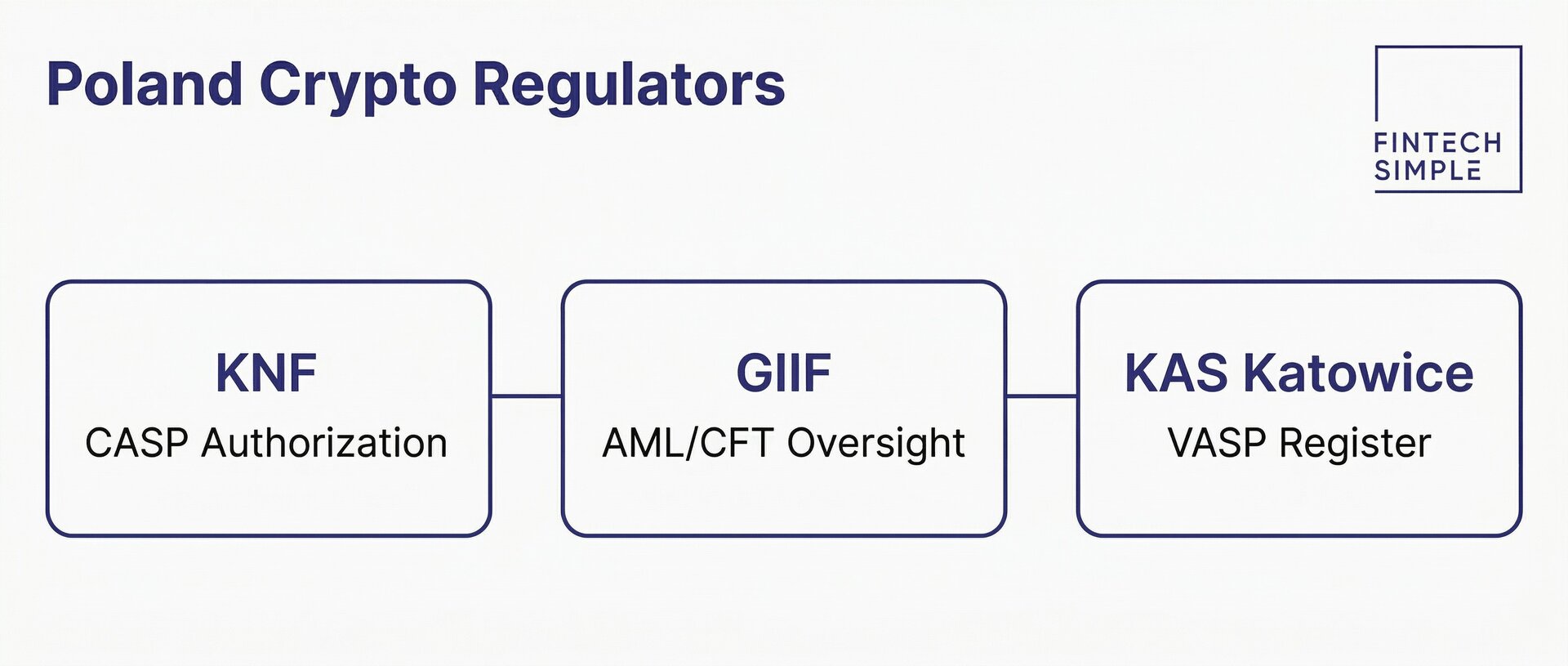
Three bodies share oversight of crypto businesses in Poland. Their roles are distinct and non-overlapping.

AuthorityRoleScope
KNF (Polish Financial Supervision Authority) CASP authorisation and prudential supervision under MiCA All MiCA-regulated crypto-asset services from 30 Dec 2024
GIIF (General Inspector of Financial Information) AML/CFT oversight for obligated entities Virtual asset service providers under the Polish AML Act 2018, including current VASP registrants
KAS Katowice (National Revenue Administration, Katowice branch) Maintains the VASP register Entities registered as VASPs under the pre-MiCA Polish regime

KNF is the competent authority under MiCA for Poland — a designation implied by the regulation itself even absent the domestic bill. However, KNF has not yet formally opened a CASP application window because the implementing legislation (Bill 1424 / 2050 / 2064) that would set out procedural rules, fees, and transition mechanics has not entered into force. Firms should expect KNF to handle CASP authorisation applications once new legislation passes, and to communicate with ESMA on supervisory convergence matters.

Hierarchy diagram showing Poland's crypto regulatory authorities: KNF for CASP authorisation under MiCA, GIIF for AML/CFT oversight, and KAS Katowice for the legacy VASP register

Key Legislation

Understanding the Polish crypto regulatory stack requires knowing which instruments are in force, which are pending, and which failed.

  • MiCA (EU Regulation 2023/1114) — Directly applicable from 30 December 2024. Governs CASP authorisation, white paper obligations, conduct of business, and prudential requirements. Supersedes national crypto licensing regimes for in-scope services.
  • Polish AML Act 2018 (as amended) — Transposes the EU’s 5th Anti-Money Laundering Directive. Defines “virtual currency” and “virtual asset service provider,” requires VASP registration with KAS Katowice, and imposes KYC, transaction monitoring, and suspicious activity reporting obligations through GIIF. Still fully in force; MiCA does not replace AML obligations.
  • Bill 1424 / 2050 / 2064 (all failed) — The draft Polish laws that would have designated KNF formally as the MiCA competent authority, established application fees, set out the transition timetable for existing VASPs, and aligned national penalties with MiCA’s Article 111 framework. Bill 1424 was vetoed by President Nawrocki on 1 December 2025. Bill 2050 (resubmitted 8 December 2025) was followed by a revised Bill 2064 that reduced the proposed KNF supervisory fee from 0.4% to 0.1% of revenue — the President vetoed it again on 12 February 2026. Parliament’s override attempt on 18 April 2026 fell short of the required three-fifths majority (243 of 263 votes needed). A fresh bill has not yet been introduced.
  • DORA (EU Regulation 2022/2554) — The Digital Operational Resilience Act applies to CASPs authorised under MiCA from 17 January 2025. It mandates ICT risk management frameworks, incident reporting to KNF, penetration testing for significant entities, and contractual requirements for third-party ICT providers. Any firm pursuing a Polish CASP licence must build DORA compliance into its operational structure from day one.

Legislative status as of May 2026

The override vote failed on 18 April 2026 and a fresh bill has not yet been introduced. KNF has not formally opened a CASP application window. Fintech Simple tracks the legislative calendar weekly. If you are planning a market entry or need to convert an existing VASP registration, book a call to get a current read on the application timeline before committing resources.

What Changes After 1 July 2026

The MiCA transitional period for existing VASPs ends on 1 July 2026 across EU member states that have not enacted a shorter national transition window. Poland has not shortened the period, so Polish VASPs currently registered with KAS Katowice can continue operating until 30 June 2026 under the old regime.

After 1 July 2026, the following applies:

  • No grandfathering without CASP authorisation — VASP registration with KAS Katowice gives no right to continue operating crypto-asset services. Firms that have not obtained a MiCA CASP authorisation from KNF must cease all in-scope activities on 1 July 2026.
  • EU passporting becomes available — A CASP authorised in Poland gains the right to notify other EU member states and provide services cross-border without additional local licences. This is materially different from the pre-MiCA VASP regime, which carried no passporting rights.
  • New entrants require CASP authorisation from day one — Companies incorporated after 30 December 2024 that provide MiCA-regulated services cannot use the transitional relief. They must apply to KNF for full CASP authorisation before commencing operations.
  • AML obligations continue unchanged — VASP registration obligations under the Polish AML Act 2018 and GIIF reporting requirements remain in force regardless of MiCA authorisation status. A CASP licence does not replace AML registration.

The practical implication is clear: firms with existing VASP registrations in Poland should begin CASP authorisation preparation now. KNF has not published a detailed application timeline, and the absence of implementing legislation means some procedural questions remain open. Building a compliant CASP application under MiCA — covering governance, capital, custody, white papers, and DORA ICT frameworks — typically takes six to nine months.

Flowchart showing the VASP-to-CASP transition timeline in Poland: from VASP register closure on 30 December 2024 through MiCA transitional period expiry on 1 July 2026

Types of Crypto Activities Requiring a License

The Markets in Crypto-Assets Regulation (MiCA) defines 10 crypto-asset service types that require CASP authorization in Poland. These 10 services are organized into 3 classes based on capital requirements and compliance complexity: Class 1 (€50,000 minimum capital), Class 2 (€125,000), and Class 3 (€150,000). A business must identify every service it intends to offer and obtain authorization for each one — providing a service without the corresponding authorization is a MiCA violation carrying penalties of up to €5 million.

Service TypeDescriptionCASP Class
Custody & Administration Safekeeping or controlling crypto-assets or the private keys that grant access to them on behalf of clients. Includes wallet services and asset segregation obligations. Class 2
Operation of a Trading Platform Running a multilateral system that brings together multiple buyers and sellers of crypto-assets and executes their transactions according to non-discretionary rules. Class 3
Exchange (Crypto‑to‑Fiat) Exchanging crypto-assets for fiat currency — or vice versa — against the firm’s own proprietary capital. The firm acts as counterparty to each transaction. Class 2
Exchange (Crypto‑to‑Crypto) Exchanging one crypto-asset for another against the firm’s own capital. Distinct from operating a trading platform: the firm takes the other side of each trade rather than matching buyers and sellers. Class 2
Execution of Orders Concluding agreements on behalf of clients to buy or sell one or more crypto-assets, including finding counterparties or accessing trading venues to fill the client order. Class 1
Placing of Crypto-Assets Marketing newly issued crypto-assets on behalf of an issuer or seller, without making a firm commitment to underwrite or purchase unsold lots. Class 1
Reception & Transmission of Orders Receiving a client’s order to buy or sell a crypto-asset and transmitting it to a third party for execution. The firm does not hold client funds and does not execute the trade itself. Class 1
Advice on Crypto-Assets Providing personalised recommendations to a client about one or more crypto-assets, whether at the client’s request or on the firm’s own initiative, based on the client’s circumstances. Class 1
Portfolio Management Managing portfolios of crypto-assets on a discretionary basis under a mandate granted by a client, with authority to make individual investment decisions without prior approval for each trade. Class 1
Transfer Services Providing services for the transfer of crypto-assets on behalf of clients from one distributed ledger address or account to another, including validating transactions and managing the technical execution. Class 1

EU Passporting under MiCA

A CASP authorization issued by the Polish Financial Supervision Authority (KNF) carries full EU passporting rights. Once authorized, a Polish CASP can passport into all 26 other EU/EEA member states by notifying the KNF, which then coordinates with the host-country regulator. Passporting covers every service type listed in the authorization — a firm authorized in Poland for custody and exchange can offer both services across the bloc without applying for a separate license in each country. This makes Poland a viable licensing hub for firms targeting pan-European operations, not just the domestic market.

CASP License Classes and Capital Requirements

Under MiCA (Regulation EU 2023/1114), Poland’s KNF issues CASP authorisations in three classes tied to the scope of crypto-asset services the firm intends to offer. Each class carries a fixed minimum own-funds threshold. Before MiCA, Poland registered VASPs under AML rules with a minimum capital of PLN 5,000 — roughly €1,200. The jump to €50,000–€150,000 under MiCA is not symbolic: it reflects a deliberate policy shift toward prudentially supervised entities operating across all 27 EU member states.

Capital must be held as Common Equity Tier 1 instruments (paid-up share capital, retained earnings, or audited interim profits). It must be maintained on an ongoing basis — not just at authorisation. MiCA also introduces a prudential floor rule: own funds must equal the higher of (a) the fixed class minimum or (b) one quarter of the firm’s fixed overheads from the previous year. For any CASP growing quickly, the overhead-based calculation will exceed the class floor within 12–24 months of launch.

ClassMin. CapitalPermitted ActivitiesTypical Business Model
Class 1 €50,000 Reception and transmission of orders; execution of orders on behalf of clients; placing of crypto-assets; advice on crypto-assets; portfolio management; transfer services Crypto investment advisers, order-routing platforms, signal-service providers without custody
Class 2 €125,000 Class 1 activities plus: custody and administration of crypto-assets; exchange of crypto-assets for funds (fiat); exchange of crypto-assets for other crypto-assets Retail exchanges, OTC desks, custodial wallet providers
Class 3 €150,000 Class 1 and 2 activities plus: operation of a trading platform for crypto-assets Full-service exchanges operating their own order book or matching engine

Class 1 — €50,000

Class 1 covers advice and order reception without taking custody of client assets. A Class 1 CASP passes orders to a third-party venue and may manage discretionary crypto portfolios, but it never holds private keys. Because the firm does not touch client funds directly, MiCA sets the lowest capital floor at €50,000. The overhead rule still applies: a Class 1 firm with €240,000 in annual fixed costs must hold €60,000 in own funds — €10,000 above the class minimum.

Practical fit: crypto robo-advisers, signal-service platforms that execute via a partnered exchange, and IFA-style crypto consultancies fall squarely in Class 1. If your business model does not touch custody or execution on your own matching engine, start here and upgrade later.

Class 2 — €125,000

Class 2 adds custody and administration of client assets, plus crypto-to-fiat and crypto-to-crypto exchange services to the Class 1 scope. A Class 2 CASP holds private keys on behalf of clients and facilitates currency conversion, but does not operate its own trading platform. The €125,000 floor reflects the higher operational and counterparty risk of safekeeping client assets and settling exchange transactions. Any firm offering custodial wallet services, a fiat on-ramp, or an OTC exchange desk will need at minimum a Class 2 authorisation.

The overhead rule gains teeth quickly at this level: a Class 2 operation with a 10-person team and standard infrastructure can easily exceed €500,000 in annual fixed costs, which triggers a required capital level of €125,000 — exactly at the class minimum in year one, but potentially €150,000–€200,000 by year two as the team grows.

Class 3 — €150,000

Class 3 is the broadest scope: it adds the operation of a trading platform for crypto-assets on top of all Class 1 and Class 2 services. The €150,000 minimum is only €25,000 above Class 2, but the regulatory obligations expand substantially — segregation of client assets, insurance or equivalent arrangements, and daily reconciliation requirements all apply at Class 3. Most full-service exchanges that operate their own order book or matching engine will require Class 3 regardless of whether they initially intend to offer the full suite, because regulators expect the authorisation to match actual business practice.

The overhead floor is where Class 3 firms feel the real capital pressure. A mid-size exchange with 20 staff and cloud infrastructure typically carries €800,000–€1,200,000 in annual fixed overheads, implying a required capital buffer of €200,000–€300,000 — well above the €150,000 class minimum. Firms should model the overhead calculation for years one through three before deciding on initial share capital.

Prudential floor rule in practice

Own funds ≥ max(€class minimum, ¼ × prior-year fixed overheads). Fixed overheads include staff costs, rent, IT infrastructure, and professional fees — but exclude variable costs such as payment processing fees tied directly to transaction volume. Build a three-year overhead model before fixing your capitalisation figure.

Requirements to Register a Crypto Company in Poland

Poland’s crypto registration sits under the Act on Combating Money Laundering and Terrorism Financing, which transposed the EU’s 5th and 6th Anti-Money Laundering Directives into Polish law. The KNF (Komisja Nadzoru Finansowego) maintains the register of Virtual Asset Service Providers. Meeting the entry requirements is straightforward if you prepare documents in the right order — but incomplete filings are the most common reason applications stall.

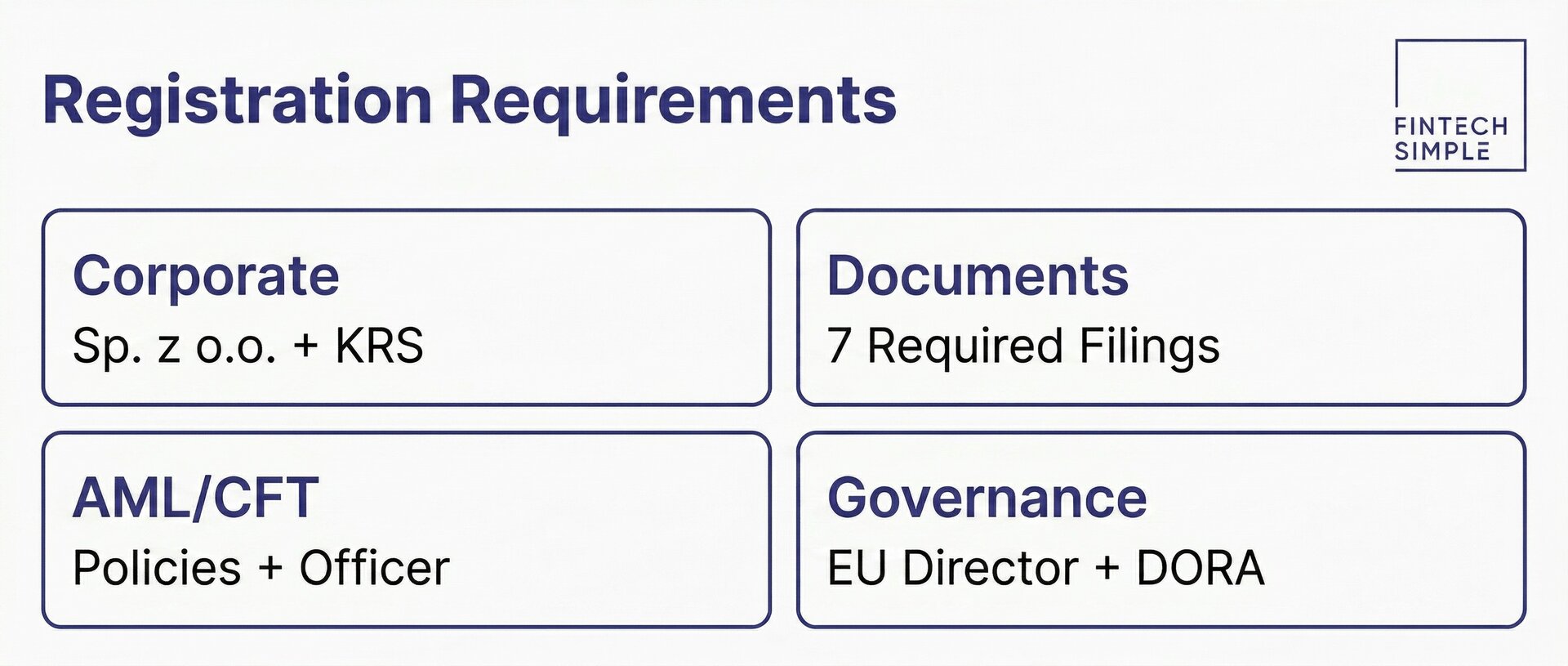
Infographic showing the four requirement categories for registering a crypto company in Poland: corporate structure, required documents, AML/CFT compliance, and staff and governance

Corporate Structure (Sp. z o.o.)

Most applicants incorporate as a Spółka z ograniczoną odpowiedzialnością (Sp. z o.o.) — the Polish equivalent of a limited liability company. This structure meets the legal-entity requirement and is well understood by Polish authorities. Key parameters:

  • Minimum share capital — PLN 5,000 (approximately €1,200). Capital must be fully paid up before you apply. This figure is low by EU standards, but regulators look closely at whether the business has enough working capital to operate compliantly, so budget well beyond the statutory minimum.
  • Registered address — a genuine Polish address is required. A virtual office at a reputable provider in Warsaw or Kraków satisfies this rule, provided mail can be received and inspectors can visit the premises.
  • KRS registration — the company must be entered in the National Court Register (Krajowy Rejestr Sądowy) before submitting the VASP application. KRS registration typically takes 7–14 days when filed electronically through the S24 portal.
  • Legal entity requirement — sole traders (jednoosobowa działalność gospodarcza) cannot hold the crypto license. You need a capital company — Sp. z o.o. or S.A.

Required Documents

The application file must be complete on first submission. Missing documents do not pause the clock — they restart it. Prepare the following before you file:

  • Articles of association (Umowa spółki) — notarised or filed electronically via S24, listing crypto activities in the company’s objects clause.
  • KRS extract — current printout from the National Court Register, dated no earlier than three months before submission.
  • UBO declarations — each beneficial owner holding 25% or more must submit a signed declaration identifying themselves and confirming the accuracy of beneficial ownership data.
  • Criminal record certificates — required for each board member, proxy, and UBO. Polish nationals obtain this from the National Criminal Register (KRK); foreign nationals must obtain an equivalent certificate from their country of residence and have it apostilled or legalised.
  • Proof of share capital payment — a bank statement or notarial confirmation showing the PLN 5,000 (or higher amount stated in the articles) has been deposited into the company account.
  • Business plan — a substantive document, typically 15–30 pages, covering the services offered, target markets, revenue model, IT infrastructure, and projected financials for the first two years. Regulators reject plans that are generic or copied.
  • IT security policy — a written policy describing how client assets and data are protected, including wallet custody arrangements, access controls, encryption standards, and incident response procedures. This document feeds directly into DORA compliance (see Staff and Governance below).

AML/CFT Compliance

Poland’s AML Act places crypto firms in the same category as banks and payment institutions for most compliance obligations. The framework is detailed and enforced — the Financial Intelligence Unit (GIIF) can and does audit registered VASPs.

  • Internal AML/CFT policies — written procedures covering customer due diligence (CDD), enhanced due diligence (EDD) for high-risk clients, politically exposed persons (PEP) screening, and sanctions list checks. Policies must be reviewed and updated at least annually.
  • Designated AML officer — you must appoint a named individual responsible for AML compliance before registration. This person does not need to be Polish but must be reachable by GIIF and must have demonstrable AML experience. The officer’s CV and qualifications are reviewed as part of the application.
  • Risk assessment — a documented, jurisdiction-specific risk assessment covering the services offered, client types, delivery channels, and geographic exposure. The assessment must follow the methodology set out in the AML Act and reference the national risk assessment published by the Polish government.
  • Suspicious transaction reporting threshold — transactions at or above €15,000 (or equivalent in PLN or crypto) trigger enhanced due diligence. Suspicious transactions of any value must be reported to GIIF within 24 hours of detection. Automated monitoring tools are not legally required but are effectively necessary at any meaningful transaction volume.
  • Record retention — KYC documents, transaction records, and STR logs must be retained for five years from the date of the transaction or the end of the business relationship.

MiCA note

Poland will implement the Markets in Crypto-Assets Regulation (MiCA) on the standard EU timeline. Firms registered under Polish national law before MiCA’s full application date benefit from a transitional period, but must begin aligning policies and disclosures with MiCA requirements now to avoid disruption.

Staff and Governance

Poland’s VASP requirements do not set a headcount minimum, but the quality and residency of key personnel are examined during the application review and any subsequent audits.

  • EU/EEA-resident director — at least one board member must be resident in the EU or EEA and available to attend meetings with regulators on short notice. This is a practical expectation rather than an explicit statutory requirement, but applications with fully offshore management structures face heightened scrutiny.
  • Fit and proper assessment — directors and senior managers must demonstrate that they have not been convicted of financial crimes, fraud, money laundering, or terrorism financing offences. The criminal record certificates serve as the primary evidence. Regulators also review professional backgrounds for relevant experience.
  • Compliance officer — distinct from the AML officer (though one person can hold both roles if the firm is small enough), the compliance officer is responsible for ongoing regulatory monitoring, filing obligations, and internal audit. The role must be resourced sufficiently to handle the firm’s actual transaction volumes.
  • DORA compliance — the Digital Operational Resilience Act applies to crypto-asset service providers from January 2025. This requires a documented ICT risk management framework, business continuity and disaster recovery plans, regular resilience testing, and a process for reporting major ICT-related incidents to the KNF within defined timeframes. The IT security policy in your application file is the starting point; DORA requires it to be operationalised and tested on a recurring basis.

How to Get a Crypto License in Poland: Step-by-Step

The full process from initial planning to live operations takes 4–6 months when managed end to end. Below is the step-by-step sequence our team follows to take you from entity setup through KNF authorization and into compliant operations.

Step 1 Week 1

Initial Assessment & Entity Planning

What we do: We review your business model, map your intended crypto activities to the correct CASP service categories under the Polish AML Act and MiCA, and determine the optimal corporate structure before any paperwork is filed.

  • Activity scoping — exchange, custody, transfer, or a combination; each carries distinct compliance requirements
  • Shareholder & director review — we identify any fit-and-proper issues early so they don’t stall the KNF application later
  • Capital & cost planning — we confirm the share capital needed and project total setup costs including state fees
Step 2 Weeks 2–5

Company Registration: Sp. z o.o. Formation

What we do: We register your Polish limited liability company (Sp. z o.o.) with the National Court Register (KRS), set up a registered office address in Poland, obtain the NIP and REGON tax identifiers, and confirm that share capital of at least PLN 5,000 is in place. For CASP applicants, the registered address in Poland is a hard requirement. We arrange a compliant solution if you don’t yet have Polish premises.

  • Deed of incorporation — notarized or via the S24 online system depending on structure
  • KRS filing & registration — typically confirmed within 1–5 working days via S24
  • Registered address — compliant Polish office address, confirmed with KNF-acceptable documentation
Step 3 Months 1–3

AML/KYC Policy Development

What we do: We draft the full AML/CFT policy suite required under Polish anti-money laundering law and the KNF authorization criteria. This is the most document-intensive part of the process and runs in parallel with company formation and bank account opening.

  • AML/CFT policy — tailored to your specific CASP activities, covering customer due diligence, enhanced due diligence, and transaction monitoring
  • Risk assessment — business-wide and product-level risk matrices as required by the Polish AML Act
  • KYC procedures — onboarding workflows, identity verification standards, and ongoing monitoring rules
  • AML officer appointment — we prepare the appointment documentation for a designated compliance officer, a mandatory role under Polish law
  • Internal controls framework — record-keeping, training plan, and suspicious transaction reporting procedures
Step 4 Weeks 3–6

Corporate Bank Account Opening

What we do: We apply to 2–3 crypto-friendly Polish banks in parallel to secure a corporate account for your entity. Running this in parallel with AML development and KRS registration saves 3–4 weeks overall. Polish banks have tightened crypto onboarding requirements, so applying to multiple institutions at once improves your chances of a timely account opening.

  • Bank shortlisting — we select institutions with a history of onboarding VASP/CASP clients in Poland
  • Application package — we prepare business plans, UBO declarations, and AML summaries in the format each bank requires
  • Follow-up management — we handle information requests from bank compliance teams directly
Step 5 25 working days

CASP Application to KNF

What we do: We compile and submit the complete CASP authorization application to KNF. The submission package must meet KNF’s formal completeness checklist; an incomplete file is returned and resets the clock. We review every document before submission to avoid that outcome.

  • Application form — KNF-standard CASP authorization form, fully completed
  • Corporate documentation — KRS extract, articles of association, shareholder register, UBO declarations
  • AML policy package — all policies developed in Step 3, formatted for KNF review
  • Capital proof — bank statement confirming share capital is fully paid up
  • State fee payment — we calculate and confirm the correct application fee before submission
Step 6 60 working days

KNF Review & Authorization

What we do: We act as the primary point of contact with KNF during the review period. KNF has a statutory 60 working days to issue a decision once the file is confirmed complete, though current backlog can extend this. We monitor the file, respond to information requests promptly, and keep you updated at each stage.

  • KNF correspondence — we draft and submit responses to any queries within the timeframes KNF sets
  • Document supplements — if KNF requests additional evidence or clarifications, we prepare them promptly
  • Decision receipt — once KNF issues the CASP authorization, we obtain the official decision document and explain its conditions
Step 7 Ongoing

Post-Authorization & Operationalization

What we do: We support you through the transition from authorization to live operations. A KNF crypto license carries ongoing obligations; we make sure none are missed in the first months.

  • KNF supervisory fee — we calculate the annual fee due to KNF and set up the payment process
  • Regulatory reporting — we establish the reporting schedule and templates for periodic KNF submissions
  • DORA compliance — for entities in scope, we initiate the Digital Operational Resilience Act framework covering ICT risk management and incident reporting
  • MiCA transition readiness — if you hold a prior VASP registration, we advise on the grandfathering timeline and any gap actions needed for full MiCA authorization
  • Ongoing AML monitoring — we review and update your AML policies annually or when regulations change

Let Us Handle Your Poland Crypto License Application

From entity setup to KNF authorization, our team manages every step of your Poland CASP application.

Crypto License in Poland: Full Cost Breakdown

Before committing to a poland crypto license, you need a realistic number to put in your budget. Most guides list one or two fees and leave the rest vague. Below are the actual figures — one-time government fees, capital requirements, and ongoing costs — so you can model a complete first-year spend. All PLN figures use an approximate rate of 1 EUR ≈ 4.25 PLN.

Government & Regulatory Fees

Poland operates a two-tier registration system. Pre-MiCA, you file with the VASP register maintained by the Director of the Tax Administration Chamber in Katowice. Under the incoming MiCA regime, supervised by the Polish Financial Supervision Authority (KNF), you submit a formal CASP authorisation application. Both fees apply if you are in the transition window and need current registration while your CASP application is pending.

Fee ItemAmountPayable To
CASP authorisation application (MiCA) €4,500 KNF
Company registration (Sp. z o.o.) PLN 250–500 (approx. €60–120) National Court Register (KRS)

The €4,500 CASP application fee is set under MiCA implementing rules — this figure is not widely publicised by competitors but is confirmed in KNF guidance. Company registration via the S24 online system costs PLN 250; the paper route runs up to PLN 500.

Capital Requirements

MiCA Article 67 sets minimum own funds thresholds by service category. The capital must be paid in and held — it is not a fee you pay and lose; it stays on your balance sheet. However, it is real cash you cannot deploy until regulatory conditions are met.

CASP Service CategoryMinimum Own Funds
Class 1 — Advisory, order reception, placement, transfer services, portfolio management €50,000
Class 2 — Adds custody and administration, crypto-to-fiat and crypto-to-crypto exchange €125,000
Class 3 — Adds operation of a trading platform €150,000

A standard exchange covering custody, fiat-to-crypto conversion, and crypto-to-crypto trading typically falls into Class 2, requiring €125,000 locked on the balance sheet at authorisation. Plan your funding round with this figure as a hard floor.

Ongoing Costs

One-time fees are the smaller problem. The recurring costs below repeat every year and scale with your revenue. Budget for all of them from day one.

Cost ItemAnnual EstimateNotes
KNF supervisory fee 0.1% of annual gross revenue Charged by KNF to all supervised CASPs; scales with your top line
AML compliance officer & programme €15,000–40,000 In-house AML officer salary or outsourced compliance retainer; mandatory under AMLD6 and KNF expectations
Annual statutory audit €8,000–20,000 Required once revenue or assets cross statutory thresholds; budget from year one if you expect growth
Registered office & local director €3,000–8,000 Poland requires a genuine local presence; a virtual address alone does not satisfy KNF
Legal & regulatory updates €5,000–15,000 MiCA is a living framework; ongoing counsel is prudent as KNF issues guidance

The KNF supervisory fee is the figure most guides omit entirely. At 0.1% of gross revenue, it becomes material as you scale: a business turning €10 million per year pays €10,000 to the regulator annually, on top of all other costs.

Total First-Year Estimate

The table below combines all categories for a Class 2 CASP (the most common profile for a crypto exchange). “Cash out” shows money you spend and do not get back. “Capital lock-up” shows money that stays on your balance sheet.

CategoryLow EstimateHigh EstimateType
CASP application fee (KNF) €4,500 €4,500 Cash out
Company registration €60 €120 Cash out
AML compliance (Year 1) €15,000 €40,000 Cash out
Statutory audit €8,000 €20,000 Cash out
Registered office & director €3,000 €8,000 Cash out
Legal & regulatory counsel €5,000 €15,000 Cash out
KNF supervisory fee 0.1% of revenue 0.1% of revenue Cash out (recurring)
Minimum own funds (Class 2) €125,000 €125,000 Capital lock-up

Cash out total (Year 1, excl. supervisory fee): approximately €35,560–87,620. Add the KNF supervisory fee on top based on your revenue projection. Add €125,000 in capital that must sit on the balance sheet.

Note on professional fees

The figures above cover government and compliance costs only. If you engage a licensing firm to manage the CASP application — document preparation, KNF liaison, AML policy drafting — add service fees on top. Working with experienced counsel reduces the risk of rejection and resubmission, which costs more time and money than the fee itself.

Taxation for Crypto Companies in Poland

Poland applies standard EU-aligned corporate and personal tax rules to crypto businesses, with a few crypto-specific provisions that can significantly affect your bottom line. The Ministry of Finance treats crypto-asset income under existing income tax legislation rather than a separate digital-asset tax code, so CASPs and their shareholders are taxed through the same framework as any other Polish company — with rates, exemptions, and employer costs that you need to budget for before committing to a Poland crypto license.

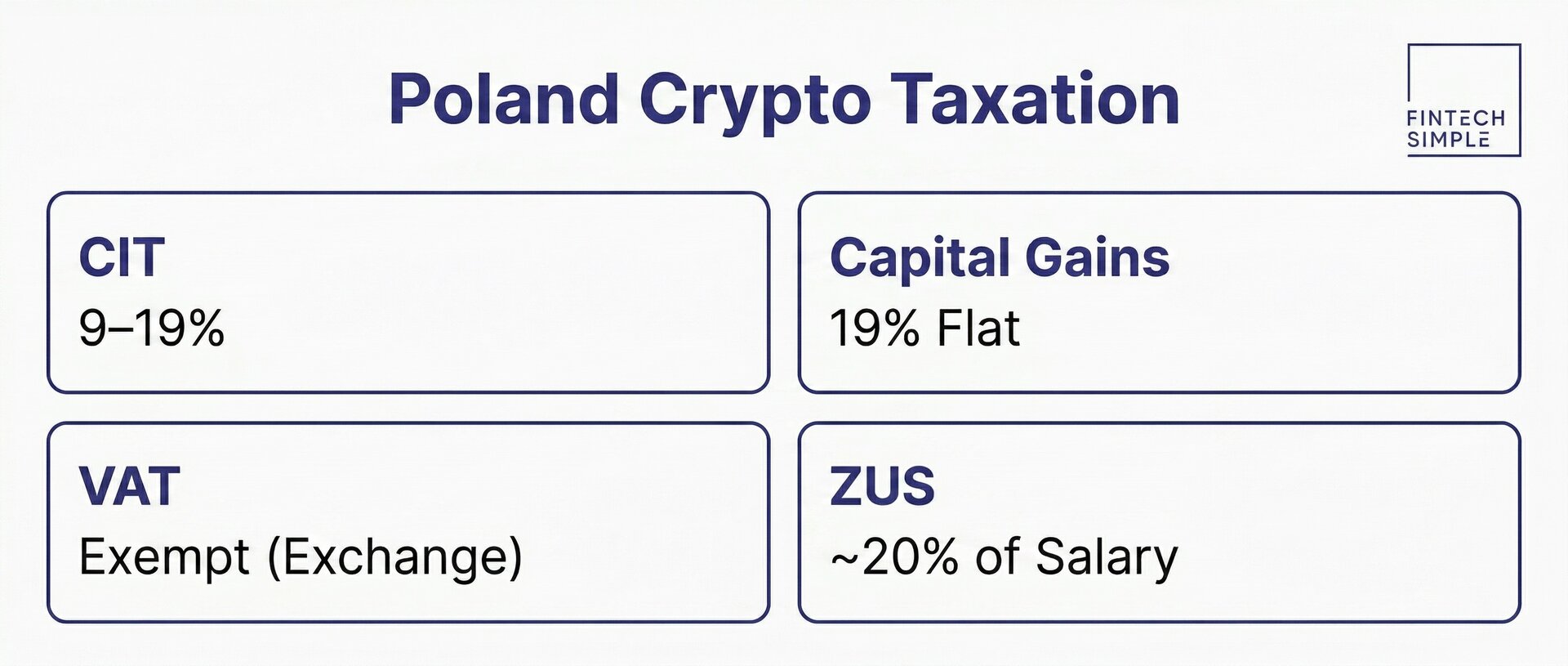
Infographic illustrating the four main tax categories for crypto companies in Poland: CIT, PIT capital gains, VAT, and ZUS employer costs
Tax TypeRateNotes
CIT (Corporate Income Tax)9–19%9% for companies with annual revenue below €2 million; 19% standard rate above that threshold.
PIT Capital Gains19%Flat rate on net gains from disposal of crypto-assets by individuals. Tax arises only on conversion to fiat.
VATExempt / 23%Crypto-to-fiat exchange exempt under CJEU Hedqvist ruling; other crypto services may attract the standard 23% rate.
ZUS (Social Security)~20% employerMandatory employer contributions for all employees on Polish employment contracts; founders on management boards may be exempt.

Corporate Income Tax (CIT)

Poland levies CIT at a standard rate of 19% on net profits. However, companies whose annual revenue does not exceed €2 million qualify for a preferential 9% CIT rate — one of the lowest headline rates in the EU and a significant advantage for early-stage crypto businesses that are still scaling. The €2 million threshold is assessed on gross revenue (przychody), not profit, so a high-revenue, low-margin exchange could lose access to the preferential rate faster than a custody-focused CASP with lower transaction volumes.

Crypto-to-crypto exchanges are not a taxable event for CIT purposes in Poland. Tax arises only when crypto-assets are converted to fiat currency or used to pay for goods and services. This means a CASP can rebalance reserves, accept crypto payments from clients, and hold digital assets on its balance sheet without triggering a CIT liability until a fiat conversion occurs. Deductible costs include acquisition price of crypto-assets, transaction fees, licensing and compliance expenses, office rent, and staff salaries — standard business expense rules apply.

Personal Income Tax & Capital Gains

Individual shareholders, founders, and employees who hold or trade crypto-assets in their personal capacity are subject to a flat 19% capital gains tax on net profits from the disposal of virtual currencies. “Disposal” means conversion to fiat, payment for goods or services, or exchange for a non-crypto asset. As with CIT, crypto-to-crypto swaps are not a taxable event for individuals — tax is deferred until fiat conversion.

Gains and losses from crypto transactions are reported in the annual PIT-38 tax return, filed by 30 April of the following year. Losses from crypto trading can be offset against crypto gains in the same tax year but cannot be carried forward to future years or offset against other categories of income (e.g., employment income or rental income). This is a meaningful restriction for traders who experience a loss year followed by a profitable year.

For CASP founders drawing a salary through a Polish employment contract, standard progressive PIT rates apply to that salary income: 12% on the first PLN 120,000 and 32% above that threshold. Dividends paid from a Polish Sp. z o.o. to individual shareholders are subject to a flat 19% withholding tax, though the EU Parent-Subsidiary Directive may eliminate withholding on dividends paid to qualifying EU corporate parents.

VAT Treatment

Crypto-to-fiat exchange services are exempt from Poland’s standard 23% VAT under the EU VAT Directive, following the CJEU’s landmark Hedqvist ruling (Case C-264/14), which classified virtual currency exchange as a financial service. The exemption applies to the exchange service itself — i.e., the act of converting crypto-assets to fiat and vice versa — and covers both the CASP’s own exchange operations and white-label exchange services provided to third parties.

Other crypto-asset services do not automatically benefit from the VAT exemption. Custody fees, portfolio management charges, advisory fees, and subscription-based access to trading platforms may be subject to the standard 23% VAT rate, depending on how the Polish tax authorities classify the service. The distinction turns on whether the service constitutes a “financial transaction” under Article 43(1)(7) of the Polish VAT Act — a question that requires case-by-case analysis for bundled service offerings.

CASPs providing cross-border services within the EU must also manage VAT reverse-charge rules for B2B transactions and may need to register for VAT OSS (One Stop Shop) for B2C digital services delivered to consumers in other member states. Getting VAT treatment wrong can result in retrospective assessments plus interest, so we recommend obtaining a binding VAT ruling (interpretacja indywidualna) from the Director of the National Tax Information Office (KIS) before launching any service that is not a straightforward crypto-to-fiat exchange.

Employer Costs (ZUS)

Any CASP employing staff on Polish employment contracts (umowa o pracę) must pay mandatory social security contributions to ZUS (Zakład Ubezpieczeń Społecznych). The employer’s share of ZUS contributions adds approximately 20% on top of the gross salary, covering pension, disability, accident insurance, and the Labour Fund. For a senior compliance officer earning PLN 15,000 gross per month, the employer pays roughly PLN 3,000 in additional ZUS contributions.

  • Pension insurance (emerytalne) — 9.76% employer share, calculated on gross salary up to the annual cap (30× the forecast average monthly salary, approximately PLN 260,000 in 2026).
  • Disability insurance (rentowe) — 6.50% employer share, same salary cap as pension.
  • Accident insurance (wypadkowe) — 0.67%–3.33% depending on the company’s risk category; office-based CASPs typically pay 0.67%.
  • Labour Fund + FGSP (Fundusz Pracy + Fundusz Gwarantowanych Świadczeń Pracowniczych) — 2.45% employer share, mandatory for most employers.

Founders and board members who do not have a separate employment contract but serve on the management board under a corporate appointment (powołanie) are generally not subject to ZUS contributions on their board remuneration. This is a common structure for CASP founders who want to minimize social security costs while drawing a management fee. However, if the same person also has an employment contract with the company, ZUS applies to the employment income regardless of the board appointment.

An alternative used by many tech and crypto companies in Poland is the civil-law contract (umowa zlecenie) for contractors and part-time staff. ZUS contributions apply to zlecenie contracts as well, but the rates and caps differ slightly. For international hires working remotely from outside Poland, ZUS obligations generally do not apply — but the CASP must verify the employee’s social security status under EU coordination rules (Regulation EC 883/2004) or bilateral agreements to avoid double contributions.

Penalties and Enforcement

Polish authorities enforce crypto regulation through two parallel frameworks: the domestic Virtual Asset Service Provider (VASP) regime under the AML Act, and the EU-wide Markets in Crypto-Assets Regulation (MiCA) applied by the Komisja Nadzoru Finansowego (KNF). Violations can trigger administrative fines, criminal charges, or both — depending on the nature and severity of the breach. The table below maps each category of violation to its corresponding sanction.

Violation CategoryLegal BasisMaximum Penalty
VASP administrative violations AML/CFT Act (Dz.U. 2018 poz. 723) Up to 100,000 PLN per breach
CASP violations under MiCA MiCA Regulation (EU) 2023/1114, Art. 111–114 €5,000,000 or 10% of annual turnover (higher applies)
AML criminal liability AML/CFT Act, Penal Code provisions 3 months to 5 years imprisonment
KNF supervisory measures KNF Act; MiCA Art. 94 Activity suspension or license revocation

VASP violations cover failures under the domestic AML/CFT regime — for example, operating without registration, failing to perform customer due diligence, or not filing suspicious transaction reports with the General Inspector of Financial Information (GIIF). KNF may impose an administrative fine of up to 100,000 PLN per individual breach, and fines can accumulate across multiple simultaneous violations.

CASP violations under MiCA apply from the date MiCA became fully applicable. KNF, acting as the competent authority designated under MiCA Article 93, can impose fines of up to €5,000,000 on legal persons, or up to 10% of total annual turnover — whichever figure is higher. For natural persons, the ceiling is €700,000. Aggravating factors include repeat offences, intentional conduct, and harm caused to clients.

AML criminal liability targets the most serious breaches — deliberately facilitating money laundering or terrorist financing through a crypto business. Conviction carries a custodial sentence ranging from 3 months to 5 years. Prosecutors can pursue individuals at the director or beneficial-owner level, not just the entity.

KNF enforcement powers extend beyond fines. The regulator can suspend a CASP’s authorisation, prohibit it from onboarding new clients, require it to cease specific activities, or revoke the licence entirely. KNF also publishes enforcement decisions on its website, creating significant reputational exposure alongside the financial penalty. Any business operating in Poland — or passporting into Poland under MiCA — should treat KNF’s supervisory capacity as a live operational risk.


Statutory reference

The foundational domestic text is the Act of 1 March 2018 on Counteracting Money Laundering and Terrorist Financing (Dz.U. 2018 poz. 723), which established the VASP register and set out the 100,000 PLN administrative fine regime. MiCA penalties are applied directly under EU law, with KNF as the designated competent authority.

Post-Licensing Compliance and Reporting

Obtaining CASP authorization from KNF is the starting point, not the finish line. Once authorized, your entity falls under continuous KNF supervision and must comply with Poland’s AML Act (implementing AMLD5 and the incoming AMLD6 provisions), MiCA’s ongoing prudential and conduct-of-business rules, and EU-level frameworks including DORA and the Travel Rule. Failure to meet reporting deadlines or supervisory requests can trigger enforcement action, fee penalties, or suspension of your authorization.

Reporting Obligations

CASP-authorized entities in Poland must submit periodic reports to both KNF and GIIF (General Inspector of Financial Information). The reporting calendar covers financial, prudential, and AML dimensions:

  • Annual financial statements — audited accounts must be filed with KNF within the timeframe set by the Polish Accounting Act, typically within six months of the financial year-end
  • Capital adequacy reports — quarterly submissions demonstrating that own funds remain above the MiCA minimum (€50,000–€150,000 or one quarter of fixed overheads, whichever is higher)
  • Suspicious transaction reports (STRs) — filed with GIIF without delay whenever a transaction or attempted transaction raises AML/CFT concerns, regardless of value
  • Above-threshold transaction reports — transactions of €15,000 or more must be reported to GIIF, including linked transactions that cumulatively reach the threshold
  • Annual AML risk assessment update — the business-wide risk assessment must be reviewed and updated at least annually, with the revised version available for KNF or GIIF inspection on request

Missing a reporting deadline does not trigger an automatic grace period. KNF can impose administrative fines for late or incomplete submissions, and repeated failures may lead to a formal supervisory review of your authorization status.

Travel Rule & OECD CARF

  • FATF Travel Rule — CASPs must transmit originator and beneficiary information with every crypto-asset transfer. For transfers between two CASPs, the originator’s name, account number, and address (or national identity number or date and place of birth) must accompany the transaction. Poland enforces this under the EU Transfer of Funds Regulation (TFR), which applies directly alongside MiCA
  • OECD Crypto-Asset Reporting Framework (CARF) — Poland has committed to implementing OECD CARF, which requires CASPs to collect and report tax-relevant information on customers’ crypto-asset transactions to Polish tax authorities, who then exchange data with other participating jurisdictions. First reporting periods are expected from 2027
  • Unhosted wallet due diligence — transfers to or from wallets not hosted by a regulated CASP require enhanced due diligence measures, including verifying whether the customer controls the wallet and assessing the risk profile of the transaction before processing

The Travel Rule and CARF create parallel data-collection obligations. Building a single compliance infrastructure that satisfies both frameworks from the outset avoids costly retrofitting when CARF reporting goes live.

Ongoing Supervision

KNF exercises continuous supervision over all CASP-authorized entities. Supervision is risk-based: entities with higher transaction volumes, more complex service offerings, or prior compliance issues receive more frequent attention. Key supervisory touchpoints include:

  • KNF supervisory fee — CASPs pay an annual supervisory fee to KNF, calculated as a percentage of revenue (proposed at 0.1% under the latest draft legislation). The fee funds KNF’s ongoing oversight activities and is due within the deadline set by KNF each year
  • On-site and off-site inspections — KNF may conduct inspections at any time, with or without advance notice. Inspections typically cover AML compliance, capital adequacy, governance arrangements, and complaints handling. Entities must provide full access to records, systems, and personnel
  • DORA compliance — the Digital Operational Resilience Act (EU 2022/2554) requires CASPs to maintain ICT risk management frameworks, report major ICT-related incidents to KNF, conduct regular digital resilience testing, and manage third-party ICT provider risks. Smaller CASPs benefit from a simplified regime but are not exempt
  • Sanctions screening — CASPs must screen all customers and counterparties against EU, Polish, and UN sanctions lists before onboarding and on an ongoing basis. Matches must be escalated and, where confirmed, transactions frozen and reported to GIIF
  • Record retention — all transaction records, customer identification data, risk assessments, and internal correspondence related to compliance must be retained for a minimum of five years after the end of the business relationship or the date of the transaction, whichever is later

KNF publishes enforcement decisions and supervisory expectations on its website. Staying current with these publications is part of the compliance obligation — ignorance of a published supervisory position is not a defence in enforcement proceedings.

Ongoing compliance support

Post-licensing compliance is where most operators underestimate the workload. Fintech Simple offers retainer-based compliance packages covering KNF reporting, AML policy updates, DORA framework maintenance, and Travel Rule implementation. We keep your entity in good standing so you can focus on building the business.

Crypto License Comparison: Poland vs. Key Alternatives

Many guides describe Poland as “affordable” without defining what that means in practice. The table below puts actual numbers side by side so you can evaluate the poland crypto license on its real merits—and identify where a competing jurisdiction outperforms it.

JurisdictionMin. CapitalTimelineGovt FeeCIT RateKey Advantage
Poland €50,000–150,000 4–6 months €4,500 9–19% Largest CEE market + EU passport
Lithuania €50,000–150,000 3–6 months €5,200 15% Fastest MiCA processing in Baltics
Czech Republic €50,000–150,000 4–8 months €3,000 19% Established crypto-friendly ecosystem
Estonia €50,000–150,000 6–12 months €10,000 0% on retained earnings 0% CIT on retained profits

Note

Minimum capital figures reflect the range across CASP service categories under MiCA. The applicable threshold for your business depends on which crypto-asset services you intend to provide. All four jurisdictions grant EU passporting rights under MiCA once authorised.

Poland vs. Lithuania

Poland holds an edge over Lithuania on government fees (€4,500 vs. €5,200) and on market access: Poland's 38 million consumers represent one of the largest retail crypto markets in Central and Eastern Europe, whereas Lithuania's domestic market is roughly 2.8 million people. If your business model depends on local customer volume or local banking relationships, Poland is the stronger base.

Lithuania wins on one dimension that matters to some operators: it has processed more MiCA transitional applications than any other Baltic state and its Bank of Lithuania runs a dedicated RegTech sandbox. If you need rapid MiCA authorisation and your team already has Lithuania-based infrastructure, the shorter average processing window in Vilnius may outweigh Poland's cost advantage. The €700 fee difference alone does not justify a jurisdiction switch—but processing speed might.

Poland vs. Czech Republic

The Czech Republic charges the lowest government fee of the four jurisdictions at €3,000, which is €1,500 less than Poland. That saving is real, though it is a one-time cost rather than an ongoing structural advantage. On CIT, the Czech flat rate of 19% is higher than Poland's small-business rate of 9% (available to companies with annual revenue below PLN 2 million, roughly €450,000). Businesses that qualify for the 9% rate will save meaningfully on tax year over year—outweighing the upfront fee difference within the first operating year.

Where the Czech Republic legitimately wins: timeline certainty. Czech authorities have a well-established track record with crypto registrations predating MiCA, which means more predictable processing and a mature legal services ecosystem around crypto compliance. If your legal team has existing Czech relationships or your target market skews toward Central European exchanges and payment corridors, the Czech Republic is a defensible choice—not merely a consolation option.

For a casp license poland application, the combination of Poland's market size, the 9% CIT option, and the EU passport under MiCA gives it a stronger overall profile for most operators. But businesses prioritising upfront cost minimisation over ongoing tax efficiency should run the numbers for their specific revenue projections before committing.

Need Expert Guidance on Polish Crypto Licensing?

From initial assessment to post-licensing compliance, our team supports you at every stage of your Poland crypto license.

Frequently Asked Questions about Crypto License in Poland

What is a crypto license in Poland?

Poland requires CASP authorization under MiCA (Markets in Crypto-Assets Regulation) for all crypto-asset service providers operating in the country. This replaced the former VASP register, which closed to new entries on 30 December 2024. CASP authorization is issued by KNF (Komisja Nadzoru Finansowego) and grants EU-wide passporting rights across all 27 member states. Existing VASPs must convert to CASP authorization by 1 July 2026 or cease operations.

How much does a crypto license in Poland cost?

The KNF application fee is €4,500. You also need between €50,000 and €150,000 in minimum share capital depending on your CASP class, plus company registration costs of PLN 250 via the S24 online portal. Total first-year costs including legal preparation, AML policy development, and professional fees typically range from €60,000 to €170,000. Annual ongoing compliance costs add a further €15,000–40,000 depending on the size and complexity of your operation.

How long does it take to get a crypto license in Poland?

Realistically, the process takes 4–6 months from start to authorization. Company registration in Poland takes 3–4 weeks, AML policy and documentation development takes 2–3 months, and KNF then has 25 working days for a completeness check followed by 60 working days for substantive review under MiCA Article 63. If KNF requests additional information during review, the clock pauses and restarts, adding further time. Applicants should budget 6 or more months if KNF is experiencing a processing backlog.

What is the minimum capital requirement for a CASP license in Poland?

MiCA sets three capital tiers based on the services you offer: €50,000 for Class 1 (order execution, placement, transfer services, reception and transmission, advice, portfolio management), €125,000 for Class 2 (adds custody and administration, crypto-to-fiat and crypto-to-crypto exchange), and €150,000 for Class 3 (adds trading platform operation). The actual requirement is the higher of the fixed amount or one quarter of the previous year’s fixed overheads. Capital must be held in liquid assets free of encumbrances.

Can a foreign company get a crypto license in Poland?

Yes, but you must establish a Polish legal entity, typically a Sp. z o.o. (limited liability company), with a minimum share capital of PLN 5,000. At least one director must be an EU or EEA resident and must demonstrate relevant professional qualifications and a clean criminal record. The entire setup process can be managed remotely with the assistance of a local law firm or licensing consultant. Non-EEA owners may hold shares, but the management structure must satisfy KNF’s fit-and-proper requirements.

What is the difference between VASP and CASP in Poland?

VASP (Virtual Asset Service Provider) registration was the old system under Poland’s AML Act, supervised by KAS Katowice with a minimal capital requirement of PLN 5,000 and limited ongoing obligations. CASP (Crypto-Asset Service Provider) authorization is the new MiCA-based regime supervised by KNF, requiring €50,000–€150,000 in capital and granting passporting rights across the EU. The CASP framework introduces stricter governance, AML, and prudential requirements. VASP registration does not confer any CASP rights.

What happens to existing VASPs after 1 July 2026?

All existing VASPs must obtain CASP authorization from KNF by 1 July 2026 or permanently cease providing crypto-asset services. The VASP register closed to new entries on 30 December 2024; existing 1,298 registrations remain valid until the transition deadline. VASPs that continue operating without CASP authorization after the deadline face penalties under MiCA of up to €5 million or 12.5% of annual turnover. Businesses that began the CASP application process before the deadline may benefit from a transitional period at KNF’s discretion, but this is not guaranteed.

Does a Poland crypto license allow EU-wide operations?

Yes. A CASP authorization issued by KNF grants passporting rights across all 27 EU member states and EEA countries, giving your business access to over 450 million consumers without separate registrations in each country. To passport into another member state, you notify KNF, which forwards the notification to the host regulator. Under Article 65, a CASP may begin cross-border operations after the home NCA forwards the notification to the host regulator, which must happen within 15 working days of submission, and the host country cannot impose additional authorization requirements on a passported CASP.

What is the CIT rate for crypto companies in Poland?

Poland applies a standard corporate income tax (CIT) rate of 19% on net profits. Companies with annual revenue below €2 million qualify for a preferential 9% CIT rate, which roughly halves the tax bill for early-stage crypto businesses. Crypto-to-crypto exchanges are not a taxable event in Poland; tax arises only upon conversion to fiat currency. Profits from crypto trading are reported under standard income calculation rules, with deductible costs including acquisition price, transaction fees, and licensing costs.

What are the AML requirements for crypto companies in Poland?

CASPs must implement documented AML/KYC policies, appoint a designated AML officer with appropriate qualifications, and conduct customer due diligence on all clients. Transactions above €15,000 require above-threshold reporting to GIIF, and suspicious transactions must be reported to GIIF without delay (General Inspector of Financial Information). These requirements apply under both Poland’s AML Act and MiCA. Annual AML risk assessments, staff training records, and transaction monitoring logs must be maintained and made available to KNF on request.

Who regulates crypto in Poland?

KNF (Komisja Nadzoru Finansowego, the Financial Supervision Authority) is the primary regulator for CASP-authorized entities, responsible for authorization, supervision, and enforcement under MiCA. GIIF (General Inspector of Financial Information) handles AML oversight and receives suspicious transaction reports. KAS Katowice managed the legacy VASP register but has no role in the new CASP framework. CASPs must report to both KNF and GIIF, as the two agencies have separate and non-overlapping mandates.

What activities require a CASP license in Poland?

MiCA defines ten crypto-asset service types that require CASP authorization: custody and administration of crypto-assets, operating a trading platform, exchanging crypto-assets for fiat currency, exchanging crypto-assets for other crypto-assets, executing orders on behalf of clients, placing crypto-assets, receiving and transmitting orders, providing advice on crypto-assets, portfolio management, and transfer services for crypto-assets on behalf of clients. Each service type falls under a specific CASP class determining your minimum capital obligation. You must hold authorization for every service type you provide. A single authorization does not cover unlisted activities.

What are the penalties for operating without a license?

Operating without VASP registration under Poland’s AML Act carried fines of up to PLN 100,000 per violation. Under MiCA, providing crypto-asset services without CASP authorization exposes a business to administrative penalties of up to €5 million or 12.5% of annual turnover, whichever is higher. AML violations can additionally result in criminal liability carrying sentences of 6 months to 8 years imprisonment (or 1 to 10 years in aggravated cases) under Article 299 of the Polish Penal Code. KNF publishes enforcement decisions publicly, so unlicensed operators face reputational damage on top of the fine.

Is crypto-to-fiat exchange VAT-exempt in Poland?

Yes. Crypto-to-fiat exchange services are exempt from Poland’s standard 23% VAT rate under the EU VAT Directive provisions applied following the CJEU Hedqvist ruling, which treats virtual currency exchange as a financial service. The exemption applies to the exchange service itself, not to ancillary fees or subscription charges, which may be subject to standard VAT. Other crypto services such as custody, portfolio management, and advice may be subject to standard VAT rates depending on their classification. Businesses should seek specific VAT advice before launching services.

What is DORA and does it apply to crypto companies in Poland?

DORA (Digital Operational Resilience Act, EU 2022/2554) applies to all CASP-authorized entities and has been mandatory since January 2025. It requires CASPs to implement an ICT risk management framework, establish incident reporting procedures, conduct regular digital resilience testing, and manage risks arising from third-party ICT providers. Smaller CASPs benefit from a simplified DORA regime with proportionate obligations, but no CASP is fully exempt. KNF can request evidence of DORA compliance during routine supervisory reviews.

Your Privacy

By clicking "Accept", you consent to the use of cookies and similar technologies on your device to improve site navigation, analyze usage, provide specific functionalities, and support our marketing initiatives. Cookies that are strictly necessary will always be active with this link.