Crypto License in Czech Republic: 2026 MiCA CASP Guide

Crypto License in Czech Republic: 2026 MiCA CASP Guide

The VASP regime is gone. In 2026, every Czech crypto business needs a MiCA CASP authorization from the Czech National Bank. Fintech Simple handles the full process end-to-end.

Since 2016, Fintech Simple has secured 500+ licenses for fintech, crypto, and payment businesses across the EU. Our Prague-based licensing team has walked clients through the Czech VASP era, the MiCA transition, and the new CASP regime under Digital Finance Act No. 31/2025 Coll. We know what the ČNB expects, where applications fail, and how to get your Class 1, 2, or 3 authorization approved the first time.

Marcin Mostowski — Czech CASP licensing lawyer at Fintech Simple
Marcin Mostowski
Lawyer, Czech & EU MiCA licensing

The End of VASP: Czech Crypto Licensing in 2026

Regulator

Czech National Bank (ČNB)

Min. capital

€50k – €150k

Timeline

5–10 months

EU passport

Yes (MiCA)

The Czech VASP grandfather regime expires on 1 July 2026. Every crypto-asset service provider that operated under the old trade-licence (živnostenské oprávnění) registration before 30 December 2024 will lose the right to serve clients in the Czech Republic unless it secures authorisation as a Crypto-Asset Service Provider (CASP) under Regulation (EU) 2023/1114 (MiCA). The 18-month transition window under Article 143(3) MiCA closes on 1 July 2026.

The transposition vehicle is the Digital Finance Act, Act No. 31/2025 Coll., in force since 15 February 2025. It designates the Czech National Bank (ČNB) as the single competent authority for CASP authorisation, supervision, and enforcement, and supersedes the AML-only registration that the Financial Analytical Office (FAÚ) previously administered (FAÚ retains AML/CFT supervisory powers over CASPs). There is no longer a “light” Czech crypto registration — every crypto service must hold a ČNB CASP licence to operate in or passport into the country.

Under Section 26 of Act No. 31/2025, only incumbents that filed a complete CASP application with the ČNB by 31 July 2025 were allowed to continue operating under their legacy trade licence during the grandfathering window, which ends on 1 July 2026 (or earlier, if the ČNB has already decided the file). Operators that missed the 31 July 2025 filing deadline have lost grandfathering rights and may no longer legally provide crypto-asset services. New entrants must file a full MiCA CASP application from day one.

Bottom line

The Czech VASP transition ends on 1 July 2026. MiCA in the Czech Republic is no longer a future event — the CASP licence issued by the ČNB under Act 31/2025 is the only legal basis for providing crypto-asset services to Czech clients in 2026 and beyond.

Fintech Simple Packages & Pricing

We’ve developed two tailored options for obtaining a crypto license in the Czech Republic — choose the one that matches your existing regulatory status and business goals.

Notification for Licensed Firms €6,500
Company Registration + CASP License €19,500
Consultation & regulatory strategy
Documentation and translations in Czech and English
Submission, RFI handling, and continuous regulatory support
ČNB administrative fees included
Post-authorisation passporting support
Review of existing legal status & update of AML/ICT/governance framework
Article 60 notification dossier
Czech s.r.o. setup (incorporation, capital deposit, 1-year Prague address)
Full MiCA documentation pack (AML/CFT, ICT/DORA, governance, custody)
Fit-and-proper documentation and interview coordination
Notification for Licensed Firms €6,500
  • Consultation & regulatory strategy
  • Documentation and translations in Czech and English
  • Submission, RFI handling, and continuous regulatory support
  • ČNB administrative fees included
  • Post-authorisation passporting support
  • Review of existing legal status & update of AML/ICT/governance framework
  • Article 60 notification dossier
  • Czech s.r.o. setup (incorporation, capital deposit, 1-year Prague address)
  • Full MiCA documentation pack (AML/CFT, ICT/DORA, governance, custody)
  • Fit-and-proper documentation and interview coordination
Company Registration + CASP License €19,500
  • Consultation & regulatory strategy
  • Documentation and translations in Czech and English
  • Submission, RFI handling, and continuous regulatory support
  • ČNB administrative fees included
  • Post-authorisation passporting support
  • Review of existing legal status & update of AML/ICT/governance framework
  • Article 60 notification dossier
  • Czech s.r.o. setup (incorporation, capital deposit, 1-year Prague address)
  • Full MiCA documentation pack (AML/CFT, ICT/DORA, governance, custody)
  • Fit-and-proper documentation and interview coordination

Not included: permanent minimum capital under MiCA Annex IV (€50,000 / €125,000 / €150,000 depending on class), professional indemnity insurance under Article 67(4)(b), notary fees for incorporation and shareholder resolutions, sworn translations beyond standard Czech ↔ English documentation, statutory audit fees once thresholds are crossed under the amended Czech Accounting Act, and VAT (21%) where applicable.

Tariffs valid for engagements commencing 1 May 2026 – 31 December 2026.

Our Experts

Since 2016, our team has secured 500+ licenses for fintech and crypto businesses across 40+ jurisdictions. Three specialists lead every Czech CASP engagement end-to-end — from ČNB pre-meetings to authorization.

Patrik Asevičius
Patrik Asevičius Lawyer
Marcin Mostowski
Marcin Mostowski Lawyer, Czech & EU MiCA licensing
Ivo S.
Ivo S. Lawyer

Regulatory Framework & Competent Authorities

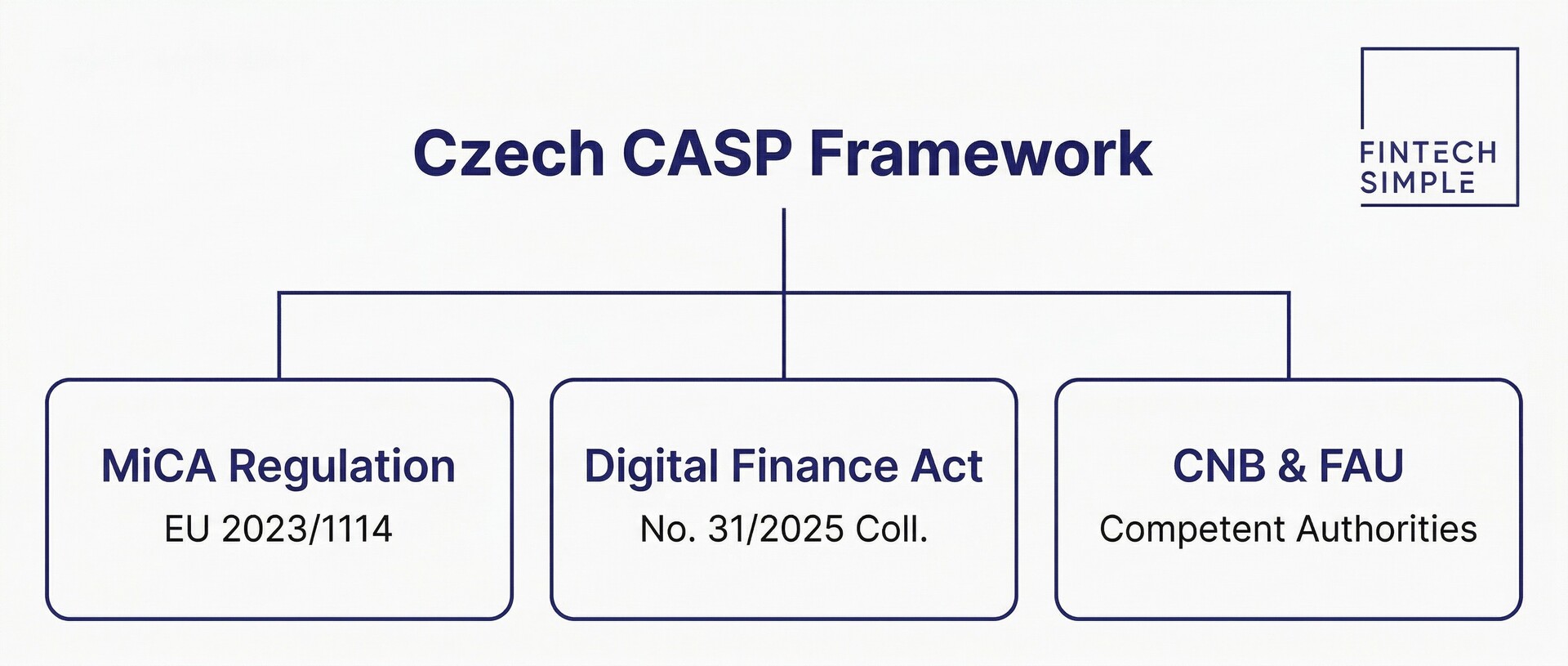
Czech CASP regulation sits on two pillars: directly applicable MiCA and the national Digital Finance Act No. 31/2025 Coll. The Česká národní banka (ČNB) authorises and prudentially supervises CASPs; the Financial Analytical Office (FAÚ) handles AML oversight.

Hierarchy diagram of Czech CASP regulatory framework pillars

MiCA Regulation (EU) 2023/1114

MiCA Title V governs CASP authorisation, governance, custody segregation, and conflict-of-interest management. Market abuse rules are addressed separately in Title VI. Under MiCA, a Czech-issued licence passports into all other EU Member States and EEA countries via the Article 65 notification procedure, without duplicate national authorisations. See the consolidated text on EUR-Lex and technical standards on the ESMA MiCA hub. See our MiCA licensing guide for the full framework.

Czech Digital Finance Act No. 31/2025 Coll.

Act No. 31/2025 Coll. entered into force in February 2025 and operationalises MiCA domestically. It designates the ČNB as the Article 93 competent authority, sets the administrative procedure for CASP applications, defines supervisory powers, and fixes sanctions for breaches. Full text: Zákony pro lidi.

Czech National Bank and FAÚ

The ČNB reviews CASP applications, assesses fit-and-proper of management and qualifying shareholders, and runs prudential supervision. Decisions follow the MiCA Article 63 timeline: a 25-working-day completeness check followed by a substantive assessment period of up to 40 working days (extendable in complex cases). AML supervision falls to the FAÚ under Act No. 253/2008 Coll., including Travel Rule enforcement under Regulation (EU) 2023/1113.

CASP License Classes: Which One Do You Need?

Under MiCA Article 67 and Annex IV, every CASP falls into one of three prudential tiers that set your minimum own funds based on the services you offer. Picking the wrong class forces a re-filing with ČNB and a capital top-up mid-growth.

ClassMin CapitalServices CoveredTypical Use Case
Class 1 ≥ €50,000 Execution of orders, reception & transmission of orders, placing of crypto-assets, transfer services, advice on crypto-assets, portfolio management Crypto advisors, robo-advisors, introducing brokers, execution-only brokers
Class 2 ≥ €125,000 Custody & administration of crypto-assets, exchange of crypto-assets for funds, exchange of crypto-assets for other crypto-assets, plus all Class 1 services Custodial wallets, OTC desks, fiat gateways
Class 3 ≥ €150,000 Operation of a trading platform for crypto-assets (requires separate authorisation for each additional service provided) Centralised crypto exchanges, order-book trading platforms

Class 1 — €50,000 Capital

Class 1 covers firms whose services do not involve holding client crypto or fiat: execution of orders on behalf of clients, reception and transmission of orders, placing of crypto-assets, transfer services, advice on crypto-assets, and portfolio management. Because no client property is at risk, ČNB applies a lighter operational-risk regime. Typical applicants: advisory boutiques, execution-only brokers, signal providers, and introducing brokers routing flow to a separately licensed venue.

Class 2 — €125,000 Capital

Class 2 adds three services to the Class 1 scope: custody and administration of crypto-assets, exchange of crypto-assets for funds, and exchange of crypto-assets for other crypto-assets. Any firm that holds client crypto or processes fiat-to-crypto conversions needs Class 2 at minimum. ČNB will expect segregated wallets, documented key-management, and a tested BCP. Typical applicants: custodial wallet providers, OTC desks, and fiat gateways into the EU.

Class 3 — €150,000 Capital

Class 3 is mandatory if you operate a trading platform for crypto-assets. The €150,000 capital floor covers the highest tier, but scope is not automatic — the CASP must be separately authorised for each service it intends to provide (e.g., a trading-platform operator that also offers custody must include custody in its application). Expect ČNB to scrutinise market-abuse surveillance, matching-engine resilience, pre- and post-trade transparency, and conflicts-of-interest controls. Typical applicants: centralised crypto exchanges and order-book trading platforms.

How to Choose Your Class

Two questions decide it. Will you ever hold client crypto or process fiat-to-crypto or crypto-to-crypto exchange? If no, Class 1 is sufficient — this includes execution-only brokers that route orders without touching client assets. If yes, you need Class 2. Will you run an order book matching third-party buyers and sellers? Then you need Class 3. Stress-test your 18-month roadmap: if you plan to launch a matching engine next year, authorise as Class 3 from the outset rather than reopening the file with ČNB mid-growth.

Note: under MiCA Article 67(1), ongoing own-funds requirements are the higher of (a) the Annex IV class minimum or (b) one quarter of the previous year’s fixed overheads. For established firms, the ¼ overhead floor often exceeds the class minimum — factor this into your capital planning from the start.

Requirements for a Czech CASP License

Beyond MiCA’s baseline, ČNB applies strict national expectations on substance, governance, and AML. You will need real economic presence in the Czech Republic, qualified people on the ground, and a complete policy suite from day one.

Share Capital and Own Funds

The class minimum (see table above) must be evidenced at the time of application — typically via a bank statement showing deposited funds, though MiCA Article 67 also permits an insurance policy or comparable guarantee as an alternative. The bank account does not have to be Czech; ČNB requires proof that the funds are deposited and available (ČNB Position RS2025‑24). On an ongoing basis, you must hold own funds equal to the higher of the class minimum or one quarter of the previous year’s fixed overheads (as calculated under MiCA Article 67(2)), documented in a capital adequacy memorandum.

Local Substance: Office, EU‑Resident Director, MLRO

The ČNB does not accept letterbox structures. Applicants must maintain a genuine physical office in the Czech Republic — virtual offices and mail-forwarding addresses are not accepted — and provide evidence of a real office, typically a signed lease and other supporting documentation. Under MiCA Article 59, at least one executive director must be resident in the EU; ČNB strongly prefers a Czech‑resident director to ensure the place of effective management is genuinely in the Czech Republic, but EU‑resident directors based in another Member State can satisfy the requirement if substance is otherwise demonstrated. The Money Laundering Reporting Officer (MLRO) must be registered with the FAÚ as the designated contact person under §22 of Act 253/2008. Note that all FAÚ communications are conducted in Czech, so the compliance team must include Czech‑language capability.

Substance tip

Applications relying on a foreign nominee director, a shared address, or a part‑time MLRO based outside the EU are likely to face pushback from the ČNB. In practice, most successful applicants staff at least three key roles on the ground — executive director, MLRO, and compliance officer — though MiCA Article 68 defines the requirement as “sufficient personnel with skills, knowledge and expertise,” so the exact headcount depends on your business model.

Fit & Proper: Shareholders, UBOs, Management

Every shareholder above 10 percent, every ultimate beneficial owner, and every member of the management body undergoes a fit‑and‑proper assessment per MiCA Article 84 and the Joint EBA/ESMA Suitability Guidelines. Each individual submits a CV, evidence of qualifications, professional references, a personal questionnaire, and a criminal record certificate from each country of recent residence (the exact time window is determined by the ČNB on a case‑by‑case basis). Certificates must be less than 3 months old at submission, apostilled, and translated into Czech by a court‑sworn translator. The ČNB also screens for adverse media, sanctions hits, and prior regulatory refusals across the EU.

Required Policies and Documentation

The application file must include a complete, internally consistent policy suite tailored to the services requested — generic templates are routinely identified and challenged during the substantive assessment. Mandatory documents include:

  • Programme of Operations — 3‑year business plan with financial projections, client segments, and volumes
  • Business Continuity Plan (BCP) and Disaster Recovery Plan with RTO and RPO targets
  • Capital adequacy memorandum — prudential safeguards calculation under MiCA Article 67
  • AML/CFT manual, KYC procedures, and KYT (transaction monitoring) rules calibrated to crypto typologies
  • Custody and safeguarding policy with client‑asset segregation and key‑management procedures
  • Travel Rule policy compliant with the EU Transfer of Funds Regulation
  • ICT and cybersecurity policy aligned with DORA
  • Outsourcing policy with a register of critical providers
  • Conflicts of interest, complaints handling, and marketing communications policies

The entire CASP application is filed with the ČNB as the sole competent authority under §9 of Act 31/2025 and MiCA Article 93. There is no separate parallel submission to the FAÚ; however, the ČNB may consult the FAÚ internally during the assessment process under MiCA Article 63(7). Separately, once authorised, the MLRO must register with the FAÚ as the designated contact person under §22 of Act 253/2008. See the Financial Analytical Office website for current AML reporting guidance.

Realistic Timeline

Your Czech CASP timeline depends on which MiCA authorisation class you pursue and how cleanly your file lands at the ČNB. The ranges below reflect prepared applicants — policies drafted, key personnel identified, and Czech substance in place before submission.

PhaseDurationNotes
Pre-assessment & gap analysis2–4 weeksScoping services, choosing the right CASP class, mapping substance.
Czech company formation10–20 business dayss.r.o. incorporation, trade licence, bank account opening in parallel.
Policy & documentation drafting6–10 weeksAML/CFT manual, ICT and operational resilience, governance, risk framework.
Class 1 authorisation (execution of orders, advice, reception/transmission, placing, transfer, portfolio management)4–6 monthsLightest scope; faster ČNB review when substance is clear.
Class 2 authorisation (custody & administration, exchange of crypto for funds or other crypto)5–8 monthsCustody and exchange safeguards drive deeper scrutiny.
Class 3 authorisation (operation of a trading platform)6–10 monthsTrading platform surveillance, market abuse, matching engine, and conflicts reviewed in depth.
Post-licence go-live4–8 weeksOnboarding flows, reporting connections, final operational readiness.

What drives delays

RFI rounds extend reviews when answers arrive late or contradict the dossier. Substance gaps — a Prague address without real local management, part-time directors, outsourced compliance — trigger follow-up questions. Thin AML documentation, missing risk assessments, or weak monitoring rules force mid-review rewrites. Fit-and-proper concerns about beneficial owners, directors, or the MLRO can stall a file for months while the ČNB verifies references and experience.

Ongoing Compliance Obligations

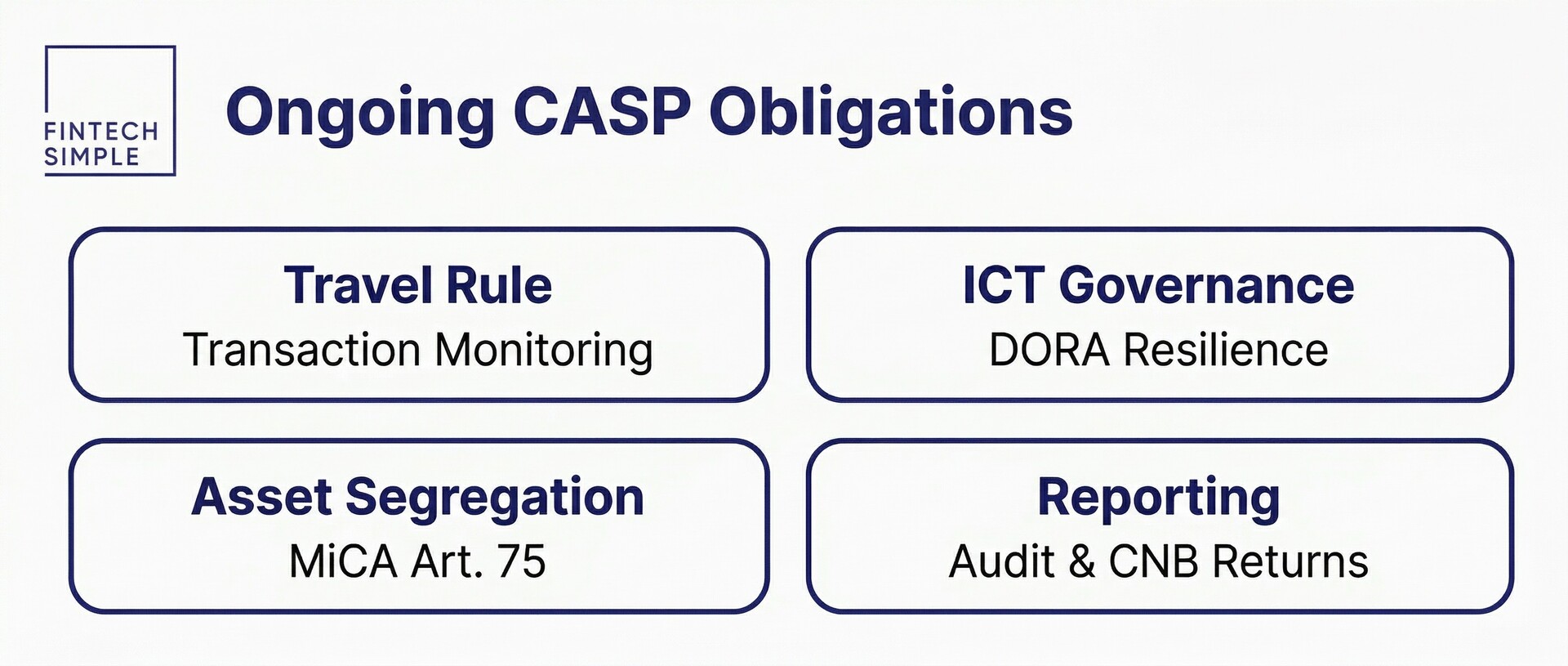
Authorisation is the starting point, not the finish line. Once the ČNB issues your CASP licence, the board owns a continuous compliance programme across the four obligations below.

Four categories of ongoing Czech CASP compliance obligations

Travel Rule and Transaction Monitoring

Czech CASPs must comply with Regulation (EU) 2023/1113 — the EU Travel Rule for crypto transfers — with no de minimis threshold. Every outgoing and incoming transfer must carry verified originator and beneficiary information, and your monitoring system must screen counterparties against sanctions lists in real time.

  • Travel Rule data — collect and transmit full originator and beneficiary information for all crypto transfers, including self-hosted wallet verification.
  • Transaction monitoring — run continuous monitoring with risk-based scenarios calibrated to Czech FAU typologies.
  • STR filing — file suspicious transaction reports to the FAU without delay.

ICT Governance and Operational Resilience

DORA (Regulation EU 2022/2554) applies directly to CASPs as classified financial entities, imposing comprehensive operational resilience requirements alongside MiCA. Under DORA Article 6, you must review your ICT risk management framework at least annually, and the ČNB conducts ongoing supervisory monitoring and periodic inspections across the full technology stack.

  • ICT risk framework — maintain a documented framework covering identification, protection, detection, response, and recovery.
  • Business continuity testing — test BCP and disaster recovery plans at least annually, including hot-wallet failover scenarios.
  • Incident reporting — report major ICT-related incidents to the ČNB within DORA timelines and maintain a register of third-party ICT providers.

Client Asset Segregation (MiCA Art. 75)

Under MiCA Article 75, CASPs custodying client crypto-assets must segregate them from proprietary holdings and ensure clients retain full ownership rights even in insolvency. The ČNB treats safeguarding breaches as a top enforcement priority.

  • Segregated wallets — hold client crypto-assets in segregated wallets, with cryptographic and accounting separation from house funds.
  • Position register — update the register of positions without undue delay and provide clients a statement of position at least quarterly and on request.
  • Custody policy — document custody arrangements, key management, and sub-custodian due diligence in a board-approved policy.

Regulatory Reporting and Audit Thresholds

Licensed CASPs submit periodic prudential, conduct, and AML reports to the ČNB. Czech accounting law also triggers a statutory audit once your firm crosses defined thresholds, so finance teams should monitor growth carefully.

  • Periodic reports — submit prudential, conduct, and AML reports to the ČNB through the SDAT system, plus annual financial statements under Czech accounting law.
  • Statutory audit — commission an audit when the firm exceeds two of three size criteria in two consecutive periods: turnover ≥ CZK 240m, assets ≥ CZK 120m, or ≥50 full-time employees (new thresholds effective 1 January 2026).
  • AML risk refresh — refresh AML risk assessments annually and whenever products, jurisdictions, or delivery channels change materially.

Taxation of Czech CASPs

Czech tax law does not carve out a special regime for crypto-asset service providers — CASPs are taxed as ordinary Czech commercial entities under the Income Tax Act (No. 586/1992 Coll.) and the VAT Act (No. 235/2004 Coll.), with the nuances that follow from the nature of the services they provide and the assets they handle. Understanding three layers — corporate income tax, VAT treatment, and payroll-related obligations — is essential before you commit to a Czech CASP structure.

Corporate Income Tax

Czech-resident CASPs pay corporate income tax at a flat rate of 21 % on worldwide profits, calculated as the difference between taxable revenues and deductible expenses in accordance with Czech accounting standards. Trading fees, custody charges, staking commissions, and any other revenue streams derived from MiCA-authorised services all fall within the corporate tax base. Deductible costs include staff salaries, office rent, technology infrastructure, AML/CFT compliance tooling, audit fees, and the annual ČNB supervisory levy. Losses may be carried forward for up to five tax years and offset against future profits, which is useful during the capital-intensive launch phase. CASPs structured as an s.r.o. (the standard Czech limited-liability company) file an annual corporate tax return by the first day of the fourth month following the fiscal year-end — or the first day of the seventh month if the return is prepared by a registered tax adviser — and make quarterly or half-yearly advance payments once their prior-year liability exceeds CZK 150,000. Transfer-pricing rules apply to intercompany transactions with related parties abroad, so groups that route liquidity or technology fees through a Czech CASP entity need arm’s-length documentation from the outset.

VAT Treatment of Crypto Services

The VAT position of crypto-asset services in the Czech Republic follows the landmark CJEU Case C-264/14 Hedqvist ruling, which held that the exchange of fiat currency for Bitcoin (and by extension other crypto assets) constitutes a supply of services exempt from VAT under Article 135(1)(e) of the VAT Directive. The Czech tax authority (Finanční správa) has adopted this interpretation: pure crypto-to-fiat and crypto-to-crypto exchange transactions are VAT-exempt without the right to deduct input VAT on related costs. Custody fees, advisory services, and portfolio-management charges, however, are standard taxable supplies subject to the 21 % Czech VAT rate because they do not qualify as transactions in currency, bank notes, or coins used as legal tender. CASPs that provide a mix of exempt exchange services and taxable ancillary services must apply a pro-rata input-VAT deduction method, splitting deductible VAT between the two streams based on revenue proportions. Getting this apportionment wrong is one of the most common post-authorisation compliance failures — the Czech tax authority has been issuing sector-specific guidance since late 2025, and Fintech Simple recommends engaging a Czech VAT specialist before the first filing period closes.

Personal and Payroll Taxes

Every Czech CASP with local employees — and MiCA substance rules virtually guarantee you will have at least a director and an MLRO on the Czech payroll — must withhold and remit personal income tax at the flat 15 % rate (or 23 % on annual income exceeding CZK 1,935,552, roughly €78,000) plus mandatory social-security and health-insurance contributions that together add approximately 33.8 % on top of the gross salary for the employer and 11 % for the employee. For senior hires such as compliance officers or CTOs recruited from abroad, the Czech Republic offers a favourable “key employee” regime under the Employee Card or Blue Card framework, but the payroll obligations remain the same once the individual is Czech tax-resident. Stock-option or token-based compensation plans — common in the crypto sector — trigger a taxable benefit at the point of exercise or vesting, valued at fair market price on that date, and both income tax and social contributions apply. CASPs should factor these costs into their financial projections submitted to the ČNB, because the regulator reviews projected operating budgets during authorisation and expects them to reflect realistic Czech payroll levels, not offshore contractor rates. Fintech Simple’s Prague team typically models a three-year payroll forecast as part of the application dossier to pre-empt RFI queries on staffing costs.

Ready to Launch Your Czech CASP Under MiCA?

Book a free, no-obligation consultation with our ČNB-experienced team — we handle the full authorisation process for a transparent fixed fee, with no surprises.

Common Reasons ČNB Rejects CASP Applications

The ČNB applies MiCA’s authorization criteria strictly, and incomplete or superficial filings are the leading cause of delays and outright rejections. Below are the six issues our licensing team encounters most often — and the concrete steps that prevent each one.

  1. Insufficient own funds or capital documentation. Applicants deposit the minimum €50k–€150k but fail to prove the funds are unencumbered, or submit bank statements that are outdated by the time the ČNB reviews them. How to avoid: obtain a fresh bank confirmation letter dated within 5 business days of filing, and ensure the capital account is free of pledges, liens, or pending outflows.
  2. No genuine local substance. A virtual office address and a non-resident director on paper will not pass. The ČNB verifies that the Czech entity has real decision-making capacity — a physical office, at least one EU-resident director, and a locally reachable MLRO. How to avoid: secure a staffed office in Prague or Brno before filing, appoint an EU-resident statutory director, and designate an MLRO who can demonstrate Czech AML/CFT knowledge.
  3. Weak or generic AML/CFT policies. Recycled compliance templates that reference FATF guidelines without mapping them to Czech Act No. 253/2008 Coll. and MiCA’s specific requirements are flagged immediately. How to avoid: draft a bespoke AML programme that references Czech legislation, names the FAÚ as the FIU, defines CDD thresholds in line with local rules, and includes a Travel Rule procedure under Regulation (EU) 2023/1113.
  4. Fit-and-proper failures among shareholders or directors. Criminal-record gaps, undisclosed beneficial owners, or directors with adverse regulatory history trigger RFI rounds that can stall an application for months. How to avoid: run pre-filing due diligence on every UBO, shareholder, and board member; disclose all regulatory sanctions proactively; and prepare CVs that demonstrate relevant financial-services experience per Joint EBA/ESMA Guidelines.
  5. Incomplete ICT and operational-resilience documentation. MiCA and DORA require applicants to demonstrate IT governance, incident-response procedures, and business-continuity planning. Many first-time filers omit these entirely. How to avoid: include an ICT governance framework, a penetration-testing schedule, a disaster-recovery plan, and an outsourcing register for any critical IT functions before submission.
  6. Mismatch between requested CASP class and actual business model. Applying for Class 1 while the whitepaper or pitch deck describes exchange, custody, and transfer services tells the ČNB the applicant does not understand the regime. How to avoid: map every planned crypto-asset service to MiCA Annex IV, confirm the correct class (1, 2, or 3), and ensure capital, policies, and staffing all align with that class from day one.

Takeaway

Treat the dossier as evidence the firm is already running — not a promise that it will start once licensed.

Czech Republic vs. Lithuania, Poland, and Malta

MiCA harmonised capital thresholds across the EU, so jurisdictions now compete on regulator predictability, substance expectations, professional fees, and working language.

JurisdictionMin CapitalTimelineSubstance IntensityTypical Total CostWorking Language
Czech Republic €50k / 125k / 150k 5–10 months High €30k–65k Czech
Lithuania €50k / 125k / 150k 4–8 months High €25k–55k Lithuanian / English
Poland €50k / 125k / 150k TBD* High €35k–70k Polish
Malta €50k / 125k / 150k 3–6 months High €80k–150k English

The Czech Republic’s main selling point is early regulatory clarity. Czechia was among the first EU Member States to transpose MiCA via Act No. 31/2025 Coll. (effective February 2025), and the ČNB issued its first six CASP authorisations on 11 February 2026. The statutory assessment follows MiCA Article 63 timelines (25 + 40 working days), the same framework every NCA in the EU applies, but early adopter status means ČNB has already built institutional experience with CASP files.

On cost, Czechia is comparable to Lithuania. Both jurisdictions require genuine local substance under MiCA Article 68 — a physical office, an EU-resident director, and local AML/compliance personnel. Malta’s costs are higher primarily because of greater staff requirements (approximately ten local employees within six months of authorisation), though MFSA’s processing times have historically been among the fastest in the EU — ESMA’s July 2025 peer review found that MFSA processed its first CASP authorisation rapidly, noting opportunities to strengthen the assessment process.

Against Poland, the Czech advantage is timing: Poland has no designated competent authority for CASP licensing yet, while Czechia already has a functioning regime. Both regulators require filings in the national language by default (Czech or Polish respectively), with official translations for foreign-language documents, though both may accept English supporting documents in practice. Any MiCA licence — Czech, Lithuanian, or Maltese — provides full EU passporting under Article 65, including into Poland.

* Poland’s Crypto-Asset Market Act was vetoed by the President twice — on 1 December 2025 and again on 12 February 2026 — leaving no competent authority designated for domestic CASP licensing. CASPs authorised in other EU Member States may passport into Poland under MiCA Article 65. Timeline estimates for domestic licensing are unavailable until new legislation passes.


Step-by-Step CASP Application Process

Our team manages every workstream in parallel, coordinating with the Czech National Bank and aligning your dossier with both MiCA and the Czech Business Corporations Act (Act No. 90/2012). The eight stages below run from gap analysis to operational launch and EU passporting.

Step 1 Weeks 1–2

Pre-assessment & Gap Analysis

What we do: We review your business model, target services, shareholder structure, and existing compliance posture against ČNB and MiCA requirements to identify the fastest authorization route.

  • Service mapping — map intended crypto-asset services (custody, exchange, transfer, advice) to the MiCA Article 3(1)(16) service categories
  • UBO suitability review — assess UBO suitability, source-of-funds documentation, and prior regulatory history
  • Gap report — deliver a written gap report with timeline, capital requirement, and budget
Step 2 ~10–20 Business Days

Czech s.r.o. Formation

What we do: We incorporate your Czech limited liability company (společnost s ručením omezeným) with articles of association tailored to MiCA-regulated activity.

  • Company registration — draft notarial deed, register the company in the Commercial Register, and obtain a general trade licence (note: the legacy virtual-asset trade licence under code 81 does not substitute for MiCA CASP authorisation)
  • Office & directors — secure a registered office in Prague or Brno and appoint resident directors where appropriate
  • Tax registration — register with the Czech tax authority and obtain a DIČ (tax identification number, which doubles as the VAT number once the company registers for VAT)
Step 3 Weeks 3–4

Capital Deposit in EEA Bank

What we do: We open a corporate account with an EEA-based credit institution and arrange the deposit of your initial capital at the class minimum shown in the CASP classes table above.

  • Bank KYC packs — prepare KYC packs for the bank, including UBO declarations and business plans
  • Capital transfer — coordinate the wire transfer and obtain the official capital confirmation letter
  • ČNB-ready evidence — deliver evidence in the format required by ČNB
Step 4 Weeks 4–10

Policy Suite & Application Dossier

What we do: We draft the full MiCA-compliant policy library and assemble the authorization dossier in Czech and English, ready for submission to ČNB.

  • AML/CFT suite — AML/CFT manual, KYC procedures, transaction monitoring rules, and travel-rule workflow
  • ICT & custody policies — ICT and cybersecurity policy, business continuity plan, custody and key management procedures
  • Financial projections — three-year financial projections, governance charter, conflict-of-interest and outsourcing policies
Step 5 Week 11

ČNB Filing & Administrative Fee

What we do: We submit the authorization application to the Czech National Bank through its electronic portal and settle the applicable administrative fee on your behalf.

  • Secure submission — file via ČNB’s secure data box (datová schránka) with all annexes indexed
  • Acknowledgment tracking — obtain the official acknowledgment of receipt and case reference number
  • Completeness clock — track the statutory clock: ČNB has 25 working days to confirm completeness
Step 6 Months 4–7

RFI Iterations with ČNB

What we do: We manage the supervisory dialogue with ČNB case officers, responding to requests for information (RFIs) and clarifying technical points on governance, risk, and ICT.

  • Fit-and-proper interviews — coordinate fit-and-proper interviews for directors, key function holders, and the MLRO
  • Technical evidence — provide supplementary evidence on tokenomics, smart-contract audits, and wallet architecture
  • Scope negotiations — negotiate scope conditions and any pre-authorization undertakings
Step 7 Month 7–8

Authorization Decision

What we do: We receive and review the formal ČNB authorization decision, confirm the scope of permitted services, and prepare you for the conditions precedent to going live.

  • Licence verification — verify the licence register entry and download the official authorization certificate
  • Conditions precedent — implement any final conditions on capital, insurance, or staffing
  • Board briefing — brief the board on ongoing supervisory reporting obligations
Step 8 Month 8–9

Operational Launch & EU Passporting Notification

What we do: We help you go live in the Czech market and file the MiCA Article 65 passporting notifications so you can serve clients across all 30 EEA member states from day one.

  • Passporting notifications — submit host-state notifications via ČNB to ESMA and target NCAs
  • Provider activation — activate banking, custody, and liquidity provider relationships
  • Client onboarding — onboard first clients under the new MiCA-compliant terms of service

Talk to Our Czech Licensing Team

Free 30-minute consultation with our Head of Licensing. Fixed-fee engagement, no hourly billing — you’ll know the total Czech CASP cost before you commit.

Frequently Asked Questions about Czech CASP Licensing

Is the Czech VASP regime still open?

The legacy Czech VASP registration regime is set to expire on 1 July 2026 as part of the MiCA transition. VASPs that filed a CASP application with the ČNB by 31 July 2025 may continue operating under grandfathering until that date or until their application is decided. All other crypto-asset service providers operating in or from the Czech Republic must already hold a CASP authorization issued by the Česká národní banka (ČNB).

What CASP class do most crypto exchanges need?

Centralised order-book exchanges fall under Class 3 (€150,000) because operating a trading platform triggers the highest prudential tier. Class 2 (€125,000) fits brokers, OTC desks, and custodial wallet providers that offer custody, exchange crypto/fiat, and order execution without running a matching venue.

What is the minimum capital requirement?

MiCA sets three tiers: €50,000 (Class 1), €125,000 (Class 2), and €150,000 (Class 3). Capital must be paid in before authorization and maintained throughout operations — falling below the threshold triggers a mandatory notification to the ČNB.

Do I need a Czech-resident director?

In practice, yes. While MiCA does not formally mandate residency, the ČNB expects meaningful local substance, and at least one executive director resident in the Czech Republic is the standard expectation. Without genuine local management, applications are routinely flagged as letterbox structures and rejected.

How long does ČNB authorization take?

Realistic timelines run between 5 and 10 months from a complete filing. Class 1 applications with simple business models tend to land closer to 5–6 months, while Class 2 and Class 3 files typically take 8–10 months due to additional Requests for Information (RFI) rounds on governance, capital, and AML controls.

What is the state fee for a Czech CASP application?

The ČNB charges an administrative filing fee set out in its published schedule of regulatory fees and charges; applicants should consult the current ČNB fee schedule before submission as the amount is periodically updated. The filing fee is a one-time charge and does not cover ongoing supervisory contributions, which are calculated separately based on the licensee’s scope and size.

Can I passport my Czech CASP across the EU?

Yes. A CASP authorization issued by the ČNB can be passported under MiCA across all 30 EEA states (27 EU Member States plus Norway, Iceland, and Liechtenstein) via a notification procedure. Once notified, you may provide crypto-asset services cross-border without obtaining separate licenses in each jurisdiction.

Is crypto exchange VAT-exempt in Czech Republic?

Yes. Following the European Court of Justice ruling in C-264/14 (Hedqvist), the exchange of traditional currency for Bitcoin and other crypto-assets is treated as a VAT-exempt financial service across the EU, including in the Czech Republic. Other CASP services such as advisory or custody fees may still be subject to VAT.

What happens to VASPs that missed the transition?

VASPs that do not secure CASP authorization by 1 July 2026 must cease all regulated crypto-asset activities immediately. To resume operations, they need to file a full CASP application with the ČNB and wait for authorization before onboarding clients again. Continuing to operate without a license exposes directors to administrative fines and potential criminal liability.

Do I need a physical office in Czech Republic?

Yes. The ČNB requires a genuine physical office in the Czech Republic where staff work and records are kept. Virtual offices, mail-forwarding addresses, and shared coworking memberships without dedicated space are not acceptable substitutes.

Can Fintech Simple act as my MLRO?

No. Under Czech AML rules, the MLRO (AML Officer) must be registered with the FAÚ, meet fit-and-proper standards, and be accountable to the licensee’s board. Fintech Simple supports clients by recruiting suitable candidates, vetting their fit-and-proper credentials, and onboarding them into your governance framework before submission.

What is the total realistic cost including capital?

For a Class 2 CASP, expect total project costs of €80,000–€220,000 all-in, excluding the €125,000 paid-in capital. This range covers legal and consulting fees, policy drafting, IT and cybersecurity setup, local hiring, office rental, and first-year compliance infrastructure. Final cost depends on business complexity, outsourcing decisions, and the speed of ČNB review.

Your Privacy

By clicking "Accept", you consent to the use of cookies and similar technologies on your device to improve site navigation, analyze usage, provide specific functionalities, and support our marketing initiatives. Cookies that are strictly necessary will always be active with this link.