Gambling License in Costa Rica

Gambling License in Costa Rica: Requirements, Cost & Process 2026

Costa Rica offers one of the fastest and most affordable paths to launching an online gambling business — with 0% tax on offshore revenue and no minimum capital requirement. Learn how to obtain your data-processing permit and go live in as little as 8 weeks.

Fintech Simple has helped over 500 businesses obtain licenses across 40+ jurisdictions since 2016. Our team provides end-to-end support for Costa Rica’s gambling data-processing permit — from company incorporation and municipal permit application to banking setup and compliance. Whether you’re launching your first online casino or expanding into a cost-effective offshore jurisdiction, we guide you through every step.

Patrik Asevicius — Costa Rica licensing expert at Fintech Simple
Patrik Asevicius
Head of Licensing Department, Costa Rica & offshore jurisdictions

TL;DR for Decision-Makers

Costa Rica does not issue a dedicated gambling licence. You operate through a data-processing permit — a municipal business registration that authorises your company to process online gaming transactions from servers hosted in Costa Rica. No minimum capital, no pre-approval from a gaming regulator, and 0% tax on offshore-sourced revenue under Costa Rica’s territorial tax system. Setup runs 8–15 weeks end-to-end — incorporation in 3–5 weeks, permit application 4–8 weeks. Total budget with Fintech Simple starts at $8,000. The trade-off versus Curaçao or Malta: faster and cheaper, but no formal gambling licence credential; you pick the framework that fits the markets you serve.

What Is a Gambling License in Costa Rica?

License type

Municipal data-processing permit

Setup cost

From $11,000

Timeline

8–15 weeks

Offshore tax

0%

Costa Rica occupies a unique position in the global online gambling landscape: the country does not issue a formal gambling license in Costa Rica at the national level. Instead, online gaming operators have historically structured their operations around a municipal data-processing permit — a commercial authorization that allows companies to process data and transactions, including those arising from gambling activity, without an explicit gaming license. This legal architecture has made Costa Rica one of the most permissive — and one of the most legally ambiguous — destinations for online gambling businesses worldwide.

Data-Processing Permit vs. Traditional Gambling License

Unlike Curaçao, Malta, or the Isle of Man, Costa Rica does not issue a purpose-built gambling authorization. Instead, operators obtain a municipal data-processing permit — a general business license (typically from the municipality of San José) that authorizes commercial data processing. The permit does not reference gambling at all. Operators rely on the absence of any national law prohibiting online gambling directed at foreign players to argue that running a sportsbook or casino platform is lawful under this permit.

The practical consequences are significant:

  • Payment processing — Most tier-1 banks and card networks do not accept a data-processing permit as evidence of a gambling license. Operators typically rely on alternative PSPs, cryptocurrency gateways, or offshore merchant accounts.
  • Player trust — Without a recognized regulatory seal, building player confidence requires greater investment in branding and third-party certification (e.g., eCOGRA, iTech Labs RNG audits).
  • Market access — Regulated markets such as the EU, UK, and US require local licenses; a Costa Rican data-processing permit provides no right of access to these markets whatsoever.
  • Legal exposure — Because there is no gambling regulator, there is also no regulatory backstop. Disputes, fraud allegations, and player complaints have no national authority to escalate to.

Key distinction

Costa Rica does not prohibit online gambling directed at foreign players, but it does not affirmatively license it either. The data-processing permit is a business registration tool, not a gambling authorization. Operators must carefully evaluate whether this grey-area model suits their target markets and banking needs before committing.

The table below compares the Costa Rica data-processing model against three established gambling license jurisdictions:

Criterion Costa Rica
(Data-Processing Permit)
Curaçao
(CGA License)
Malta
(MGA License)
Isle of Man
(GSC License)
Formal gambling license issued? No Yes Yes Yes
Regulatory body Municipal authority (no gaming regulator) Curaçao Gaming Control Board Malta Gaming Authority (MGA) Gambling Supervision Commission (GSC)
Setup cost (approx.) €2,000–€6,000 €25,000–€40,000 €25,000–€35,000 €30,000–€50,000
Annual fees Low (municipal permit renewal) ~€20,000+ ~€25,000+ ~€20,000+
Time to operate 4–8 weeks 3–6 months 9–18 months 6–12 months
Tier-1 bank account access Very limited Limited Good (EU banking) Good
EU/UK market access No No (sub-license required) Yes (EU passporting) UK & selected markets
AML/KYC obligations None mandated Mandatory Mandatory Mandatory
Ongoing compliance burden Minimal Moderate High High
Reputation / player trust Low Moderate High High

The Costa Rica model offers the lowest entry cost and fastest setup time, but trades regulatory credibility and banking access for that convenience. For operators targeting grey or unregulated markets and primarily using cryptocurrency or alternative payment methods, the cost-benefit calculation may favour Costa Rica. For operators targeting European players or seeking mainstream payment processing, a Curaçao, Malta, or Isle of Man license is the appropriate choice.


Why the Legal Grey Area Exists

Costa Rica’s grey area traces back to Law No. 3 of 1922, a gambling statute written to regulate land-based gambling halls and lottery-style games — decades before the internet existed. Because the law never addressed online wagering, early operators in the 1990s began incorporating in Costa Rica and serving foreign players under municipal data-processing permits. In 2012, the legislature considered a bill that would have created a formal online gambling licensing regime with a dedicated regulatory body, but the legislation stalled and was never enacted. As of 2026, no subsequent law has filled the gap, leaving the data-processing permit model as the de facto operating framework.

Legal grey area

The absence of a formal gambling law is not the same as legal approval. Costa Rican courts have not definitively ruled on the lawfulness of online gambling operations directed at foreign players. Operators assume legal risk under this model, and the position can shift if new legislation is enacted. Fintech Simple recommends legal counsel in both Costa Rica and the operator’s target markets before structuring any operation around the data-processing permit alone.

Packages & Pricing for Gambling License in Costa Rica

Every package below covers the core elements required to obtain a gambling license in Costa Rica: company formation, notarial registrations, permit application, and dedicated case management. The fees charged by the Ministerio de Hacienda and the municipal authority are included in all tiers. What differs across tiers is the depth of legal advisory, the speed of processing, and whether banking and ongoing compliance are handled for you. All work is performed by our in-house licensing team — no outsourcing, no hidden third-party markups.

The total cost of a gambling license in Costa Rica typically ranges from $8,000 to $18,000 all-in, depending on the level of support required.

Essential $8,000
Advanced $12,000
Premium $18,000
Company incorporation (LLC or Corporation)
Data Processing License application
Registered legal address
Local registered agent services
AML/KYC policy preparation
Preparation and submission of all necessary documentation
Consultation & support throughout process
Corporate bank account assistance (outside Costa Rica)
Tax ID application
Submission of UBO declaration
Bookkeeping setup advisory
Employment registration with CCSS
Office lease contract assistance
Customized AML/CFT compliance training for staff & annual accounting and bookkeeping service (first year included)
Risk management policy implementation
Crypto payments integration advisory
Business structure advisory (international scaling)
Expert legal support on-demand (1 year)
Essential $8,000
  • Company incorporation (LLC or Corporation)
  • Data Processing License application
  • Registered legal address
  • Local registered agent services
  • AML/KYC policy preparation
  • Preparation and submission of all necessary documentation
  • Consultation & support throughout process
  • Corporate bank account assistance (outside Costa Rica)
  • Tax ID application
  • Submission of UBO declaration
  • Bookkeeping setup advisory
  • Employment registration with CCSS
  • Office lease contract assistance
  • Customized AML/CFT compliance training for staff & annual accounting and bookkeeping service (first year included)
  • Risk management policy implementation
  • Crypto payments integration advisory
  • Business structure advisory (international scaling)
  • Expert legal support on-demand (1 year)
Advanced $12,000
  • Company incorporation (LLC or Corporation)
  • Data Processing License application
  • Registered legal address
  • Local registered agent services
  • AML/KYC policy preparation
  • Preparation and submission of all necessary documentation
  • Consultation & support throughout process
  • Corporate bank account assistance (outside Costa Rica)
  • Tax ID application
  • Submission of UBO declaration
  • Bookkeeping setup advisory
  • Employment registration with CCSS
  • Office lease contract assistance
  • Customized AML/CFT compliance training for staff & annual accounting and bookkeeping service (first year included)
  • Risk management policy implementation
  • Crypto payments integration advisory
  • Business structure advisory (international scaling)
  • Expert legal support on-demand (1 year)
Premium $18,000
  • Company incorporation (LLC or Corporation)
  • Data Processing License application
  • Registered legal address
  • Local registered agent services
  • AML/KYC policy preparation
  • Preparation and submission of all necessary documentation
  • Consultation & support throughout process
  • Corporate bank account assistance (outside Costa Rica)
  • Tax ID application
  • Submission of UBO declaration
  • Bookkeeping setup advisory
  • Employment registration with CCSS
  • Office lease contract assistance
  • Customized AML/CFT compliance training for staff & annual accounting and bookkeeping service (first year included)
  • Risk management policy implementation
  • Crypto payments integration advisory
  • Business structure advisory (international scaling)
  • Expert legal support on-demand (1 year)

Not sure which package fits your operation?

The Advanced tier covers the majority of operators launching an online gambling business in Costa Rica for the first time. It includes corporate bank account assistance, tax ID application, and employment registration — services absent from the Essential tier that can otherwise stall your go-live by weeks. If you already have a banking relationship or are an experienced operator scaling into a second jurisdiction, the Essential package may be sufficient. The Premium tier is designed for operators who want a single point of contact handling everything from day one through to renewal.

Costs and Fees for a Gambling License in Costa Rica

Beyond the one-time setup covered in the Packages section, operators should budget for recurring annual costs to keep the company in good standing and the permit valid.

Ongoing Annual Costs

Initial setup costs are covered in the Packages section above. Below are the recurring costs after year one.

Annual Cost ItemMinimum (USD/year)
Municipal permit renewal From $1,000
Local legal representative From $1,200
Registered office From $600
Accounting & tax compliance From $1,500
AML compliance programme From $2,000
Platform hosting/colocation* From $3,000

*Colocation or dedicated server in a Costa Rican data centre is required for operators hosting gambling platforms on local infrastructure. This requirement stems from Executive Decree 39231, which governs data-processing companies in Costa Rica.

A note on permit renewal costs: Some online guides claim the municipal permit carries no annual renewal fee. In practice, municipalities charge $1,000–$5,000 depending on the declared capital base.

At minimum, recurring annual costs run $6,300/year excluding server infrastructure, or $9,300/year with local platform hosting.

Why Choose Costa Rica for Your Gambling Business

Costa Rica occupies a unique position in the online gambling landscape — it is one of the few jurisdictions where operators can legally process wagers from international players without a dedicated gaming authority, a minimum capital requirement, or mandatory software certification. Before committing, however, it is equally important to understand what the framework does not provide.

Key Advantages

Costa Rica remains one of the most accessible entry points for operators who need to launch quickly and preserve capital during the early growth phase.

  • 0% tax on offshore-sourced revenue — Costa Rica operates a territorial tax system. Income generated from players outside the country is not subject to domestic corporate income tax, capital gains tax, or VAT. For operators serving exclusively international markets, the effective tax rate on gross gaming revenue is zero. Companies must still file annual returns and pay a nominal corporate tax of roughly $400–$500 per year.
  • Low operating costs — Company formation fees, annual maintenance, and local legal representation cost a fraction of what regulated jurisdictions charge. Total first-year setup typically ranges from $11,000 to $18,000, with ongoing annual costs of $6,300–$9,300 — compared to six-figure budgets for Malta or the Isle of Man.
  • Fast setup timeline — A Costa Rican data-processing company can be incorporated and fully operational in as little as eight weeks. Company incorporation takes 3–5 weeks, and the municipal data-processing permit adds a further 4–8 weeks. This is dramatically faster than regulated markets, where a Malta Gaming Authority licence can take 12–18 months.
  • 100% foreign ownership permitted — Non-resident shareholders and directors can own the entire entity. There is no requirement for local shareholders, local directors, or Costa Rican nationals on the board. The only local requirement is a registered agent (a Costa Rican attorney).
  • No minimum capital requirement — Costa Rica imposes no statutory minimum share capital for either an S.A. or an S.R.L. This removes the capital lock-up that jurisdictions like Malta (€100,000+) or the Isle of Man require before operations can begin.
  • No mandatory software testing or certification — No RNG or game-math certifications are required before launch. Operators are free to integrate any platform provider without pre-approval from a regulator. While voluntary certifications (eCOGRA, iTech Labs) are recommended for player trust, they are not a legal prerequisite.
  • OECD member country — Costa Rica is an OECD member, which signals a baseline of institutional stability, rule of law, and international cooperation on tax transparency. This matters for banking relationships, correspondent banking due diligence, and investor confidence.

Risks and Limitations

Most competitor guides present Costa Rica as an unqualified opportunity. It is not. Operators who commit without understanding the constraints risk wasted capital and operational paralysis — particularly around banking and payment processing.

  • Persistent banking challenges — This is the single most significant practical obstacle for Costa Rica gambling operators. Local banks routinely decline corporate accounts linked to online gambling, and international payment processors treat a data-processing permit as insufficient evidence of a gambling licence. Operators must rely on alternative PSPs, cryptocurrency gateways, or offshore merchant accounts — all of which carry higher fees and greater counterparty risk.
  • Limited jurisdictional recognition — A Costa Rican data-processing authorisation is not recognised as a gambling licence by any regulated market. It provides no right of access to the EU, UK, US, Australia, or any jurisdiction that requires a local gaming licence. Operators targeting these markets must obtain separate licences in each territory.
  • No formal player-protection framework — Costa Rica does not mandate responsible gambling tools, self-exclusion registers, deposit limits, or cooling-off periods. Operators who fail to implement these voluntarily face reputational risk and may be excluded from affiliate networks and comparison sites that require evidence of player-protection measures.
  • Reputational concerns with partners and players — Premium affiliate networks, white-label providers, and sophisticated players increasingly distinguish between licensed and unlicensed jurisdictions. A Costa Rica data-processing permit does not carry the trust signal of an MGA, UKGC, or even a Curaçao licence. Operators must invest more heavily in third-party audits, provably fair technology, and brand building to compensate.

Note: The current permissive environment depends on the absence of prohibitive legislation. If Costa Rica enacts a formal online gambling law — which is a matter of when, not if — operators structured around the data-processing permit may face mandatory re-licensing, new capital requirements, or forced closure. A contingency plan for migration to a regulated jurisdiction should be part of every operator’s risk framework.

Our assessment

Costa Rica is best suited to operators who need speed-to-market and cost efficiency during an early validation phase — testing a new product vertical, proving unit economics, or serving markets where licence provenance is not a decisive factor for players. It is not a long-term standalone solution for operators targeting regulated markets or seeking tier-1 banking relationships. The optimal strategy for most clients is to launch in Costa Rica, validate the business model, and then migrate or add a Curaçao, Malta, or Isle of Man licence once revenue justifies the higher compliance cost.

Regulatory Framework & Authorities

Costa Rica’s approach to gambling regulation is unlike almost any other jurisdiction in Latin America. Rather than establishing a single dedicated gaming authority, the country divides oversight across four separate government bodies, each responsible for a distinct aspect of casino and gaming activity.

Key Regulatory Authorities

Two government bodies are directly relevant to online offshore operators:

AuthorityRole & MandateOfficial Website
ICD (Instituto Costarricense sobre Drogas) National AML/CFT authority. Receives and analyses suspicious-transaction reports (STRs) from all obligated entities, including data-processing-permit holders. Oversees compliance with Law 8204. icd.go.cr
MEIC (Ministerio de Economía, Industria y Comercio) Regulates commercial activity, consumer protection, and business registrations. Sets standards for advertising, fair trading, and commercial licensing at the national level. meic.go.cr

Two additional bodies — the Ministry of Public Security (MoPS) and the Junta de Protección Social (JPS) — oversee land-based casino permits and the state lottery monopoly respectively. Neither body regulates online gambling directed at foreign players, and neither issues permits relevant to offshore operators. Their jurisdiction is limited to domestic, physical gaming venues and the national lottery system.

Key Legislation

  • Law 8204 (2001) — AML Law — Costa Rica’s primary anti-money laundering statute. Establishes customer due diligence, suspicious-transaction reporting, and record-keeping obligations for all regulated entities, including companies holding a data-processing permit. Administered by the ICD under Law 8204.
  • Law 9050 (2012) — Casino & Electronic Betting Tax — Imposes a specific tax on land-based casinos and electronic betting terminals. Does not apply to online gambling operators holding a data-processing permit, but establishes the legislative precedent for taxing gaming activity in Costa Rica. Full text at SCIJ.

Other legislation governs land-based casinos (including the original Law No. 3 of 1922, which predates the internet entirely) and the state lottery monopoly. None of these statutes address online gambling directed at foreign players — a gap that defines the regulatory grey area operators must navigate.

Online Gambling: A Regulatory Grey Area

As explained in the data-processing permit section above, Costa Rica has no legislation that expressly authorises or prohibits online gambling directed at foreign players. Operators incorporate a Costa Rican entity, obtain a municipal data-processing permit, and rely on the absence of a prohibitive law to conduct gambling operations from Costa Rican territory. This is not a formal licence — it is a structural workaround that has persisted for over two decades because no legislature has moved to close or formalise it.

Key Distinction — Online Gambling Grey Area

Costa Rica does not issue a dedicated online gambling licence. Operators who incorporate a Costa Rican entity and conduct online gambling activities targeted exclusively at foreign jurisdictions operate in a legal grey area — not illegal, but not affirmatively licensed. The data-processing permit is a municipal business registration, not a gaming authorisation. Operators should obtain independent legal advice in both Costa Rica and their target markets before committing to this model. For jurisdictions with formal gambling licensing frameworks, see Malta.

Future Regulatory Outlook

Formal regulation of online gambling in Costa Rica is likely a matter of when, not if. The 2012 bill that would have established a dedicated gaming authority and licensing framework stalled, but growing international pressure — from the FATF, OECD, and regional bodies such as GAFILAT — continues to push Costa Rica toward formalising oversight of its substantial online gambling sector. Any future legislation would likely introduce licensing fees, compliance requirements, and potentially a dedicated regulator, bringing Costa Rica closer to the Curaçao model.

Operators relying on the current data-processing permit model should have a contingency plan. If formal regulation is enacted, existing operators will likely face a transition period to apply for a new licence — but there is no guarantee of grandfathering. Building robust AML/KYC infrastructure, maintaining clean corporate records, and operating transparently will position your business favourably regardless of how the regulatory landscape evolves.

Types of Gambling Activities Allowed Under a Costa Rica License

The table below summarises which product verticals are permitted under the Costa Rica framework.

ActivityPermitted?Conditions & Notes
Online casino, poker, sports betting, bingoYes — offshore onlyPermitted under the municipal data-processing permit provided all activity is directed exclusively at players outside Costa Rica. No game-type restrictions apply — operators may offer slots, table games, live dealer, poker, sportsbook, and bingo on a single platform without separate authorisations.
Crypto gamblingYesCosta Rica does not require a specific payment-service licence for cryptocurrency transactions. Operators may accept deposits and process withdrawals in Bitcoin, Ethereum, stablecoins, and other digital assets without additional regulatory approval. Crypto-native casinos benefit from faster settlement and reduced reliance on traditional banking channels.
Lottery (non-JPS)Yes — with restrictionsPrivate lottery-style games directed at international players are permitted under the data-processing permit, provided they do not infringe on the Junta de Protección Social (JPS) monopoly over domestic lottery operations. Operators must ensure no marketing or ticket sales target Costa Rican residents.
Domestic lottery & land-based gamingNot permittedThe state lottery is operated exclusively by the JPS under a constitutional monopoly. Land-based casino permits are issued by the Ministry of Public Security (MoPS) under a separate regime and are not available through the data-processing permit pathway.

Geo-blocking is mandatory, not optional

Best practice is to implement IP-based geo-blocking at the server level to prevent Costa Rican residents from accessing your platform. Failure to geo-block domestic players falls outside the scope of the data-processing permit and may expose the operator to local legal risk. Most payment processors and compliance partners will require evidence of active geo-blocking before onboarding.

Requirements for a Gambling License in Costa Rica

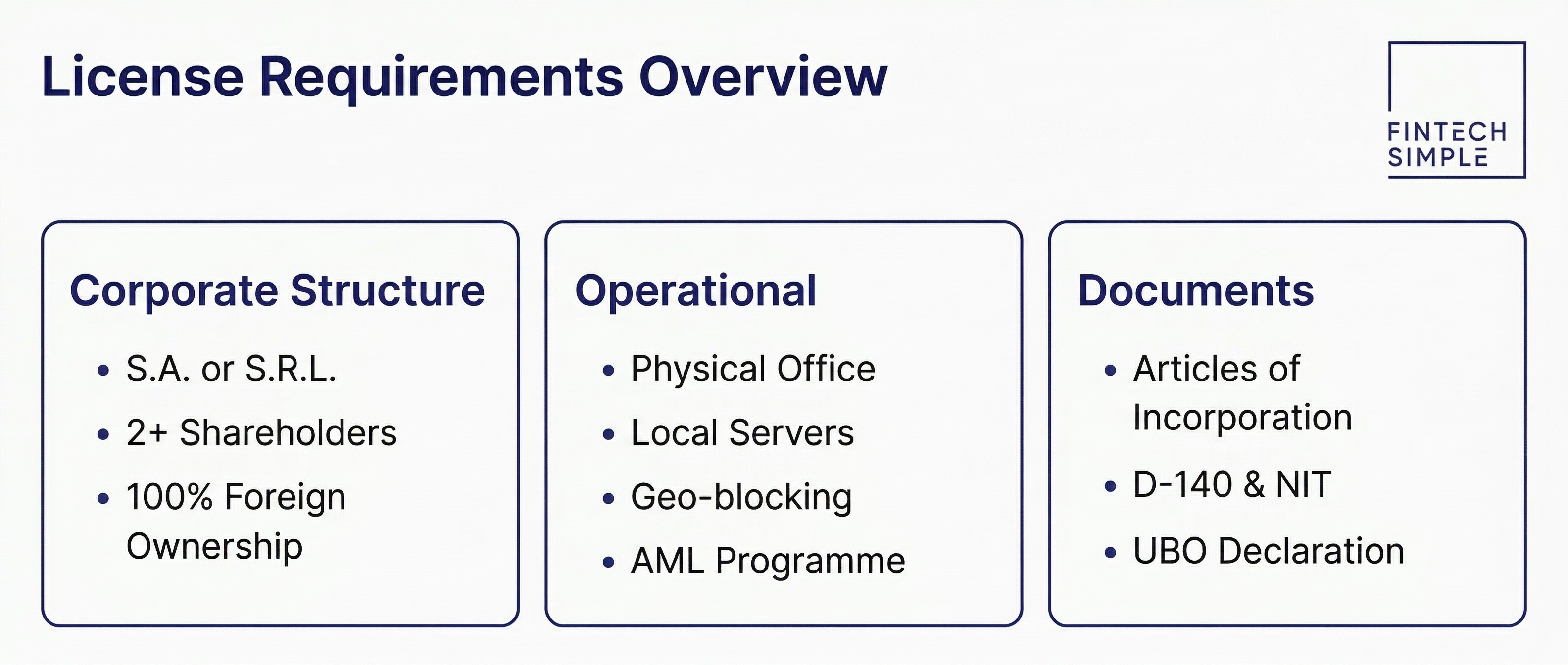
Costa Rica does not operate a formal gambling licensing authority, yet obtaining legal standing to operate an online casino or sportsbook here demands careful attention to corporate, operational, and documentary requirements. Meeting every requirement from day one prevents costly delays and keeps your operation off the radar of payment processors and banking partners that scrutinize compliance. Below we break the requirements into three pillars: the corporate structure you must form, the operational infrastructure you must maintain, and the documents you must file.

Breakdown infographic showing three categories of requirements for a Costa Rica gambling license: corporate structure, operational requirements, and required documents.

Corporate Structure

Costa Rican law recognises several commercial entity types, but two dominate the online gambling sector: the Sociedad Anónima (S.A.) and the Sociedad de Responsabilidad Limitada (S.R.L.). Both provide limited liability, yet they differ materially in governance flexibility, transferability of ownership interests, and the perception of international banking partners.

Entity TypeMin. Members / ShareholdersOwnership TransferBest For
S.A. (Sociedad Anónima) 2 shareholders Shares freely transferable Operators seeking investor flexibility
S.R.L. (Sociedad de Responsabilidad Limitada) 2 partners (socios) Requires partner consent Closely held, owner-operated platforms

Other entity types (S.C.S., S.C.A., S.N.C., branch of a foreign company) exist but are rarely used in online gambling. For most operators expecting growth or outside investment, the S.A. is the preferred vehicle — it issues shares, permits unrestricted transfers, and is the structure international banks recognise most readily. Costa Rica imposes no minimum paid-up capital requirement and permits 100% foreign ownership across both entity forms.

Operational Requirements

Legal Representative — Personal Liability Warning

Every Costa Rican legal entity must appoint a Representante Legal (legal representative) who is resident in Costa Rica. Unlike a registered agent in many offshore jurisdictions, the Costa Rican legal representative carries personal liability for the company’s local tax filings, regulatory submissions, and certain contractual obligations. Your chosen representative’s exposure is real and must be mitigated through clear indemnification agreements and professional insurance.

  • Physical office — Costa Rica requires your company to maintain a registered address in-country. Banking partners and payment processors increasingly distinguish between a permanent office (dedicated commercial premises with staff) and a temporary or virtual address. A permanent, staffed office substantially improves your chances of opening a merchant account with an international acquirer.
  • Servers located in Costa Rica — Under Executive Decree 39231, companies providing online gaming services to players outside Costa Rica must host their gaming servers on Costa Rican territory. Compliance requires a contract with a local data centre or colocation provider and supporting documentation for due-diligence reviews.
  • Geo-blocking of Costa Rican residents — The implicit basis of Costa Rica’s de facto licensing framework is that operators serve foreign markets, not the domestic population. Geo-blocking Costa Rican IP addresses is an operational prerequisite, not merely best practice — see geo-blocking details above for implementation guidance.
  • AML/KYC programme — Although Costa Rica does not mandate a formal gaming licence, the country’s anti-money-laundering laws apply to online gaming entities. A documented AML and KYC programme is required for banking relationships and is reviewed by correspondent banks that process your transactions — full details in the AML/KYC section.

Required Documents

All documents submitted to Costa Rican public bodies must be in Spanish; foreign-language originals require a certified translation by an authorised Costa Rican translator (traductor público autorizado). The document set spans company formation records, identity verification, and tax registration.

  • Articles of Incorporation (Escritura de Constitución) — Notarised before a Costa Rican notary and registered with the Registro Nacional de Costa Rica. Must state the company’s corporate purpose (referencing online gaming or internet-based services), capital structure, share or quota distribution, and the identity of directors and the legal representative.
  • Government-issued IDs for all directors, shareholders, and UBOs — Passports or national identity documents for every person holding a position or ownership interest. Certified copies are standard; some banks require apostilled originals.
  • D-140 Form & NIT — The official registration declaration filed with the Ministerio de Hacienda to register the entity as a taxpayer. Submission of the D-140 triggers issuance of the company’s Número de Identificación Tributaria (NIT) — the fiscal identification number required for every subsequent tax filing, invoicing obligation, and bank account opening in Costa Rica.
  • UBO Declaration (Declaración de Beneficiario Final) — Under Law 9416, all Costa Rican legal entities must file an annual beneficial ownership declaration identifying every natural person who ultimately owns or controls ≥15% of the entity. This is filed electronically with the Banco Central de Costa Rica’s registry and must be updated within 15 business days of any ownership change.

Practical tip

Preparing a complete, apostilled document pack before engaging a Costa Rican notary compresses the incorporation timeline from several weeks to as few as 5–7 business days. Fintech Simple coordinates document authentication in your home jurisdiction and certified translation in-country to eliminate back-and-forth delays.

Step-by-Step: How to Get a Gambling License in Costa Rica

Costa Rica does not issue a single “gambling license” from a central regulator. Instead, operators establish a legally compliant structure by combining company incorporation, tax registration, a municipal data-processing permit, and the right operational infrastructure. The process is well-defined and — with experienced local counsel — takes 8–15 weeks from kick-off to go-live.

StepActivityTimeline
1Choose Entity Type and Prepare DocumentsWeek 1
2Incorporate the Company with the National RegistryWeeks 2–5
3Tax Registration — D-140 Form and NITWeek 6
4Secure Office Space and Server InfrastructureWeeks 6–7
5Apply for the Municipal Data-Processing PermitWeeks 7–11
6Banking, Payment Processing, and Go-LiveWeeks 11–15
Step 1 Week 1

Choose Entity Type and Prepare Documents

What we do: We advise you on the right corporate structure for your operation — either a Sociedad Anónima (S.A.) or a Sociedad de Responsabilidad Limitada (S.R.L.) — and compile all incorporation documents before engaging the notary. The S.A. is the default choice for online gambling operations because it allows multiple shareholders, unrestricted share transfers, and a familiar governance structure for international investors. The S.R.L. suits smaller, closely held operations with fewer shareholders.

  • Corporate structure decision — S.A. vs. S.R.L. based on shareholder count, future fundraising plans, and operational complexity.
  • Document preparation — passports and proof of address for all directors and shareholders; company name search to confirm availability at the National Registry.
  • Registered agent appointment — a Costa Rica-resident attorney is required as registered agent; we coordinate this appointment as part of our service.
  • Articles of incorporation draft — we prepare the escritura de constitución specifying capital, corporate purpose (data processing and online services), directors, and fiscal address.
Step 2 Weeks 2–5

Incorporate the Company with the National Registry

What we do: We coordinate execution and notarisation of the articles of incorporation and manage the submission to the Costa Rica National Registry (Registro Nacional). Once the deed is registered and the company number assigned, the entity gains full legal personality and can open bank accounts, execute contracts, and apply for permits.

  • Notary execution — the articles must be executed before a Costa Rican notary public; we work with certified local notaries to schedule this within 2–3 business days of document approval.
  • National Registry filing — submission of the protocolised deed, payment of the registration stamp duty, and entry into the Registro de Personas Jurídicas.
  • Registration timeline — following 2025 digitisation reforms, standard processing at the National Registry now takes approximately 5–7 business days; expedited “priority inscription” (inscripción prioritaria) can further reduce this at an additional government fee.
  • Corporate books — we obtain and certify the shareholder register, minute book, and accounting books required by the Commercial Code.
Step 3 Week 6

Tax Registration — D-140 Form and NIT

What we do: We register the company with the Ministerio de Hacienda (Tax Authority) using form D-140. This produces the Número de Identificación Tributaria (NIT), which is the corporate tax ID required for all subsequent government dealings, including the municipal permit application.

  • D-140 preparation — we complete the declaration confirming fiscal domicile, economic activity code (data processing / technology services), and representative details.
  • NIT issuance — Hacienda typically issues the NIT within 3–5 business days of a complete filing; the number is immediately usable for invoice issuance and municipal applications.
  • VAT registration — we simultaneously register for the 13% value-added tax (IVA) if the company will issue invoices to local clients; offshore-only operators may qualify for exemption.
  • Legal representative inscription — the appointed legal representative must also be registered with Hacienda and have a valid DIMEX or cédula identification.
Step 4 Weeks 6–7

Secure Office Space and Server Infrastructure

What we do: We guide you through the physical and technical requirements set out in Executive Decree 39231-MSP-MH, which governs data-processing companies in Costa Rica. A verifiable local office address and, for most operators, servers physically located on Costa Rican territory are prerequisites for the municipal permit application that follows in Step 5.

  • Office address — the company must have a genuine fiscal domicile within the municipality where it will apply for the data-processing permit; virtual offices at a law firm are commonly accepted for the permit stage.
  • Server placement — many operators co-locate servers in one of San José’s certified data centres (e.g., CR Colocation, Cabletica DC) to satisfy the local-infrastructure requirement while maintaining international connectivity.
  • Technical documentation — we prepare the server inventory list, network topology diagram, and data-flow description required by the municipality as part of the permit dossier.
  • Lease agreements — office and server-rack lease agreements must be in Spanish and notarised if requested by the municipality; we review all contracts before execution.
Step 5 Weeks 7–11

Apply for the Municipal Data-Processing Permit

What we do: We prepare and submit the complete dossier to the relevant municipal government (municipalidad). This permit — formally a patente municipal for data-processing activities — is the closest equivalent to an operating licence for online gambling companies in Costa Rica and is the document most payment processors and B2B partners request as proof of legitimacy.

  • Dossier compilation — certified copy of the National Registry inscription, NIT certificate, office lease, server documentation, corporate books, and a detailed description of the company’s data-processing activities.
  • Municipal submission — we file in the relevant canton (typically San José or Escazú) and track the dossier through the technical review and inspector visit stages.
  • Site inspection — the municipality typically conducts a physical inspection of the registered office to verify that operational activity matches the stated corporate purpose; we coordinate attendance and prepare staff for the visit.
  • Permit issuance — once approved, the patente is renewed annually by filing a municipal tax return; we set up a compliance calendar to ensure timely renewal.
Step 6 Weeks 11–15

Banking, Payment Processing, and Go-Live

What we do: With the company registered, tax ID in hand, and municipal permit issued, we assist you in establishing banking relationships and integrating payment processing solutions suitable for online gambling operations — then support your final pre-launch compliance review before you go live.

  • Corporate bank account — we introduce you to Costa Rican private banks and international EMIs that accept online gaming companies; the municipal permit and full corporate dossier are required by all institutions.
  • Payment processor agreements — we help you negotiate with PSPs and crypto payment gateways that accept Costa Rica-registered operators; the data-processing permit substantially improves onboarding success rates.
  • AML/KYC framework — although Costa Rica does not mandate a government-approved AML programme for online operators, international PSPs and banks require one; we draft a tailored policy aligned with FATF recommendations.
  • Pre-launch review — we conduct a final checklist review covering corporate standing, tax compliance, permit validity, terms and conditions, responsible-gambling disclosures, and geo-blocking of prohibited jurisdictions before you accept the first player.

Get Expert Help with Your Costa Rica Gambling License

From company incorporation to municipal permit application and banking setup — our team handles the entire process. Fixed pricing, no hidden fees, operational in 8–15 weeks.

Taxation for Gambling Companies in Costa Rica

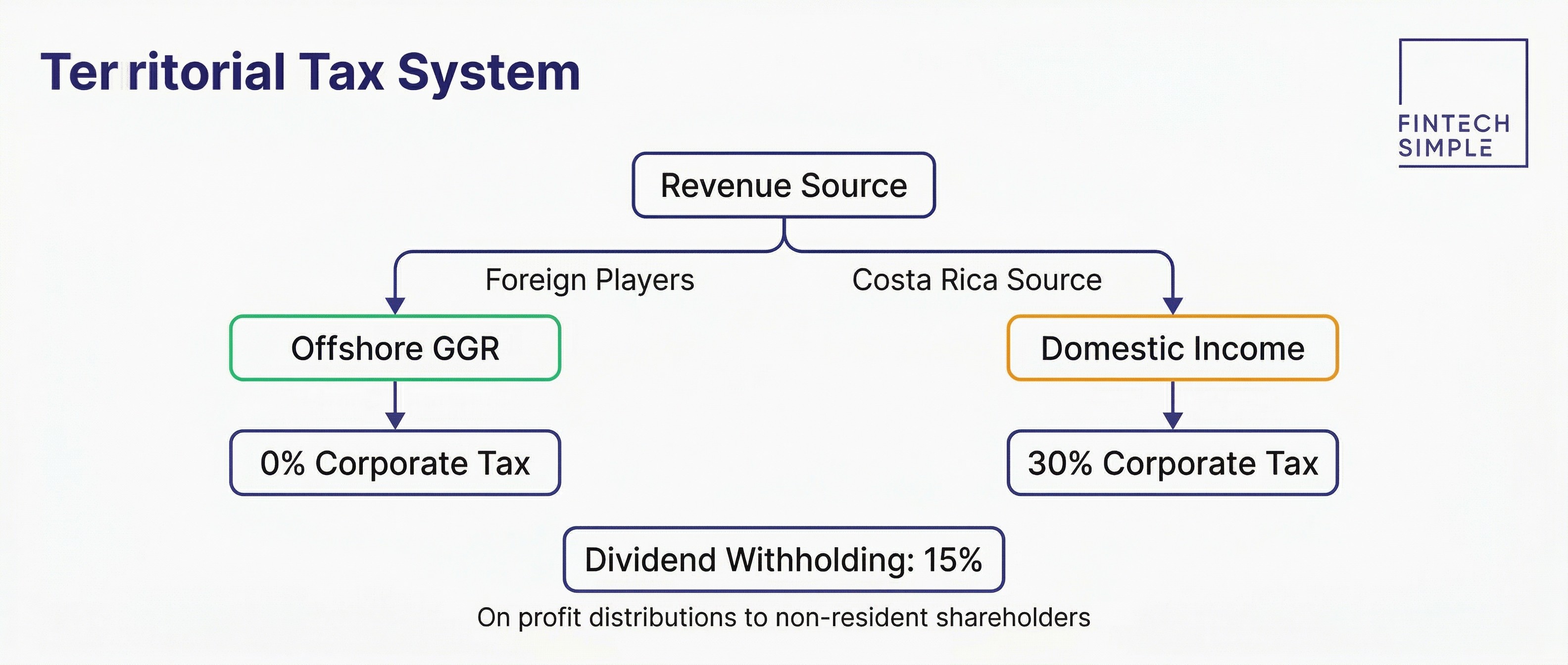
As covered above, Costa Rica’s territorial tax system means 0% tax on offshore GGR. This section covers the other tax obligations operators need to plan for.

Flowchart infographic showing how Costa Rica's territorial tax system works: 0% tax on offshore gambling revenue from foreign players, 30% on domestic-source income.

Territorial Tax System

Under Costa Rica’s Income Tax Law (Ley del Impuesto sobre la Renta), taxable income is defined exclusively as income with a Costa Rican source. Since a data-processing-permit operator’s revenue derives from international players — not from Costa Rican residents — this income is typically exempt from domestic corporate income tax. The result is an effective 0% corporate tax rate on offshore gambling revenue, making Costa Rica one of the most tax-efficient jurisdictions for online gaming operators targeting international markets.

Other Tax Obligations

While offshore revenue escapes corporate tax, operators maintaining a physical presence in Costa Rica still face several tax obligations on domestic-source income and local operations. The table below summarises the key taxes and their impact on a typical offshore gambling business.

Tax TypeRateApplies ToOffshore Gambling Impact
Corporate Income Tax30%Costa Rican-source income only0% on offshore revenue — foreign-sourced GGR is exempt under the territorial system
VAT (IVA)13%Goods and services consumed in Costa RicaApplies to local purchases (office rent, equipment, local services); does not apply to offshore gambling revenue
Dividend Withholding Tax15%Dividends distributed from Costa Rican entitiesApplies when profits are distributed to shareholders — the most significant ongoing tax consideration for operators
Interest & Royalty Withholding15–25%Payments to non-residents for interest, royalties, and fees for technical servicesRelevant if the corporate structure involves intercompany royalties or loan interest paid from the Costa Rican entity
Capital Gains Tax15%Gains on disposal of Costa Rican-source assets0% on offshore assets — gains from foreign-source investments or intellectual property are exempt
Payroll / Social Security (CCSS)26.83%Employer contribution on local employee salariesMandatory for any staff employed in Costa Rica; split between employer (~26.33%) and employee (~10.67%) contributions

The dividend withholding tax of 15% is the most significant ongoing consideration for operators extracting profits from their Costa Rican entity. Unlike corporate income tax — which can be avoided entirely through the territorial exemption — the withholding tax applies at the point of distribution regardless of income source. Operators should work with a qualified tax adviser to structure distributions efficiently, particularly when the parent company is domiciled in a jurisdiction that has a double-taxation agreement with Costa Rica.

Similarly, if your corporate structure involves intercompany royalties or management fees paid from the Costa Rican entity to a related company abroad, the 15–25% withholding on those payments can erode the tax advantage. Structuring these arrangements before incorporation — not after — avoids costly restructuring down the line.

AML/KYC Compliance Requirements

Costa Rica does not issue a dedicated gambling license, but that does not exempt operators from rigorous anti-money laundering obligations. Any business conducting financial activity in or through Costa Rica — including online gambling platforms — must comply with Law No. 8204/2001, the country’s primary AML statute. The law imposes customer due diligence, suspicious-transaction reporting, record-keeping, and internal-controls requirements on all obligated entities, including data-processing-permit holders.

Banks, payment processors, and international partners will require evidence of a functioning compliance programme before opening accounts or processing transactions. Operators who treat AML/KYC as an afterthought routinely discover that their biggest obstacle is not the permit itself — it is the inability to onboard with a PSP or open a corporate bank account without a documented compliance framework in place.

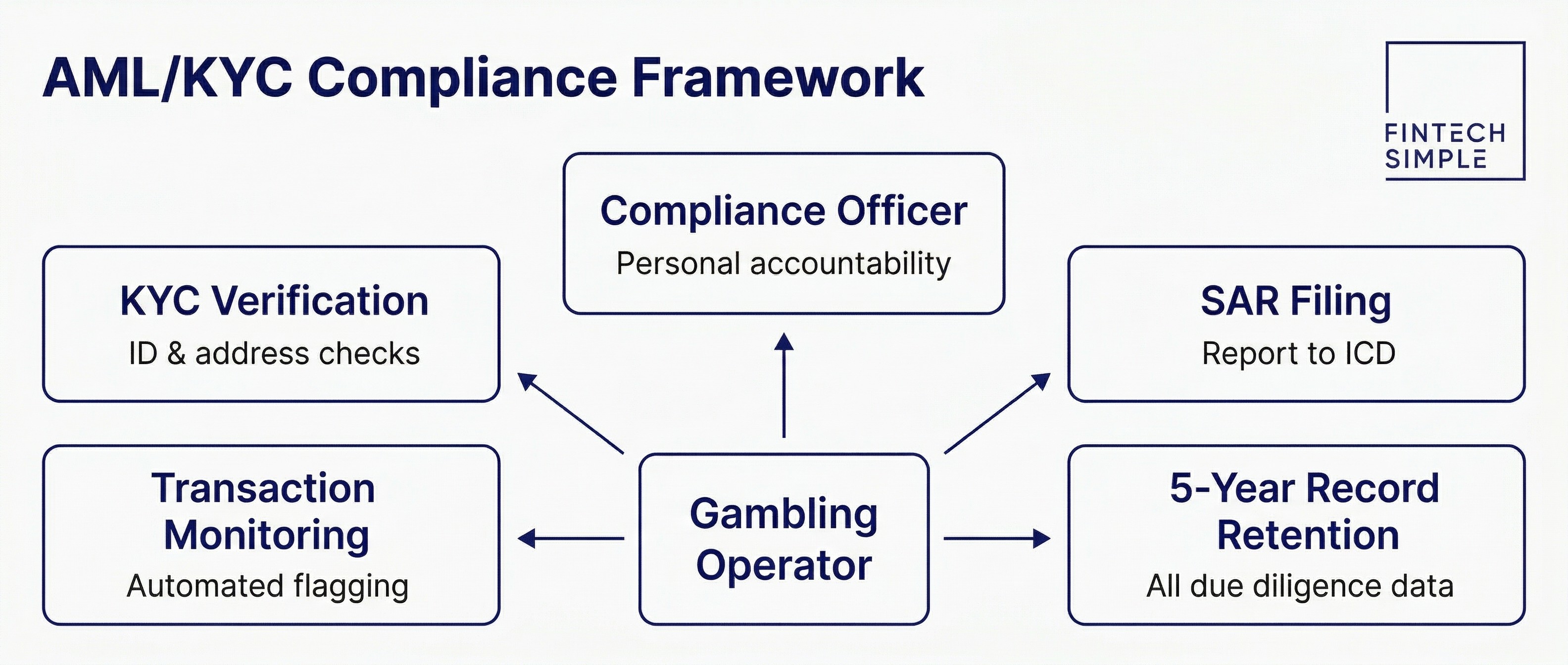
Flowchart infographic showing five key AML/KYC compliance obligations for Costa Rica gambling operators: KYC verification, transaction monitoring, SAR filing, record retention, and compliance officer.

Key Compliance Obligations

Law No. 8204/2001 imposes a structured set of obligations on regulated entities. For online gambling operators holding a Costa Rica data-processing permit, the practical requirements are as follows:

  • KYC verification — Collect and verify government-issued identification, proof of address, and source-of-funds documentation for every customer before allowing deposits or wagering. Enhanced due diligence applies to politically exposed persons (PEPs) and customers from high-risk jurisdictions.
  • Transaction monitoring — Implement automated systems to flag unusual patterns — large single transactions, rapid deposit-withdrawal cycles, structuring below reporting thresholds, and activity inconsistent with a customer’s declared profile.
  • Suspicious activity reporting (SAR) — File suspicious-transaction reports with the Instituto Costarricense sobre Drogas (ICD) within the statutory timeframe. Failure to report is a criminal offence under Law 8204.
  • 5-year record retention — Maintain all customer identification records, transaction logs, and internal compliance documentation for a minimum of five years from the date of the last transaction or the end of the business relationship.
  • Compliance officer appointment — Designate a local compliance officer (or responsible party) with authority to implement and enforce the AML programme, escalate suspicious activity, and liaise with the ICD.
  • Staff training — Conduct regular AML/KYC training for all employees involved in customer-facing, payment-processing, or risk-assessment functions. Training must be documented and updated annually.
  • Risk-based internal controls — Develop and maintain a written AML/CFT policy manual that defines risk categories, escalation procedures, and audit schedules. The policy must be proportionate to the scale and complexity of the operator’s business.

Failure to meet these obligations exposes the operator — and its officers — to administrative sanctions, fines, and potential criminal liability under Costa Rican law. In practice, enforcement intensity is lower than in jurisdictions such as Malta or Gibraltar, but non-compliance creates a material risk to banking relationships and PSP onboarding, which are already the most significant operational hurdles for Costa Rica-based gambling companies.

FATF Status

FATF Status — Not Grey-Listed

Costa Rica is a member of the GAFILAT (the regional FATF-style body for Latin America) and underwent its most recent Mutual Evaluation in 2015. As of 2026, Costa Rica is not on the FATF grey list (Jurisdictions under Increased Monitoring) or the black list (High-Risk Jurisdictions). Full country profile: FATF — Costa Rica.

In practical terms, this status matters because acquiring banks and payment service providers assess jurisdictional risk as part of their onboarding process. A grey-listed jurisdiction triggers enhanced due diligence requirements — or outright refusal — from most financial institutions. Costa Rica’s current clean standing removes one potential barrier to banking access, though it does not eliminate scrutiny of the gambling sector itself.

However, FATF membership does not eliminate scrutiny. Costa Rica’s 2015 Mutual Evaluation identified several areas of concern — including the effectiveness of suspicious-transaction reporting and the supervision of designated non-financial businesses and professions (DNFBPs). Operators should not assume that a clean FATF status translates into relaxed compliance expectations from banking partners; it simply means the country-level risk factor is neutral rather than negative.

Fintech Simple can assist with preparing a bank-ready compliance pack that demonstrates adherence to FATF recommendations and Costa Rican AML law — a critical deliverable for any operator seeking to open corporate accounts or onboard with international payment processors.

Banking and Payment Processing

One of the most persistent practical challenges for any Costa Rica gambling operation is not obtaining the license itself — it is getting money in and out of the business reliably. Costa Rica’s banking sector treats igaming companies with caution, and operators who do not plan their payment infrastructure in advance often face delays, frozen accounts, or outright refusals from local and international banks.

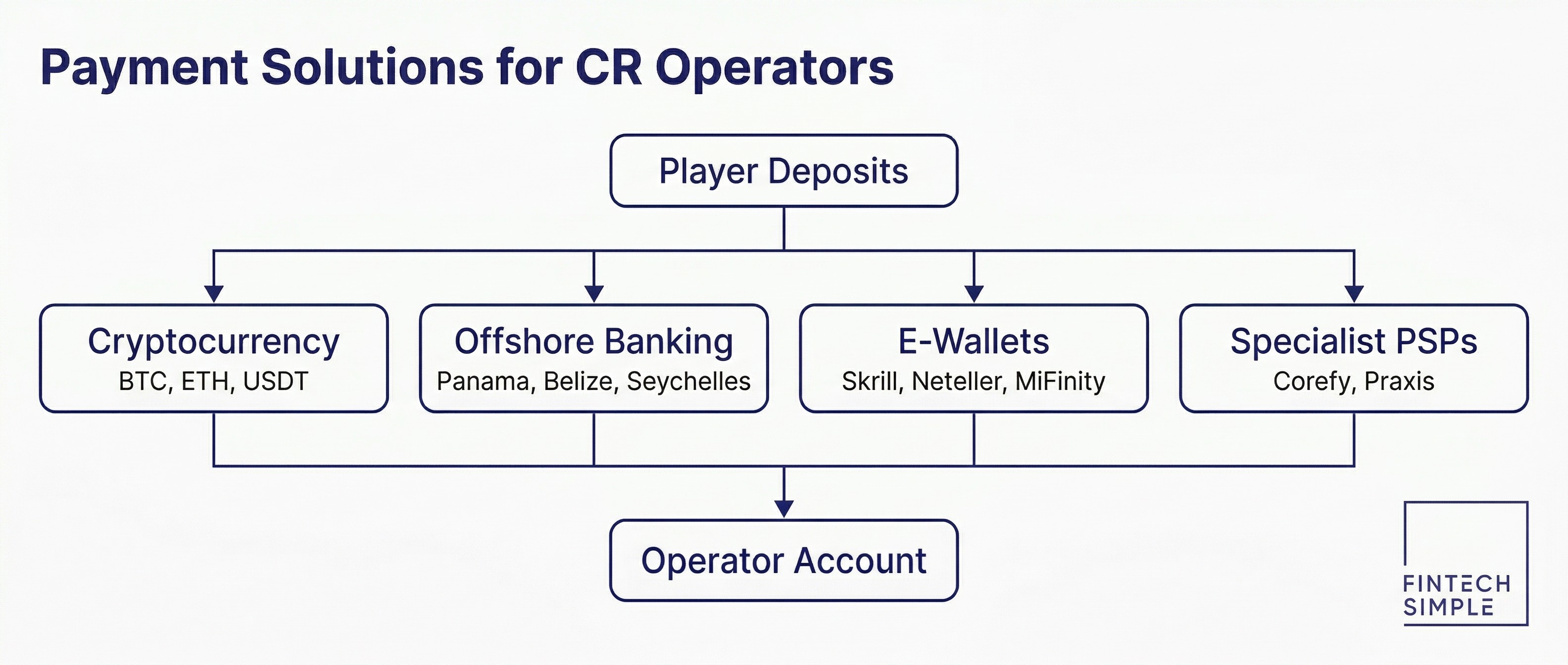
Flowchart infographic showing four payment solution channels for Costa Rica gambling operators: cryptocurrency, offshore banking, e-wallets, and specialist PSPs.

Banking Challenges

Operators frequently discover that the regulatory freedom Costa Rica offers does not extend to its banking system. Even with a fully registered data-processing company, opening and maintaining banking relationships requires persistence and proper documentation.

  • Local bank refusals — Most Costa Rican commercial banks decline to onboard companies whose primary activity is online gambling, citing internal risk policies regardless of the operator’s legal standing.
  • International processor scrutiny — Global payment processors classify igaming as high-risk, leading to elevated processing fees, extended underwriting timelines, and rolling reserves that can lock up 5–10 % of monthly volume.
  • Correspondent banking pressure — Even when a local bank agrees to service an igaming company, its US or European correspondent bank may flag the relationship during routine compliance reviews, triggering account closures with little notice.
  • Chargeback vulnerability — Card-based deposits carry chargeback rates significantly above the industry average for gambling transactions, pushing acquirers to impose strict velocity limits or terminate merchant accounts.
  • Currency conversion friction — Operators collecting revenue in multiple currencies face compounding conversion costs when settling into Costa Rican colones or repatriating funds to offshore accounts.

Payment Solutions

Experienced Costa Rica igaming operators do not rely on a single payment channel. Instead, they build a diversified payment stack that minimises dependency on any one banking partner or processor.

  • Cryptocurrency as the primary workaround — Bitcoin, USDT, and other stablecoins bypass traditional banking entirely, enabling instant deposits and withdrawals without chargeback risk or correspondent bank interference.
  • Offshore banking relationships — Banks in jurisdictions such as Belize, Puerto Rico, and certain Caribbean nations are more accustomed to igaming clients and offer USD-denominated accounts with fewer restrictions.
  • E-wallet integration — Providers like Skrill, Neteller, and MuchBetter specialise in igaming payments and offer player-friendly deposit and withdrawal flows with built-in fraud screening.
  • Specialist igaming PSPs — Payment service providers such as PayRedeem, Noda, and CashtoCode focus exclusively on gambling verticals, offering multi-currency acquiring, local payment methods, and chargeback management tools.
  • Prepaid card and voucher solutions — Systems like AstroPay and Flexepin allow players in restricted banking environments to deposit using prepaid vouchers purchased at retail locations or online.
  • Structured banking diversification — Maintaining accounts across multiple banks and jurisdictions ensures that a single account closure does not halt operations; experienced operators keep at least two active banking channels at all times.

Need help structuring your payment stack?

Our team works with vetted banking partners, PSPs, and crypto payment providers to build a resilient payment infrastructure tailored to your Costa Rica gambling operation.

Gambling License Comparison: Costa Rica vs. Key Alternatives

Licensing costs, tax exposure, time to market, and brand perception vary dramatically by jurisdiction. Below is a side-by-side breakdown of Costa Rica, Curaçao, Malta, and the Isle of Man — the four jurisdictions our clients compare most often when planning an online gambling launch.

CriterionCosta RicaCuraçaoMalta (MGA)Isle of Man (GSC)
Setup cost€5,000–€20,000€30,000–55,000€50,000–80,000+€30,000–60,000+
Ongoing annual costFrom $6,300/year€47,000–55,000€25,000–40,000+€30,000–50,000+
Setup timeline8–15 weeks3–5 months6–12 months3–6 months
Corporate tax rate0% on foreign-sourced income2%–15%5%–35%0% on gambling profits
International recognitionLow–moderateModerateVery high (EU-recognised)Very high
Player trust & brand perceptionLowerModerateHighHigh
License renewalNo formal renewalAnnual (CGA)AnnualAnnual
Best suited forStartups, MVP launch, non-EU marketsEarly-growth operatorsEstablished EU-facing operatorsPremium Tier-1 market operators

How to Read This Comparison

The Costa Rica vs. Curaçao trade-off is nuanced. Costa Rica wins on cost and speed but lacks a formal gambling licence — which limits payment-processor acceptance and player trust. Curaçao’s reformed CGA framework (effective 2024) offers a recognised gaming licence at a higher price point, making it the natural next step for operators who have validated their product and need broader PSP and affiliate access. Malta and the Isle of Man sit at the premium end: high upfront investment, long timelines, but unmatched credibility in regulated European and Tier-1 markets.

Bottom line: Use Costa Rica to launch fast and prove your concept. Once revenue justifies the investment, layer on a Curaçao or Malta licence to unlock better banking, stronger affiliate partnerships, and access to regulated player pools.

Not sure which licence fits your roadmap?

Our licensing team works across all four jurisdictions and can help you design a phased strategy — starting with the fastest, most cost-effective option and scaling into higher-tier licences as your operation grows.

Why Choose Fintech Simple for Your Costa Rica Gambling License

Obtaining a gambling license in Costa Rica involves navigating a patchwork of municipal frameworks, corporate structuring requirements, and banking relationships that most general-practice firms are not equipped to handle. Fintech Simple specialises exclusively in fintech and igaming licensing — it is our core business, and has been since 2016.

What Sets Us Apart

  • Proven track record since 2016 — More than 500 licenses issued for crypto, igaming, payment, and EMI clients worldwide. We have guided operators through Costa Rica’s data-processing permit process dozens of times and understand every step — from municipal filing nuances to inspector-visit preparation.
  • Fixed, transparent pricing — No hourly billing surprises. Every package on this page is a flat fee that covers government charges, notary costs, and our professional service. You know exactly what you will pay before you sign.
  • End-to-end support — From company incorporation and local director arrangements through bank account opening and AML policy drafting, we handle every element of the process so you can focus on building your platform.
  • Dedicated account manager — You are assigned a single point of contact who knows your file inside out. No call centres, no ticket queues — direct access to the person managing your application.
  • Multi-jurisdiction expertise — If your growth roadmap includes Curaçao, Isle of Man, Malta, or additional markets, we structure your Costa Rica entity with future expansion in mind and can run parallel licensing projects across jurisdictions.
  • Ongoing compliance support — Licensing is not a one-time event. We provide post-licence advisory, annual permit renewals, AML programme updates, and regulatory monitoring so your operation stays compliant as rules evolve.

Start Your Costa Rica Gambling Business Today

Join 500+ businesses that trust Fintech Simple for licensing and compliance. Get a personalized quote for your Costa Rica data-processing permit — no obligation, no hidden fees.

Our Experts

Our licensing team has guided 500+ gambling businesses through Costa Rica incorporation and data-processing permits since 2016. Each engagement is led by a dedicated lawyer with deep experience in offshore gaming jurisdictions, corporate structuring, and payment solutions.

Patrik Asevičius
Patrik Asevičius Lawyer, offshore gambling licensing specialist
Ilya Nikiforov
Ilya Nikiforov International Corporate Law Attorney
Anastassia Rumjantseva
Anastassia Rumjantseva Lawyer

Frequently Asked Questions about Gambling License in Costa Rica

Is online gambling legal in Costa Rica?

Online gambling is legal in Costa Rica under a long-standing permissive framework — the country has never enacted a law that explicitly prohibits internet gaming. Instead, operators obtain a data-processing permit issued by the local municipal authority (most commonly in San José), which authorises the company to run gambling software on servers hosted in Costa Rica. The key caveat is that the permit covers processing activity, not the targeting of Costa Rican residents; directing marketing at local players falls outside the permit’s scope.

What is the data-processing permit in Costa Rica?

The Costa Rica data-processing permit (sometimes called a gaming data-processing licence) is the primary authorisation available to online gambling operators in the country. It is issued by the local municipal authority and grants the right to host and operate gambling platforms — sports betting, casino games, poker rooms — from Costa Rican territory. The permit does not carry the same regulatory weight as, say, a Malta Gaming Authority licence; it is best understood as a business registration for data-processing services combined with a tax-residency structure rather than a strict gambling regulator approval.

How much does a gambling license in Costa Rica cost?

Total first-year costs for a gaming licence in Costa Rica typically range from $11,000 to $18,000, depending on whether you incorporate a Sociedad Anónima (S.A.) or a Sociedad de Responsabilidad Limitada (S.R.L.) and the level of service support you engage. This figure covers government incorporation fees, notary and apostille costs, registered-agent fees, the data-processing permit application, and a local legal representative for the first year. Ongoing annual maintenance — registered agent, accounting, and permit renewal — typically runs $3,000–$5,000 per year. There is no large licence fee comparable to regulated jurisdictions such as Malta or the Isle of Man.

How long does it take to obtain a Costa Rica gaming license?

Company incorporation in Costa Rica takes 3–5 weeks once all KYC documents are in order. The data-processing permit application adds a further 4–8 weeks, making the total timeline roughly 2–3 months from engagement to an operational entity. This is considerably faster than regulated markets — a Malta Gaming Authority licence, for comparison, can take 12–18 months. Delays typically arise from document apostille requirements, slow bank account opening, or incomplete beneficial-owner declarations.

Do I need a physical office in Costa Rica?

A registered address in Costa Rica is mandatory — the company must have a legal domicile for official correspondence. However, a full serviced physical office is not strictly required for the data-processing permit; most operators use a registered-agent address provided by a local law firm or formation agent. If you intend to employ staff locally or claim territorial tax exemption on foreign-sourced income, a more substantive presence (a lease, utility bills, and local staff) strengthens your position and reduces tax-residency risks.

Can I accept Costa Rican players?

No — not under the data-processing permit. The permit authorises processing services directed at players outside Costa Rica. Accepting bets from Costa Rican residents falls outside the permit’s scope and could expose the operator to local legal risk. In practice, most operators geo-block Costa Rica at the IP level. If you specifically wish to serve the local Costa Rican market, a separate concession from the Junta de Protección Social — which oversees domestic lottery and gambling — would be required, and those concessions are tightly restricted.

What is the difference between an S.A. and an S.R.L. in Costa Rica?

A Sociedad Anónima (S.A.) is the Costa Rican equivalent of a corporation — it issues shares, can have an unlimited number of shareholders, and is the most common vehicle for foreign-owned online gambling operations. Shares are transferable, making future equity arrangements straightforward. An S.R.L. (Sociedad de Responsabilidad Limitada) is closer to a limited-liability company; it has ‘quotas’ rather than shares and requires unanimous consent of members for transfers, making it better suited to small, stable ownership structures. For most online gambling operators expecting growth or investment, the S.A. is the preferred entity type.

Is Costa Rica a good jurisdiction for crypto gambling?

Costa Rica is a popular starting point for crypto gambling operators because of its low barriers to entry, absence of a prescriptive gambling law, and territorial tax system that exempts foreign-sourced income. Crypto transactions do not require a specific payment-service licence, unlike in many EU jurisdictions. However, the data-processing permit does not provide the same credibility signal as an MGA or UKGC licence, so crypto casinos using Costa Rica typically combine it with robust self-regulatory measures — provably fair certifications, third-party audits — to build player trust. Payment processor and banking access remain the biggest operational challenges.

What are the tax obligations for a Costa Rica gambling company?

Costa Rica operates a territorial tax system: income generated from sources outside Costa Rica is not subject to domestic corporate income tax. Since a data-processing-permit operator’s revenue derives from international players, this income is typically exempt from Costa Rican corporate tax. Local-source income (e.g., revenue from any Costa Rican players, which is already prohibited under the permit) would attract the standard 30% corporate rate. Companies must still file annual returns with the Ministerio de Hacienda and pay a small annual corporate tax (impuesto a las personas jurídicas) of roughly USD 400–500 regardless of activity level. Value-added tax (VAT) at 13% applies to local services consumed in Costa Rica.

Do I need a local legal representative in Costa Rica?

Yes. Costa Rican corporate law requires every S.A. to appoint a local registered agent and, in practice, most operators also retain a resident legal representative (often a Costa Rican attorney) who can act on behalf of the company before the Registro Nacional and government authorities. The local representative does not need to be a director or shareholder — they are typically engaged through a power of attorney. Fintech Simple’s Costa Rica service includes sourcing and managing a trusted local representative on your behalf.

Costa Rica vs. Curaçao — which is better for online gambling?

The right choice depends on your budget, target markets, and credibility requirements. Costa Rica is cheaper (lower setup and maintenance costs), faster to obtain, and imposes minimal regulatory burden — ideal for operators testing a new product or targeting markets indifferent to licence provenance. Curaçao (under the reformed Curaçao Gaming Authority framework since 2024) offers a recognised gaming licence, better payment-processor acceptance, and stronger brand credibility with players — at a higher cost and longer processing time. If you need to access payment processors that require a named gambling licence, or if your affiliate partners demand it, Curaçao is generally the more practical choice; for lean, crypto-focused operations, Costa Rica remains competitive.

What AML/KYC requirements apply to Costa Rica gambling companies?

Costa Rica’s Anti-Money Laundering Law (Law 8204) and its amendments impose AML/KYC obligations on all companies incorporated in the country, including data-processing-permit holders. Operators must maintain a written AML compliance programme, appoint a local compliance officer (or designate a responsible party), conduct customer due diligence proportionate to transaction risk, and file suspicious-transaction reports with the Instituto Costarricense sobre Drogas (ICD). In practice, the enforcement intensity is lower than in regulated jurisdictions such as Malta or Gibraltar, but non-compliance remains a legal risk — particularly given growing FATF scrutiny of Costa Rica’s AML framework.

Your Privacy

By clicking "Accept", you consent to the use of cookies and similar technologies on your device to improve site navigation, analyze usage, provide specific functionalities, and support our marketing initiatives. Cookies that are strictly necessary will always be active with this link.