


EMI License in Malta

EMI License in Malta

Authorise an Electronic Money Institution with the Malta Financial Services Authority. Issue e-money, run payment services across all 30 EEA jurisdictions, and add MiCA Electronic Money Tokens where the business model calls for it, all from a single EU base.

Fintech Simple has guided fintech founders through Malta EMI authorisation since 2016, with more than 500 licences obtained across the EU, LATAM, MENA and APAC. Our Malta team handles the full file under the Financial Institutions Act (Cap. 376) and the revised MFSA Financial Institutions Rulebook: corporate structuring, the MFSA application package, capital deployment, AML/CFT and DORA compliance, governance hires, and the MiCA EMT overlay where the business model touches stablecoins.

Ilya Nikiforov — Co-Founder and Head of Legal Department at Fintech Simple
Ilya Nikiforov
Co-Founder & Head of Legal Department

What Is a Malta EMI License?

Minimum capital

€350,000

MFSA application fee

From €10,000

End-to-end timeline

9–12 months

EU / EEA passport

30 jurisdictions

An EMI license in Malta is an authorisation issued by the Malta Financial Services Authority (MFSA) that allows a Maltese company to issue electronic money and provide a defined set of payment services to customers across the European Economic Area. The authorisation sits within the EU’s harmonised e-money framework, so a Malta EMI license carries a single passport into 27 EU Member States and the 3 EEA EFTA states (Iceland, Liechtenstein and Norway), reaching 456 million people from one regulated entity.

Definition under EMD2 and Cap. 376

A Malta EMI license is granted under the Financial Institutions Act, Cap. 376 of the Laws of Malta, which transposes EMD2 (Directive 2009/110/EC). The Act sets the €350,000 minimum capital under EMD2 Art. 4 and the governance, safeguarding and reporting rules on EMIs. It is supplemented by the MFSA Financial Institutions Rulebook: Chapter 1 (FIR/01) was republished in fully rewritten form on 14 October 2025, replacing FIR/01/2020 with a three-title structure covering application, licensing and post-licensing, while Chapter 3 (FIR/03) is the EMI-specific chapter.

EMI vs Payment Institution under Cap. 376

Cap. 376 also hosts the Maltese Payment Institution (PSP-only) regime, transposing PSD2. A Payment Institution may execute payment services listed in PSD2 Annex I (cash placement and withdrawal, execution of payment transactions, issuing and acquiring of payment instruments, money remittance, payment initiation and account information), with capital tiers of €20,000, €50,000 or €125,000 depending on the activity mix. A Malta EMI license adds the right to issue electronic money: redeemable monetary value stored electronically against funds received, which is what makes prepaid cards, e-wallets and stablecoin-style products possible. That extra right is why MFSA EMI authorisation requires €350,000 of paid-up capital rather than a PSP tier, and why an EMI may also carry on payment services and certain ancillary services within the same licence.

What changes under PSD3 / PSR

EMD2 is on a defined sunset path. The Council posted the final compromise texts of PSD3 and the Payment Services Regulation (PSR) on 23 April 2026, with Official Journal publication anticipated in mid-2026 (June–July, with a possible slip to September). The bulk of PSR conduct rules apply roughly 18 months after entry into force, in practice late 2027. PSD3 carries an 18-month transposition deadline, putting the national deadline in Q2/Q3 2028, at which point EMD2 is repealed and the EMI as a standalone authorisation disappears. Existing EMIs benefit from a 24-month grandfathering period, extendable to 30 months at national competent authority discretion, to re-authorise as Payment Institutions permitted to issue e-money. A Malta EMI license obtained today carries forward into the new framework rather than expiring on transposition day.

Malta EMI Licensing: Packages & Total Cost

Our Malta EMI packages cover the legal and project work needed to take a founder from incorporation to a live MFSA authorisation. All three tiers include Maltese company set-up, the full MFSA application dossier and RFI handling. They do not include the €350,000 initial capital, the MFSA application and supervisory fees under S.L. 376.03, the cost of premises, salaries for the Maltese governance team, or the statutory audit. Those are paid directly by the licensed entity. Ranges below cover scopes from Cat. 1 plus one Cat. 2 activity at the lower bound to full dual-Cat. 2 with a MiCA EMT overlay at the upper bound.

Upon request Standard
Upon request Plus
Upon request Premium
Maltese company incorporation & registered office
MFSA pre-application meeting preparation (10-working-day pack)
Full application dossier: business plan, 3-year projections, programme of operations
MFSA submission via LH Portal & RFI handling through In-Principle Approval
Governance hires support: MLRO, Compliance Officer, executive directors
AML/CFT manual, safeguarding policy & DORA compliance plan
Pre-licensing conditions remediation (capital, premises, staffing sign-off)
Personal Questionnaire (PQ) drafting for directors, shareholders & key persons
Safeguarding & operating bank account introductions
MiCA EMT whitepaper notification support (20 / 40 working-day filings)
EU / EEA passporting notifications (Freedom of Services & Establishment)
First-year ongoing compliance retainer (REQ, FI Returns, board pack)
Upon request Standard
  • Maltese company incorporation & registered office
  • MFSA pre-application meeting preparation
  • Full application dossier & 3-year projections
  • MFSA submission & RFI handling through In-Principle Approval
  • Governance hires support (MLRO, Compliance, directors)
  • AML/CFT manual, safeguarding policy & DORA plan
  • Pre-licensing conditions remediation
  • Bank & safeguarding account introductions
  • MiCA EMT whitepaper notification support
  • EU / EEA passporting notifications
  • First-year ongoing compliance retainer
Upon request Plus
  • Maltese company incorporation & registered office
  • MFSA pre-application meeting preparation
  • Full application dossier & 3-year projections
  • MFSA submission & RFI handling through In-Principle Approval
  • Governance hires support (MLRO, Compliance, directors)
  • AML/CFT manual, safeguarding policy & DORA plan
  • Pre-licensing conditions remediation
  • PQ drafting for directors, shareholders & key persons
  • Bank & safeguarding account introductions
  • MiCA EMT whitepaper notification support
  • EU / EEA passporting notifications
  • First-year ongoing compliance retainer
Upon request Premium
  • Everything in Plus
  • Safeguarding & operating bank account introductions
  • MiCA EMT whitepaper notification support (20 / 40 working-day filings)
  • EU / EEA passporting notifications (Freedom of Services & Establishment)
  • First-year ongoing compliance retainer (REQ, FI Returns, board pack)

MFSA application and supervisory fees (post-1 January 2025 schedule)

The MFSA fee schedule was revised under S.L. 376.03 with effect from 1 January 2025. The pre-revision €3,500 / €2,500 figures that still circulate on competitor pages are outdated and should not be used to budget a new file. Under the current schedule, both the application fee and the annual supervisory fee scale with the activity mix, and the supervisory fee carries a variable component on top of the fixed floor, capped at €250,000 per year.

Activity scopeApplication fee (one-off)Annual supervisory fee (fixed component)
Cat. 1 (e-money issuance) + one Cat. 2 activity ~€10,000 €25,000
Both Cat. 2 activities ~€15,000 €35,000

On top of the fixed component, the supervisory fee adds a variable component equal to the higher of (i) 0.02% of total assets, or (ii) the aggregate of 0.0003% of total payment-transaction value plus 0.01% of average daily outstanding e-money. The total annual supervisory fee is capped at €250,000, and first-year fees are prorated from the date of authorisation.

Total cost of entry: realistic budget range

A Malta EMI is not a low-cost authorisation. Budget the full Year-1 cost of entry, not the advisory fee alone: regulatory capital, MFSA fees, premises, governance hires and the statutory audit dominate the spend. The table below shows the range from a single-Cat. 2 file at the lower bound to a dual-Cat. 2 file with MiCA EMT overlay at the upper bound.

Cost lineYear-1 range
Initial regulatory capital (locked, not a fee)€350,000
MFSA application fee (one-off)~€10,000 – ~€15,000
MFSA annual supervisory fee (fixed, prorated Year 1)€25,000 – €35,000 + variable component
Fintech Simple advisory (Standard → Premium)Upon request
Year-1 OPEX (Maltese premises, MLRO, Compliance Officer, executive directors, IT, statutory audit)€180,000 – €350,000+
Indicative Year-1 total (excluding locked capital)~€250,000 – ~€500,000+

Fee bands depend on the activity mix elected and should be confirmed against the current consolidated S.L. 376.03 fee schedule at the time of application.

Our Malta EMI Licensing Team

500+ licence approvals since 2016 across 40+ jurisdictions, with a dedicated EU practice covering MFSA EMI files, MiCA EMT issuance, EMD2 and PSD2. Our Malta team runs e-money files end-to-end: MFSA pre-application meetings, in-principle approval, capital injection and post-licensing conditions.

Ilya Nikiforov
Ilya Nikiforov Co-Founder & Head of Legal Department
Patrik Asevičius
Patrik Asevičius Head of Licensing Department
Marcin Mostowski
Marcin Mostowski Lawyer, EU & MiCA

Why Choose Malta for an EMI License

Malta is the EU’s most credible English-language base for an Electronic Money Institution that also intends to issue Electronic Money Tokens under MiCA. It is not the cheapest or fastest route (Lithuania remains lighter-touch for pure e-money), but for founders who need a clean MiCA EMT story, eurozone settlement, and a regulator that engages substantively in English, the calculus tilts to Valletta.

MFSA: pragmatic but credible regulator

The Malta Financial Services Authority is the single authoriser and supervisor for EMIs under the Financial Institutions Act (Cap. 376) and the MFSA Financial Institutions Rulebook. Its reputation sits between the heavyweight (BaFin, ACPR) and the light-touch (Bank of Lithuania) regulators: substantive enough that MFSA-authorised entities carry weight with EU correspondent banks and MiCA host states, pragmatic enough to engage with novel fintech business models in pre-application meetings.

Eurozone settlement, not just an EEA passport

The 30-jurisdiction EEA passport is the headline benefit, but the operational edge is the euro. Malta sits inside the eurozone, so SEPA and SEPA Instant settlement are domestic, not cross-border, an ongoing cost advantage over EMIs based in non-eurozone EEA jurisdictions such as Sweden, Denmark or Poland.

MiCA-compatible base for EMT issuers

Under MiCA, an authorised EMI can issue Electronic Money Tokens by notifying the MFSA, which receives but does not formally approve the whitepaper. For founders building euro- or USD-pegged stablecoin rails, Malta lets you anchor both the EMI and the EMT under one regulator instead of stitching together authorisations across two jurisdictions.

English-speaking professional ecosystem

English is an official working language of Malta alongside Maltese. Legislation is enacted bilingually, while MFSA correspondence, audit reports and the regulator’s pre-application meetings run in English; court proceedings default to Maltese but are conducted in English by consent of the Maltese-speaking parties under the Judicial Proceedings (Use of English Language) Act, Cap. 189 — the practice in most commercial matters. The legal system is a civil-law/common-law hybrid, with common-law overlay in fiscal, corporate, shipping and trust law from the British colonial era, which reduces translation friction for UK, US, Irish, Indian and Commonwealth-domiciled founders. Big-Four and mid-tier auditors, Maltese-warranted advocates, and fintech-experienced compliance officers are all available in-market.

Tax efficiency without offshore stigma

Malta’s nominal corporate rate is 35%, but the full imputation system delivers an effective rate of ~5% on trading income via the 6/7 shareholder refund on dividend distribution. Malta is the only EU member state operating a full imputation system, so this is an EU-internal tax outcome, not an offshore shelter. Groups that prefer a flat rate can elect the FITWI regime (15% final tax) introduced in September 2025.

Where Malta is NOT the right pick

The tradeoff

Malta is heavier-touch than Lithuania: the mandatory MFSA pre-application meeting, 9–12 month timeline, and 6–18 month post-licensing conditions window are real friction. If you need the fastest, cheapest pure-EMI authorisation with no MiCA overlay, Lithuania is usually the better pick. Malta wins when the business model touches MiCA EMT issuance, when English-language regulator dialogue matters for your investors or board, or when you want a single EU home for both the EMI and the stablecoin rail.

Permitted Activities & MiCA / EMT Crossover

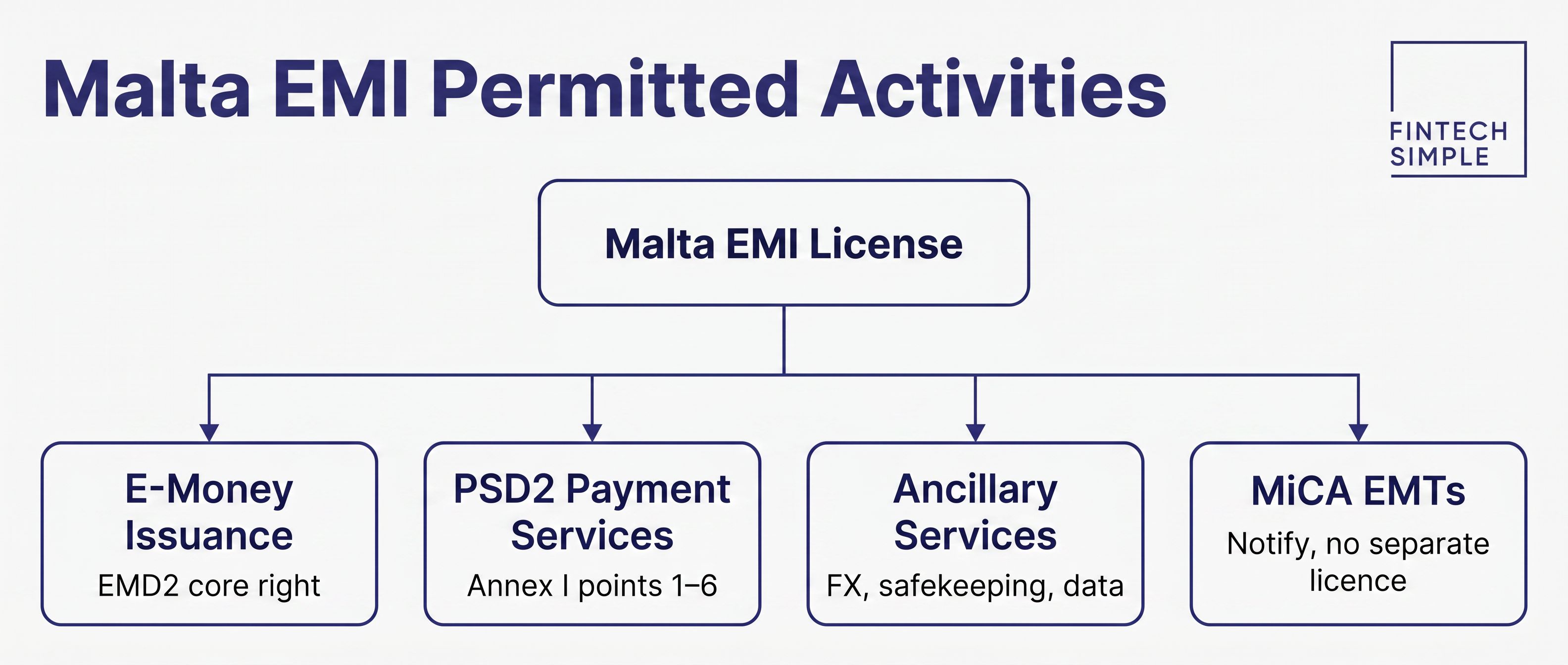
A Malta Electronic Money Institution authorised under the Financial Institutions Act (Cap. 376) and the MFSA Financial Institutions Rulebook can operate across three layers: it issues electronic money, it provides PSD2 payment services elected at application, and it offers a defined set of ancillary services. MiCA adds a fourth layer (issuance of Electronic Money Tokens) that an EMI can combine with the base licence to issue stablecoins from the same EU entity. The Instant Payments Regulation (Reg (EU) 2024/886) overlays SEPA Instant on this scope.

Hierarchy diagram showing the four activity layers under a Malta EMI license: e-money issuance, PSD2 payment services, ancillary services, and MiCA Electronic Money Tokens.

Core: issuance of electronic money

The defining activity of an EMI is issuing electronic money: monetary value stored electronically against funds received from the holder, redeemable at par, and accepted by third parties. The legal basis is EMD2 (Directive 2009/110/EC), transposed into Cap. 376 and supplemented by the MFSA FIR/03. Funds received against e-money are not deposits and cannot be lent. They sit under the safeguarding regime at all times.

Payment services under PSD2 Annex I

A Malta EMI may, alongside e-money issuance, elect any of the payment services in Annex I of PSD2 (Directive (EU) 2015/2366), transposed into Cap. 376:

  • Cash placement and withdrawal on a payment account, including all related operations.
  • Execution of payment transactions: direct debits, card payments and credit transfers, whether funded by the user’s balance or by a credit line.
  • Issuing and/or acquiring of payment instruments: card issuing, wallet issuing, merchant acquiring.
  • Money remittance: transfer of funds without a payment account in the payer’s or payee’s name.
  • Payment initiation services (PIS): initiating a payment order at the user’s request from an account held at another PSP.
  • Account information services (AIS): consolidated account information from one or more PSPs.

Ancillary services (FX, safekeeping, data, ancillary credit)

Cap. 376 also permits a closed list of ancillary services tied to the EMI’s core scope: foreign exchange in connection with payment services, safekeeping activities and storage and processing of data related to payment services, and the operation of payment systems. Ancillary credit may be granted only where it is strictly incidental to a payment transaction: short-term, never granted from funds received against e-money or from safeguarded payment-service funds, and consistent with the EMI’s own funds. Standalone lending and deposit-taking remain outside the licence.

Issuing Electronic Money Tokens (EMTs) under MiCA

Under Regulation (EU) 2023/1114 (MiCA), an authorised EMI may issue Electronic Money Tokens without a separate crypto-asset licence, provided it continues to satisfy Cap. 376 in full and complies with the MiCA EMT regime mapped out in the MFSA MiCA Rulebook. The whitepaper is not formally “approved” by the MFSA. The issuer notifies the Authority within the lead times below.

MiCA EMT notificationMinimum lead time to MFSALegal basis
Whitepaper notification At least 20 working days before publication Art. 51(11) MiCA
Intention to offer to the public or admit to trading At least 40 working days in advance Art. 48(6) MiCA

Instant Payments Regulation (Reg (EU) 2024/886)

The Instant Payments Regulation extends SEPA Instant to every eurozone PSP on a phased schedule, with separate timetables by PSP type: eurozone credit institutions must be able to receive SEPA Instant credit transfers from 9 January 2025 and send them from 9 October 2025, while eurozone payment institutions and EMIs have a single deadline of 9 April 2027 for both receive and send. Verification of Payee (VoP) applies to all eurozone PSPs (including EMIs) from 9 October 2025, with later deadlines for non-eurozone PSPs. In 2025 the MFSA amended FIR/03 to set out the procedure for PIs and EMIs to participate in designated payment systems supporting instant credit transfers. A Malta EMI moving euro flows now plans for SEPA Instant access at authorisation, not as a later upgrade.

Capital & Own-Funds Requirements

Capital is the gating constraint for any Malta EMI file. The Malta Financial Services Authority (MFSA) applies the EMD2 baseline plus the calibrations in Chapter 3 of the Financial Institutions Rulebook (FIR/03), transposed through the Financial Institutions Act, Cap. 376. Founders need to know three numbers before filing: the initial capital threshold, the PSP-only tier that applies if the licence does not include e-money issuance, and the ongoing own-funds floor.

Initial capital: €350,000 for an EMI

A Malta EMI must hold a minimum initial capital of €350,000, fully paid-up before the licence is issued. The figure derives from Article 4 of EMD2 (Directive 2009/110/EC) and is transposed into Cap. 376 and FIR/03. MFSA verifies the deposit at the in-principle approval stage. Capital is injected once the application has cleared substantive review, alongside the other pre-licensing conditions (banking, premises, key personnel).

PSP-only capital tiers (€20k / €50k / €125k)

If the entity will not issue e-money and instead seeks a Payment Institution (PSP) authorisation under Cap. 376 transposing PSD2 Article 7, the initial capital scales to the activity mix:

Initial capitalPSD2 Annex I activity
€20,000 Money remittance only (Annex I point 6)
€50,000 Payment initiation services (Annex I point 7), not “execution of payment transactions”
€125,000 All other payment services in Annex I points 1–5 (cash placement/withdrawal, execution of payment transactions, issuing/acquiring of payment instruments)

An EMI authorisation supersedes these PSP tiers: the €350,000 EMI threshold applies regardless of which PSD2 services are bundled into the licence.

Ongoing own-funds rule

EMD2 Article 5 and FIR/03 require Malta EMIs to hold own funds at all times equal to the higher of (i) the €350,000 initial capital floor, and (ii) the calculated own-funds requirement under FIR/03: broadly 2% of average outstanding electronic money, plus, where the EMI also carries out payment services unrelated to e-money issuance, additional Method A / B / C scaling from PSD2 (commonly 0.25%–4%). The calculation is recomputed on each reporting cycle. Any shortfall must be remediated immediately, and an own-funds breach is a supervisory trigger.

Where capital must sit and how it is verified

The €350,000 must be paid-up share capital deposited with a Maltese credit institution and evidenced to MFSA before licence issuance. It cannot be commingled with client funds, which sit separately under the safeguarding rules (see the Ongoing Compliance section). Securing a Maltese banking relationship for the capital account is one of the more time-sensitive pre-licensing tasks and should be scoped from week one of the engagement.

Discuss Your Malta EMI File With Our Licensing Team

Book a 30-minute scoping call. We will map your activity mix, capital, timeline and budget against the post-1 January 2025 MFSA fee schedule and return a clear next-step plan.

Malta EMI Application Process: Step-by-Step

End-to-end timeline runs 9–12 months for a well-prepared file. The statutory decision window under PSD2/EMD2 (carried into FIR/01) is three months from a complete dossier to determination, with a hard cap of six months from initial receipt; in MFSA practice the formal decision typically lands close to that six-month cap, with the remainder of the 9–12 months absorbed by banking, capital deployment and pre-licensing conditions. The eight phases below reflect how Fintech Simple runs a Malta EMI file under the revised Financial Institutions Rulebook Chapter 1 (FIR/01, October 2025).

Step 1 Weeks 1–2

Pre-engagement and scoping

What we do: We map your target activity mix (Cat. 1 e-money issuance, Cat. 2 payment services, MiCA EMT overlay) against MFSA expectations, then size capital, governance and the realistic timeline before any cost is committed.

  • Activity-scope analysis: e-money issuance plus the specific PSD2 Annex I services you need, with MiCA EMT layered in where stablecoins are part of the model
  • Capital and own-funds modelling: €350,000 initial baseline plus the FIR/03 ongoing calculation against projected outstanding e-money
  • Engagement letter and Year-1 budget: advisory fees, MFSA fees, capital, premises, staffing and audit set out in a single forecast
Step 2 Weeks 3–6

Mandatory pre-application meeting with MFSA

What we do: We prepare the formal pre-application presentation now required under the revised FIR/01 (October 2025) and submit it to MFSA at least 10 working days before the meeting, then sit on the call alongside the founders.

  • Group structure and flow-of-funds diagrams: shareholders, beneficial owners, settlement rails and safeguarding accounts mapped end-to-end
  • 3-year financial projections: P&L, balance sheet and cash flow with stress-testing scenarios per FIR/01
  • Governance and DORA compliance plan: board composition, key function holders, ICT risk framework and third-party oversight
Step 3 Weeks 4–8 (parallel)

Maltese company incorporation

What we do: We incorporate the Maltese applicant entity in parallel with the pre-application track so the legal vehicle is ready to receive paid-up capital and contract for premises and staff the moment In-Principle Approval lands.

  • Malta Business Registry filing: memorandum and articles, share register, registered office and statutory officers in place
  • Tax and VAT registrations: income tax number and, where relevant, VAT registration filed
  • Operational onboarding readiness: corporate KYC pack and banking-ready file built around the projected capital deployment
Step 4 Weeks 6–14

Application package preparation

What we do: We assemble the full MFSA application file (business plan, projections, policies, programme of operations and Personal Questionnaires) in line with FIR/01 and FIR/03 expectations for an EMI applicant.

  • Business plan and programme of operations: products, target markets, distribution, agents and outsourcing arrangements
  • Internal control framework: AML/CFT manual, safeguarding methodology, IT and security policy with DORA mapping, complaints, conflicts and outsourcing
  • Personal Questionnaires: PQs for qualifying shareholders, directors, chief officers, MLRO, compliance officer and internal auditor, compiled with supporting documentation
Step 5 Weeks 14–16

Formal submission via the MFSA LH Portal

What we do: We upload the complete dossier to the MFSA Licence Holders (LH) Portal, pay the application fee under the post-1 January 2025 schedule and submit the PQs alongside.

  • LH Portal upload: full application package, supporting documents and PQs filed in one submission
  • Application fee payment: €10,000 for Cat. 1 plus one Cat. 2 activity, or €15,000 where both Cat. 2 activities are sought
  • Acknowledgement and case team: MFSA confirms receipt and assigns the analyst team that will run the review
Step 6 Months 4–8

MFSA review, RFIs and fit-and-proper assessment

What we do: We act as the single point of contact for MFSA, coordinating Requests for Information, drafting responses, and preparing each director, shareholder and key function holder for the fit-and-proper assessment.

  • RFI management: substantive answers to MFSA queries on business model, projections, governance, safeguarding and ICT
  • Fit-and-proper coverage: directors, qualifying shareholders (10% threshold), MLRO and internal auditor assessed under MFSA Fitness & Properness Guidance
  • Interviews and clarifications: preparation and attendance for any MFSA interviews with directors or key personnel
Step 7 Months 8–10

In-Principle Approval and pre-licensing conditions

What we do: We close out the MFSA pre-licensing conditions that follow In-Principle Approval (capital injection, banking, premises, staffing and safeguarding arrangements) before the licence is formally issued.

  • Capital deployment: €350,000 paid-up share capital placed with a Maltese credit institution, evidenced to MFSA
  • Operational substance: Maltese office, resident director(s), MLRO, compliance officer and key staff onboarded
  • Safeguarding accounts opened: segregated client-money accounts with a Maltese credit institution, with reconciliation procedures evidenced to MFSA
Step 8 Months 10–12 + 6–18 months post-licensing

Final licence and post-licensing conditions window

What we do: We collect the final EMI authorisation, launch live operations and run the post-licensing conditions window of 6 to 18 months that MFSA reserves under the revised FIR/01.

  • Licence issuance and go-live: EMI authorisation under Cap. 376 issued; live products switched on with safeguarding accounts active
  • Post-licensing conditions (6–18 months): MFSA may require, for example, an independent internal audit report or additional reporting on capital, governance and ICT
  • Ongoing reporting cadence: quarterly FI Returns within one month of reporting date and Annual REQ by 31 January each year, in line with MFSA expectations for newly authorised EMIs

Required Documents for the MFSA Application

A Malta EMI application is a single, integrated file rather than a list of forms. The MFSA expects a coherent business case backed by audited-grade financials, a complete internal control suite mapped to the MFSA Financial Institutions Rulebook — principally the revised FIR/01 (authorisation and licensing, October 2025) together with FIR/03 (the EMI-specific chapter on safeguarding and conduct), and Personal Questionnaires for all proposed directors, qualifying shareholders and key function holders (Compliance Officer, MLRO and other key persons).

Business plan and 3-year financial projections

The business plan must explain the target customer, product mix, distribution model, programme of operations across the requested PSD2 / EMD2 activities, organisational structure and reporting lines, and the planned Maltese substance: head office, on-island staffing and the board and committee architecture. Every other document (capital plan, AML risk assessment, IT policy) ties back to it.

Financials run on a three-year horizon (P&L, balance sheet and cash-flow statements), with stress-testing scenarios that demonstrate the EMI can meet the ongoing own-funds requirement under adverse conditions. Volumes of e-money outstanding and payment transactions should be modelled month-by-month so the MFSA can assess capital adequacy and safeguarding capacity at submission.

Internal controls and policy suite

The MFSA expects a full internal control framework, not template documents lifted from another jurisdiction. Each policy must be tailored to the applicant’s business model and reflect Maltese law, FIR/03 and the relevant EU Regulations. The core suite includes:

  • AML/CFT manual: risk-based methodology, customer due diligence, ongoing monitoring and STR procedures aligned with the PMLFTR and FIAU Implementing Procedures.
  • Safeguarding policy: chosen method — segregation (by deposit in a credit institution or investment in secure, liquid, low-risk assets) or insurance / comparable guarantee — and operational controls evidencing daily reconciliation.
  • Conflicts of interest policy: identification, mitigation and disclosure across board, shareholders, agents and outsourcing providers.
  • Complaints handling procedure: intake, escalation, regulator reporting and customer-facing disclosure.
  • Outsourcing policy: critical-and-important function identification, due diligence, contract minimums and exit plans.
  • IT and security policy: mapped to DORA (Regulation (EU) 2022/2554) requirements on ICT risk management, incident reporting, resilience testing and third-party ICT oversight.

Personal Questionnaires (PQs) and fit-and-proper evidence

Personal Questionnaires are submitted via the MFSA LH Portal at least one month before appointment and are required for all proposed directors, qualifying shareholders and key function holders (Compliance Officer, MLRO and equivalent roles). PQ scope covers:

  • Qualifying shareholders: any holder of ≥10% of capital or voting rights.
  • Ultimate beneficial owners further up the ownership chain.
  • Chairperson and all directors (executive and non-executive).
  • Chief officers (CEO, CFO, COO and equivalents).
  • Compliance Officer and the MLRO.
  • Internal auditor and other key function holders.

Each PQ is supported by certified passport, proof of address, CV, professional references, regulatory references where the candidate has prior FS roles, and a clean police-conduct certificate. MFSA assesses the file against the MFSA Fitness & Properness Guidance and the MFSA PQ Guidelines. Weakness in any individual PQ is the most common cause of avoidable delay.

Governance, Substance & Fit-and-Proper Test

The MFSA assesses a Malta EMI application on its business plan, its capital, the people behind it, and the operational footprint that will run the licence day-to-day. Governance, fitness-and-properness and substance are tested together. Weak board composition, an unproven Money Laundering Reporting Officer (MLRO), or a paper-only Maltese presence are common reasons applications stall. The rules below come from Chapter 3 of the Financial Institutions Rulebook (FIR/03) and the related MFSA guidance notes.

Board composition: at least three directors, including one INED

Under FIR/03, the licence holder’s business must be effectively directed from Malta by at least two individuals serving as executive directors and/or senior management, and the board must comprise at least three members, including at least one Independent Non-Executive Director (INED). This is not codified as “two local directors”, but the practical evidence the MFSA expects is mind-and-management actually carried out on-island, typically a Malta-resident director (or directors) supported by local key personnel. Additional non-executive directors and an independent chair are normal, proportionate to the size and risk profile of the EMI.

Qualifying shareholders: the 10% threshold

A 10% holding of capital or voting rights (direct or indirect) makes a person a qualifying shareholder and triggers a full MFSA fitness assessment. The threshold matches the EU CRD-style transposition into the Financial Institutions Act (Cap. 376). Subsequent changes that cross the 20%, 30% or 50% thresholds, and any change of control, also require prior MFSA notification and approval. Personal Questionnaires, source-of-funds evidence and ultimate beneficial-owner disclosures must be lodged for every qualifying shareholder.

Fit-and-proper test: who it covers

The fit-and-proper assessment under the MFSA Fitness and Properness Guidance applies to directors, qualifying shareholders, key personnel, the MLRO and the internal auditor. The MFSA examines competence and experience (relevant payments, EMI or financial services background), reputation and integrity (criminal, regulatory and civil record), independence of mind, and conflicts of interest. Adverse findings against any one person on this list can hold up the whole application until the individual is replaced or the concern is resolved.

MLRO appointment: prior MFSA approval required

The MLRO is an MFSA-approved officer, not an internal hire the EMI makes unilaterally. Prior MFSA approval is required before the MLRO takes up the role. The MFSA Guidance for Money Laundering Reporting Officers in the Financial Services Sector (14 March 2024) sets out what the regulator expects: adequate AML/CFT experience, sufficient seniority and authority within the organisation, independence from commercial functions, and a direct reporting line to the board. A Personal Questionnaire is submitted via the LH Portal in good time before the proposed start date to allow for the MFSA’s due-diligence process on the role.

Mind-and-management substance in Malta

Substance is operational, not cosmetic

The MFSA expects a Malta EMI to be run from Malta: a Maltese head office (not a co-working address used only for correspondence), local compliance and MLRO functions, periodic on-island board meetings with proper minutes, and ICT operations organised consistently with DORA. Outsourcing to group entities is permitted under FIR/03 but cannot hollow out the Maltese substance: the regulated functions, key decisions and oversight must demonstrably sit with the Malta-licensed entity.

Ongoing Compliance: Safeguarding, AML/CFT, DORA & Reporting

Once the Malta EMI licence is live, the operational burden shifts from authorisation to continuous compliance. The MFSA expects a Malta EMI to safeguard every cent of client e-money, run a risk-based AML/CFT programme reporting into the FIAU, meet DORA’s ICT-resilience expectations, and submit prudential and compliance returns on a fixed annual and quarterly calendar.

Safeguarding of client funds: two methods

Safeguarding of e-money holders’ funds is governed by Article 7 of EMD2 and, at Maltese level, by the Financial Institutions Act (Safeguarding of Funds) Regulations (S.L. 376.04). The framework offers two permitted methods — segregation or insurance — and Malta EMIs must document which method (or combination) they rely on and how it operates in practice.

  1. Segregation: client funds are kept separate from the EMI’s own funds, either by depositing them in a separately designated account at an authorised credit institution, or by investing them in secure, liquid, low-risk assets held in a separately designated custody account. In both cases the funds are ring-fenced from the EMI’s general estate and from insolvency creditors.
  2. Insurance policy or comparable guarantee: coverage from a credit institution or insurance undertaking that does not belong to the EMI’s group, payable to e-money holders if the EMI fails to meet its obligations.

The full text of S.L. 376.04 is available on legislation.mt; the EMD2 baseline is summarised by the FCA.

AML/CFT, FIAU reporting and record retention

A Malta EMI is a “subject person” under the PMLFTR and must run a full risk-based AML/CFT programme: business-wide risk assessment, customer due diligence, ongoing monitoring, sanctions screening, training and an MLRO function with a direct reporting line to the board. Suspicious Transaction Reports and Suspicious Activity Reports (STRs / SARs) are filed to the FIAU through the goAML Malta portal; the MFSA acts as agent of the FIAU for supervisory purposes on the prudential side.

Customer identification, transaction and due-diligence records must be retained for a minimum of 5 years and no more than 10 years after the end of the business relationship or completion of the occasional transaction, per the PMLFTR and FIAU Implementing Procedures Part 1 (2025).

DORA: ICT risk and operational resilience

The Digital Operational Resilience Act (Regulation (EU) 2022/2554) has applied to Malta EMIs since 17 January 2025. The four pillars an EMI must build into its operating model are: ICT risk management (governance, identification, protection, detection, response and recovery); ICT-related incident reporting on the supervisory timeline; digital operational resilience testing, including threat-led penetration testing for significant entities; and third-party ICT risk oversight, including a register of contractual arrangements and contractual safeguards with critical providers.

Prudential reporting under FIR/03 and the FI Return

Beyond AML and ICT, Malta EMIs file periodic prudential and statistical returns to the MFSA under the reporting obligations in Chapter 3 of the Financial Institutions Rulebook (FIR/03), submitted via the consolidated FI Return jointly designed by the MFSA, the Central Bank of Malta and the FIAU. The reporting package covers the balance sheet, income statement and capital-adequacy templates (tracking own funds against the higher of €350,000 and the calculated FIR/03 requirement), alongside audited annual financial statements and the interim data the MFSA uses for off-site supervision.

Annual REQ and quarterly FI Returns deadlines

The compliance and reporting calendar is fixed and was clarified by an MFSA Circular dated 27 January 2026. The annual external audit is mandatory with no size-based exemption: MFSA-regulated EMIs cannot claim audit relief regardless of balance-sheet size.

ObligationFrequencyDeadline
Annual REQ (Compliance Report) Annual 31 January each year
FI Returns Quarterly Within one month of the reporting date
External audit of financial statements Annual Per FIR Chapter 8 (no size exemption)

EU Passporting From Malta

A Malta EMI authorisation gives you the right to operate across all 30 EEA jurisdictions through three routes: establishing a branch (Freedom of Establishment), providing services cross-border without local presence (Freedom of Services), or appointing agents and distributors in host states. Each route has its own MFSA notification mechanics and host-state expectations, detailed below.

Freedom of Establishment (branch) vs Freedom of Services

Freedom of Services (FoS) lets you serve customers in another EEA state without any local presence. Freedom of Establishment (FoE) means operating through a branch in the host state, and (where the EMI also uses agents under right of establishment) the host may require a Central Contact Point under PSD2 Article 29(4) and the related EBA RTS.

DimensionFreedom of Establishment (branch)Freedom of Services (cross-border)
Local presence Branch in host state (+ Central Contact Point if the host requires one for agent networks) None required
MFSA expectation before passport ~6–12 months of stable operation in Malta (market practice, not codified) Can begin almost immediately after notification
Host-state supervision Shared (home + host competent authority for conduct) Home-state supervision (MFSA)
Typical use case Material on-the-ground operations, agent networks, cash handling Pure digital distribution, app-based e-money, B2B payments

Agents and distributors for cross-border e-money

EMIs may also extend their reach in other Member States through agents (for payment services, governed by PSD2 passporting rules applied mutatis mutandis via EMD2 Article 3(1)) and distributors (for the distribution and redemption of e-money under EMD2 Article 3(4)–(5)). Each agent or distributor must be notified to the MFSA, which in turn notifies the host-state authority. The EBA Opinion on passport notifications for e-money agents and distributors clarifies that these notifications are a form of passporting in their own right and must follow the established passport notification procedure.

Notification procedure via MFSA

All three routes (branch, services and agents/distributors) flow through the MFSA as home-state competent authority. The institution files a passport notification with MFSA specifying the host state(s), the services to be provided, and (for branches and agents) the local arrangements. MFSA reviews the file, then transmits it to the host competent authority within the statutory window set out in EMD2 and PSD2. Once the host authority confirms receipt and the home authority registers the passport, the institution can commence activity in the host state.

Market reach: 30 EEA jurisdictions, ~456M people

A single Malta EMI authorisation reaches 30 EEA jurisdictions: the 27 EU Member States plus the three EEA EFTA states (Iceland, Liechtenstein and Norway). Combined population is approximately 456 million consumers: the EU stood at ~450.4 million on 1 January 2025 per Eurostat, with the EEA EFTA trio adding roughly 6 million more.

Malta Tax Treatment for EMIs

Malta’s headline corporate tax is 35% on chargeable income, but the full imputation system has historically delivered an effective rate of around 5% on trading income for non-electing companies. From year of assessment 2025 onwards, Malta-licensed EMIs also have a second option: the new Final Income Tax Without Imputation (FITWI) regime, a flat 15% final tax with no refunds and a 5-year lock-in. The Pillar Two rules are separately deferred under a six-year derogation (detail below).

RegimeDefault (full imputation)FITWI election
Headline rate35% corporate tax15% final tax
Effective rate on trading income~5% (6/7 shareholder refund)15% (no refund)
Imputation / refunds6/7, 5/7 or 2/3 by income typeNone
CommitmentSwitch in or out year by year5-year lock-in (re-locks for another 5 years on switch back)

Nominal 35% corporate tax

A Malta-resident EMI is subject to corporate income tax at the standard 35% rate on its worldwide chargeable income (2026). The Malta Tax and Customs Administration administers the regime under the Income Tax Act. See the MTCA corporate tax overview for the current rates and filing mechanics.

Full imputation refund and ~5% effective rate

Malta is the only EU member state still operating a full imputation system. The 35% tax paid at company level is imputed as a credit to shareholders on dividend distribution, and the company can claim a refund of 6/7, 5/7 or 2/3 of the Malta tax depending on the income type. For trading income (which covers most EMI fee revenue) the 6/7 refund typically brings the effective Malta tax burden down to around 5% for non-electing companies. This remains the default position for most EMI and fintech start-ups in 2026.

FITWI 15% optional final tax

Introduced by Legal Notice on 2 September 2025 and effective from year of assessment 2025 onwards, the Final Income Tax Without Imputation (FITWI) regime lets any Maltese entity elect a flat 15% final tax with no shareholder refunds and no imputation credits. The election carries a 5-year lock-in, and switching back out of FITWI re-locks the company under its previous regime for a further 5 years, so the decision turns on the full distribution policy rather than a single year.

Pillar Two: six-year deferral, no QDMTT yet

Malta has invoked the six-year derogation in Article 50 of the EU Pillar Two Directive, deferring the Income Inclusion Rule (IIR) and Undertaxed Profits Rule (UTPR) until financial years starting on or after 31 December 2029. As of early 2026, no Qualified Domestic Minimum Top-up Tax (QDMTT) has been enacted, and none is expected to be introduced in 2026, although Malta is consulting the European Commission on a regime of qualified refundable tax credits. In-scope multinational groups with consolidated revenues above €750 million remain within the global Pillar Two perimeter (top-up tax may be collected by another jurisdiction) but face no Maltese domestic top-up tax for now. Sub-threshold EMIs continue to apply the imputation or FITWI regimes described above.

Get a Tailored Timeline & Documents Checklist

Share your business model and target activity mix. We will return a tailored 9–12-month timeline plus a Malta EMI documents checklist within two working days.

Frequently Asked Questions about the Malta EMI License

How much does a Malta EMI license cost in 2026?

Under the MFSA fee schedule that took effect on 1 January 2025, the application fee is €10,000 for Cat. 1 plus one Cat. 2 activity, or €15,000 where both Cat. 2 activities are sought. Annual supervisory fees comprise a fixed component of €25,000 or €35,000 plus a variable component capped at €250,000. Add €350,000 paid-up capital; Fintech Simple advisory pricing is available upon request. See the consolidated S.L. 376.03.

What is the minimum capital for a Malta EMI?

Initial capital is €350,000 fully paid-up before the licence is issued, as required by EMD2 Article 4 and transposed in the Financial Institutions Act (Cap. 376) and MFSA FIR/03. On an ongoing basis, an EMI must hold own funds equal to the higher of €350,000 or the calculated own-funds requirement under FIR/03 (broadly 2% of average outstanding electronic money), with additional scaling where unrelated payment services are also performed.

How long does it take to obtain an EMI license in Malta?

Plan for 9–12 months end-to-end from a complete application to the final licence. The formal MFSA decision window for a complete file is around 6 months, with banking arrangements, the mandatory pre-application meeting and remediation extending the overall timeline. Under the revised FIR/01 (republished 14 October 2025), MFSA may also impose post-licensing conditions for 6 to 18 months after commencement of business.

Who regulates Electronic Money Institutions in Malta?

EMIs are authorised and supervised by the Malta Financial Services Authority (MFSA) under the Financial Institutions Act (Cap. 376), which transposes EMD2 (Directive 2009/110/EC). The regime is supplemented by the MFSA Financial Institutions Rulebook: FIR/01 (republished 14 October 2025) on application, licensing and post-licensing, and FIR/03, the dedicated chapter for Electronic Money Institutions.

Can a Malta EMI passport into other EU and EEA countries?

Yes. A Malta EMI can passport into 30 EEA jurisdictions (the 27 EU Member States plus Iceland, Liechtenstein and Norway) through EMD2 and PSD2 notification procedures. Freedom of Services (cross-border, remote) can begin shortly after notification. Freedom of Establishment (a branch) takes longer: MFSA typically expects 6–12 months of stable operation in Malta before supporting a branch passport application.

What are the safeguarding requirements for client funds under a Malta EMI license?

EMD2 Article 7 and Malta’s subordinate regulations S.L. 376.04 prescribe two methods: (1) segregation of client funds — either deposited in a separately designated account at a Maltese credit institution, or invested in secure, liquid, low-risk assets held in a separately designated custody account; or (2) an insurance policy or comparable guarantee from an insurance undertaking or credit institution outside the EMI’s group. Most Malta EMIs combine segregation with a contingent insurance arrangement for resilience.

Does my Malta EMI need a physical office and local directors?

Yes. MFSA requires at least two executive directors who effectively direct the business from Malta, with mind-and-management substance demonstrated through resident director(s) and local personnel (typically including a compliance officer and an MLRO). The licensee must maintain a Maltese head office, hold board meetings on the island and run its core risk, compliance and finance functions from Malta rather than delegating them offshore.

Can a Malta EMI issue Electronic Money Tokens (EMTs) under MiCA?

Yes. Under Article 48(1) of MiCA (Regulation (EU) 2023/1114), a Cap. 376 EMI may issue Electronic Money Tokens without a separate authorisation. The crypto-asset whitepaper must be notified to MFSA at least 20 working days before publication (Article 51(11)), and the intention to offer to the public or admit to trading at least 40 working days in advance (Article 48(2)). MFSA receives the notification; it does not formally “approve” the whitepaper.

What is the effective corporate tax rate for a Malta EMI in 2026?

The nominal corporate tax rate is 35% on chargeable income, but Malta’s full imputation system reduces it to an effective rate of around 5% on trading income via a 6/7 shareholder refund on dividend distributions. As an alternative, the Final Income Tax Without Imputation (FITWI) regime, introduced by Legal Notice on 2 September 2025, allows a 15% final tax election with no refunds and a 5-year lock-in, which usually only suits specific group structures.

How does DORA apply to a Malta EMI?

Regulation (EU) 2022/2554 (DORA) has applied to Malta EMIs since 17 January 2025. It covers ICT risk management, incident classification and reporting, digital operational resilience testing, and oversight of critical third-party ICT providers. MFSA expects DORA to be embedded in the applicant’s IT and security policy at submission, including the third-party ICT register and incident-handling procedures.

What happens to my Malta EMI authorisation when PSD3 and PSR take effect?

The Council’s final compromise on PSD3 and PSR was posted in April 2026, with OJ publication expected by end of Q2 2026. The bulk of PSR conduct rules will apply around late 2027, and EMD2 will be repealed once PSD3 is transposed (Q2/Q3 2028 deadline). Existing Malta EMIs benefit from a 24-month grandfathering window (extendable to 30 months) to re-authorise as Payment Institutions issuing e-money.

Your Privacy

By clicking "Accept", you consent to the use of cookies and similar technologies on your device to improve site navigation, analyze usage, provide specific functionalities, and support our marketing initiatives. Cookies that are strictly necessary will always be active with this link.