

UK Crypto License: FCA Registration Requirements, Cost & Process (2026)

UK Crypto License: FCA Registration Requirements, Cost & Process (2026)

Get FCA cryptoasset registration with expert guidance. Full-service support from UK company formation to regulatory approval, 3 to 6 month timeline.

Fintech Simple has guided crypto businesses through FCA registration since the UK introduced its cryptoasset licensing framework in 2020. Our team handles every stage, from UK company formation and MLRO appointment through AML policy development and FCA application management. With over 500 licences obtained across 40+ jurisdictions, we bring hands-on experience with the FCA’s requirements and registration process.

Patrik Asevičius — UK licensing expert at Fintech Simple
Patrik Asevičius
Head of Licensing Department, United Kingdom & offshore jurisdictions

TL;DR for decision-makers

The UK does not have a separate "crypto license" — you need FCA registration under the Money Laundering Regulations 2017. The application fee is £11,150 (flat fee, Category 6); processing takes roughly 5 months for a well-prepared submission (statutory deadline is 3 months). You will need a real UK office, a UK-knowledgeable MLRO, a full AML/KYC framework, and fit-and-proper clearance for all directors and beneficial owners. Corporation tax is 19–25%. The FSMA authorisation gateway opens 30 September 2026 — if you are not launching before that date, apply directly for FSMA authorisation instead of MLR registration. Total budget from engagement to launch: roughly £45,000–£70,000 depending on the service package, plus ongoing compliance costs.

What Is a UK Crypto License?

Application fee

GBP 11,150

Timeline

3–6 months

Corporate tax

19–25%

Licences issued

500+ since 2016

The United Kingdom does not issue a standalone "crypto license." Instead, any business that carries out cryptoasset activity in the UK must register with the Financial Conduct Authority (FCA) under the Money Laundering, Terrorist Financing and Transfer of Funds (Information on the Payer) Regulations 2017, commonly known as the MLR 2017. This registration has been mandatory since 10 January 2020, when the UK transposed the EU's Fifth Anti-Money Laundering Directive (5AMLD) into domestic law. The FCA acts as the AML/CTF supervisor, while HM Treasury sets the broader policy direction for cryptoasset regulation.

FCA Cryptoasset Registration Under MLR 2017

MLR 2017 registration is not the same as full FCA authorisation. It confirms that a firm meets the FCA's anti-money-laundering standards: KYC/CDD procedures, transaction monitoring, suspicious activity reporting, and record-keeping. It does not cover conduct-of-business rules, capital adequacy, or consumer protection in the way that authorised-firm status does.

The FCA assesses every applicant against several criteria before granting registration:

  • Fit-and-proper test — directors, beneficial owners, officers, managers, and the Money Laundering Reporting Officer (MLRO) must demonstrate integrity, competence, and financial soundness
  • UK physical office — the FCA requires a bona fide UK presence under the MLRs (Regulation 8L covers cryptoasset businesses specifically); a brass-plate address will not suffice
  • MLRO with UK regulatory knowledge — while no absolute statutory bar on location exists, the FCA expects the MLRO to have appropriate knowledge of UK regulation and AML/CTF practice
  • AML/CTF policies and procedures — a documented risk assessment, compliance manual, staff training programme, and ongoing monitoring framework

The FCA application fee for cryptoasset registration is £11,150 (Category 6 of FCA pricing, per FEES Appendix 4 Annex 1, ORA-indexed annually). The fee is non-refundable regardless of the outcome.

Activities That Require Registration

Under the MLR 2017 framework, you must hold FCA registration if your business carries out any of the following cryptoasset activities in or from the UK:

  • Cryptoasset exchange services — converting cryptoassets to fiat currency, fiat to cryptoassets, or one cryptoasset to another
  • Custodial wallet provision — safeguarding or administering cryptoassets, or private keys, on behalf of customers
  • Cryptoasset ATM operation — running machines that allow users to buy or sell cryptoassets
  • ICO and token issuance facilitation — issuing or facilitating the sale of cryptoassets as part of an initial coin offering or token generation event
  • Peer-to-peer exchange platforms — operating a platform that matches buyers and sellers of cryptoassets

Warning

Operating without registration is a criminal offence. Under Regulation 86 of the Money Laundering Regulations 2017, carrying on cryptoasset business without FCA registration can result in up to 2 years' imprisonment and/or a fine on indictment.

The Upcoming FSMA Crypto Regime (October 2027)

The current MLR-only registration system is transitional. HM Treasury has enacted the Financial Services and Markets Act 2000 (Cryptoassets) Regulations 2026, which extends FSMA 2000 to cover a broad range of cryptoasset activities. The new regime takes effect on 25 October 2027.

Once active, the FSMA-based framework will replace MLR registration with full FCA authorisation. Key changes include:

  • Broader scope — the new rules will cover activities beyond AML/CTF, including conduct-of-business requirements, capital adequacy, and consumer protection obligations
  • Authorisation instead of registration — firms will need to meet capital and organisational requirements comparable to those applied to traditional financial services firms
  • Faster processing targets — since January 2026, the FCA targets 4-month turnaround for complete applications, an improvement over the current average of approximately 5 months

If you currently hold MLR registration, you should begin preparing for the transition now. The FCA has published guidance on what firms can expect from the new regime and the steps required to convert an existing registration into full FSMA authorisation.

Planning ahead

Our licensing team tracks every FCA policy update and regulatory change affecting crypto businesses in the UK. Whether you need MLR registration today or want to prepare for the FSMA transition, we can map out the right strategy for your timeline and business model.

UK Crypto License Cost

FCA registration costs fall into two categories: the service fee you pay a consultancy to prepare and manage your application, and the government fees paid directly to the FCA. Every package below includes FCA application preparation, AML/KYC policy drafting, and compliance documentation. The FCA registration fee is non-refundable regardless of outcome, so the quality of your submission matters.

Our Packages

All packages include document preparation, FCA application filing, and ongoing communication with the regulator throughout the review process (the FCA's statutory deadline is 3 months from a complete application, though actual processing often takes longer).

Standard £17,000
Premium £28,000
Full application preparation
Document drafting
FCA submission & correspondence
Legal representation during review
End-to-end "white glove" support
Direct FCA liaison
Implementation of compliance tools
Staff training
Post-registration audit prep
Standard £17,000
  • Full application preparation
  • Document drafting
  • FCA submission & correspondence
  • Legal representation during review
  • End-to-end "white glove" support
  • Direct FCA liaison
  • Implementation of compliance tools
  • Staff training
  • Post-registration audit prep
Premium £28,000
  • Full application preparation
  • Document drafting
  • FCA submission & correspondence
  • Legal representation during review
  • End-to-end "white glove" support
  • Direct FCA liaison
  • Implementation of compliance tools
  • Staff training
  • Post-registration audit prep

Government Fees

The FCA charges a flat, non-refundable registration fee for cryptoasset business applications. Once registered, firms pay annual supervision fees based on their income. These fees are set by the FCA and adjusted annually.

Fee typeAmountWhen paid
Registration fee (Category 6) £11,150 With application
Annual supervision fee (minimum) ~£2,229 Annually after registration
Annual supervision fee (variable) £15.13 per £1,000 of income over £100,000 Annually after registration

Fee sources

Registration fees are set by the FCA Handbook FEES App 4 Annex 1. Annual supervision fees are published in the FCA FEES App 4.3. All fees are ORA-indexed and may be adjusted each financial year.

Total Budget Estimate

The table below estimates total first-year costs for each service package, including government fees and key operational expenses. Actual costs depend on your business structure, MLRO arrangements, and office requirements.

Cost categoryStandardPremium
Service fee £17,000 £28,000
FCA registration fee £11,150 £11,150
UK office / registered address £3,000–£6,000/yr Included
MLRO (outsourced or in-house) £12,000–£30,000/yr £12,000–£30,000/yr
Compliance setup Included Included
Annual FCA supervision fee From ~£2,229/yr From ~£2,229/yr
Estimated first-year total £45,350–£65,350 £53,350–£70,350

Budget note

The MLRO line is often the largest variable. An in-house, UK-based MLRO with FCA experience typically commands £60,000–£90,000 per year in salary alone. Outsourced MLRO services start at around £12,000 per year for smaller firms. Your choice here significantly affects both total cost and the strength of your FCA application.

Our Experts

Our team specialises in UK financial regulation and FCA crypto registration. With 500+ license approvals worldwide and experience licensing crypto businesses since 2016, we handle the full FCA application process, from initial compliance assessment to final authorisation. Our specialists know what the FCA expects and work with each client to build a submission that passes on the first review.

Patrik Asevičius
Patrik Asevičius Lawyer, FCA-licensed
Ilya Nikiforov
Ilya Nikiforov International Corporate Law Attorney
Anastassia Rumjantseva
Anastassia Rumjantseva Lawyer

Regulatory Framework for Crypto in the UK

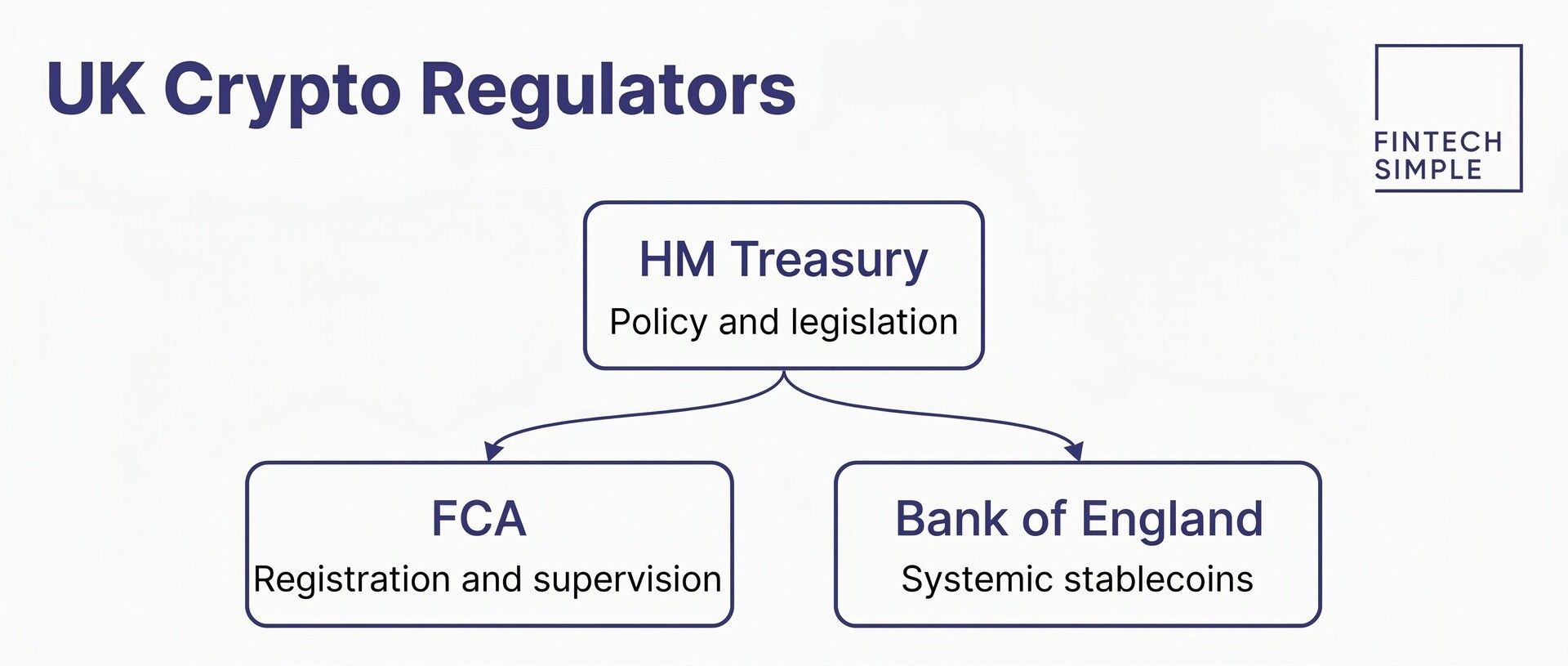
The UK regulates crypto businesses through three government bodies with distinct responsibilities. The rules that apply to your firm today differ from those taking effect on 25 October 2027.

Hierarchy diagram showing three UK crypto regulatory bodies: HM Treasury setting policy, FCA handling registration, and Bank of England overseeing systemic stablecoins

FCA: The Primary Regulator

The Financial Conduct Authority (FCA) is the primary regulator for crypto businesses in the UK. Since January 2020, any firm carrying on cryptoasset activity in the UK must register with the FCA under the Money Laundering Regulations. The FCA assesses whether applicants meet anti-money laundering standards, conducts fit and proper checks on directors and beneficial owners, and maintains the public Financial Services Register where all approved crypto firms appear.

The FCA’s role is expanding. Under the new regulatory framework taking effect on 25 October 2027, the FCA will move from a registration-based model to a full authorisation regime — meaning crypto firms will need to meet conduct-of-business standards, capital requirements, and ongoing supervisory obligations comparable to those of traditional financial services firms.

HM Treasury and Bank of England

HM Treasury sets the policy direction for UK crypto regulation. It drafts the statutory instruments that define which cryptoasset activities become regulated, determines the timetable for new rules, and consults with industry on the shape of the future regime. The Financial Services and Markets Act 2000 (Cryptoassets) Regulations 2026 — the legal instrument extending FSMA to cover crypto — was published by HM Treasury.

The Bank of England’s role is narrow. Its Financial Policy Committee monitors crypto-related risks to financial stability, but the BoE does not regulate crypto businesses generally. The Bank will regulate systemic stablecoins once HM Treasury formally recognises specific stablecoin issuers as systemically important — a step that has not yet occurred. Do not confuse the BoE with a day-to-day crypto regulator; that function sits with the FCA.

Key Legislation

Two statutes form the backbone of UK crypto regulation:

  • Money Laundering Regulations 2017 (MLR 2017) — the current framework. Amended in January 2020 to transpose EU 5AMLD, the MLRs require crypto firms to register with the FCA, implement AML/CTF controls, appoint a Money Laundering Reporting Officer, and submit suspicious activity reports. This is the regime you must comply with today.
  • Financial Services and Markets Act 2000 (FSMA 2000) — the incoming framework. The FSMA 2000 (Cryptoassets) Regulations 2026 extend FSMA’s regulated activities regime to cover cryptoassets. This does not take effect until 25 October 2027. Once live, crypto firms will need full FSMA authorisation — not just MLR registration.

Important distinction

As of May 2026, crypto firms need only MLR registration. FSMA authorisation for crypto activities is not yet required. Firms that conflate these two regimes risk preparing for the wrong set of obligations.

Financial Promotions Regime

If your business markets crypto products or services to UK consumers — regardless of where your company is based — the financial promotions regime applies. Under FSMA Section 21, communicating a financial promotion without authorisation is a criminal offence carrying up to 2 years’ imprisonment and an unlimited fine.

There are four lawful routes to issue a crypto financial promotion in the UK:

  1. Made by an authorised person — an FCA-authorised firm issues the promotion directly as part of its own regulated business.
  2. Approved by an authorised person — an FCA-authorised firm reviews and approves the promotion on behalf of an unauthorised company before it is published.
  3. MLR-registered cryptoasset business — firms on the FCA’s crypto register can communicate their own promotions, provided they comply with FCA rules on risk warnings, appropriateness assessments, and a mandatory 24-hour cooling-off period for new customers.
  4. Exempt under statutory order — certain promotions qualify for exemptions (e.g., communications to high-net-worth investors or sophisticated investors), but these exemptions are narrow and fact-specific.

Most competitors overlook this regime entirely. For your business, it means that FCA registration is not just about AML compliance — it also unlocks the ability to legally market your crypto services in the UK. Without registration, you cannot advertise to UK customers through any of the routes above.

Regulatory Timeline: 2020 to 2027

DateMilestoneImpact
10 Jan 2020 MLR 2017 amendments take effect; FCA becomes AML/CTF supervisor for cryptoasset businesses Crypto firms must register with the FCA for the first time
30 Sep 2024 Digital Securities Sandbox launched (Policy Statement PS24/12) Controlled environment for firms testing tokenised securities under modified regulations
2025 FCA publishes Discussion Paper DP25/1 and Consultation Paper CP25/15 on the new crypto regime Industry input shapes authorisation requirements, conduct rules, and prudential standards
2026 FSMA 2000 (Cryptoassets) Regulations 2026 published Legal instrument extending FSMA to cryptoassets — but does not take effect until October 2027
25 Oct 2027 New FSMA-based crypto authorisation regime takes effect Crypto firms transition from MLR registration to full FCA authorisation with conduct and prudential requirements

The gap between now and October 2027 is your preparation window. Firms that secure MLR registration today will be better positioned to transition to the full authorisation regime — the FCA has indicated that existing registered firms will have a structured pathway to the new regime.

Requirements for FCA Crypto Registration

Before the FCA will add your firm to its register of cryptoasset businesses, you need to satisfy a set of structural, personnel, and documentary requirements under the Money Laundering Regulations 2017 (MLR 2017). The bar is high — the FCA assesses not just your paperwork, but whether your business can genuinely prevent financial crime from day one of operations.

UK Presence and Office

A bona fide UK physical presence is mandatory under Regulations 8 and 9 of the MLRs. This means a real office staffed by people who make decisions — not a virtual mailbox or a serviced-address registration. The FCA will verify that your UK establishment is operational and that key management functions are carried out from it.

Your firm does not need to be structured as a limited company. While a UK Ltd is the most common vehicle, the FCA accepts sole traders, partnerships, and other legal structures. Choose a structure that fits your business model, but be aware that the fit-and-proper assessment applies to all beneficial owners and officers regardless of entity type.

Key Personnel and MLRO

Every applicant must appoint a Money Laundering Reporting Officer (MLRO) responsible for your firm’s compliance with AML/CTF obligations. The FCA expects the MLRO to be based in the UK and will look carefully at any application where the MLRO is located elsewhere. While no statutory bar prevents a non-UK MLRO, the practical reality is that FCA interviews are conducted in person at its offices — creating a strong operational requirement for UK presence.

All directors, beneficial owners, officers, managers, and the MLRO undergo a fit and proper assessment. The FCA evaluates each individual’s honesty, integrity, reputation, competence, and financial soundness. Criminal records, prior regulatory sanctions, and undisclosed conflicts will result in rejection. Prepare detailed CVs and disclosure statements for every person in a controlled function.

AML/KYC Policy Requirements

Your application must include a comprehensive AML/KYC policy framework that demonstrates how the firm will identify, assess, and mitigate money laundering and terrorist financing risks. The FCA expects these policies to be specific to your business activities — generic templates copied from other sectors will not pass review. See the full documents checklist below for the complete list of required documentation.

Financial Resources

The FCA requires applicants to demonstrate adequate financial resources to carry out their cryptoasset activities and meet ongoing regulatory obligations. Your application must include financial projections, evidence of funding sources, and a clear explanation of how the business will sustain itself through the initial period of operation.

Unlike some jurisdictions that specify a fixed minimum capital figure, the FCA takes a proportionate approach — what counts as “adequate” depends on the nature, scale, and complexity of your business. A firm offering only crypto-to-crypto exchange services may need less capital than one handling large-volume fiat-to-crypto transfers. Expect the FCA to scrutinise your financial forecasts and challenge assumptions that appear unrealistic.

Documents Checklist

The following documents form the core of your FCA cryptoasset registration application. Missing or incomplete items are the primary cause of delays — the FCA will not begin substantive review until your submission is complete.

DocumentDetails
Completed application form FCA’s standard cryptoasset business registration form, signed by an authorised officer
Business plan Description of cryptoasset activities, target markets, revenue model, and three-year financial projections
Business-wide risk assessment ML/TF risk assessment specific to your cryptoasset services, customer types, and geographies
AML/KYC policies and procedures Full policy suite covering CDD, EDD, ongoing monitoring, PEP screening, and sanctions checks
Organisational chart Group structure showing all entities, beneficial owners (25%+ threshold), and reporting lines
Key personnel documentation CVs, DBS checks, and fit-and-proper declarations for all directors, beneficial owners, and the MLRO
Proof of UK office Lease agreement or property ownership evidence for the UK establishment
Financial evidence Bank statements, funding source documentation, and evidence of adequate financial resources
IT security documentation Systems architecture, data protection measures, and cybersecurity policies relevant to cryptoasset custody or transactions
SAR reporting procedures Internal process for identifying suspicious activity and reporting to the National Crime Agency
Staff training programme AML/CTF training schedule and materials for all relevant employees

Registration fee

The FCA charges a non-refundable application fee of £11,150 (Category 6 of FCA pricing, per FEES Appendix 4 Annex 1, ORA-indexed annually). Budget accordingly — this fee is payable on submission regardless of outcome.

Step-by-Step: How to Get a UK Crypto License

FCA registration under the Money Laundering Regulations 2017 is currently required to operate a crypto business in the United Kingdom. However, the FSMA-based authorisation gateway opens on 30 September 2026, with the new regime taking full effect on 25 October 2027. From that gateway date, the FCA recommends firms apply for FSMA authorisation rather than MLR registration. The MLR path remains relevant for firms that need to begin operations before the FSMA gateway opens. The FCA's statutory deadline for complete MLR applications is 3 months, but real-world processing averages roughly 5 months as of April 2025. Poor-quality submissions can take a year or longer. Our realistic total timeline, from first engagement to operational launch, is 6–9 months.

Step 1 1–2 weeks

Initial Assessment & Compliance Planning

What we do: We review your business model, target crypto activities, and corporate structure to determine exactly what falls within the FCA's registration scope under MLR 2017. We identify compliance gaps, confirm personnel requirements, and map out the full timeline and budget before any filings begin.

  • Scope mapping — crypto activities matched to FCA registration categories (exchange, custody, ATM, ICO facilitation)
  • Personnel review — directors, beneficial owners, and proposed MLRO assessed against the fit-and-proper test
  • UK presence check — office arrangements and management-and-control structure evaluated for FCA requirements
  • Timeline and fee estimate — realistic project plan covering all stages from incorporation to FCA decision
Step 2 2–4 weeks

UK Company Formation

What we do: We incorporate your UK entity at Companies House, establish a genuine UK office presence, open a business bank account, and appoint a UK-based Money Laundering Reporting Officer. Every element is structured to satisfy the FCA's requirements for management and control from the outset.

  • Company registration — UK limited company incorporated at Companies House with appropriate share structure and registered office
  • Bank account opening — business bank account secured with a UK-licensed institution
  • MLRO appointment — qualified Money Laundering Reporting Officer appointed with appropriate UK regulatory knowledge
Step 3 4–6 weeks

AML/KYC Framework & Policy Documentation

What we do: We build the anti-money laundering and counter-terrorist financing framework that the FCA evaluates as part of your registration. Every document is drafted to meet the standards outlined in the FCA's feedback on good and poor applications, covering risk assessment, customer due diligence, transaction monitoring, and suspicious activity reporting.

  • Business-wide risk assessment — comprehensive analysis of ML/TF risks specific to your crypto activities, customer base, and jurisdictions served
  • AML/CTF policies and procedures — CDD, EDD, ongoing monitoring, and SAR reporting documented to FCA standards
  • Governance framework — roles, responsibilities, escalation procedures, and board-level oversight formalised
  • Staff training programme — AML/CTF training plan designed for all relevant employees, with records ready for FCA review
Step 4 1–2 weeks

FCA Application Submission via My FCA

What we do: We compile and submit your complete registration application through the My FCA portal. Every form, attachment, and supporting document is quality-checked against FCA requirements before submission to minimise the risk of delays from incomplete or inconsistent filings.

  • Application formFCA registration form completed with all required fields and declarations
  • Supporting documents — AML policies, risk assessment, organisational chart, business plan, and financial projections packaged for submission
  • Quality assurance review — full internal review of the application against FCA guidance to catch errors before filing
Step 5 3–6 months

FCA Review & Assessment

What we do: We manage the FCA dialogue on your behalf, respond to information requests within the regulator's deadlines, and prepare your directors and MLRO for potential fit-and-proper interviews. The FCA's statutory deadline is 3 months for a complete application, but actual processing averages approximately 5 months as of April 2025.

  • Information requests — FCA queries answered promptly with accurate, well-documented responses to avoid processing delays
  • Fit and proper interviews — directors and MLRO briefed and prepared for FCA interviews, including mock sessions
  • Application tracking — status monitored throughout the review period with regular progress updates to your team
Step 6 1–2 weeks

Registration & Operational Launch

What we do: Once the FCA grants your registration, we help you go live. We confirm your listing on the FCA Financial Services Register, activate your compliance monitoring systems, and brief your team on ongoing regulatory obligations including annual supervision fees and reporting requirements.

  • Registration confirmation — FCA register listing verified and registration certificate secured for your records
  • Operational compliance setup — transaction monitoring, CDD workflows, and SAR reporting systems activated and tested
  • Ongoing obligations briefing — annual FCA fees, regulatory reporting deadlines, and FSMA transition timeline documented for your team

Let Our Team Handle Your FCA Application

We prepare your AML/KYC documentation, submit through FCA Connect, and manage all regulator communications until you receive your registration.

Taxation for Crypto Companies in the UK

Your crypto company's UK tax obligations depend on entity structure, activity type, and profit level. HMRC treats cryptoassets as property for tax purposes, and the rules differ depending on whether your company is exchanging tokens, mining, or selling goods and services for crypto. Here is what you need to know.

Corporation Tax Rates

Since 1 April 2023, UK corporation tax is no longer a single flat rate. The rate your crypto company pays depends on its taxable profits:

Profit BandRateDetails
£0–£50,00019% (small profits rate)Applies to companies with profits at or below £50,000
£50,001–£250,00019%–25% (marginal relief)Effective rate rises gradually; marginal relief reduces the jump to 25%
Over £250,00025% (main rate)Applies to companies with profits above £250,000

Note

Marginal relief uses a specific formula that can produce effective rates above 25% on the marginal band itself. Use “marginal relief” language rather than assuming a simple graduated scale. See HMRC's marginal relief guidance for the full calculation, and current corporation tax rates for official thresholds.

Capital Gains Tax

When your company disposes of cryptoassets — whether by selling, exchanging one token for another, or using crypto to pay for goods — any gain is subject to Capital Gains Tax. HMRC classifies tokens as property, so each disposal triggers a potential taxable event. Allowable costs (acquisition price, transaction fees) reduce the chargeable gain.

If your business holds cryptoassets as trading stock rather than as investments, profits may fall under income tax or corporation tax instead of CGT. The classification depends on the nature and frequency of your trading activity. HMRC's cryptoasset disposal guidance explains how to determine which regime applies.

VAT Treatment of Crypto Transactions

VAT rules for crypto businesses are not uniform — treatment depends on what your company actually does:

  • Exchanging crypto for fiat or other crypto — VAT-exempt. HMRC treats these as transactions in a financial instrument.
  • Mining and transaction validation fees — VAT-exempt. There is no direct link between the service and the consideration received, so no taxable supply arises.
  • Selling goods or services for crypto — normal VAT applies. The crypto payment is converted to its sterling value at the point of sale, and standard VAT rules apply to the underlying supply.
  • Advisory and consultancy services paid in crypto — standard-rated. The VAT treatment follows the nature of the service, not the payment method.

The distinction matters for input VAT recovery. If your supplies are mostly exempt, your ability to reclaim VAT on costs is restricted. For full details, see the HMRC Cryptoassets Manual (CRYPTO45000).

Infographic showing VAT treatment of different crypto transaction types in the United Kingdom

Tax Advantages of the UK

The UK offers several features that matter for crypto companies planning their tax position:

  • Small profits rate — early-stage crypto firms with profits under £50,000 pay only 19%, keeping costs lower during the growth phase.
  • Extensive double taxation treaty network — the UK has treaties with over 130 jurisdictions, reducing withholding tax on cross-border income and preventing double taxation for companies operating internationally.
  • R&D tax relief — crypto companies developing new technology (blockchain protocols, smart contract platforms) may qualify for enhanced deductions or tax credits on qualifying R&D expenditure.
  • No VAT on core exchange activity — if your primary business model is crypto-to-fiat or crypto-to-crypto exchange, your core revenue stream carries no VAT liability.

Compliance and Ongoing Obligations

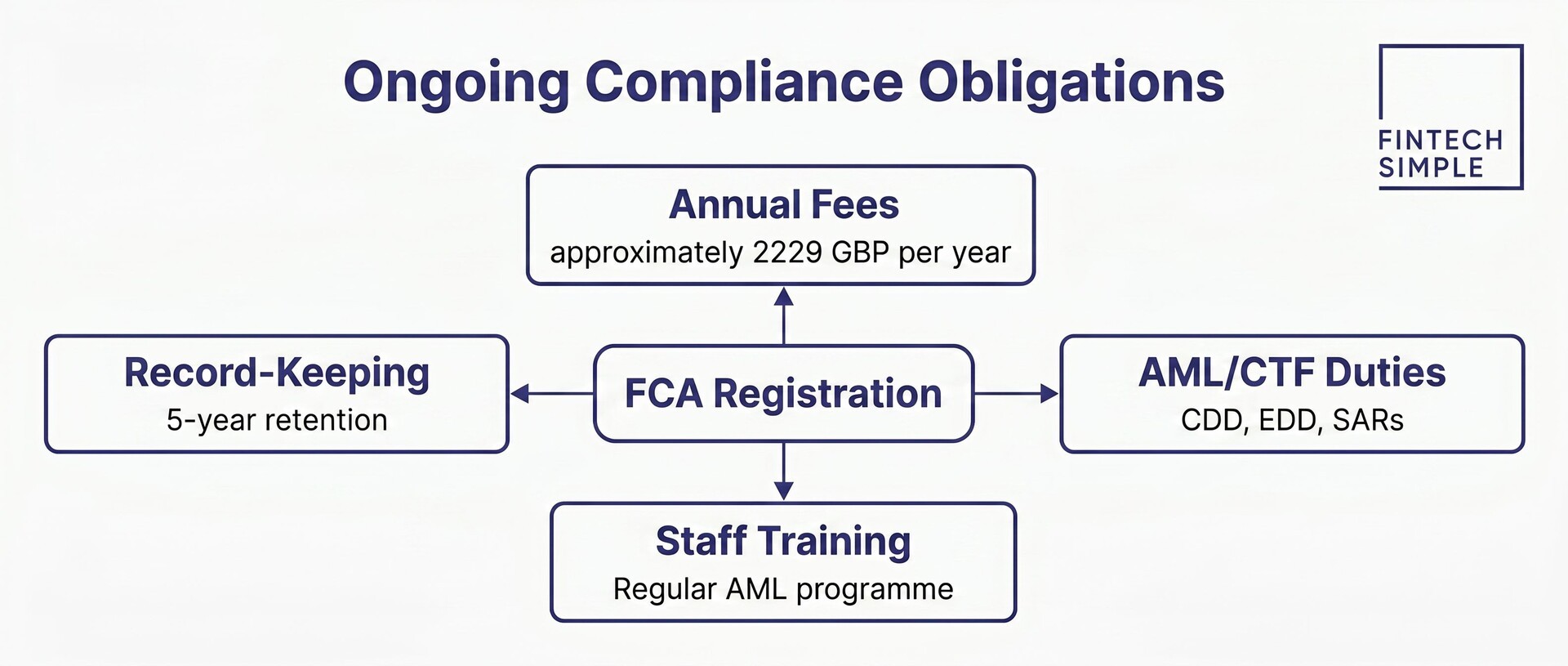
Once your firm appears on the FCA Financial Services Register, the real compliance work begins. FCA registration is not a one-off event — it creates a continuous set of obligations that your business must meet for as long as it operates as a registered cryptoasset firm. Failure to maintain these standards can result in enforcement action, fines, or removal from the register.

Annual Fees and Reporting

Registered cryptoasset businesses pay annual periodic fees to the FCA. The minimum fee is approximately £2,229 per year, plus a variable component of £15.13 per £1,000 of income over £100,000 (based on the 2025/26 fee schedule). Fees are invoiced annually and must be paid within 30 days — late payment triggers administrative surcharges and may prompt supervisory enquiry.

In addition to fees, the FCA expects registered firms to submit regulatory returns on time and to notify the regulator of material changes to their business — including changes to directors, beneficial owners, the MLRO, office address, or the nature of cryptoasset activities carried on. Keeping your register entry accurate and up to date is a standing obligation, not an optional administrative task.

AML/CTF Obligations

Registered firms must maintain and apply their AML/CTF framework on an ongoing basis. The policies submitted during registration are not static documents — they must be reviewed, updated, and enforced as part of daily operations. Core obligations include:

  • Customer due diligence (CDD) — verify the identity of every customer before establishing a business relationship, and apply ongoing monitoring to detect changes in risk profile
  • Enhanced due diligence (EDD) — apply additional scrutiny to high-risk customers, including politically exposed persons (PEPs), customers from high-risk jurisdictions, and unusually complex transaction patterns
  • Suspicious activity reports (SARs) — file reports with the National Crime Agency (NCA) whenever there are reasonable grounds to suspect money laundering or terrorist financing, without tipping off the customer
  • Travel rule compliance — transmit originator and beneficiary information with cryptoasset transfers in line with the UK’s implementation of the FATF Travel Rule, ensuring traceability across transactions

Staff Training and Record-Keeping

The MLRO must receive adequate training on UK AML/CTF regulation and ensure that all relevant staff understand their responsibilities under the firm’s compliance framework. Training is not a one-time induction — the FCA expects regular refresher sessions that cover regulatory updates, emerging typologies, and lessons learned from internal reviews or industry enforcement cases. New joiners must be trained before they handle customer-facing or compliance-sensitive tasks.

Record-keeping obligations require firms to retain all customer identification records, transaction data, risk assessments, and SAR-related documentation for a minimum of 5 years after the end of the business relationship or the completion of the transaction. Records must be retrievable promptly if the FCA, NCA, or law enforcement requests them. Inadequate record-keeping is one of the most common compliance failures cited in FCA supervisory findings.

Penalties for Non-Compliance

The FCA has a broad range of enforcement tools at its disposal. For registered cryptoasset firms that breach AML/CTF obligations, the consequences can include public censure, financial penalties, conditions or restrictions on the firm’s registration, or complete removal from the register.

Criminal sanctions apply to the most serious breaches. Under Regulation 86 of the Money Laundering Regulations 2017, operating a cryptoasset business without FCA registration — or failing to comply with core AML/CTF requirements — can result in up to 2 years’ imprisonment and/or an unlimited fine on indictment. Directors and officers may be held personally liable where the offence was committed with their consent or connivance.

Beyond criminal liability, the FCA’s civil penalty powers allow it to impose significant financial sanctions on firms and individuals. The regulator publishes enforcement outcomes, which means a compliance failure also becomes a reputational event — visible to banking partners, customers, and competitors on the FCA’s public register and decision notices.

Key point

The FCA calculates fines individually based on the severity, duration, and impact of each breach. Documented policies, trained staff, and timely SAR filings are your strongest defence if supervisory questions arise.

Advantages of Getting a Crypto License in the UK

The United Kingdom offers crypto businesses a combination of regulatory credibility, market depth, and innovation-friendly policy that few jurisdictions can match. FCA registration signals to clients, banks, and partners that your firm meets one of the world’s most rigorous AML/CTF standards — opening doors to institutional relationships and cross-border opportunities that unregulated competitors cannot access.

Reputation and Market Access

The FCA is one of the most recognised financial regulators globally. Holding FCA cryptoasset registration tells institutional counterparties, payment processors, and banking partners that your firm has passed a rigorous fitness-and-propriety assessment and maintains a compliant AML/CTF framework. This credibility advantage is particularly valuable when onboarding enterprise clients, negotiating correspondent banking relationships, or expanding into other common-law jurisdictions that recognise FCA standards as a benchmark.

Fintech Ecosystem

The UK is home to one of the world’s largest fintech ecosystems, with deep pools of venture capital, specialised legal and compliance talent, and government-backed support through bodies like Innovate UK. London’s concentration of crypto-native funds, established banks exploring digital assets, and blockchain infrastructure providers creates a network effect that accelerates partnerships, hiring, and fundraising. The FCA’s regulatory sandbox programme further lowers barriers for firms testing novel products under supervised conditions.

Tax Competitiveness

The UK’s corporation tax structure remains competitive among major financial centres. Small profits (up to £50,000) are taxed at 19%, while the main rate of 25% applies to profits above £250,000 — with marginal relief smoothing the transition between bands. Crypto-to-crypto and crypto-to-fiat exchange services are VAT-exempt, reducing the tax burden on core business operations. The UK’s extensive double-taxation treaty network (over 130 agreements) also supports international expansion. For a full breakdown, see the taxation section above.

Digital Securities Sandbox

The Digital Securities Sandbox (DSS), launched jointly by the FCA and the Bank of England, allows firms to issue, trade, and settle digital securities using distributed ledger technology under a modified regulatory framework. Participants can test tokenised financial instruments — such as bonds, equities, and fund units — without needing to comply with legacy requirements designed for traditional settlement infrastructure. For crypto businesses looking to bridge into regulated securities markets, the DSS provides a structured path to do so while maintaining FCA oversight.

Still Have Questions? Schedule a Call with Our Licensing Experts

Our specialists answer your questions on FCA requirements, timelines, and costs, and map out the registration steps for your specific business structure.

Frequently Asked Questions about UK Crypto Licensing

How much does a UK crypto license cost?

The FCA application fee is £11,150 (Category 6 of FCA pricing, per FEES Appendix 4 Annex 1, ORA-indexed annually). The fee is non-refundable. Legal and compliance consulting costs are additional, along with annual supervision fees (minimum ~£2,229 per year).

How long does it take to get FCA crypto registration?

The FCA's statutory deadline for complete MLR applications is 3 months, but real-world processing typically takes 5 months as of April 2025. Poor-quality or incomplete submissions can take up to 12 months. The full process, from document preparation through FCA decision, takes 3–6 months for a well-prepared application.

What activities require FCA cryptoasset registration?

Under the Money Laundering Regulations 2017, you must register if you operate a crypto exchange, provide custodial wallet services, run crypto ATMs, or facilitate ICO issuance in the UK. The obligation applies to any firm carrying on cryptoasset business by way of business in the UK.

Do I need a physical office in the UK?

Yes. The FCA requires a bona fide UK presence under Regulation 8L and Regulation 9 of the MLRs, with Regulation 14A defining in-scope cryptoasset services. A virtual office or registered-agent address alone is not sufficient. You need a genuine operational presence where the business is managed and controlled.

Does the MLRO need to be UK-based?

There is no absolute statutory prohibition, but the FCA expects the Money Laundering Reporting Officer to have appropriate knowledge of UK regulation and AML/CTF practice. The FCA may require interviews, including in person at its offices, creating a strong practical incentive for UK presence. Appointing a non-UK MLRO increases the risk of delays or refusal.

What are the AML/KYC requirements for UK crypto businesses?

Registered firms must comply with the Money Laundering Regulations 2017, which mandate customer due diligence (CDD), ongoing transaction monitoring, suspicious activity reporting to the NCA, and record-keeping. You must appoint a qualified MLRO, maintain a documented risk assessment, and apply enhanced due diligence for high-risk customers. The FCA assesses your AML framework as part of the registration process through a fit and proper assessment of directors, beneficial owners, and officers.

What happens if I operate without FCA registration?

Operating a cryptoasset business without registration is a criminal offence. Under Regulation 86 of the Money Laundering Regulations 2017, carrying on cryptoasset business without FCA registration can result in up to 2 years' imprisonment and/or a fine on indictment. The FCA also maintains a public warning list and can seek injunctions to shut down unregistered operations.

Is cryptocurrency taxed in the UK?

Yes. Corporation tax applies at 25% (main rate for profits over £250,000) or 19% (small profits rate for profits up to £50,000), with marginal relief for profits in between. Capital Gains Tax applies to crypto disposals. Exchange of crypto tokens for fiat or other tokens is VAT-exempt, but goods or services sold for crypto are subject to VAT in the normal way.

What is the difference between MLR registration and FSMA authorisation?

MLR registration is the current regime. It covers anti-money laundering and counter-terrorist financing obligations under the Money Laundering Regulations 2017. FSMA authorisation is the broader, conduct-based regime being extended to crypto under the Financial Services and Markets Act 2000 (Cryptoassets) Regulations 2026. Currently, crypto firms only need MLR registration. From October 2027, a full FSMA authorisation will replace it, bringing crypto under the same regulatory framework as traditional financial services.

Can non-UK companies get FCA crypto registration?

The FCA does not restrict registration to UK-incorporated companies: sole traders, partnerships, and other structures are accommodated. However, you must establish a genuine UK presence with local management and control. A foreign parent company can set up a UK subsidiary or branch, but a shell presence will not satisfy FCA requirements.

What are the annual fees for registered crypto businesses?

Registered crypto firms pay annual periodic fees to the FCA. The minimum is approximately £2,229 per year, plus a variable fee of £15.13 per £1,000 of income over £100,000 (based on the 2025/26 fee schedule). These fees are separate from the one-time registration fee.

What changes are coming in October 2027?

On 25 October 2027, a new FSMA-based authorisation regime replaces the current MLR registration for crypto businesses. Under the Financial Services and Markets Act 2000 (Cryptoassets) Regulations 2026, crypto activities become regulated activities requiring full FCA authorisation, the same framework that governs banks and investment firms. This means more extensive conduct rules, capital requirements, and consumer protections. Firms currently holding MLR registration will need to transition to the new regime.

Your Privacy

By clicking "Accept", you consent to the use of cookies and similar technologies on your device to improve site navigation, analyze usage, provide specific functionalities, and support our marketing initiatives. Cookies that are strictly necessary will always be active with this link.