Crypto License in Singapore

Crypto License in Singapore

Singapore’s crypto licensing regime under the Payment Services Act 2019 offers regulatory clarity, global credibility, and access to Asia-Pacific markets, but demands rigorous compliance, substantial capital, and local operational presence.

Fintech Simple has guided crypto businesses through MAS licensing since 2016, helping founders navigate Singapore’s demanding but prestigious regulatory framework. With 500+ licenses obtained across jurisdictions, our licensing team understands what MAS expects, from capital structuring and AML/CFT frameworks to post-licensing compliance obligations.

Patrik Asevicius — Singapore licensing expert at Fintech Simple
Patrik Asevicius
Head of Licensing Department, Singapore & offshore jurisdictions

TL;DR for Decision-Makers

You need a MAS licence under the Payment Services Act 2019 — the primary framework for virtually all crypto businesses in Singapore, including those serving overseas customers. Two tiers: SPI (capital SGD 100K) and MPI (capital SGD 250K + security deposit SGD 100–200K). Application fees SGD 1–1.5K; annual fees SGD 5–10K. Realistic all-in first-year budget: SGD 200–500K+. Timeline: 6–12 months. You must have a Singapore-registered company, a resident director, and a local AML/CFT compliance officer. Corporation tax is 17% with no capital gains tax; start-up relief brings the effective rate below 5% for the first three years. Total budget from engagement to launch depends on the service package, plus ongoing compliance costs.

What Is a Crypto License in Singapore?

Regulator

MAS (Monetary Authority of Singapore)

Minimum Capital

From SGD 100,000

Timeline

6–12 months

Core Legislation

Payment Services Act 2019

In Singapore, operating a business that deals in cryptocurrencies or digital tokens is a regulated activity. The Monetary Authority of Singapore (MAS) is the sole licensing authority. The primary licensing route is the Payment Services Act 2019 (PSA), which covers the vast majority of crypto businesses — including those serving both domestic and overseas customers. Operating without a licence exposes your business to criminal penalties: a fine of up to SGD 125,000 and/or imprisonment of up to 3 years.

Digital Payment Token Services Under the PSA

The PSA defines a “digital payment token” (DPT) as any digital representation of value that is not denominated in any currency, can be transferred or stored electronically, and is intended as a medium of exchange. This definition captures Bitcoin, Ethereum, stablecoins pegged to fiat, and virtually all utility and payment tokens traded on exchanges.

In April 2024, MAS expanded the scope of regulated DPT services to include custodial services, cross-border transfer facilitation, and token exchange between different DPT types. Any entity providing these services — whether to Singapore residents or overseas customers from a Singapore base — must hold a valid Payment Services licence.

The licence tier you need depends on your monthly transaction volume:

  • Standard Payment Institution (SPI) — for businesses processing less than SGD 3,000,000 per month for any single payment service and less than SGD 6,000,000 per month across all services combined.
  • Major Payment Institution (MPI) — required once either volume threshold is exceeded. Carries higher capital requirements, a mandatory security deposit, and stricter governance obligations.

The DTSP Regime Under FSMA (Gap-Filling Only)

Singapore’s Financial Services and Markets Act 2022 (FSMA) introduced Part 9, establishing a separate Digital Token Service Provider (DTSP) licensing regime effective 30 June 2025. This regime was designed as a narrow gap-filling measure — it captures only activities that do not already fall under the PSA, the Securities and Futures Act, or the Financial Advisers Act.

PSA licensees are exempt from DTSP licensing for activities already covered by their PSA licence (FSMA s.137(5)), even when serving overseas customers. The two frameworks differ as follows:

DimensionPSA LicenceFSMA DTSP
Governing law Payment Services Act 2019 Financial Services and Markets Act 2022, Part 9
Scope DPT services (domestic + overseas customers) Digital token services not covered by PSA, SFA, or FAA
Effective since 28 January 2020 30 June 2025
New licences available Yes — MAS actively accepts applications Extremely limited — MAS grants new DTSP licences only in exceptional circumstances

In practice, MAS has stated it will grant new DTSP licences only in “extremely limited circumstances.” For the vast majority of crypto businesses, the PSA remains the sole viable licensing route. The DTSP regime is relevant only to a narrow class of overseas-facing activities that genuinely fall outside PSA coverage.

Practical note

Do not assume you need a DTSP licence simply because you have overseas customers. PSA licensees are exempt from the DTSP regime for their licensed activities. If your business model involves DPT exchange, transfer, or custody — even for overseas clients — the PSA covers you. Consult a specialist before concluding that FSMA Part 9 applies to your operations.

Who Needs a License

Any business that provides one or more DPT services from Singapore — whether to local or overseas customers — must hold a PSA licence. The following activities are expressly regulated:

  • Cryptocurrency exchanges — platforms facilitating the buying, selling, or exchange of DPTs for fiat currency or other DPTs.
  • OTC desks — over-the-counter dealing services that buy or sell DPTs directly with customers outside an order-book exchange.
  • Crypto wallet providers — services that store customers’ private keys or provide interfaces for managing DPT holdings.
  • Custodians — entities that safeguard DPT assets on behalf of customers, including institutional custody and sub-custody arrangements.
  • DPT transmission services — facilitating the transfer of DPTs from one account or address to another on behalf of customers.

If your platform deals with tokens classified as capital markets products (e.g., security tokens representing shares or debt), you may also need a Capital Markets Services licence under the Securities and Futures Act — in addition to or instead of a PSA licence. MAS applies a substance-over-form analysis to determine classification.

Operating any of these services without a valid MAS licence is a criminal offence under Section 5(1) of the Payment Services Act 2019. The penalty is a fine of up to SGD 125,000 and/or imprisonment of up to 3 years, with an additional fine of up to SGD 12,500 for each day the offence continues after conviction.

Our Licensing Packages

Applying for a crypto license in Singapore requires expert guidance through MAS’s MPI or SPI application process. Our three packages match your stage of readiness, from initial consultation and gap analysis through to a fully operational, licensed entity with a ready-made company structure. Each package is fixed-fee and covers every milestone from document preparation to regulatory correspondence.

Consultation €3,500
Full Licensing €10,500
Premium €17,500
MAS licensing strategy & regulatory gap analysis
MAS application preparation (MPI or SPI licence)
AML/CFT policy & compliance programme development
Compliance officer sourcing & onboarding support
Ready-made Singapore company (pre-incorporated)
Bank account & payment account opening assistance
Post-licensing compliance support (12 months)
Liaison with MAS during review period
Consultation €3,500
  • MAS licensing strategy & regulatory gap analysis
  • MAS application preparation (MPI or SPI licence)
  • AML/CFT policy & compliance programme development
  • Compliance officer sourcing & onboarding support
  • Ready-made Singapore company (pre-incorporated)
  • Bank account & payment account opening assistance
  • Post-licensing compliance support (12 months)
  • Liaison with MAS during review period
Full Licensing €10,500
  • MAS licensing strategy & regulatory gap analysis
  • MAS application preparation (MPI or SPI licence)
  • AML/CFT policy & compliance programme development
  • Compliance officer sourcing & onboarding support
  • Ready-made Singapore company (pre-incorporated)
  • Bank account & payment account opening assistance
  • Post-licensing compliance support (12 months)
  • Liaison with MAS during review period
Premium €17,500
  • MAS licensing strategy & regulatory gap analysis
  • MAS application preparation (MPI or SPI licence)
  • AML/CFT policy & compliance programme development
  • Compliance officer sourcing & onboarding support
  • Ready-made Singapore company (pre-incorporated)
  • Bank account & payment account opening assistance
  • Post-licensing compliance support (12 months)
  • Liaison with MAS during review period

Our Experts

Our in-house team of crypto regulatory lawyers has been licensing crypto businesses since 2016, including Digital Payment Token service providers under Singapore’s MAS framework. With 500+ VASP license approvals across global jurisdictions, we know exactly what MAS expects and how to get your DPT application across the line.

Patrik Asevičius
Patrik Asevičius Lawyer, MAS licensing specialist
Ilya Nikiforov
Ilya Nikiforov International Corporate Law Attorney
Anastassia Rumjantseva
Anastassia Rumjantseva Lawyer

License Types: SPI vs MPI

The Payment Services Act (PSA) creates two tiers of payment institution licence: the Standard Payment Institution (SPI) and the Major Payment Institution (MPI). The tier you need is determined by your projected transaction volumes and e-money float, not by choice. MAS licensing framework for payment service providers sets out the full criteria.

Standard Payment Institution (SPI)

An SPI licence applies when your projected monthly transaction volume remains below SGD 3,000,000 for any single payment service and below SGD 6,000,000 in aggregate across all services. If you also hold e-money, the outstanding float must stay below SGD 5,000,000 on any given day. Breaching any one of these thresholds triggers mandatory upgrade to an MPI licence.

Compliance obligations for an SPI are lighter than for an MPI, but far from trivial:

  • Resident AML/CFT officer — a Singapore-resident compliance officer at management level must be appointed and named in the application. This person must be independent of revenue-generating functions.
  • Licensed auditor — annual independent audits covering financials, AML/CFT controls, and cybersecurity are mandatory from the first year of operations.
  • Fund segregation — customer monies and digital payment tokens must be held in segregated accounts or trust arrangements, separate from operating funds.
  • MAS Notice PSN02 — full AML/CFT programme including customer due diligence, ongoing monitoring, Travel Rule compliance, and suspicious transaction reporting.
  • PS-G03 90% cold storage — at least 90% of customer digital payment token assets must be held in cold storage at all times, with documented safeguarding procedures.
  • Daily reconciliation — daily balance reconciliation of all customer assets is mandatory; discrepancies must be investigated and reported within prescribed timeframes.

Major Payment Institution (MPI)

An MPI licence becomes mandatory when your business breaches any SPI threshold — either the SGD 3,000,000 single-service cap, the SGD 6,000,000 aggregate cap, or the SGD 5,000,000 e-money float ceiling. You cannot voluntarily remain on an SPI licence once volumes exceed these limits; MAS requires notification and upgrade within a prescribed period.

The MPI tier imposes a substantially higher regulatory burden:

  • Base capital SGD 250,000 — minimum paid-up capital must be maintained at all times. A breach triggers immediate notification to MAS and remediation within a specified period.
  • Security deposit SGD 100,000–200,000 — an MPI must lodge a security deposit with MAS (or provide a bank guarantee): SGD 100,000 if monthly transaction volume is ≤ SGD 6,000,000, or SGD 200,000 if volume exceeds that level.
  • Enhanced governance — MAS expects a dedicated compliance function with clear reporting lines to the board, a risk management committee, and documented escalation procedures for regulatory breaches.
  • Stricter ongoing reporting — MPIs face more frequent and detailed regulatory returns, including quarterly financial statements and ad-hoc reporting on material changes to the business.

Side-by-Side Comparison

The table below summarises the key differences between the SPI and MPI licence tiers. All figures are per MAS licensing requirements for payment service providers.

FactorSPIMPI
Base capital SGD 100,000 SGD 250,000
Security deposit Not required SGD 100,000–200,000
Application fee SGD 1,000 per service SGD 1,500 per service
Annual fee SGD 5,000 SGD 10,000
Single service threshold < SGD 3,000,000/month ≥ SGD 3,000,000/month
Aggregate threshold < SGD 6,000,000/month ≥ SGD 6,000,000/month
E-money float < SGD 5,000,000 daily ≥ SGD 5,000,000 daily

Which tier to choose

If you are launching a new DPT service with modest initial volumes, start with an SPI — it is faster and cheaper to obtain, and your compliance overhead is lower during the growth phase. Plan your MPI upgrade path from day one: once any single threshold is breached, you have a limited window to notify MAS and apply for the higher-tier licence. Fintech Simple structures applications so that the transition from SPI to MPI is a planned upgrade, not an emergency scramble.

Capital Requirements for a Singapore Crypto License

Before MAS approves your application, you must demonstrate that your company holds sufficient capital and, where applicable, maintains a security deposit. The amount depends on which license class you are applying for (Standard Payment Institution or Major Payment Institution) and on the monthly transaction volumes you expect to process. Meeting these thresholds on day one is mandatory; falling below them triggers immediate reporting obligations and can lead to suspension. The figures below are drawn directly from the MAS licensing page for payment service providers.

Base Capital

MAS sets a minimum base capital that must be paid up and maintained at all times. The threshold determines whether you qualify as a Standard Payment Institution (SPI) or must apply for a Major Payment Institution (MPI) licence:

License ClassMin Base CapitalPermitted Monthly Txn Volume
SPI SGD 100,000 Up to SGD 3M per service + SGD 6M combined
MPI SGD 250,000 Exceeds SPI thresholds

If your transaction volumes start below the SPI ceiling but you expect rapid growth, incorporate with SGD 250,000 from the outset. Upgrading from SPI to MPI mid-operation requires a fresh application and introduces a compliance gap that MAS scrutinises closely.

Security Deposits

Major Payment Institutions must lodge a security deposit with MAS before commencing operations. The deposit protects consumers in the event of insolvency and scales with your monthly transaction volume:

Monthly Txn VolumeRequired DepositAcceptable Forms
≤SGD 6M SGD 100,000 Cash held with MAS or bank guarantee
>SGD 6M SGD 200,000 Cash held with MAS or bank guarantee

Standard Payment Institutions are exempt from the security deposit requirement entirely — this is one of the material cost advantages of staying within SPI thresholds.

The deposit must remain in place for the full duration of the licence. MAS will not release it until all customer obligations have been discharged, even after voluntary surrender of the licence.

If you choose a bank guarantee rather than a cash deposit, negotiate a multi-year facility upfront. Annual renewals create a window of non-compliance risk that MAS may flag during inspections.

Planning tip

Singapore crypto license capital requirements are set at the entity level — not per service. If you plan to offer multiple Digital Payment Token services under one licence, you only need to meet the base capital and security deposit thresholds once, not once per service. Structure your corporate entity to consolidate services where possible and avoid duplicating capital across subsidiaries.

Licensing Fees and Total Costs

Most guides list the MAS application fee and stop there. That number (SGD 1,000 or SGD 1,500) covers less than 1% of what you will actually spend. Your Singapore crypto license cost depends on which licence tier you need, how much capital you must hold, and what your ongoing compliance stack costs every year. The figures below cover every line item, so you can budget accurately before you begin.

Grid breakdown showing six major cost categories for obtaining a Singapore crypto licence, totalling SGD 200K to 500K+

Official MAS Fees

MAS publishes a fixed fee schedule for Payment Services licence applications. These are non-refundable regardless of outcome and payable per service at the point of submission via the MAS e-Licensing portal.

Fee TypeSPIMPI
Application fee (per service) SGD 1,000 SGD 1,500
Annual licence fee SGD 5,000 SGD 10,000
Minimum base capital SGD 100,000 SGD 250,000
Security deposit SGD 100,000–200,000

The security deposit scales with transaction volume: SGD 100,000 if your monthly DPT transactions are SGD 6,000,000 or below, and SGD 200,000 once they exceed that threshold. The deposit may be held as cash with MAS or as a bank guarantee from an approved institution. SPIs are not required to maintain a security deposit at any volume level.

SPI vs MPI threshold

You remain an SPI as long as monthly transactions stay below SGD 3,000,000 for any single payment service and below SGD 6,000,000 across all services combined. The moment either limit is breached, you must upgrade to an MPI licence — which means higher capital, higher fees, and the security deposit obligation. Budget for MPI from the start if your growth projections show you crossing these thresholds within 12–18 months of launch.

Total Cost Estimate

The application fee is a rounding error in your total budget. Below is a realistic breakdown of what first-year licensing actually costs, including preparation, capital lock-up, and ongoing obligations:

Cost CategorySPI EstimateMPI Estimate
Singapore incorporation SGD 2,000–5,000 SGD 2,000–5,000
MAS application fee SGD 1,000 SGD 1,500
Legal counsel & legal opinion SGD 30,000–60,000 SGD 50,000–100,000
Compliance build-out (AML/CFT, cyber, policies) SGD 20,000–50,000 SGD 40,000–80,000
Minimum base capital (locked) SGD 100,000 SGD 250,000
Security deposit SGD 100,000–200,000
Technology & infrastructure SGD 20,000–40,000 SGD 30,000–60,000
Annual independent audits SGD 15,000–30,000 SGD 25,000–50,000
Ongoing staff & compliance (annual) SGD 50,000–100,000 SGD 80,000–150,000

When you total these figures, a realistic all-in budget for an SPI licence sits at SGD 200,000–350,000 in the first year, while an MPI licence typically requires SGD 400,000–500,000+. These ranges assume a straightforward single-service application; multi-service filings, complex corporate structures, or expedited timelines push costs higher.

Important context for 2025–2026 applicants

MAS review timelines have lengthened as the regulator processes a backlog of applications submitted before the April 2024 scope expansion. Longer review periods mean more months of burn on staff, office, and compliance infrastructure before revenue begins. Factor 9–12 months of pre-revenue operating costs into your budget — not just the direct licensing expenses shown above.

Get Expert Guidance on Your Singapore Crypto License

MAS rejects incomplete applications without review. Our specialists help you prepare a compliant submission and avoid costly delays. Talk to us before you file.

Application Process: Step by Step

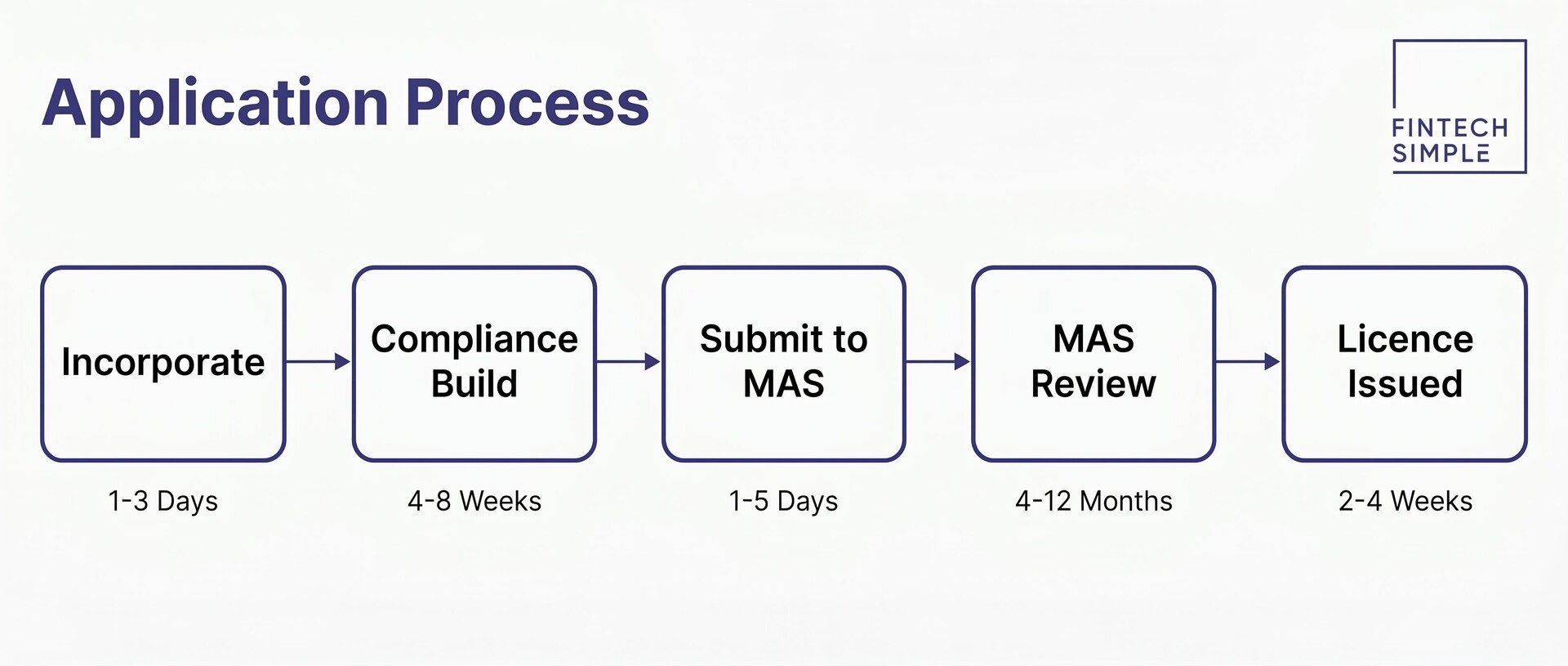
Getting a DPT service provider licence from MAS follows a defined sequence. ACRA company registration takes 1–3 business days, not two weeks. The real time investment sits in compliance infrastructure and MAS review, which together account for the bulk of your 6–12 month timeline.

Horizontal timeline showing the five steps to obtain a Singapore crypto licence: incorporation, compliance build, submission, MAS review, and licence issuance
Step 1 Days 1–3

Incorporate a Singapore Entity

What we do: We incorporate your Singapore private limited company through ACRA’s online portal, prepare the constitution, and secure the mandatory resident director, completing standard incorporation in 1–3 business days.

  • Resident director — at least one director must ordinarily reside in Singapore (Companies Act s.145). We arrange a qualifying nominee director if your team is based offshore.
  • Paid-up capital — minimum SGD 100,000 for an SPI or SGD 250,000 for an MPI must be reflected in the share structure from incorporation.
  • Registered address — a Singapore registered office address is required; a virtual office is sufficient at this stage.
  • Company secretary — a qualified company secretary residing in Singapore must be appointed within six months of incorporation.
Step 2 Weeks 1–8

Prepare Compliance Infrastructure

What we do: We draft and implement the full compliance stack required by MAS before submission: AML/CFT policies, cybersecurity framework, business plan, and legal opinion.

  • AML/CFT programme — policies, procedures, and controls aligned to MAS Notice PSN02 (originally issued 5 December 2019; current version dated 2 April 2024, last revised 30 June 2025). A resident, management-level AML/CFT Compliance Officer must be appointed and named in the application.
  • Cybersecurity framework (FSM-N13) — written policies covering system access controls, incident response, vulnerability management, and business continuity planning, consistent with MAS Technology Risk Management guidelines.
  • Business plan — a detailed five-year financial projection, revenue model, customer acquisition strategy, and liquidity management plan. MAS scrutinises viability and ownership concentration.
  • Legal opinion — written analysis confirming the tokens and services in scope are correctly classified under the PSA and, where applicable, the FSMA Part 9 DTSP framework effective June 2025.
  • Customer asset safeguarding procedures — documentation demonstrating ≥90% cold storage of customer DPT assets and daily balance reconciliation processes, consistent with MAS Guidelines PS-G03.
Step 3 Days 1–5

Submit Application to MAS

What we do: We compile the complete application package and lodge it via the MAS e-Licensing portal using Form 1, paying the non-refundable application fee at the point of submission.

  • MAS e-Licensing portal — Form 1 is used for both SPI (SGD 1,000 per service) and MPI (SGD 1,500 per service) applications. Fees are non-refundable regardless of outcome.
  • Supporting documents — ACRA business profile, audited or management accounts, corporate structure chart, CVs and personal declarations for all directors and substantial shareholders, and the full compliance pack prepared in Step 2.
  • Completeness check — MAS will issue a receipt confirming acceptance or request outstanding documents. An incomplete submission restarts the clock, so we verify completeness before submission.
Step 4 Months 4–12

MAS Review and Due Diligence

What we do: We manage ongoing MAS correspondence, prepare your executives for interviews, and respond to requests for additional information throughout the assessment period, which typically runs 4–12 months from a complete submission.

  • Fit-and-proper assessment — MAS conducts detailed background checks on directors, substantial shareholders (≥10%), and key management personnel. Executive interviews are standard; MAS typically conducts these directly with the named officers.
  • Compliance programme review — MAS examiners assess your AML/CFT policies, technology risk framework, and financial projections. Deficiencies result in written queries that must be addressed within a specified period.
  • On-hold provisions — MAS has the authority to place applications on hold for up to six months. We track these timelines and engage proactively to prevent delays.
  • DTSP moratorium note — since June 2025, MAS grants new DTSP licences (for overseas-facing DT services under FSMA Part 9) only in “extremely limited circumstances.” If your business model is primarily overseas-facing, we assess viability before submission.
Step 5 Post-approval

Licence Issuance and Conditions

What we do: We guide you through post-approval conditions, arrange the MPI security deposit where required, and confirm your systems are compliant before you commence regulated activities.

  • Licence conditions — MAS issues the licence with specific conditions attached, which may include restrictions on the range of services, transaction volume caps, or enhanced reporting obligations. Commencement of regulated activities before conditions are met is a criminal offence.
  • Security deposit (MPI only) — an MPI must place SGD 100,000 with MAS (or via bank guarantee) if monthly DPT transactions are ≤ SGD 6 million, or SGD 200,000 if they exceed that threshold.
  • Annual licence fee — SGD 5,000 for an SPI; SGD 10,000 for an MPI. Payable annually from the date of issue.
  • Ongoing compliance — annual independent audits (financial, technology/cyber, AML/CFT, and consumer protection), daily balance reconciliation, and marketing restrictions apply from the first day of operations.

Timeline Summary

StageDurationKey Dependency
Incorporation (ACRA)1–3 business daysResident director availability
Compliance build4–8 weeksAML/CFT programme & legal opinion
Application submission1–5 daysDocument completeness
MAS review4–12 monthsFit-and-proper checks & interviews
Licence issuancePost-approvalConditions satisfied & deposit placed

Total elapsed time from incorporation to licence issuance is typically 6–12 months. The compliance preparation phase (Weeks 1–8) can run in parallel with incorporation, but MAS will not begin its review until a complete Form 1 submission is accepted through the e-Licensing portal.

Requirements and Documentation

Before MAS reviews a Digital Payment Token (DPT) service application, your company structure, personnel, and documentation package must each satisfy a separate layer of requirements. Meeting these conditions in full before submission shortens review time and avoids the hold periods MAS can impose.

Company and Director Requirements

Your operating entity must be a Singapore-incorporated private limited company registered with ACRA. Standard incorporation takes 1–3 business days for straightforward applications. The company must have a registered office address in Singapore and a constitution that does not restrict the proposed DPT activities.

At least one director must be ordinarily resident in Singapore under the Companies Act s.145. MAS expects this individual to be actively involved in the business — a purely nominal appointment will not satisfy the fit-and-proper assessment. All directors and substantial shareholders are evaluated against MAS’s Guidelines on Fit and Proper Criteria, which examine honesty, integrity, reputation, competence, and financial soundness.

Any person who becomes a 20% controller of the licensed entity must obtain MAS approval in advance under PSA s.27/28. This includes indirect controllers and persons acting in concert. MAS will reject or revoke a licence where a controller is deemed unfit.

A qualified company secretary ordinarily resident in Singapore must be appointed within six months of incorporation. The secretary cannot be the sole director.

Personnel Requirements

MAS requires every DPT service provider to appoint a dedicated AML/CFT compliance officer. This person must meet three criteria simultaneously:

  • Singapore residency — the compliance officer must ordinarily reside in Singapore and be available for MAS engagement at short notice.
  • Management-level seniority — the officer must hold a position at or above middle management, with direct reporting access to the board or CEO.
  • Independence of function — the compliance role cannot be subordinated to revenue-generating functions or combined with sales responsibilities.

Under MAS Notice PSN02, the compliance officer bears personal responsibility for ensuring the entity’s AML/CFT programme is implemented, maintained, and updated. MAS assesses this individual’s qualifications and track record as part of the licence application.

The CEO or executive director is also subject to a separate fit-and-proper assessment. MAS may conduct interviews with key personnel during the review period and reserves the right to object to any appointment it considers inadequate.

Document Checklist

The following documents must accompany your Form 1 submission via the MAS e-Licensing portal. An incomplete package will not be reviewed — MAS returns it and the assessment clock resets.

  • Form 1 — the prescribed MAS application form for a Standard or Major Payment Institution licence, completed for each DPT service you intend to provide.
  • Business plan — a detailed five-year financial projection covering revenue model, customer acquisition strategy, liquidity management, and ownership structure.
  • AML/CFT policies — a comprehensive compliance manual aligned to MAS Notice PSN02, covering CDD, enhanced due diligence, transaction monitoring, and suspicious transaction reporting.
  • Risk assessment — an enterprise-wide ML/TF risk assessment identifying inherent risks by customer type, product, geography, and delivery channel, with corresponding mitigating controls.
  • Cybersecurity plan — a technology risk management framework consistent with MAS Notice FSM-N13, covering system access controls, incident response, vulnerability management, and business continuity.
  • Flow diagrams — visual representations of customer onboarding flows, transaction processing paths, and fund/asset custody arrangements demonstrating how DPT moves through your systems.
  • Legal opinion — a written analysis from qualified counsel confirming that your tokens and services are correctly classified under the PSA and, where applicable, the FSMA Part 9 DTSP framework.
  • Audited financials — audited or management accounts for the applicant entity (or its parent), demonstrating the capacity to meet minimum base capital requirements from incorporation.

Note on the DTSP regime

Since 30 June 2025, businesses that provide DPT services exclusively to overseas customers from a Singapore base may fall under the FSMA Part 9 DTSP framework rather than the PSA. However, MAS grants new DTSP licences only in “extremely limited circumstances.” If your model is primarily overseas-facing, consult our breakdown of the PSA vs DTSP frameworks before preparing your application.

AML/CFT Compliance Framework

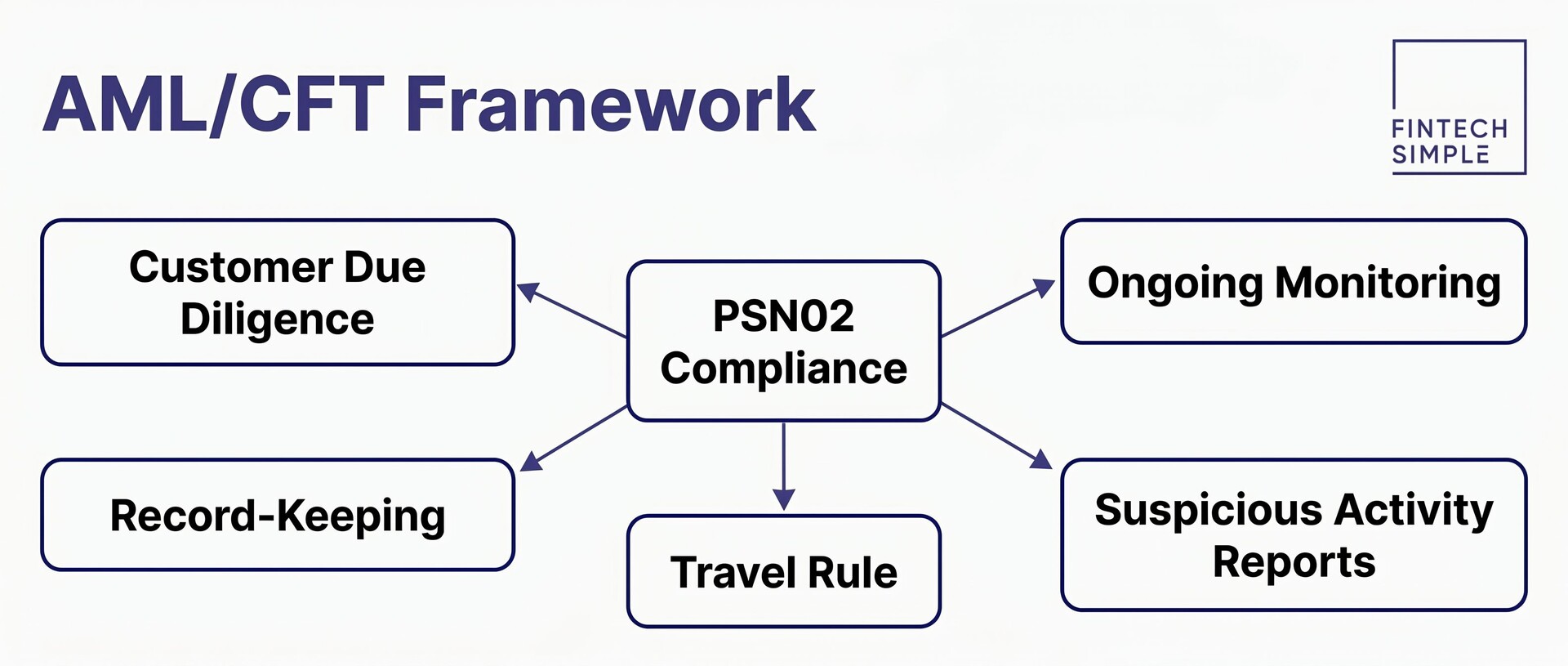
MAS holds Digital Payment Token service providers to some of the strictest anti-money laundering and counter-terrorism financing standards in Asia. MAS Notice PSN02 (originally issued 5 December 2019; current version dated 2 April 2024, last revised 30 June 2025) sets out binding obligations that apply from the day you receive your licence. Operating without meeting these standards exposes your company to criminal liability under the PSA 2019, with fines up to SGD 125,000 and imprisonment for up to three years. MAS expects your compliance programme to be operational on day one.

MAS Notice PSN02 Requirements

PSN02 imposes a full suite of AML/CFT controls across your customer lifecycle and transaction activity. Every DPT licensee — SPI and MPI alike — must implement and maintain each of the following:

  • Customer Due Diligence (CDD) — Verify customer identity before establishing a business relationship. Standard CDD applies to all customers; enhanced due diligence (EDD) is mandatory for higher-risk customers, politically exposed persons, and complex or large transactions where ownership is unclear.
  • Ongoing Monitoring — Continuously screen transactions and customer behaviour against your risk profile. MAS expects you to detect patterns inconsistent with the stated nature of a customer’s business and to act on them promptly.
  • Suspicious Activity Reports (SARs) — File reports with the Suspicious Transaction Reporting Office (STRO) whenever a transaction gives rise to reasonable grounds for suspicion of money laundering or terrorism financing. There is no materiality threshold — the obligation attaches to the suspicion, not the amount.
  • Record-Keeping — Retain CDD documents, transaction records, and internal investigation files for a minimum of five years. Records must be retrievable promptly on MAS request.
  • AML/CFT Compliance Officer — Appoint a management-level officer resident in Singapore who holds responsibility for the programme and reports directly to senior management. MAS will assess this individual’s competence as part of your licence application.

Key point

PSN02 requires a documented, risk-based programme with policies, controls, staff training, and regular internal audits. It is not a checklist you complete at application. MAS conducts thematic reviews and can impose licensing conditions or revoke a licence if the programme is inadequate after authorisation.

Travel Rule and Transaction Monitoring

Singapore implemented the FATF Travel Rule for DPT transfers under PSN02. When you send or receive a DPT transfer above the applicable threshold, you must collect, verify, and transmit originator and beneficiary information to the counterparty institution. For outgoing transfers, you must screen beneficiary information before executing the transaction. For incoming transfers, you must screen originator data before making funds available to the recipient. Transfers to or from unhosted wallets require additional due diligence steps to establish the ownership of those wallets.

Alongside the Travel Rule, MAS Notice FSM-N13 establishes technology risk management obligations that sit alongside your AML/CFT controls. FSM-N13 requires DPT licensees to conduct regular penetration testing of customer-facing and internal systems, maintain a vulnerability remediation programme with defined resolution timelines, and report material technology incidents to MAS within prescribed windows. In practice this means you need a documented IT security framework — not just a policy document, but evidence of testing cycles, remediation tracking, and board-level oversight of technology risk — before MAS will be satisfied that your licence application reflects a fully operational compliance function.

MAS Guidelines PS-G03 require DPT service providers to hold at least 90% of customer digital payment token assets in cold storage at all times, with daily balance reconciliation of all customer assets. MAS expects your technology controls and your AML/CFT controls to function as an integrated programme, audited annually by an independent external auditor covering both AML/CFT compliance and technology risk.


Post-Licensing Obligations

MAS expects licensees to maintain infrastructure, reconciliation cycles, audit schedules, and marketing practices that meet specific regulatory standards from day one of operation. Falling short in any one area can trigger supervisory action, licence conditions, or revocation.

Asset Custody and Cold Storage

MAS Guidelines PS-G03 require DPT service providers to hold at least 90% of all customer digital payment token assets in cold storage at all times. The safeguarding requirements took effect on 4 October 2024, with full custody measures applying from 19 June 2025. Although PS-G03 is framed as “guidelines” rather than binding regulations, MAS treats non-compliance as grounds for supervisory action — in practice, the distinction carries little operational difference for licensees.

In practice, “cold storage” means private keys that are never exposed to an internet-connected environment — air-gapped hardware devices, offline multi-signature schemes, or third-party institutional custody solutions that meet MAS’s standards. The remaining ≤10% of assets may be held in hot wallets to service withdrawals and operational liquidity, but this ceiling is firm.

  • Segregation — customer assets must be held separately from the licensee’s own assets at all times. Commingling is a breach of licence conditions.
  • Custody documentation — you must maintain written policies governing key management, access controls, and recovery procedures. MAS expects these policies to be reviewed and tested regularly.
  • Third-party custodians — if you outsource custody, the custodian must be approved and the arrangement must not dilute your regulatory obligations. You remain fully accountable to MAS.

The 90% cold storage threshold is not aspirational guidance — it is a hard floor. Build your wallet architecture to stay comfortably above it, not to hover at the minimum.

Daily Reconciliation and Audits

MAS post-licensing obligations require daily entity-level reconciliation of customer assets. Every business day, your records of customer balances must match the assets actually held in custody — both on-chain and in cold storage. Any discrepancy must be identified, investigated, and resolved promptly. MAS expects this process to be documented and auditable on demand.

Beyond the daily cycle, licensees must commission annual independent external audits covering three distinct areas:

  • Financial audit — standard statutory audit of the licensee’s financial statements, conducted by an approved auditor. Required for all PSA licensees.
  • Compliance audit — an independent review of AML/CFT controls, customer due diligence processes, and adherence to MAS Notice PSN02. The auditor must have no operational relationship with the compliance function being reviewed.
  • Cybersecurity audit — an independent technical assessment of your technology infrastructure, key management systems, and cyber resilience. MAS expects this to be performed by a qualified external party, not internal IT staff.

All three audits must be completed by independent external auditors — you cannot self-certify. Audit reports are submitted to MAS as part of ongoing supervisory oversight. Budget for these as recurring annual costs, not one-off exercises.

Practical note

Finding auditors experienced in Singapore crypto compliance takes time. Engage your audit providers before the licence is granted so they are ready to begin work when you go live.

Marketing Restrictions

MAS PS-G02 — the Guidelines on Provision of Digital Payment Token Services to the Public — places strict limits on how licensed DPT service providers may promote their services to the general public in Singapore. The restrictions exist because MAS does not consider DPT trading appropriate for retail consumers and does not want licensees driving general public demand.

Under PS-G02, marketing directed at the Singapore public is permitted only through these channels:

  • Your own website — owned and operated by the licensee.
  • Your own mobile application — the app through which customers access your services.
  • Your official social media accounts — accounts registered in the licensee’s name, not third-party profiles.

The following are prohibited for DPT service advertising directed at the public in Singapore:

  • Public advertising — no transit ads, outdoor billboards, or physical placements in public spaces.
  • Broadcast and print media — no television, radio, newspaper, or magazine advertisements.
  • Third-party digital placements — no paid advertising on external websites, apps, or platforms.
  • Influencer marketing — no paid endorsements or promotional arrangements with individuals outside your organisation.
  • Unsolicited promotions — no cold outreach, pop-up ads, or promotional messages sent to people who have not opted in.

These restrictions apply to marketing directed at the general public in Singapore. Communications with existing customers, responses to direct enquiries, and B2B marketing to institutional counterparties fall outside the scope of PS-G02. However, the boundary between permitted institutional outreach and prohibited public-facing promotion can be narrow — document your rationale for each campaign before launch.

Taxation for Crypto Companies in Singapore

Singapore’s tax framework for crypto companies combines a low headline rate, targeted startup relief, and GST rules that require careful structuring. The distinctions around GST treatment and the 2024 Section 10L change affect how you set up your entity from day one.

Corporate Income Tax

Singapore’s headline corporate income tax (CIT) rate is 17% — one of the lowest in Asia-Pacific for a Tier-1 financial centre. For Year of Assessment (YA) 2026, the government provides a 40% Corporate Income Tax Rebate capped at SGD 30,000 per company. In addition, qualifying companies receive a CIT Rebate Cash Grant of SGD 1,500, providing further relief in the first years of operation.

Singapore taxes on a territorial basis: only income sourced in or remitted to Singapore is subject to CIT. However, the Foreign-Sourced Income Exemption (FSIE) regime means that foreign-sourced income — including dividends, branch profits, and service income — can be received in Singapore tax-free if certain conditions are met: the income has been subject to tax in the source jurisdiction (headline rate of at least 15%), and the remittance is beneficial to the Singapore company. For crypto companies structuring multi-entity operations across jurisdictions, the interplay between territorial taxation and FSIE determines whether offshore revenue can flow back to the Singapore holding entity without additional tax cost.

IRAS — Corporate Income Tax Rate, Rebates and Tax Exemption Schemes

Capital Gains and GST Treatment

Singapore does not impose capital gains tax. Gains arising from the disposal of digital payment tokens held as long-term investments are not taxable — a significant advantage for crypto treasuries and venture-backed token portfolios.

Section 10L caveat (effective 1 January 2024)

Foreign-sourced disposal gains received in Singapore by an entity without adequate economic substance may now be treated as taxable income under Section 10L of the Income Tax Act. If your Singapore entity holds tokens through an offshore subsidiary and repatriates the disposal proceeds, you must demonstrate that the overseas entity has genuine economic activities — employees, decision-making, operational expenditure — in its jurisdiction. Entities that cannot meet the substance test risk reclassification of capital gains as taxable income at 17%.

For GST purposes, the exchange of Digital Payment Tokens (DPTs) for fiat currency or other DPTs is treated as an exempt supply — not zero-rated. This distinction matters: exempt supplies do not attract GST but also do not allow recovery of input GST on related expenses. Since 1 January 2024, intermediary services (such as brokerage, custody, and advisory services connected to DPT transactions) attract GST at the standard rate of 9%. NFT transactions may not qualify for the DPT exemption — IRAS has indicated that NFTs do not meet the definition of a digital payment token under the GST Act, meaning sales of NFTs may be subject to 9% GST if the supplier is GST-registered.

IRAS — GST Treatment of Digital Payment Tokens

Start-up Tax Exemptions

Newly incorporated Singapore companies — including crypto licensees — qualify for the Start-up Tax Exemption (SUTE) scheme during their first three consecutive Years of Assessment. The exemption applies as follows:

  • 75% exemption — on the first SGD 100,000 of normal chargeable income
  • 50% exemption — on the next SGD 100,000 of normal chargeable income

This results in a maximum tax exemption of SGD 125,000 per YA (75% of SGD 100,000 = SGD 75,000 plus 50% of SGD 100,000 = SGD 50,000). For a crypto company earning SGD 200,000 in its first year, the effective tax rate falls below 5% — significantly below the headline 17% rate.

After the first three YAs, the company transitions to the Partial Tax Exemption scheme for established companies, which provides 75% exemption on the first SGD 10,000 and 50% on the next SGD 190,000. While less generous than SUTE, it still reduces the effective rate on the first SGD 200,000 of income to approximately 8.3%.

Why Choose Singapore for Your Crypto License?

If your crypto business needs institutional credibility, APAC distribution, and a low-tax base, Singapore is consistently the reference jurisdiction. A MAS licence (under the Payment Services Act or the FSMA’s DTSP regime) signals to banks, investors, and institutional partners that your operation meets a regulatory standard that rejects over 80% of applicants. That signal has concrete value: it opens correspondent banking relationships and serious due-diligence conversations that most other licences cannot.

Regulatory Clarity and Global Reputation

MAS publishes detailed guidance, consultation responses, and binding notices that tell applicants exactly what compliance looks like. Two documents anchor the DPT regulatory framework: MAS Notice PSN02 sets out AML/CFT requirements for DPT service providers, while Guidelines PS-G02 governs consumer-protection standards and advertising restrictions. That transparency reduces operational uncertainty and, crucially, makes your compliance posture legible to counterparties. Global custodians, prime brokers, and institutional investors treat MAS oversight as a credible proxy for governance quality.

The licensing framework is also broad-based. The PSA covers both domestic and overseas-facing DPT services — trading, custody, transfer, and exchange — under a single regulatory umbrella. Between the PSA and the narrower FSMA Part 9 DTSP regime (effective 30 June 2025), most crypto business models can find a regulated home under Singaporean law without needing multiple licences.

Access to Asia-Pacific Markets

Singapore sits at the intersection of South-East Asia’s 700-million-person consumer market and the institutional capital flows that move through Hong Kong, Tokyo, and Sydney. Operating from Singapore gives your business a physical and regulatory anchor that carries weight across the region. Local presence — required under Companies Act section 145 (resident director) and MAS rules (resident AML/CFT compliance officer) — is not just a box-tick: it puts your team in the same time zones as your customers and regulators, which accelerates decisions and builds relationships that remote licensing structures cannot replicate.

Tax Efficiency

Singapore operates a territorial tax system with a 17% headline corporate rate, but three features reduce effective costs:

  • New company exemption — 75% exemption on the first SGD 100,000 of chargeable income and 50% on the next SGD 100,000 for each of the first three Years of Assessment, bringing the effective rate to roughly 6.4% on the first SGD 200,000.
  • No capital gains tax — gains on disposal of capital assets are generally not taxed in Singapore. Since 1 January 2024, Section 10L taxes certain foreign-sourced disposal gains received by entities without sufficient economic substance, but domestically-held crypto capital gains remain outside the tax net.
  • DPT exchange GST exemption — the exchange of Digital Payment Tokens is an exempt supply under GST rules since 1 January 2020, meaning no GST applies to token trading. Intermediary service fees (exchange commissions, wallet fees) remain subject to the current 9% GST rate.

For a detailed breakdown of how Singapore taxes crypto businesses, see the full taxation section below.

Challenges you should weigh

Singapore’s regulatory credibility comes at a cost. MAS operates one of the strictest DPT licensing regimes globally, and the review process is demanding: expect 4–12 months for MAS to assess your application, with the possibility of a 6-month hold. Total timelines from company formation to licence-in-hand typically run 6–12 months. Banking access for crypto firms remains genuinely difficult — even licensed entities face slow onboarding or outright refusals from local banks. Most significantly, since June 2025, MAS has signalled it will grant new DTSP licences only in “extremely limited circumstances,” which means new applicants targeting overseas DT services face an uncertain path. Singapore rewards well-capitalised, compliance-ready operators with a serious long-term commitment to the jurisdiction — it is not a fast or easy licence to obtain.

Ready to Apply for Your Singapore Crypto License?

Our team guides you through every step of the MAS application, from entity setup and compliance documentation to submission and approval.

Frequently Asked Questions about Crypto Licensing in Singapore

What is a crypto license in Singapore called?

MAS issues a Payment Services licence for Digital Payment Token (DPT) services under the Payment Services Act 2019. Depending on transaction volume, this is either a Standard Payment Institution (SPI) licence or a Major Payment Institution (MPI) licence. Businesses serving overseas customers from Singapore may also require a Digital Token Service Provider (DTSP) licence under the Financial Services and Markets Act 2022, which took effect on 30 June 2025.

How much does a Singapore crypto license cost?

Official MAS application fees are SGD 1,000 for SPI and SGD 1,500 for MPI (per service, non-refundable). Annual licence fees are SGD 5,000 (SPI) and SGD 10,000 (MPI). On top of those fees, you must hold minimum base capital of SGD 100,000 (SPI) or SGD 250,000 (MPI), plus a security deposit of SGD 100,000–200,000 for MPI. When you add legal counsel, compliance infrastructure build-out, and AML/CFT technology, the all-in budget for a first-year licence typically runs SGD 200,000–500,000 or more.

How long does it take to get a crypto license in Singapore?

The full process takes 6–12 months from incorporation to licence issuance. Singapore company formation through ACRA takes 1–3 business days. Preparing your compliance framework, policies, and application documents takes 4–8 weeks. MAS review and due diligence then takes 4–12 months; MAS can place applications on hold for up to 6 months. Note that since June 2025, MAS grants new DTSP licences only in “extremely limited circumstances,” which may extend timelines for overseas-facing operations indefinitely.

What is the difference between SPI and MPI?

The threshold is transaction volume. An SPI (Standard Payment Institution) licence covers businesses processing less than SGD 3,000,000 per month for any single payment service and less than SGD 6,000,000 per month across all services combined. It requires SGD 100,000 base capital and carries lower compliance obligations. An MPI (Major Payment Institution) licence is required once either threshold is exceeded. It demands SGD 250,000 base capital, a security deposit of SGD 100,000–200,000, higher governance standards, and stricter ongoing reporting to MAS.

Do I need a local office in Singapore?

Yes. Physical presence in Singapore is mandatory. You must incorporate a Singapore-registered entity and appoint at least one Singapore-resident director under the Companies Act. A Singapore-resident AML/CFT compliance officer at management level must also be appointed. MAS expects genuine operational substance, not a shell structure. The resident director and compliance officer cannot both be the same person filling purely nominal roles; MAS assesses whether key personnel are fit and proper and actively involved in the business.

What are the capital requirements?

Capital requirements differ by licence class. SPI: minimum base capital of SGD 100,000. MPI: minimum base capital of SGD 250,000 plus a security deposit held with MAS or as a bank guarantee: SGD 100,000 if monthly transaction volume is SGD 6,000,000 or below, or SGD 200,000 if volume exceeds that level. Base capital must be maintained at all times; a breach triggers notification and remediation obligations. All figures are per MAS licensing requirements.

Is there capital gains tax on crypto in Singapore?

Singapore has no general capital gains tax, so disposal gains on crypto assets held as capital are typically not taxed. However, two important exceptions apply. First, if trading frequency and intent indicate a business activity, MAS may reclassify gains as income subject to the 17% corporate income tax rate. Second, since 1 January 2024, Section 10L of the Income Tax Act taxes foreign-sourced disposal gains remitted to Singapore by entities lacking adequate economic substance in Singapore. Businesses should obtain a tax opinion before structuring cross-border DPT trading flows. Source: DLA Piper analysis on Section 10L.

What are the ongoing compliance requirements?

Post-licence obligations are substantial. MAS requires annual independent audits covering financials, AML/CFT controls, cybersecurity, and consumer protection. Under MAS Guidelines PS-G03, DPT service providers should hold ≥90% of customer assets in cold storage at all times. Daily balance reconciliation of all customer assets is mandatory. AML/CFT obligations under MAS Notice PSN02 include ongoing KYC, transaction monitoring, suspicious activity reporting, and Travel Rule compliance. Marketing to the general public in Singapore is restricted to your own website, mobile app, and official social media channels under PS-G02.

Can I advertise my crypto services in Singapore?

Advertising to the general public in Singapore is heavily restricted under MAS Guidelines PS-G02. Permitted channels are your own website, your mobile application, and your official social media accounts. Prohibited formats include advertising on public transport, broadcast media, newspapers, third-party websites, and via influencers. These restrictions apply to marketing directed at retail members of the public in Singapore. B2B communications and advertising outside Singapore are not covered by PS-G02, though other regulations may still apply.

What happens if I operate without a license?

Operating a payment service including DPT services without a MAS licence is a criminal offence under Section 5(1) of the Payment Services Act 2019. The penalty is a fine of up to SGD 125,000 and/or imprisonment of up to 3 years. For continuing offences, an additional fine of up to SGD 12,500 applies for each day the offence continues after conviction. MAS actively monitors for unlicensed operators and publishes investor alert lists. A SGD 125,000 ceiling applies per count; multiple charges are possible for sustained operations.

Does the FSMA 2022 affect crypto licensing?

Yes. Singapore's Financial Services and Markets Act 2022 introduced Part 9, which established a separate DTSP (Digital Token Service Provider) licensing regime effective 30 June 2025. This regime targets businesses that provide DPT services to overseas customers from a Singapore base. PSA licensees are exempt from DTSP licensing for activities already covered by their PSA licence. However, since June 2025 MAS has stated it will grant new DTSP licences only in “extremely limited circumstances,” making the regulatory pathway for new overseas-facing applicants highly restricted.

What is the PSN02 notice?

MAS Notice PSN02 is the primary AML/CFT ruleset for DPT service providers. Originally issued 5 December 2019, the current version is dated 2 April 2024 and was last revised 30 June 2025. It sets binding requirements for customer due diligence (CDD), enhanced due diligence for higher-risk customers, ongoing transaction monitoring, Travel Rule compliance for DPT transfers, and suspicious transaction reporting. PSN02 applies to all PSA licensees providing DPT services. Breaches are treated as serious regulatory failures. Compliance with PSN02 is assessed during MAS audits and is a prerequisite for licence renewal. Your AML/CFT framework must be built around PSN02 from day one.

Your Privacy

By clicking "Accept", you consent to the use of cookies and similar technologies on your device to improve site navigation, analyze usage, provide specific functionalities, and support our marketing initiatives. Cookies that are strictly necessary will always be active with this link.