Crypto License in Labuan

Crypto License in Labuan 2026

Labuan offers one of Asia-Pacific’s most competitive crypto licensing frameworks: 3% corporate tax, 100% foreign ownership, and a 4–6 month approval timeline through the Labuan Financial Services Authority (LFSA).

Since 2016, Fintech Simple has helped over 500 businesses secure financial licenses across 30+ jurisdictions. Our licensing team has hands-on experience with Labuan’s digital financial services framework, guiding clients through LFSA’s application process from company incorporation through to license approval and post-licensing compliance.

Ilya Nikiforov — International Corporate Law Attorney at Fintech Simple
Ilya Nikiforov
International Corporate Law Attorney

TL;DR for decision-makers

Labuan (Malaysia) offers a fully regulated crypto license through the Labuan Financial Services Authority (LFSA). The license type for exchanges and brokerages is Money Broker (Digital Asset). Minimum paid-up capital is RM 1.5 million (~USD 378,000). Corporate tax is a flat 3% on net profit. The application process takes 4–6 months from incorporation to license approval. Annual licence fee for new licensees is USD 10,000 (application fee: USD 500 one-time). 100% foreign ownership is permitted, and directors do not need to be resident in Malaysia. Substance requirements: at least 2 full-time employees in Labuan, minimum RM 100,000 annual operating expenditure, and a physical office in Labuan. Employment passes are available for foreign staff. The licence covers international clients only — serving Malaysian residents requires a separate BNM authorisation.

What Is a Labuan Crypto License?

Regulator

LFSA

Timeline

4–6 months

Corporate tax

3% on net profits

Foreign ownership

100% permitted

A Labuan crypto license is a financial services authorization issued by the Labuan Financial Services Authority (LFSA) under the Labuan Financial Services and Securities Act 2010 (Act 704). It permits a company incorporated in the Labuan International Business and Financial Centre (IBFC) to offer digital asset services (crypto exchange, digital asset brokerage, custodianship, and token issuance) to clients outside Malaysia. The license is a creature of Labuan law; it does not originate from, and is not shared with, Bank Negara Malaysia (BNM), which regulates onshore Malaysian financial institutions. LFSA is the sole licensing authority for the Labuan IBFC.

Labuan sits off the coast of Malaysian Borneo and operates as a designated offshore financial centre under a distinct legal and regulatory framework. A company holding an LFSA digital financial services license conducts business internationally from Labuan, subject to LFSA supervision, without being subject to the domestic Malaysian regulatory regime that BNM administers. Malaysia designed this separation deliberately when establishing the IBFC in 1990. For crypto operators, it means a single regulator and a single rulebook.

The license type that covers most crypto exchange and brokerage activity is the Money Broker (Digital Asset) license. Minimum paid-up capital for this category is RM 1,500,000 (approximately USD 378,000). Other license categories carry different capital thresholds, detailed in the requirements section below.

LFSA maintains a public register of all currently licensed digital financial service providers, updated as licenses are granted or revoked. Any counterparty, investor, or compliance team can verify a provider’s standing before engaging with them.

Regulator clarification

BNM’s mandate covers onshore Malaysian entities only. The LFSA is the sole regulator for digital financial services in Labuan, and the LFSA public register of licensed providers is the authoritative source for verifying any Labuan digital asset license.

The Labuan license operates under three core statutes: the Labuan Companies Act 1990 (Act 441) for incorporation, the Labuan Financial Services and Securities Act 2010 (Act 704) for licensing, and the Anti-Money Laundering, Anti-Terrorism Financing and Proceeds of Unlawful Activities Act 2001 (Act 613) for AML/CFT. Foreign ownership is unrestricted (100% permitted for all license types), and directors are not required to be resident in Labuan or Malaysia.

Labuan Crypto License Cost

Government fees changed on 1 January 2026. The one-time licence application fee is USD 500. The annual licence fee for a Digital Asset Money Broker is USD 10,000 per year for new licensees. Existing licensees follow a transitional schedule: USD 1,500 in 2026, USD 5,750 in 2027, and USD 10,000 from 2028. Capital requirements are set by law in Malaysian Ringgit: RM 1,500,000 (~USD 378,000) for a Money Broker (crypto exchange), RM 500,000 (~USD 126,000) for a Digital Asset Custodian, and RM 5,000,000 (~USD 1,260,000) for an IEO Operator. Figures at 1 MYR ≈ 0.2519 USD (2026 YTD average). Official fee reference: LFSA Fee Schedule.

Our three service packages below cover the full process, from company formation to LFSA approval. Services included in all packages: Labuan company incorporation, registered office address, company secretary (licensed trust company), and preparation of AML/CFT policies.

Essential On Request
Custodian On Request
Full-Stack On Request
License type covered Money Broker — Digital Digital Asset Custodian Exchange + Custodian + IEO Operator (multi-activity)
LFSA application preparation & filing
Physical office setup assistance (Labuan)
AML/Compliance officer placement
Multi-activity LFSA coordination
IEO insurance arrangement
Post-license compliance support (12 months)
Estimated timeline to license 4–5 months 4–6 months 5–6 months
Essential On Request
  • License type covered: Money Broker — Digital
  • LFSA application preparation & filing
  • Physical office setup assistance (Labuan)
  • AML/Compliance officer placement
  • Multi-activity LFSA coordination
  • IEO insurance arrangement
  • Post-license compliance support (12 months)
  • Estimated timeline to license: 4–5 months
Custodian On Request
  • License type covered: Digital Asset Custodian
  • LFSA application preparation & filing
  • Physical office setup assistance (Labuan)
  • AML/Compliance officer placement
  • Multi-activity LFSA coordination
  • IEO insurance arrangement
  • Post-license compliance support (12 months)
  • Estimated timeline to license: 4–6 months
Full-Stack On Request
  • License type covered: Exchange + Custodian + IEO Operator (multi-activity)
  • LFSA application preparation & filing
  • Physical office setup assistance (Labuan)
  • AML/Compliance officer placement
  • Multi-activity LFSA coordination
  • IEO insurance arrangement
  • Post-license compliance support (12 months)
  • Estimated timeline to license: 5–6 months

Our Experts

Our team has been licensing crypto businesses since 2016 and has secured over 500 VASP license approvals across multiple jurisdictions, including Labuan. We guide applicants through every LFSA requirement, from structuring the local entity to submitting the final compliance framework.

Patrik Asevičius
Patrik Asevičius Lawyer, Labuan & offshore licensing
Ilya Nikiforov
Ilya Nikiforov International Corporate Law Attorney
Anastassia Rumjantseva
Anastassia Rumjantseva Lawyer

Types of Crypto Licenses in Labuan

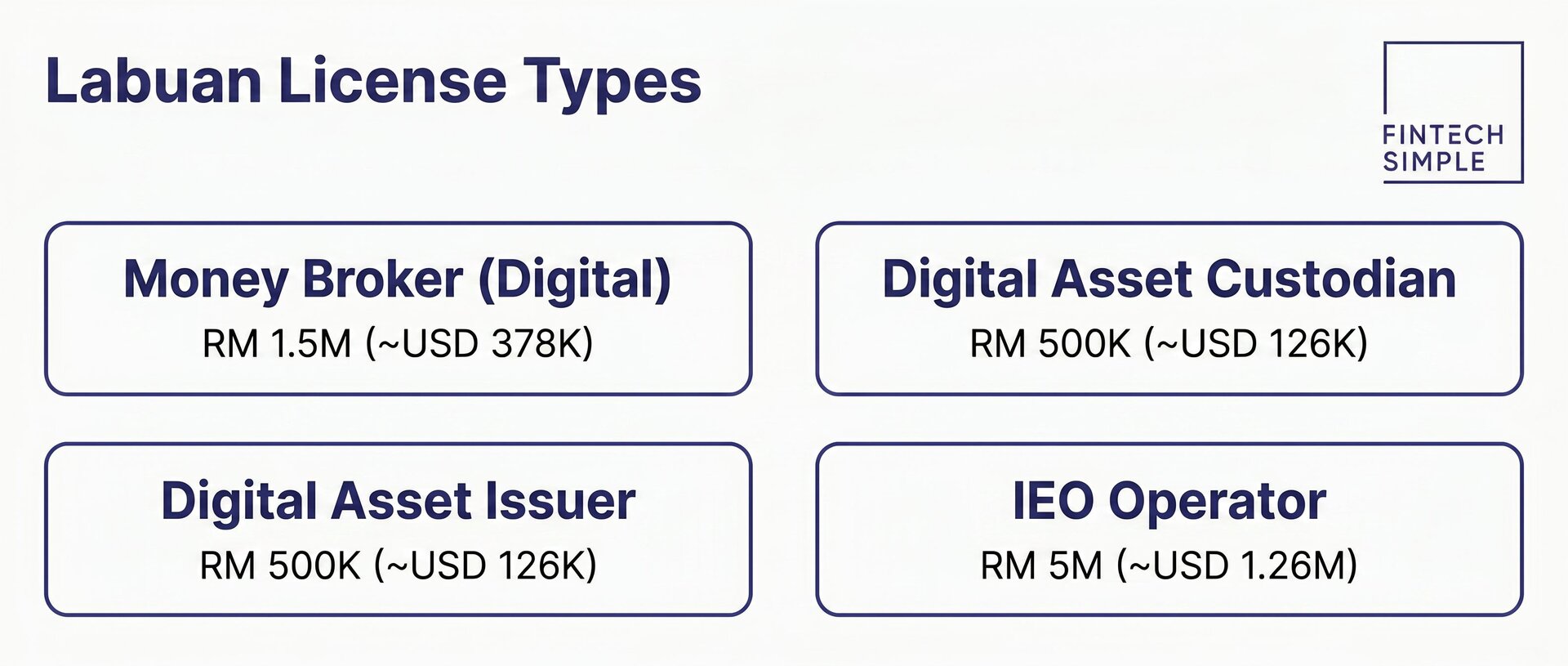
The Labuan Financial Services Authority (LFSA) issues several digital financial service licenses under the Labuan Financial Services and Securities Act 2010 (Act 704). The four most relevant categories for crypto businesses are outlined below. Each covers a different business model. Capital figures below are denominated in Malaysian Ringgit (the legally binding currency), with USD approximations at the 2026 YTD average exchange rate of 1 MYR ≈ 0.2519 USD.

Grid showing four Labuan crypto license types: Money Broker Digital (RM 1.5M), Digital Asset Custodian (RM 500K), Digital Asset Issuer (RM 500K), and IEO Operator (RM 5M)

Digital Asset Exchange — Money Broker (Digital Asset)

If your platform matches buy and sell orders for digital assets (spot exchange or OTC desk), you need a Money Broker (Digital Asset) license. This is the route most exchange operators take. Minimum paid-up capital is RM 1,500,000 (~USD 378,000).

Some consulting sources reference a separate “Digital Asset Exchange (DAX)” category with a higher capital threshold. However, the current LFSA fee schedule does not list DAX as a distinct license category. Applicants seeking to operate an institutional-grade multilateral trading facility should confirm the applicable route directly with LFSA during the pre-application process.

Operational requirements for the Money Broker (Digital Asset) route include a minimum of 2 full-time employees based in Labuan and annual operating expenditure of at least RM 100,000. The annual LFSA licence fee is USD 10,000 for new licensees from 2026. Existing licensees follow a transitional schedule: USD 1,500 in 2026, USD 5,750 in 2027, and USD 10,000 from 2028.

Digital Asset Custodian

A Digital Asset Custodian license covers the safekeeping and administration of digital assets on behalf of third parties: wallet infrastructure, key management, and asset storage services. This license does not permit trading or brokering. Minimum paid-up capital is RM 500,000 (~USD 126,000).

The custodian category suits businesses building regulated custody rails for institutional clients, family offices, or as a standalone service ancillary to an exchange. AML/CFT obligations under Act 613 apply in full regardless of license type.

  • Core permitted activities — safekeeping private keys, managing wallets, settling digital asset transfers on client instruction
  • Not permitted under this license — operating an exchange, offering brokerage, issuing tokens

Digital Asset Issuer (STO / Token Issuance)

The Digital Asset Issuer license permits a Labuan entity to issue digital tokens to the public, including security token offerings (STOs) and utility token sales structured as regulated instruments. This is the pathway for token projects that want a recognised regulatory framework rather than operating from an unlicensed jurisdiction.

Minimum paid-up capital is RM 500,000 (~USD 126,000). A caveat applies: if your token constitutes a Credit Token under LFSA’s classification, the capital requirement may rise to RM 1,000,000 (~USD 252,000). LFSA classifies token type during the review process; structure your offering documents carefully before submission.

Shariah-compliant digital token issuers (structured under Act 705) are eligible for a 0% corporate tax rate from YA2024 through YA2028 under P.U.(A) 127/2024, compared to the standard 3% rate for conventional issuers.

IEO Operator

An Initial Exchange Offering (IEO) Operator license authorises a platform to conduct token fundraising rounds on behalf of issuing projects. The IEO Operator acts as the intermediary between the token issuer and investors, running the sale on its platform and conducting due diligence on listed projects.

This is the most capital-intensive license category. Indicative guidance from consulting practice suggests minimum paid-up capital of RM 5,000,000 (~USD 1,260,000) and compulsory insurance through an LFSA-approved insurer. Note: the current LFSA fee schedule does not list “IEO Operator” as a separate category; the specific framework should be confirmed with LFSA during the pre-application process. Budget for insurance premiums as an ongoing operating cost separate from the capital requirement.

  • Due diligence obligation — the IEO Operator is responsible for vetting each token project listed on its platform
  • Compulsory insurance — must be placed with an LFSA-approved insurer before licence activation
  • AML screening — investor KYC and transaction monitoring apply to all IEO participants under Act 613
License Type Permitted Activity Min. Capital (MYR) Min. Capital (USD approx.) Special Requirements
Money Broker (Digital Asset) / Crypto Exchange Spot exchange, OTC desk, digital asset brokerage RM 1,500,000 ~USD 378,000 2 FTE staff in Labuan; RM 100,000 min. annual OPEX
Digital Asset Custodian Safekeeping & administration of digital assets for third parties RM 500,000 ~USD 126,000
Digital Asset Issuer (STO) Public token issuance, STOs, regulated token sales RM 500,000 ~USD 126,000 RM 1,000,000 if token classified as Credit Token
IEO Operator Running token fundraising rounds on behalf of issuers RM 5,000,000 ~USD 1,260,000 Compulsory insurance via LFSA-approved insurer

Not sure which license fits your model?

The distinction between license types determines both your capital commitment and your compliance obligations. LFSA pre-application meetings are available but require preparation. We structure these discussions to get a clear answer before you commit resources.

Why Choose Labuan for a Crypto License?

If you run a crypto exchange, custody operation, or token issuance business and need a regulated home in Asia, Labuan combines low tax rates, unrestricted foreign ownership, and proximity to ASEAN markets. The numbers below are drawn from the Labuan IBFC tax structure and official treaty registers, not estimates.

Tax Advantages

A Labuan trading company pays 3% corporate tax on audited net profits, provided it meets economic substance requirements (physical office, resident staff, minimum operating expenditure). Fail substance, and the rate reverts to Malaysia’s standard 24%. The 3% applies to conventional business activities; non-trading activities attract 0%.

Two additional exemptions apply on top of the base rate:

  • Withholding tax relief — P.U.(A) 59/2025 exempts specific income types (dividends, interest, royalties, and service payments between Labuan entities) from income tax for YA 2023–2027; withholding tax under Sections 109/109B/109C does not apply where the underlying income itself is exempt. This is a time-limited concession covering defined income categories, not a blanket WHT exemption.
  • Islamic digital activities — 0% tax — companies operating Islamic digital banking, bourses, ummah entities, or Islamic digital token issuance qualify for full tax exemption from YA2024 to YA2028 under the Labuan Business Activity Tax Exemption Order 2024.

Capital gains: 0%. Profits from disposing of digital assets are not taxed at the corporate or shareholder level in Labuan.

Malaysia has concluded 73 comprehensive double taxation avoidance agreements (DTAAs), covering most major trading jurisdictions. Labuan companies can access this treaty network. The full list is maintained by Malaysia’s Inland Revenue Board at hasil.gov.my. For a business with cross-border payment flows, this network reduces withholding costs on dividends, royalties, and interest received from treaty partners.

Note on the MYR 20,000 “fixed tax”

The fixed annual tax of MYR 20,000 was abolished on 1 January 2019. MYR 20,000 is the minimum annual operating expenditure threshold for non-trading (holding) companies only. Money broking (including digital asset) companies must meet a higher threshold — RM 100,000 minimum OPEX plus at least 2 full-time employees in Labuan (see Requirements). Other trading activities have varying thresholds.

Business-Friendly Framework

Labuan permits 100% foreign ownership across all license categories, with no local partner requirement and no mandatory shareholding for Malaysian nationals. No currency controls apply: you can move capital in and out freely, hold accounts in foreign currencies, and repatriate profits without central bank approval.

For staffing, the Labuan Employment Pass gives non-Malaysian directors and senior staff a multiple-entry pass for up to 5 years (minimum 2-year contract required), renewable, with the right to live in both Labuan and mainland Malaysia. The minimum qualifying salary is MYR 10,000 per month (increasing to MYR 20,000+ from 1 June 2026 per revised Ministry requirements). You can place a management team in-jurisdiction to satisfy substance requirements without committing to permanent residency.

The Labuan Financial Services Authority (LFSA) operates under a single-regulator model. You deal with one agency for licensing, ongoing supervision, and AML/CFT reporting. Bank Negara Malaysia (BNM) does not license or directly supervise Labuan IBFC entities, though BNM’s prudential guidelines may apply to banks operating within Labuan.

Strategic Location

Labuan is a federal territory of Malaysia, situated in the South China Sea off the coast of Borneo. It sits within four hours’ flying time of Singapore, Hong Kong, Jakarta, Manila, and Ho Chi Minh City. For a crypto business serving clients across the Asia-Pacific region, that proximity means same-timezone operations with Southeast Asia’s 700 million population.

As an ASEAN member state jurisdiction, a Labuan entity operates within Malaysia’s broader trade and treaty network, including preferential access under the ASEAN Free Trade Area and bilateral investment treaties with key markets.

Labuan also functions as a gateway for Islamic finance. The Labuan Islamic Financial Services and Securities Act 2010 (Act 705) provides a parallel licensing track for Shariah-compliant digital instruments. If you target GCC investors, Malaysian retail clients, or institutions requiring halal-compliant structures, this track pairs with the YA2024–2028 tax exemption noted above.

Requirements for a Labuan Crypto License

Before LFSA reviews your application, your company must satisfy a fixed set of structural, capital, and operational conditions. LFSA inspects physical premises and reviews staffing records, so paper compliance alone will not pass.

Corporate Structure Requirements

A Labuan digital financial services company must meet the following corporate structure requirements:

  • Directors — minimum 2, natural persons only; 3–5 years of documented financial services experience required. Since the Labuan Companies (Amendment) Act 2022 (effective 10 June 2022), at least one director must be a resident director (a trust officer with a Labuan trust company approved by LFSA, or a natural person aged 18+ meeting LFSA criteria). Other directors may be non-resident.
  • Shareholders — minimum 1 (natural or legal person); 100% foreign ownership is permitted with no currency controls.
  • Company secretary — mandatory; must be a licensed Labuan trust company. You cannot appoint an individual secretary directly.
  • AML/Compliance officer — mandatory appointment. If this role becomes vacant, you must notify LFSA within 10 working days and fill the position within 30 days. The requirement derives from the LFSA Guidelines on AML/CFT/CPF and TFS for Labuan KRIs (February 2025).
  • Physical office — a private, dedicated premises in Labuan with its own entrance. Virtual offices do not satisfy this requirement, and LFSA checks that the office size is proportionate to the scale of the business.

Capital Requirements by License Type

All minimum capital figures are set in Malaysian Ringgit (MYR) under Labuan law. USD equivalents below use the 2026 YTD average exchange rate of approximately 1 MYR ≈ USD 0.2519. These are paid-up share capital thresholds. Working capital for operations is a separate consideration.

License TypeMinimum Capital (MYR)Approx. (USD, 2026 avg.)
Money Broker (Digital Asset) / Crypto Exchange RM 1,500,000 ~USD 378,000
Digital Asset Custodian RM 500,000 ~USD 126,000
Digital Asset Issuer RM 500,000 ~USD 126,000
IEO Operator RM 5,000,000 ~USD 1,260,000

Most crypto exchange operators apply under the Money Broker (Digital Asset) route at RM 1,500,000. Confirm the correct route for your business model with your licensed trust company or directly with LFSA before filing.

Economic Substance Requirements

Labuan’s 3% preferential tax rate applies only to companies that demonstrate genuine economic activity in the territory. Failing to meet substance rules triggers the standard Malaysian corporate tax rate of 24%. The substance thresholds for money broking (crypto exchange) activities are:

  • Full-time employees — minimum 2 full-time staff based in Labuan. These must be genuine employees, not contractors filling nominal roles.
  • Annual operating expenditure — minimum RM 100,000 per year incurred in Labuan (effective under the revised Guidelines for Money Broking Business, 9 September 2024). The correct threshold is RM 100,000.
  • Dedicated IT member — at least one staff member with IT responsibility is required, reflecting LFSA’s expectation that digital asset operations maintain local technical oversight.

Substance vs. tax rate

If your Labuan entity fails to maintain the required headcount, physical office, or annual expenditure, LFSA can reclassify your trading income as subject to the 24% standard Malaysian rate rather than the 3% Labuan rate. Budget for substance costs from day one.

For license types outside the money broking category (custodians, IEO operators), employee and expenditure thresholds differ. Contact us to confirm the exact substance rules for your license type before incorporation.

Regulatory Framework for Labuan Crypto Licensing

The Labuan Financial Services Authority (LFSA) is the sole regulator for crypto and digital financial services within the Labuan International Business and Financial Centre (IBFC). It issues licences, sets conduct standards, and enforces compliance, entirely independently of Bank Negara Malaysia (which covers onshore Malaysian financial services only). Four principal statutes govern company formation, licensing, AML/CFT obligations, and Shariah-compliant operations.

Key Legislation

Four Acts form the statutory backbone of every Labuan crypto license:

ActShort NameRole in Labuan Crypto Regulation
Act 704 Labuan Financial Services and Securities Act 2010 Primary licensing instrument for digital financial services. Defines permitted licence categories, capital thresholds, and LFSA’s enforcement powers.
Act 441 Labuan Companies Act 1990 Governs incorporation of Labuan IBFC companies, including directorship, share structure, and registered-office requirements that precede any licence application.
Act 613 Anti-Money Laundering Act 2001 Federal AML/CFT statute applicable to all financial entities. Establishes customer due diligence obligations, suspicious transaction reporting, and money-laundering penalties.
Act 705 Labuan Islamic Financial Services and Securities Act 2010 Shariah-compliant digital financial instruments. Operators issuing or brokering Islamic digital tokens must satisfy both Act 705 and LFSA Shariah governance requirements.

Note: PU(A) 127/2024 is a tax exemption order granting 0% corporate tax on qualifying Islamic digital activities from YA2024 to YA2028. It is not a licensing instrument and does not alter the licence application process under Act 704.

AML/KYC Obligations

All holders of a Labuan crypto license must comply with Act 613 and the LFSA’s AML/CFT guidelines and directives. The LFSA most recently updated these guidelines in February 2025 (expanding the scope to include counter-proliferation financing), and they apply from day one of operations. The four core obligations are:

  • KYC procedures — verify identity of every customer and beneficial owner before onboarding; enhanced due diligence for PEPs and higher-risk relationships
  • Transaction monitoring — automated screening with internal escalation of unusual patterns
  • Suspicious transaction reporting (STR) — file with the Financial Intelligence and Enforcement Department when reasonable grounds exist; tipping off is prohibited under Act 613
  • Record keeping — retain customer identification, transaction data, and correspondence for a minimum of six years

Responsibility for AML/CFT sits with a dedicated compliance officer appointed at incorporation. If the compliance officer leaves, the LFSA must be notified within 10 working days and a replacement named within 30 days.

Penalties under Act 613 for money-laundering violations include fines starting at MYR 5,000,000 (or five times the proceeds of the offence, whichever is higher) and imprisonment of up to 15 years. Operating without an LFSA licence is a separate criminal offence.

Practical note

LFSA conducts periodic on-site and off-site inspections of licensed entities. Maintaining audit-ready AML records from the first day of operations (not just at renewal) is the most effective way to avoid licence suspension.

How to Get a Crypto License in Labuan

The end-to-end process, from incorporating a Labuan company to receiving your license, takes 4–6 months for most applicants. Delays typically come from banking and document preparation, not from the LFSA review itself.

Step 1 Weeks 1–3

Incorporate a Labuan Company

What we do: We register a Labuan company under the Labuan Companies Act 1990 (Act 441) and set up the governance structure required before an application can proceed.

  • Directors — appoint at least 2 directors (natural persons), including at least one resident director; each must evidence 3–5 years of relevant financial services experience
  • Company secretary — appoint a licensed Labuan trust company as resident secretary; this is mandatory under Act 441
  • Registered office — secure a physical office in Labuan (private space with its own door; virtual offices do not satisfy LFSA requirements)
  • Shareholder structure — minimum 1 shareholder; 100% foreign ownership is permitted with no currency controls
Step 2 Weeks 3–6

Open a Corporate Bank Account

What we do: We identify suitable banking partners and manage the account-opening process, including the capital deposit that LFSA will verify at application stage.

  • Minimum capital deposit — RM 1,500,000 (~USD 378,000) for a Money Broker (Digital Asset) / crypto exchange license; RM 500,000 (~USD 126,000) for a Digital Asset Custodian
  • Banking challenges — crypto-related businesses face elevated due diligence from banks; account opening is often the longest single step and can push the overall timeline toward 6 months
  • Currency — capital requirements are denominated in MYR by law; USD equivalents use the prevailing exchange rate (1 MYR ≈ 0.2519 USD as of 2026)
Step 3 Weeks 3–7

Prepare License Application Documents

What we do: We draft and assemble the full application package in parallel with the banking step, so both are ready to submit together.

  • Business plan — detailed description of proposed activities, target markets, revenue model, and technology infrastructure
  • AML/KYC policies — written procedures aligned with Act 613
  • Compliance framework — appointment of a dedicated AML/Compliance officer
  • Director credentials — CVs, professional references, and proof of financial services experience for each director
  • Economic substance plan — confirmation of at least 2 full-time employees in Labuan and minimum annual operating expenditure of RM 100,000
Step 4 Week 7

Submit Application to LFSA

What we do: We file the completed application with the Labuan Financial Services Authority (LFSA) and pay the application fee.

  • Application fee — USD 500 (one-time). The annual licence fee is USD 10,000 for new licensees from 2026; existing licensees follow a transitional schedule.
  • Submission — all documents submitted directly to LFSA; incomplete packages are returned and restart the review clock
Step 5 Months 2–5

LFSA Review & Interview

What we do: We stay in active contact with LFSA throughout the review period, respond to requests for additional information promptly, and prepare key personnel for any interviews.

  • Assessment — LFSA evaluates the business plan, compliance framework, director fitness, and capital adequacy against Act 704
  • Interviews — LFSA may schedule interviews with directors or the compliance officer; attendance is mandatory
  • Additional documentation — LFSA may request supplementary materials; our team prepares responses within LFSA’s prescribed deadlines
Step 6 Weeks 1–4 after approval

License Approval & Commencement

What we do: Once LFSA issues the approval-in-principle, we manage the final steps to get the company operational and compliant from day one.

  • License issuance — LFSA issues the formal license and the company appears on the LFSA public register
  • Operational setup — activate technology systems, onboard staff to Labuan, and confirm the physical office meets LFSA’s substance requirements
  • Compliance reporting — the annual licence fee is USD 10,000 for new licensees from 2026. Ongoing AML reporting and economic substance obligations begin immediately.
  • Annual OPEX — maintain economic substance requirements to preserve the 3% preferential tax rate

Total timeline

4–6 months from company incorporation to license issuance for a standard Money Broker (Digital Asset) application. IEO operator licenses may take longer due to higher capital requirements (RM 5,000,000) and more complex LFSA scrutiny.

Start Your Labuan License Application

With 500+ licenses obtained since 2016, our team handles every step from Labuan company incorporation to LFSA approval. Get your application started today.

Taxation for Labuan Crypto Companies

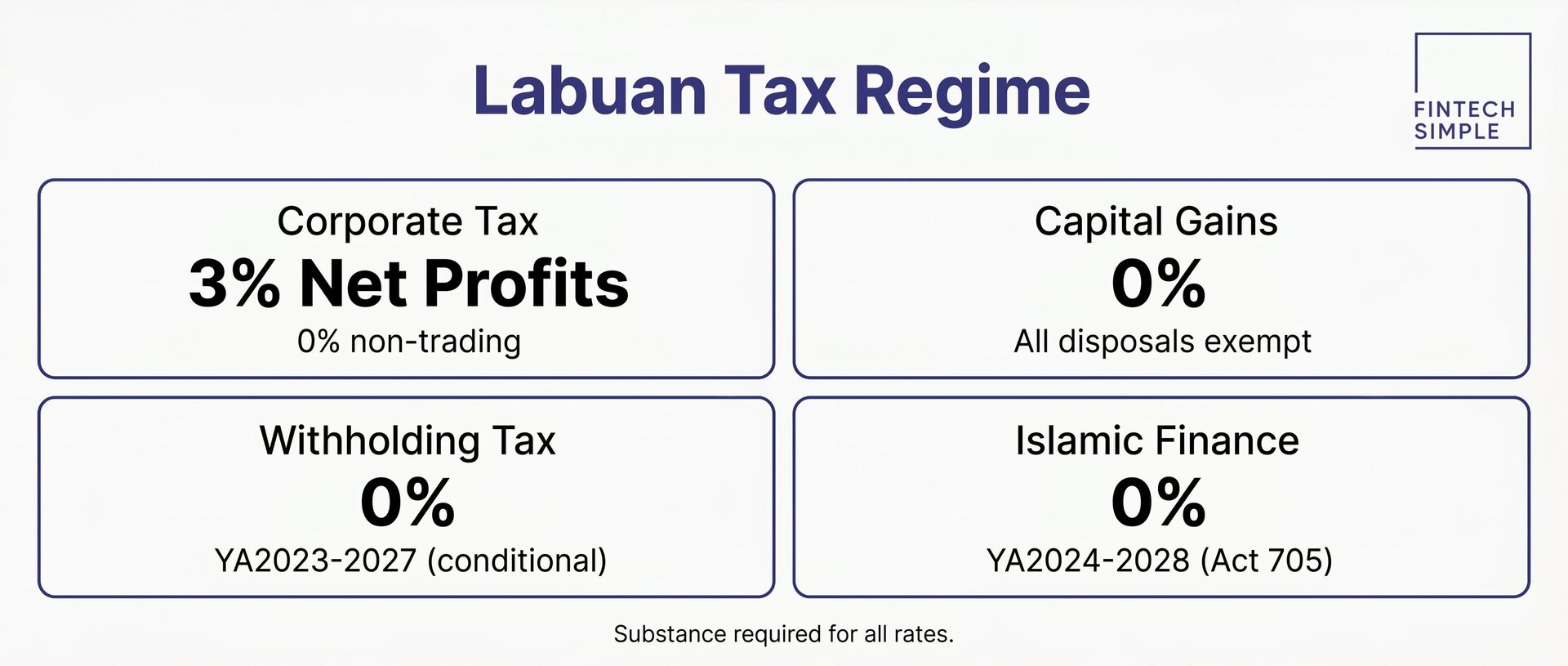
Labuan’s tax framework is a primary reason crypto businesses choose the jurisdiction. Trading companies pay 3% on audited net profits. Non-trading companies pay nothing. Both rates depend on meeting economic substance requirements; companies that fail substance tests revert to Malaysia’s standard 24% corporate rate. The subsections below cover each component of the Labuan crypto tax regime, including time-limited exemptions and treaty access.

Grid of four tax components: 3% corporate tax, 0% capital gains, 0% withholding tax (YA2023–2027), and 0% Islamic finance tax (YA2024–2028)

Corporate Tax

Labuan trading companies (crypto exchanges, digital asset brokers, and token issuers) are taxed at 3% of audited net profits under the Labuan Business Activity Tax Act 1990. Labuan non-trading companies (holding structures, investment vehicles) pay 0% corporate tax on income derived from their Labuan business activity.

The 3% rate applies only when a company satisfies the economic substance requirements set by LFSA (see Requirements). Companies that do not meet these thresholds are deemed to conduct a non-qualifying Labuan business activity and are assessed at the standard Malaysian corporate rate of 24%.

Substance is not optional

The 3% rate is conditional, not automatic. LFSA monitors compliance through annual reporting to the Labuan FSA, and the Inland Revenue Board cross-checks substance data. Factor in the cost of real office space and local payroll from day one.

Capital Gains & Withholding Tax

Labuan companies pay 0% capital gains tax on gains from disposal of digital assets and securities. Malaysia introduced CGT on disposal of unlisted shares from 1 March 2024 (10% on net gain), but gains on digital assets and listed securities held by a Labuan entity remain exempt from Malaysian capital gains tax. This applies to both trading and non-trading companies.

P.U.(A) 59/2025 exempts specific income types from income tax for assessment years YA2023 through YA2027: dividends from Labuan companies, interest received by non-residents or Labuan companies, royalties from Labuan companies, distributions from Labuan trusts/partnerships/foundations, and service payments between Labuan entities. Where the underlying income is exempt, withholding tax under Sections 109/109B/109C does not apply. This is not a blanket WHT exemption — it covers defined income categories only. Outside the exemption window or for income types not covered, standard Malaysian withholding tax rates apply.

Source: Crowe Malaysia, Labuan Tax Exemptions 2023–2027.

Islamic Finance Tax Incentives

Under P.U.(A) 127/2024 (Labuan Business Activity Tax Exemption Order 2024), qualifying Islamic digital finance activities are fully exempt from Labuan business activity tax for YA2024 through YA2028. Eligible entity types include:

  • Islamic digital banking operators — licensed under the Labuan Islamic Financial Services and Securities Act 2010
  • Islamic digital bourses — Shariah-compliant digital asset exchange platforms
  • Ummah companies — entities established to serve the Muslim community through digital financial products
  • Islamic digital token issuers — issuers of Shariah-compliant digital tokens and sukuk

This incentive sits alongside, not instead of, the standard 3% / 0% regime. A conventional crypto company does not qualify simply by adding Shariah-compliant products; the entity itself must operate under the Islamic finance licensing framework under the Labuan Islamic Financial Services and Securities Act 2010 (Act 705).

Double Taxation Agreements

Malaysia has concluded 73 comprehensive double taxation avoidance agreements (DTAAs) with treaty partners across Asia, Europe, the Middle East, the Americas, and Africa. Labuan companies can access these treaties, which can reduce withholding taxes on dividends, interest, and royalties paid between Malaysia and treaty countries.

Treaty access is relevant for crypto businesses that route payments to foreign vendors, pay management fees to offshore holding companies, or distribute profits to non-resident shareholders. Under many DTAAs, withholding tax rates are reduced to 5–10%, or to nil where the underlying income is exempt from Malaysian tax (as is the case for qualifying income types under P.U.(A) 59/2025 during YA2023–YA2027).

The full list of Malaysia’s comprehensive DTAAs is maintained by the Inland Revenue Board: LHDN, Comprehensive DTAs.

Ongoing Compliance & Obligations

A Labuan crypto license does not end at issuance. Licensees must satisfy continuous reporting duties, maintain AML/CFT controls, and pay annual fees to keep the license in good standing.

Reporting & Audit Requirements

LFSA imposes three recurring reporting obligations on all digital financial service licensees:

  • Annual audited accounts — financial statements must be audited by an approved auditor and submitted to LFSA each year. The audit must cover the full financial year and comply with Malaysian Financial Reporting Standards.
  • Annual returns to LFSA — statutory annual returns are filed with the regulator, confirming the company’s directors, shareholders, registered office, and business activities remain accurate and unchanged.
  • AML/CFT compliance reporting — licensees operate under the Anti-Money Laundering, Anti-Terrorism Financing and Proceeds of Unlawful Activities Act 2001 (Act 613). This requires a designated AML/Compliance Officer, periodic compliance reports, transaction monitoring records, and suspicious transaction reports filed with the Financial Intelligence and Enforcement Department. If the Compliance Officer position becomes vacant, LFSA must be notified within 10 working days and a replacement appointed within 30 days.

Economic substance requirements (see Requirements) run in parallel. Failure to maintain substance triggers reclassification to Malaysia’s standard 24% corporate tax rate.

Penalties for Non-Compliance

Penalties vary by statute and violation type. The ceiling for money laundering under Act 613 is 15 years.

  • Money laundering (AMLA Section 4) — conviction carries up to 15 years imprisonment. The minimum fine is MYR 5,000,000 or five times the proceeds of the offence, whichever is higher.
  • Other AML/CFT violations — breaches such as failure to report suspicious transactions, inadequate record-keeping, or failure to conduct customer due diligence carry up to 5 years imprisonment and fines up to MYR 3,000,000.
  • Corporate offences (Labuan Companies Act) — Sections 108A through 108H were deleted by the Labuan Companies (Amendment) Act 2025 (Act A1756), effective 23 April 2025, and replaced by a new beneficial ownership framework under Part Va. Remaining corporate penalty provisions carry distinct thresholds.

Statutory note

The 15-year imprisonment term for money laundering is set by Act 613 (AMLA). The Labuan Companies Act contains separate corporate offence provisions with distinct thresholds. See the BNM AML/CFT penalties reference for further detail.

License Renewal

Labuan crypto licenses are subject to annual renewal. Two conditions must be met each year to retain the license without interruption.

  • Annual fee — USD 10,000 per year for new licensees from 2026. Existing licensees follow a transitional schedule: USD 1,500 in 2026, USD 5,750 in 2027, and USD 10,000 from 2028.
  • Substance maintenance — the physical Labuan office, minimum staffing (2 full-time employees), and operating expenditure thresholds (RM 100,000 for money broking) must be maintained continuously. LFSA can revoke or suspend a license where substance requirements lapse, regardless of whether the annual fee has been paid.

Budget for the LFSA fee, audit costs, and ongoing substance from day one. A missed deadline or lapsed substance requirement can trigger a renewal review that delays operations while the regulator investigates.

Risks & Challenges of the Labuan Crypto License

Labuan has real advantages, but it also has real drawbacks. Before committing capital and management time to this jurisdiction, you should understand what consistently causes problems for licensees. These are not edge cases; they affect most applicants at some point.

Banking is the biggest practical obstacle. Opening a corporate bank account for a Labuan crypto entity takes longer and fails more often than in comparable jurisdictions. Most Malaysian banks either refuse crypto businesses outright or impose months-long due diligence processes with no guaranteed outcome. Many licensees end up relying on EMIs or payment processors in third countries, which adds cost and complexity. Fintech Simple manages introductions to account-friendly institutions, but we will not oversell this: banking for crypto remains harder in Labuan than in the UAE or Lithuania.

Economic substance is a real operational burden, not a checkbox. The substance requirements are enforced through annual reporting with no grace period. Failure triggers the standard Malaysian corporate tax rate of 24% instead of the preferential 3%.

Regulatory fees are rising sharply. LFSA revised its fee structure effective 1 January 2026. The annual licence fee for a Money Broker (Digital Asset) license is USD 10,000 from 2026 for new licensees. Existing licensees benefit from a transitional schedule: USD 1,500 in 2026, USD 5,750 in 2027, and USD 10,000 from 2028. A separate one-time application fee of USD 500 also applies. Ongoing cost projections must account for these scheduled increases.

Competition from UAE and Singapore has intensified. Both jurisdictions now offer stronger international banking access and more globally recognised regulatory brands for crypto businesses targeting institutional clients. Labuan competes primarily on cost and speed for operators who do not need MAS or VARA-level recognition. See the full comparison for a detailed breakdown.

Political and regulatory uncertainty is a long-term consideration. Malaysia’s policy environment for crypto is still maturing. LFSA has updated its guidelines, fee schedules, and substance requirements multiple times since 2021. The current preferential tax treatment, including specific income exemptions between Labuan entities under P.U.(A) 59/2025 covering YA 2023–2027, is conditional and time-limited. Operators building a long-term structure should model scenarios in which the tax and fee landscape continues to tighten.

Labuan vs Other Crypto Jurisdictions

All four jurisdictions below permit 100% foreign ownership. The comparison covers upfront capital, tax, licensing speed, substance obligations, banking access, and global standing. Figures are approximate and reflect conditions as of mid-2026.

FactorLabuan (LFSA)Singapore (MAS)UAE – Dubai (VARA)Hong Kong (SFC)
Capital requirementRM 500K–RM 1.5M (~USD 126K–378K)SGD 250K–1M+ (~USD 185K–740K+)AED 100K–1.5M (~USD 27K–408K)HKD 5M–10M (~USD 640K–1.3M)
Corporate tax3% on net profits (0% non-trading)17% standard rate9% federal16.5% profits tax
Licensing timeline4–6 months6–18 months6–12 months6–18 months
Substance requirements2 FTE; RM 100K annual OPEX; physical officeLocal director; material opsPhysical UAE office; MLROResponsible officers resident in HK
Banking accessModerateGoodImprovingGood
Global recognitionRegionalHighGrowingHigh

Labuan has the lowest tax (3%) and the fastest timeline (4–6 months) among these four jurisdictions. Singapore and Hong Kong typically require 6–18 months for approval and charge 16.5–17% corporate tax, but their licences carry more weight with institutional counterparties and tier-one banks. The UAE (VARA) is closest to Labuan on speed in some licence classes, though the 9% tax rate and uneven banking access reduce the cost advantage.

If you are targeting Asian markets and need a regulated, cost-efficient base with FATF compliance, Labuan is the strongest option in this group. If your business depends on a licence recognised in Europe or North America, Singapore or Hong Kong will serve you better.

Speak With Our Labuan Licensing Experts

Get a personalized assessment of your licensing needs, timeline, and costs. Our team will map out the right LFSA license type for your business model.

Frequently Asked Questions about Crypto Licensing in Labuan

What is a crypto license in Labuan?

A crypto license in Labuan is a digital financial services (DFS) license issued by the Labuan Financial Services Authority (LFSA) under the Labuan International Business and Financial Centre (IBFC) framework. The primary legislation is the Labuan Financial Services and Securities Act 2010 (Act 704). License types include Digital Asset Money Broker, Digital Asset Custodian, Digital Asset Issuer, and IEO Operator, each covering distinct crypto activities from exchange operations to token issuance.

How much does a Labuan crypto license cost?

The annual licence fee for a Digital Asset Money Broker is USD 10,000 from 2026 for new licensees. Existing licensees follow a transitional schedule: USD 1,500 in 2026, USD 5,750 in 2027, USD 10,000 from 2028. A one-time application fee of USD 500 also applies. Minimum paid-up capital ranges from RM 500,000 (~USD 126,000) for a Digital Asset Custodian to RM 1,500,000 (~USD 378,000) for a Money Broker (Digital Asset) and RM 5,000,000 (~USD 1,260,000) for an IEO Operator. Budget separately for incorporation, office setup, and the RM 100,000 minimum annual operating expenditure required for economic substance.

How long does it take to get a crypto license in Labuan?

The end-to-end process, from company incorporation through LFSA approval, typically takes 4 to 6 months. Simpler license types such as Digital Asset Broking can be closer to 2–3 months, while more complex applications involving token issuance or IEO platforms may reach 6 months. The LFSA review phase alone is commonly 3–4 months; the remaining time covers company registration, document preparation, and office setup.

Can foreigners own a Labuan crypto company?

Yes. Labuan permits 100% foreign ownership for all digital financial services license types with no restrictions on nationality of shareholders. Malaysia imposes no foreign exchange controls on cross-border remittances for Labuan IBFC entities, so funds can move freely in and out of the jurisdiction in foreign currencies. Transactions in Malaysian Ringgit (MYR) require Bank Negara Malaysia approval. At least one resident director is required under the Labuan Companies (Amendment) Act 2022, though other directors may be of any nationality or residency. A licensed Labuan trust company must be appointed as resident company secretary.

What is the corporate tax rate in Labuan?

Licensed Labuan trading companies (including crypto exchanges) pay 3% corporate tax on audited net profits, provided they meet economic substance requirements. Non-trading (investment-holding) activity is taxed at 0%. The former fixed annual tax election of MYR 20,000 was abolished on 1 January 2019 and no longer applies. Failure to satisfy substance requirements results in the standard Malaysian corporate tax rate of 24% applying to all income.

Do I need a physical office in Labuan?

Yes, a private physical office in Labuan is mandatory for all licensed digital financial services entities. The LFSA requires the office to have its own entrance, be of a size appropriate to the scale of business, and be exclusively dedicated to the licensee. Shared co-working spaces and virtual offices do not qualify. The physical office also supports the economic substance test, which underpins the 3% preferential tax rate.

What are the economic substance requirements?

For money broking (crypto exchange) activities, LFSA requires a minimum of 2 full-time employees based in Labuan and minimum annual operating expenditure of RM 100,000, per the revised Guidelines for Money Broking Business effective 9 September 2024. Other license types carry different headcount and OPEX thresholds. Substance must be genuine: employees must perform core income-generating activities, not merely administrative functions.

What happens if I don’t meet substance requirements?

If your Labuan company fails to meet economic substance requirements, the preferential 3% tax rate is withdrawn and the standard Malaysian corporate tax rate of 24% applies to all taxable income. LFSA also has grounds to impose regulatory sanctions, restrict activities, or revoke the licence in cases of persistent non-compliance. Maintaining substance (real employees, genuine OPEX, and an operational physical office) is required for both the preferential tax rate and licence retention.

Can I get a work visa through my Labuan company?

Yes. A Labuan licensed company can sponsor a 2-year renewable multiple-entry employment pass for directors, management, and key professionals. The minimum qualifying salary is MYR 10,000 per month (increasing to MYR 20,000+ from 1 June 2026). Pass holders may live and work in both Labuan and mainland Malaysia.

What are the penalties for non-compliance?

Penalties operate under two separate statutes. Under the Anti-Money Laundering, Anti-Terrorism Financing and Proceeds of Unlawful Activities Act 2001 (AMLA), a money laundering conviction carries up to 15 years imprisonment and a fine of not less than five times the sum or value of the proceeds of the offence, or MYR 5,000,000, whichever is higher. The Labuan Companies Act contains various penalty provisions for corporate violations by directors and officers; note that Sections 108A through 108H were deleted by the Labuan Companies (Amendment) Act 2025 (Act A1756), effective 23 April 2025, and replaced by a new beneficial ownership framework under Part Va. Operating without an LFSA licence is a criminal offence.

Is Labuan good for Islamic / Shariah-compliant crypto?

Yes. Labuan is one of the few jurisdictions with dedicated legislation for Shariah-compliant digital activities: the Labuan Islamic Financial Services and Securities Act 2010 (Act 705). Under the Labuan Business Activity Tax Exemption Order 2024 (PU(A) 127/2024), qualifying Islamic digital activities (Islamic digital banking, Islamic digital bourses, and Islamic digital token issuers) benefit from full corporate tax exemption through Year of Assessment 2028.

How does Labuan compare to Singapore for crypto licensing?

Labuan’s entry costs are lower: RM 1,500,000 (~USD 378,000) minimum capital for a Money Broker (Digital Asset) versus SGD 250,000 (~USD 196,000) base capital for Singapore’s Major Payment Institution licence, with higher total setup costs in Singapore. Corporate tax is 3% in Labuan versus 17% in Singapore. Singapore offers stronger banking infrastructure and a more widely recognised regulatory brand. See the full comparison for a detailed breakdown.

Your Privacy

By clicking "Accept", you consent to the use of cookies and similar technologies on your device to improve site navigation, analyze usage, provide specific functionalities, and support our marketing initiatives. Cookies that are strictly necessary will always be active with this link.