



Bulgaria Crypto License 2026

Bulgaria Crypto License 2026

Bulgaria offers the EU's lowest corporate tax rate (10%) combined with full MiCA passporting rights, making it one of the most cost-effective jurisdictions for crypto-asset service providers entering the European market.

Since 2016, Fintech Simple has helped 500+ businesses secure crypto licenses across 30+ jurisdictions. Our licensing team has guided multiple clients through Bulgaria’s regulatory transition, from the legacy NRA registration to the current FSC-administered MiCA CASP regime, and we remain actively engaged with the Bulgarian licensing ecosystem as MiCA enforcement takes full effect.

Ivo S. — Bulgaria licensing expert at Fintech Simple
Ivo S.
Bulgaria licensing expert at Fintech Simple

TL;DR for Decision-Makers

Bulgaria is the cheapest EU jurisdiction to get a MiCA crypto licence. The FSC (Financial Supervision Commission) is the regulator. Three licence classes exist: Class 1 starts at €50K capital and a €5,113 filing fee; Class 3 (trading platforms) requires €150K capital and a €30,678 fee. Corporate tax is a flat 10% — the lowest in the EU after Hungary. You need a Bulgaria-resident executive officer, a real office in Sofia (not virtual), and a full AML/DORA compliance pack. Realistic timeline from incorporation to licence: 6–12 months. The grandfathering deadline for existing operators is 1 July 2026 — after that, no licence means no operations. Our packages: €6,500 for firms that already hold an EU financial licence (Article 60 notification), €18,500 for new company registration + full CASP authorisation.

What Is a Bulgaria Crypto License Under MiCA?

Licence Fee (Class 1)

From €5,113

Capital Required

From €50,000

Timeline

6–12 months

Corporate Tax

10% (flat)

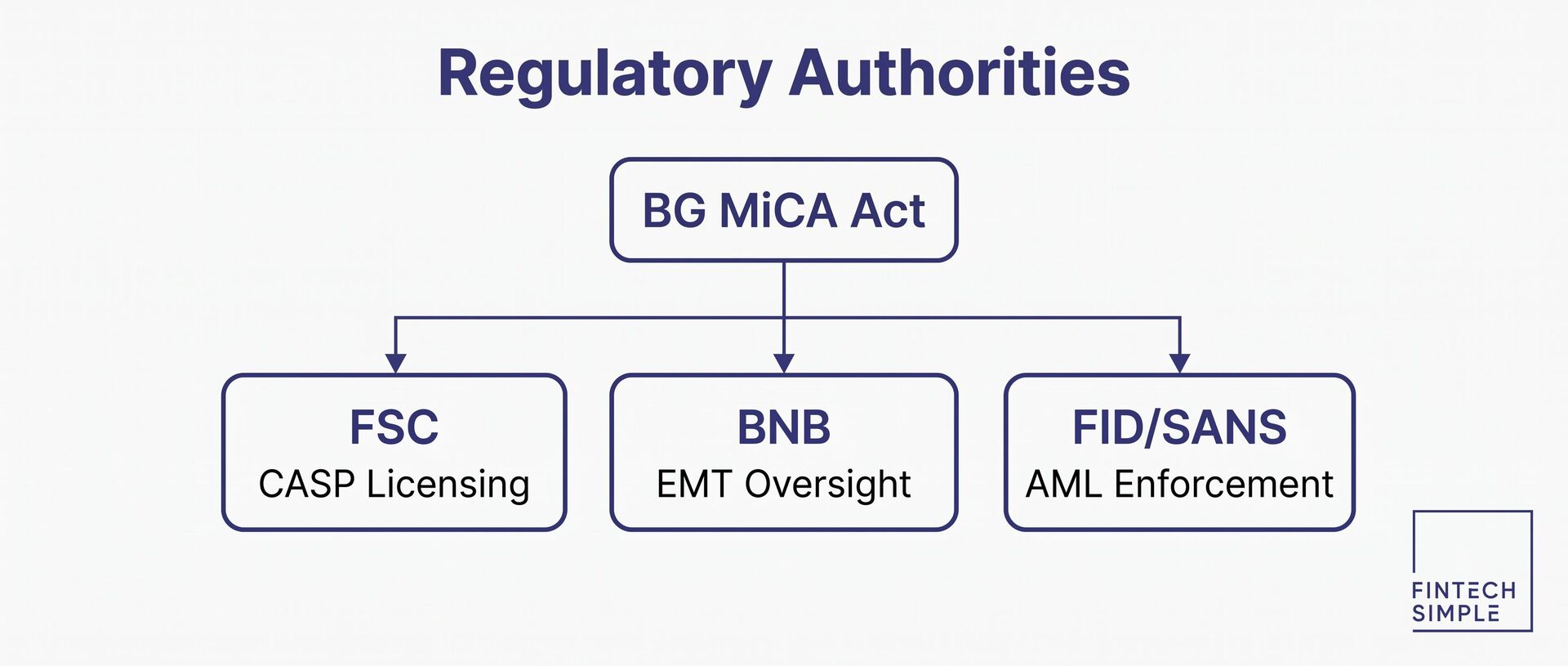
Since 30 December 2024, the EU’s Markets in Crypto-Assets Regulation (MiCA) has required every crypto-asset service provider (CASP) operating in the EU to hold a licence from its home-state regulator. In Bulgaria, that regulator is the Financial Supervision Commission (FSC). The Bulgarian parliament adopted the national BG MiCA Act on 20 June 2025, and the law entered into force on 8 July 2025. This act designates the FSC as the competent authority for authorising and supervising CASPs, assigns e-money token (EMT) oversight to the Bulgarian National Bank (BNB), and places anti-money-laundering enforcement under the Financial Intelligence Directorate (FID) within the State Agency for National Security (SANS).

Hierarchy diagram showing Bulgaria's three crypto regulatory authorities under the BG MiCA Act: FSC for CASP licensing, BNB for EMT oversight, and FID/SANS for AML enforcement

MiCA Framework in Bulgaria

Before MiCA, Bulgaria regulated crypto businesses through a simple registration with the National Revenue Agency (NRA). That regime imposed minimal prudential requirements and offered no EU-wide passporting. Under the BG MiCA Act, all new CASPs must obtain a full licence from the FSC. Existing NRA-registered CASPs benefit from a grandfathering period until 1 July 2026.

Bulgaria adopted the euro on 1 January 2026, so all fees, capital thresholds, and fines are now denominated in EUR. DORA (Regulation EU 2022/2554) has applied directly to CASPs EU-wide since 17 January 2025. Bulgaria enacted complementary amendments transposing DORA Directive (EU 2022/2556) into national financial-sector legislation on 8 July 2025, alongside the BG MiCA Act.

Three CASP Licence Classes

MiCA groups crypto-asset services into three licence classes, each carrying different prudential safeguards (own funds or an equivalent insurance policy) and FSC application fees set by Ordinance No. 76. The table below maps the classes to their requirements:

Licence Class Minimum Prudential Safeguards FSC Application Fee Covered Services
Class 1 €50,000 ~€5,113 Receiving & transmitting orders; providing advice on crypto-assets; portfolio management; execution of orders on behalf of clients; placing of crypto-assets; transfer services on behalf of clients
Class 2 €125,000 ~€10,226 Class 1 services + custody & administration; exchange of crypto-assets for funds; exchange of crypto-assets for other crypto-assets
Class 3 €150,000 ~€30,678 Class 2 services + operation of a trading platform for crypto-assets

A CASP holding a lower-class licence can upgrade: extending from Class 1 to Class 2 costs ~€6,136, and from Class 2 to Class 3 ~€18,538. A single entity may hold only one licence at a time, covering all authorised service categories.

Regulated Crypto-Asset Services

Under MiCA, MiCA Article 3(1)(16) defines ten categories of crypto-asset services, each requiring authorisation within the appropriate licence class:

  • Custody and administration of crypto-assets
  • Operation of a trading platform
  • Exchange of crypto-assets for funds (fiat on/off-ramp)
  • Exchange of crypto-assets for other crypto-assets
  • Execution of orders on behalf of clients
  • Placing of crypto-assets
  • Receiving and transmitting orders
  • Providing advice on crypto-assets
  • Providing portfolio management
  • Providing transfer services

Every licensed CASP must appoint a dedicated AML/compliance officer and undergo ongoing FSC supervision, with AML enforcement handled by FID/SANS. Once authorised, you can passport services across all 27 EU member states without separate national approvals.

Key distinction

The FSC authorises and supervises CASPs. The BNB regulates EMT issuers. FID/SANS enforces AML obligations. All three authorities have independent oversight roles under the BG MiCA Act.

Bulgaria Crypto License Cost

Bulgaria’s Financial Supervision Commission (FSC) sets all CASP licensing fees through Ordinance No. 76 (State Gazette No. 51/2025). Since Bulgaria adopted the euro on 1 January 2026, every fee, capital requirement, and supervisory charge is denominated in EUR. Costs divide into three layers: the one-time FSC licence fee, the MiCA prudential safeguard, and recurring annual supervisory fees. The total first-year investment depends on which of the three licence classes you apply for.

FSC Licensing Fees (Ordinance No. 76)

MiCA groups crypto-asset services into three classes of increasing scope. The FSC charges a single upfront fee per class at the time of authorisation:

Licence ClassScopeFee (EUR)
Class 1 Receiving/transmitting orders, advisory, portfolio management, order execution, placement, transfer services €5,113
Class 2 Class 1 + custody, exchange for funds, exchange for other crypto €10,226
Class 3 Class 2 + trading platform operation €30,678

CASPs that start with a lower class and later expand their activities pay an extension fee rather than re-applying from scratch:

Extension PathFee (EUR)
Class 1 → Class 2 €6,136
Class 2 → Class 3 €18,538

Capital Requirements (Prudential Safeguards)

Under MiCA Article 67, every authorised CASP must maintain prudential safeguards (own funds, an insurance policy, or a comparable guarantee) at all times. The minimum amounts, set by MiCA Annex IV, apply uniformly across the EU:

Licence ClassMinimum Prudential Safeguard (EUR)
Class 1 €50,000
Class 2 €125,000
Class 3 €150,000

This capital must remain on the CASP’s balance sheet (or covered by insurance) for the entire duration of the licence. Under MiCA Article 67, the actual requirement is the higher of the Annex IV class minimum or one quarter of prior-year fixed overheads.

Important distinction

MiCA calls these “prudential safeguards,” not capital requirements. You can satisfy the obligation through own funds, insurance, or a comparable guarantee, so you choose the structure that fits your balance sheet.

Annual Supervisory Fees

Beyond the one-time licence fee, the FSC charges annual supervisory fees with a fixed component per activity type. A variable component of 0.03% of total annual income also applies. Ordinance No. 76 lists nine fee lines (consolidating MiCA’s two exchange services into a single line):

Activity TypeAnnual Fixed Fee (EUR)
Trading platform operation €6,136
Transfer services €5,113
Exchange (crypto-fiat / crypto-crypto) €1,636
Portfolio management €818
Order execution €511
Custody & administration €409
Advisory services €409
Placement €306
Receiving / transmitting orders €200

If you hold multiple activity authorisations, you pay the fixed fee for each one. The 0.03% variable component applies to your combined total.

Total First-Year Investment Breakdown

The table below combines the FSC licence fee, the minimum prudential safeguard, and a representative annual supervisory fee to show the total first-year financial commitment per class. Company formation costs (EUR 1 minimum share capital, notary/registration fees) and legal advisory fees are additional.

Cost ComponentClass 1Class 2Class 3
FSC licence fee €5,113 €10,226 €30,678
Prudential safeguard (minimum) €50,000 €125,000 €150,000
Annual supervisory fee (example) €200–5,113 €409–1,636 €6,136
First-year total (regulatory only) €55,313–60,226 €135,635–136,862 €186,814

Note

The supervisory fee ranges reflect the cheapest and most expensive single-activity fees that each class adds. Class 1 covers six services (from €200 for RTO up to €5,113 for transfer services); Class 2 adds custody and exchange (€409–€1,636); Class 3 adds trading platform operation (€6,136). CASPs authorised for multiple activities pay cumulative fixed fees. Legal and consulting costs, office lease, AML compliance infrastructure, and staffing are not included in these regulatory-only estimates.

The prudential safeguard dominates every scenario, accounting for roughly 80–91% of first-year regulatory spend. Company formation, legal advisory, office lease, AML infrastructure, and staffing costs sit on top of these figures.

Service Packages for Obtaining a Crypto License in Bulgaria

We’ve developed two tailored options for obtaining a crypto license in Bulgaria — choose the one that matches your existing regulatory status and business goals.

Notification for Licensed Firms €6,500
Company Registration + CASP License €18,500
Consultation & regulatory strategy
Documentation and translations in Bulgarian and English
Pre-application meeting with the FSC
Submission, RFI handling, and continuous regulatory support
FSC administrative fees included
Post-authorisation passporting support
Review of existing legal status & update of AML/ICT/governance framework
Article 60 notification dossier
Bulgarian OOD/EOOD setup (incorporation, capital deposit, 1-year Sofia address)
Full MiCA documentation pack (AML/CFT, ICT/DORA, governance, custody)
Fit-and-proper documentation and interview coordination
Notification for Licensed Firms €6,500
  • Consultation & regulatory strategy
  • Documentation and translations in Bulgarian and English
  • Pre-application meeting with the FSC
  • Submission, RFI handling, and continuous regulatory support
  • FSC administrative fees included
  • Post-authorisation passporting support
  • Review of existing legal status & update of AML/ICT/governance framework
  • Article 60 notification dossier
  • Bulgarian OOD/EOOD setup (incorporation, capital deposit, 1-year Sofia address)
  • Full MiCA documentation pack (AML/CFT, ICT/DORA, governance, custody)
  • Fit-and-proper documentation and interview coordination
Company Registration + CASP License €18,500
  • Consultation & regulatory strategy
  • Documentation and translations in Bulgarian and English
  • Pre-application meeting with the FSC
  • Submission, RFI handling, and continuous regulatory support
  • FSC administrative fees included
  • Post-authorisation passporting support
  • Review of existing legal status & update of AML/ICT/governance framework
  • Article 60 notification dossier
  • Bulgarian OOD/EOOD setup (incorporation, capital deposit, 1-year Sofia address)
  • Full MiCA documentation pack (AML/CFT, ICT/DORA, governance, custody)
  • Fit-and-proper documentation and interview coordination

Not included: minimum capital under MiCA Annex IV (€50,000/€125,000/€150,000 depending on class), professional indemnity insurance, notary fees, sworn translations beyond standard Bulgarian ↔ English documentation, annual FSC supervisory fees, statutory audit fees, and VAT (20%) where applicable.

Our Experts

Our licensing team has guided 500+ crypto businesses through EU regulatory frameworks since 2016. Each engagement is led by a dedicated lawyer with deep experience in MiCA CASP authorisation, Bulgarian FSC procedures, and cross-border EU passporting.

Patrik Asevičius
Patrik Asevičius Lawyer, MiCA licensing specialist
Marcin Mostowski
Marcin Mostowski Lawyer, EU regulatory specialist
Ivo S.
Ivo S. Lawyer, EU compliance specialist

Ready to Start Your Bulgaria Crypto License Application?

Our licensing specialists guide you through every step of the Bulgarian MiCA CASP licensing process, from document preparation to FSC authorisation.

Requirements for a Bulgaria Crypto License

Obtaining a CASP licence in Bulgaria under the Markets in Crypto-Assets Regulation (MiCA) requires meeting five FSC assessment pillars: corporate structure, governance, AML framework, operational substance, and IT resilience.

Company Structure (OOD/LLC)

The standard vehicle for a Bulgarian CASP is an OOD (Druzhestvo s Ogranichena Otgovornost), the local equivalent of a limited liability company. An OOD can be formed by one or more founders, whether natural persons or legal entities, with no nationality restrictions under Bulgarian commercial law.

The statutory minimum share capital for an OOD is just €1 since Bulgaria adopted the euro on 1 January 2026. However, this bare minimum has no bearing on your licence application. MiCA Article 67 imposes separate prudential safeguards that every CASP must maintain:

  • Class 1 services (receiving/transmitting orders, advisory, portfolio management, order execution, placement, transfer services) — €50,000 in own funds or equivalent insurance policy
  • Class 2 services (Class 1 + custody, exchange for funds, exchange for other crypto) — €125,000
  • Class 3 services (Class 2 + operating a trading platform) — €150,000

When CASPs choose the own-funds path, the capital must be CET1-quality under MiCA Article 67(3). But CET1 capital is not the only option — MiCA also accepts an insurance policy or comparable guarantee covering the relevant amount. Company formation itself takes 3–7 business days for in-person registration with ready documents, or 2–3 weeks when handled remotely via power of attorney.

Management & Governance

MiCA Article 68(1) requires that all members of the management body of a CASP possess sufficient knowledge, skills, and experience to perform their duties, and that they are of good repute. The FSC conducts fit-and-proper assessments during the application review.

Residency requirement

Bulgarian company law imposes no citizenship or residency requirement on directors. However, MiCA mandates that CASPs have “effective management” in the EU. The FSC specifically expects at least one Bulgaria-resident executive officer fully dedicated to the CASP’s activities (FSC FAQ Q7). Competitor claims of “no residency requirement” reflect pre-MiCA rules that no longer apply.

Board members must demonstrate they can collectively devote sufficient time to governance, have no disqualifying criminal convictions, and have not been associated with a previously revoked financial licence.

Registered Office & Operational Substance

Your CASP must have its registered office in Bulgaria and carry out at least part of its crypto-asset services from that location.

Virtual office warning

A virtual address may suffice for initial company registration, but it will not satisfy the FSC during CASP authorisation. MiCA requires CASPs to maintain a registered office where they carry out at least part of their services with real operational presence. Expect the FSC to verify that staff, systems, and records are physically accessible at the declared address.

The FSC may conduct on-site visits to verify that staff, systems, and records are accessible at your declared address.

AML/CFT Compliance Framework

CASPs are obliged entities under EU anti-money laundering law. The FSC and the Financial Intelligence Directorate (FID) under SANS jointly oversee AML compliance for crypto-asset service providers in Bulgaria.

Your application must include a detailed AML/CFT programme covering:

  • Customer due diligence (CDD) — identity verification for all clients, with enhanced due diligence for higher-risk relationships. Under the EU Transfer of Funds Regulation (TFR/Reg. 2023/1113), CASPs must collect originator and beneficiary data for every crypto-asset transfer regardless of amount. From July 2027, AMLR Article 19 sets the CASP-specific occasional transaction CDD threshold at €1,000
  • Transaction monitoring — automated systems to detect and flag suspicious activity, with reporting obligations to the FID
  • Risk assessment — a documented firm-wide risk assessment covering customer types, geographic exposure, product lines, and delivery channels
  • Record-keeping — retention of CDD data, transaction records, and internal reports for the legally mandated period

Competitor correction

LegalBison claims an AML compliance officer is “not mandatory.” This is false under MiCA. CASPs must appoint a dedicated AML/compliance officer responsible for the internal control framework. ESMA’s regulatory technical standards require named owners for each core compliance function. A Bulgarian-speaking AML officer is strongly advised because regulatory correspondence with the FSC and FID is conducted in Bulgarian.

IT Security & DORA

The Digital Operational Resilience Act (DORA, Regulation EU 2022/2554) has applied directly to CASPs EU-wide since 17 January 2025. Bulgaria enacted complementary amendments transposing DORA Directive (EU 2022/2556) into national financial-sector legislation on 8 July 2025, the same date the national MiCA Act entered into force.

DORA imposes five pillars of digital resilience that every CASP must implement:

  • ICT risk management framework — documented policies and procedures for identifying, protecting against, detecting, responding to, and recovering from ICT-related incidents
  • Incident reporting — classification and notification of major ICT incidents to the FSC within the prescribed timeframes
  • Digital operational resilience testing — regular testing of ICT systems, including threat-led penetration testing for significant entities
  • Third-party risk management — oversight of ICT service providers (cloud, infrastructure, software), with contractual provisions meeting DORA standards
  • Information sharing — arrangements for exchanging cyber-threat intelligence with other financial entities and authorities

Important distinction

DORA is an EU Regulation that applies directly across all Member States without requiring transposition. The Bulgarian amendments enacted on 8 July 2025 complement DORA by aligning national supervisory powers and penalties with the regulation’s requirements. Some competitor guides incorrectly state that Bulgaria “transposed” DORA. Regulations are not transposed; they take direct effect.

The FSC expects CASP applicants to demonstrate DORA readiness as part of the licence application. This includes evidence of an ICT risk management framework, business continuity plans, and incident response procedures already in place or under active implementation.

How to Get a Crypto License in Bulgaria: Step-by-Step

The CASP licensing process under MiCA follows a structured path set out in MiCA Article 63. The Financial Supervision Commission (FSC) has 25 working days to assess completeness, then 40 working days to issue a decision. In practice, Q&A rounds and document preparation extend the total timeline to 6–12 months.

Step 1 Days 1–20

Company Formation & Corporate Setup

What we do: We incorporate a Bulgarian OOD (limited liability company) through the Commercial Register and set up the corporate structure required for a MiCA-compliant CASP. In-person registration with ready documents takes 3–7 business days; remote registration via power of attorney takes 2–3 weeks.

  • Entity type — OOD (LLC equivalent) is the preferred structure for CASP licensing in Bulgaria
  • Minimum share capital — EUR 1 under Bulgarian company law (MiCA prudential safeguards are separate and higher)
  • Registered office — MiCA requires CASPs to have a registered office where they carry out at least part of their crypto-asset services; a purely virtual address will not satisfy this requirement
  • Bulgaria-resident management — MiCA mandates effective management in the EU; the FSC specifically expects at least one executive officer residing in Bulgaria and fully dedicated to the CASP’s activities
  • Bank account — we open a corporate bank account (expect 4–8 weeks for KYC and onboarding; not all Bulgarian banks accept CASP applicants, so we manage parallel applications)
Step 2 Weeks 3–10

Prepare Compliance Documentation

What we do: We draft the full compliance documentation package that the FSC requires with your CASP application.

  • AML/CFT programme — internal policies for customer due diligence, transaction monitoring, and suspicious activity reporting to the Financial Intelligence Directorate (FID)
  • Dedicated AML/compliance officer — mandatory under MiCA; we recommend appointing a Bulgarian-speaking officer since regulatory interactions with FSC and FID are conducted in Bulgarian
  • Business continuity plan — disaster recovery, data backup, and operational resilience procedures aligned with DORA (applicable EU-wide since 17 January 2025; Bulgarian complementary amendments in force since 8 July 2025)
  • Governance framework — management body composition demonstrating relevant financial sector experience and good repute per MiCA Article 68
  • Prudential safeguards evidence — proof of own funds or insurance policy meeting the MiCA threshold for your service class: €50,000 (Class 1), €125,000 (Class 2), or €150,000 (Class 3)
Step 3 Week 11

Submit CASP Application to FSC

What we do: We compile and submit the formal CASP authorisation application to the FSC, together with all supporting documentation and the applicable licensing fee.

  • Licensing fees — ~€5,113 for Class 1, ~€10,226 for Class 2, or ~€30,678 for Class 3 (set by FSC Ordinance No. 76)
  • Application dossier — includes programme of operations, organisational chart, compliance documentation, proof of prudential safeguards, and fit-and-proper evidence for all key personnel
  • Submission triggers the clock — the FSC’s 25-working-day completeness assessment period begins on the date of receipt
Step 4 Weeks 12–17

FSC Completeness Assessment (25 Working Days)

What we do: We liaise with the FSC during the completeness review, responding to any requests for clarification or missing documents. Under MiCA Article 63, the FSC has 25 working days to acknowledge receipt and confirm the application is complete.

  • Information requests — if the FSC finds information missing, it sets a deadline (up to 20 working days) for the applicant to submit it; the completeness clock is suspended until receipt
  • Our role — we prepare and submit responses promptly to minimise any suspension
  • Outcome — the FSC either confirms completeness (advancing to substantive review) or rejects the application as incomplete
Step 5 Weeks 17–25

FSC Substantive Review & Decision (40 Working Days)

What we do: We support you through the substantive review phase, where the FSC evaluates whether your organisation meets all MiCA requirements.

  • Due diligence — the FSC assesses governance, prudential safeguards, AML/CFT systems, IT security, and consumer protection measures
  • Additional information requests — the FSC may request information once during the substantive phase, suspending the clock for up to 20 working days (MiCA Article 63); further requests do not trigger additional suspensions
  • Decision — the FSC grants or refuses the CASP licence; refusal must be reasoned and is subject to appeal
Step 6 Week 25+

Licence Issuance & EU Passporting

What we do: Once the FSC grants your CASP licence, we handle post-authorisation requirements and initiate the EU passporting procedure so you can serve clients across all 27 member states.

  • FSC register entry — your company is added to the FSC’s public register of authorised CASPs and notified to ESMA
  • EU passporting — the licence allows you to provide crypto-asset services throughout the EU/EEA without obtaining separate national authorisations
  • Annual supervisory fees — ongoing fixed fees apply per activity type (e.g., ~€6,136 for trading platforms, ~€1,636 for exchange services, ~€409 for custody)
  • Ongoing compliance — mandatory reporting to the FSC, continued AML/CFT obligations, and adherence to MiCA conduct-of-business rules

Realistic timeline: The formal MiCA review (Steps 3–5) takes approximately 3 months under ideal conditions. With document preparation, company formation, information requests, and bank account opening, the total process realistically spans 6–12 months. Claims of “4–6 weeks” on competitor websites refer to the discontinued NRA/VASP registration, not the MiCA CASP authorisation that is now required.

Bulgaria Crypto License Timeline

Obtaining a MiCA CASP licence in Bulgaria takes 6–12 months from the decision to incorporate through to the FSC’s final authorisation. The process has three distinct phases: company formation, document preparation, and regulatory review.

Timeline infographic showing three phases of Bulgaria CASP licensing: company formation in 1 to 3 weeks, document preparation in 1 to 3 months, and FSC review in 3 to 5 months, totaling 6 to 12 months
Phase Key Activities Duration
1. Company Formation Register an OOD (LLC) with the Bulgarian Commercial Register, open a corporate bank account, appoint an EU-resident director with effective management based in Bulgaria 3–7 business days (in-person) or 2–3 weeks (remote via power of attorney)
2. Document Preparation Draft AML/CFT policies, business plan, governance framework, IT security documentation, complaints-handling procedures, proof of prudential safeguards (from €50,000 depending on CASP class) 1–3 months
3. FSC Review Completeness check (25 working days), substantive assessment and decision (40 working days). The FSC may request additional information once during this phase, suspending the clock for up to 20 working days in total. Further requests for clarification do not trigger additional suspensions under MiCA Article 63. 3–6 months
Total (realistic) End-to-end from incorporation to authorisation, including Q&A rounds and bank account setup 6–12 months

Under MiCA Article 63, the FSC may suspend the review clock once for up to 20 working days when it requests missing information; subsequent requests do not suspend the clock further (MiCA Article 63). Applicants who submit incomplete filings (missing governance procedures, insufficient proof of prudential safeguards, or inadequately documented IT security) face delays that push the review phase beyond the statutory minimum.

Document preparation is the phase most within an applicant’s control. A well-resourced team with prior MiCA licensing experience can compress it to 4–6 weeks. First-time applicants drafting policies from scratch should budget 2–3 months, particularly for the AML/CFT framework and ICT risk management documentation required under DORA (Regulation EU 2022/2554, applicable EU-wide since 17 January 2025). Bulgaria enacted complementary amendments transposing DORA Directive (EU 2022/2556) into national financial-sector legislation on 8 July 2025.

Ready to Start Your Bulgaria Crypto License Application?

Let our team handle the FSC application process from start to finish so you can focus on building your business.

Taxation for Crypto Companies in Bulgaria

Bulgaria maintains one of the lowest corporate tax rates in the EU, a flat 10% that has been in place since 2007. Combined with VAT exemptions on core crypto-to-fiat exchange services and straightforward dividend rules, your tax burden as a CASP stays predictable.

TaxRateKey Detail
Corporate income tax 10% Flat rate; 15% effective for multinationals >€750M (Pillar Two QDMTT)
Dividend WHT — EU/EEA parent 0% Per EU Parent-Subsidiary Directive
Dividend WHT — non-EU 5% Baseline rate; situation was recently in flux (proposed increases were dropped)
VAT 20% Standard rate; crypto-to-fiat exchange exempt
Individual capital gains (crypto) 10% Flat PIT; effective ~9% after 10% deemed-expense deduction
Social & health contributions ~32.7%–33.4% Split between employer and employee

Corporate Tax

You pay a flat 10% corporate income tax on worldwide profits, a rate Bulgaria has held steady since 2007. No progressive brackets, no surcharges. If your group’s consolidated revenue exceeds €750 million, the Pillar Two Qualified Domestic Minimum Top-Up Tax (QDMTT) brings the effective rate to 15%, in line with the OECD global minimum. For the vast majority of crypto startups, the 10% rate applies without qualification.

Dividend Withholding Tax

When you distribute profits to a parent company in the EU or EEA, you owe 0% withholding tax on dividends under the EU Parent-Subsidiary Directive. For shareholders outside the EU/EEA, the baseline withholding rate is 5%. A proposed increase to 10% appeared in the November 2025 budget draft but was dropped from the revised budget in December 2025 after coalition negotiations. Double-tax treaties may reduce the 5% rate further depending on the shareholder’s jurisdiction.

VAT Treatment

Bulgaria applies a standard 20% VAT to most goods and services. However, pure crypto-to-fiat exchange services are VAT-exempt under the European Court of Justice’s Hedqvist ruling (Case C-264/14), which treats cryptocurrency exchange as a supply of services exempt from VAT in the same way as transactions in currency, banknotes, and coins. This exemption covers the core exchange activity only. Ancillary services such as consulting, technical integrations, or platform subscriptions may still attract the full 20% VAT. Structure your service agreements carefully to separate exempt exchange activity from taxable ancillary offerings.

Employee Contributions

If you hire staff in Bulgaria, expect total social and health contributions of approximately 32.7%–33.4% of gross salary, split between employer and employee. This breaks down into two components:

  • Social security — 24.7%–25.4% of gross salary (the exact rate depends on the occupational risk category). The employer covers roughly 60% of this amount, the employee the remaining 40%.
  • Health insurance — 8% of gross salary (employer 4.8%, employee 3.2%).

Despite these contributions, Bulgaria’s overall labour costs remain among the lowest in the EU. Bulgaria adopted the euro on 1 January 2026, so all salaries, contributions, and reporting are now denominated in EUR at the fixed conversion rate of 1 EUR = 1.95583 BGN.

Source

Corporate and withholding tax rates from PwC Tax Summaries — Bulgaria Corporate Tax and PwC Tax Summaries — Bulgaria Withholding Taxes. Rates current as of 2026; consult a local tax advisor for your specific situation.

Grandfathering & Transitional Provisions

Bulgaria’s MiCA Regulation includes transitional provisions that allow existing crypto-asset service providers to continue operating while they apply for full authorisation. These provisions apply to CASPs that held a valid registration with the National Revenue Agency (NRA), with two tracks depending on registration date: providers registered before 30 December 2024 may continue operating until 1 July 2026, while those registered between 30 December 2024 and 8 July 2025 had a shorter window (application deadline: 8 October 2025). The deadline is 1 July 2026, less than two months from now.

Urgent, Deadline: 1 July 2026

CASPs operating without a full MiCA licence must cease all crypto-asset services after 1 July 2026. If your firm has not yet submitted an application to the Financial Supervision Commission (FSC), act now. The FSC assessment process alone takes up to 25 working days for a completeness check plus 40 working days for a decision, with potential extensions of up to 20 additional working days for information requests.

Existing NRA-Registered CASPs

CASPs registered with Bulgaria’s NRA as of 30 December 2024 can continue offering crypto-asset services while their MiCA licence application is under FSC review, provided they submit before the transitional period expires. This allows them to meet MiCA’s full requirements (prudential safeguards starting at €50,000, governance standards, dedicated AML/compliance officer) without interrupting their business.

CASPs that registered with the NRA after 30 December 2024 faced a shorter window. Under Bulgaria’s MiCA Act (entered into force 8 July 2025), these late registrants had until 8 October 2025 (three months from the Act’s entry into force) to submit their licence applications to the FSC. Any late registrant that missed that deadline lost its right to operate under the transitional regime.

Deadline: 1 July 2026

The grandfathering period ends on 1 July 2026 with no extensions or grace periods. After that date, every CASP operating in Bulgaria must hold a full MiCA licence issued by the FSC. Providers that fail to obtain authorisation must cease all crypto-asset services immediately.

Given the FSC’s review timeline (detailed in the info box above), firms that have not yet filed face a real risk of missing the cutoff. As of 6 May 2026, only 56 days remain. If your firm is still operating under the transitional regime, submit your application to the FSC now.

Why Bulgaria for Your Crypto License?

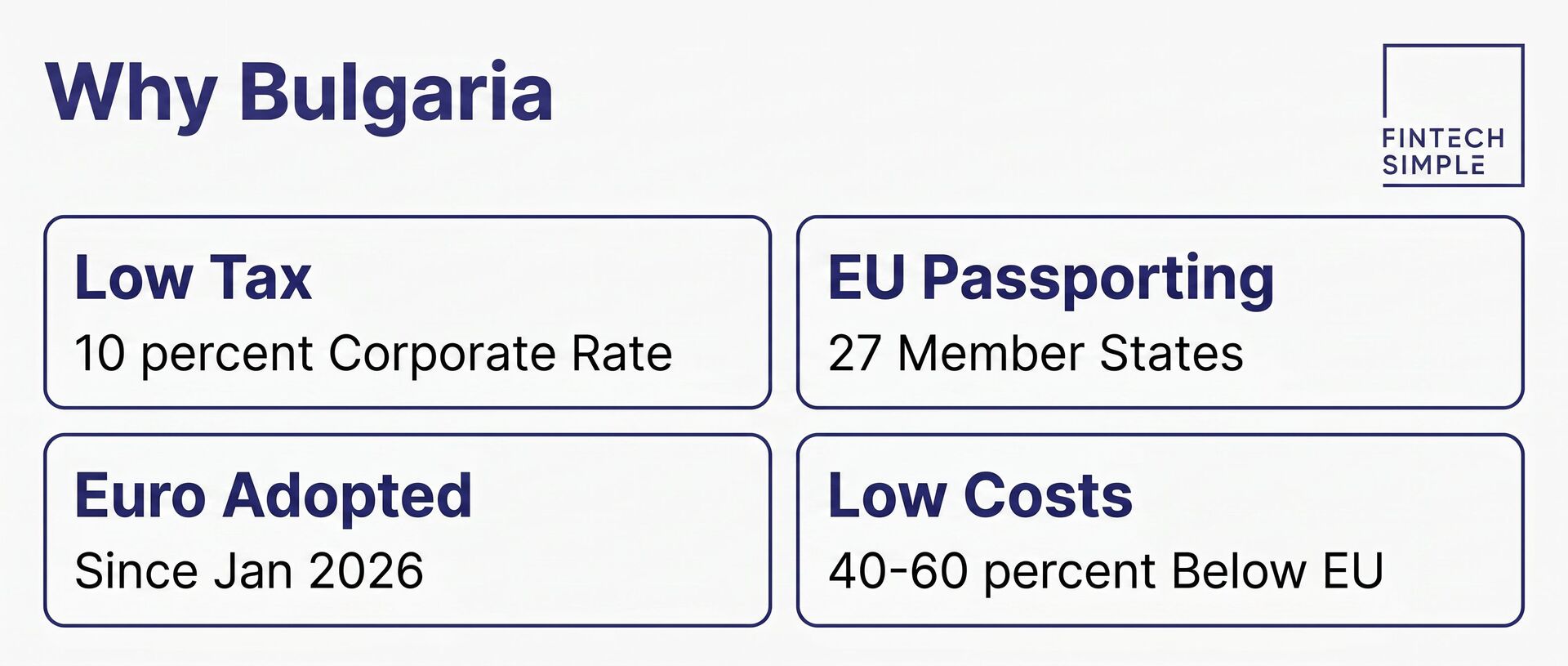
Bulgaria combines one of the EU’s lowest flat corporate tax rates with full MiCA passporting and operational costs well below Western European averages. Since joining the eurozone on 1 January 2026, the country eliminates foreign-exchange risk for crypto businesses serving EU markets.

One of the Lowest Corporate Tax Rates in the EU

Bulgaria’s 10% flat corporate income tax, in effect since 2007, is the second-lowest flat rate among all 27 EU member states (only Hungary’s 9% is lower). For a CASP generating €1 million in taxable profit, that means €100,000 in corporate tax versus €250,000 in France (25%) or roughly €300,000 in Germany (~30% effective). Dividends to qualifying EU/EEA parent companies (holding ≥10% for at least 12 months per the Parent-Subsidiary Directive) are taxed at 0%, and crypto-to-fiat exchanges are VAT-exempt. See the full tax breakdown below.

EU Passporting Under MiCA

A CASP licence issued by Bulgaria’s Financial Supervision Commission (FSC) grants passporting rights across all 27 EU member states plus the EEA. You apply once in Sofia and serve clients from Lisbon to Helsinki without additional national authorisations. Bulgaria’s MiCA Act entered into force on 8 July 2025, and the FSC is already accepting licence applications under Ordinance No. 76. Licensing fees start at approximately €5,113 for a Class 1 CASP licence, materially below comparable application fees in France (AMF) and Germany (BaFin), which according to industry sources fall in the €10,000–€20,000 range depending on services and supervisory complexity.

Growing Crypto Ecosystem

Bulgaria’s entry into the eurozone on 1 January 2026 removed the last currency barrier for crypto firms operating in EUR-denominated markets. Several Bulgarian banks accept CASP applicants, though not all — expect 4–8 weeks for KYC and account onboarding. The Financial Intelligence Directorate (FID) under SANS handles AML supervision, providing a clear regulatory chain alongside the FSC.

Cost-Effective Operations

Operational expenses in Bulgaria run 40–60% below Western EU benchmarks. Company formation takes 3–7 business days for in-person registration, and the preferred entity type, an OOD (Bulgarian LLC), requires a minimum share capital of just €1. Total combined social contributions (employer + employee) run approximately 32.7%–33.4% (including health insurance), with the employer's share at roughly 18.9%–19.6%, higher than some competitors on paper but offset by base salaries that are 2.5–5 times lower than in Luxembourg, Ireland, or the Netherlands (with the highest multiplier applying to Luxembourg). See the full cost breakdown for licensing fees, prudential safeguards, and annual supervisory charges by CASP class.

Penalties & Enforcement

The Financial Supervision Commission (FSC) enforces Bulgaria’s crypto-asset regulations with a graduated penalty framework. Sanctions apply to both the licensed entity and its individual officers, and the FSC can act without prior court approval in urgent cases.

Category Penalty range Legal basis
Individuals (officers, directors) From ~€511 Bulgarian AMLA / FSC enforcement powers
Legal entities — standard violations From ~€10,226 Bulgarian AMLA / FSC enforcement powers
Legal entities — grave violations (first offence) Up to BGN 5M (~€2.56M) or 6.25% of annual turnover Bulgarian MICAL
Legal entities — grave violations (repeat breach) Up to BGN 10M (~€5.12M) or 12.5% of annual turnover Bulgarian MICAL
MiCA-specific enforcement (CASPs) €5M or 5% of annual turnover, whichever is higher MiCA Regulation (EU) 2023/1114, Art. 111

Beyond monetary fines, the FSC holds broad administrative powers. It can revoke a CASP licence outright, order an immediate suspension of operations for up to 30 working days, or impose a permanent prohibition on conducting crypto-asset services. These measures can target the firm, specific business lines, or individual managers responsible for the breach.

Personal liability of directors. MiCA and Bulgarian law hold members of the management body individually accountable. Directors and senior managers who fail to maintain adequate internal controls, ignore compliance deficiencies, or obstruct supervisory requests face personal fines starting at ~€511. In serious cases, the FSC can bar individuals from holding management positions at any regulated entity.

Enforcement actions are published on the FSC website, creating reputational consequences beyond the financial penalty. Firms operating under the grandfathering transition (deadline: 1 July 2026) remain subject to FSC enforcement powers under Bulgarian AML rules and the MICAL transitional provisions, although they are not yet subject to the full CASP-specific obligations of MiCA until they obtain a licence or the transitional period expires.

Key takeaway

Bulgarian MICAL supplements MiCA’s minimum penalty thresholds with higher national maxima (as permitted by MiCA Article 111(6)). The FSC applies the sanctions regime corresponding to the category of breach — MICAL for national violations, MiCA Article 111 for CASP-specific breaches — with national maxima exceeding MiCA floors for repeat offences.

Have Questions About Bulgaria Crypto Licensing?

Our experts guide you through every step of the Bulgarian crypto licensing process, from application to FSC approval. Book a free consultation for tailored advice.

Frequently Asked Questions about Bulgaria Crypto Licensing

How much does a Bulgaria crypto license cost?

The FSC licensing fee depends on the CASP class you apply for. A Class 1 licence costs approximately €5,113, a Class 2 licence costs approximately €10,226, and a Class 3 licence costs approximately €30,678. These fees are set by FSC Ordinance No. 76 and cover only the regulatory application. You should also budget for legal preparation, company formation, and ongoing annual supervisory fees that vary by activity type.

How long does it take to get a CASP license in Bulgaria?

The end-to-end process typically takes 6–12 months, including preparation, company formation, and regulatory review. The FSC has 25 working days for a completeness check and then 40 working days to issue a decision, but the clock can be suspended for up to 20 additional working days if the authority requests further information. In practice, Q&A rounds between the FSC and applicants are common, which extends the overall timeline.

What is the minimum capital requirement for a Bulgarian CASP?

MiCA defines minimum prudential safeguards rather than traditional share capital requirements. The amounts are €50,000 for Class 1, €125,000 for Class 2, and €150,000 for Class 3 CASPs. These safeguards can be fulfilled through own funds or an equivalent insurance policy or comparable guarantee, as defined under MiCA Article 67. The minimum share capital for forming a Bulgarian OOD (LLC) itself is just €1.

Do I need to be a Bulgarian resident to obtain a CASP license?

Bulgarian company law does not impose a residency or citizenship requirement on company founders or shareholders. However, under MiCA, CASPs must demonstrate “effective management” within the EU. The FSC specifically expects at least one executive officer residing in Bulgaria and fully dedicated to the CASP’s activities (FSC FAQ Q7). While shareholders and other directors can be based anywhere, having a Bulgaria-resident executive officer is a practical necessity for licensing approval.

Can I use a virtual office for my Bulgarian crypto company?

A virtual office address may suffice for basic company registration in Bulgaria, but it is unlikely to satisfy MiCA requirements for CASP licensing. MiCA requires that licensed CASPs have a registered office where they carry out at least part of their crypto-asset services, with real operational substance. You will need a physical office with genuine business operations. A purely virtual or mailbox address will not pass regulatory scrutiny.

Is an AML compliance officer mandatory for a Bulgarian CASP?

Yes, appointing a dedicated AML/compliance officer is mandatory under MiCA. CASPs are classified as obliged entities under EU anti-money laundering law, and ESMA’s regulatory technical standards require named owners for core internal control functions. The compliance officer should speak Bulgarian, since regulatory interactions with both the FSC and the Financial Intelligence Directorate (FID) under SANS are conducted in Bulgarian.

What is the corporate tax rate in Bulgaria?

Bulgaria applies a flat corporate income tax rate of 10%, which has been in place since 2007 and is among the lowest in the European Union. This rate applies to all corporate profits, including those generated from crypto-asset services. Multinational groups with consolidated revenues exceeding €750 million may face an effective rate of 15% under the Pillar Two Qualified Domestic Minimum Top-up Tax (QDMTT).

Can I passport a Bulgarian CASP license to other EU countries?

Yes. Once licensed by the FSC under MiCA, you can passport your authorisation across all 27 EU member states plus the EEA without needing separate licences in each country. With licensing fees starting at €5,113 and a 10% corporate tax rate, Bulgaria offers a cost-effective base for EU-wide operations.

What happens to existing NRA registrations after 1 July 2026?

CASPs that were registered with the National Revenue Agency (NRA) as of 30 December 2024 benefit from a grandfathering period that expires on 1 July 2026. By that date, they must either obtain a full MiCA CASP licence from the FSC or cease providing crypto-asset services in Bulgaria. Late registrants (those registered after 30 December 2024) had to apply for MiCA authorisation within three months (by 8 October 2025). Any entity operating without a valid licence after the deadline faces enforcement action.

Which banks in Bulgaria accept crypto companies?

Some Bulgarian banks accept CASP applicants, but not all — expect 4–8 weeks for KYC and account onboarding with enhanced due diligence. Having a licensed CASP status under MiCA improves your chances of securing a corporate banking relationship, as banks are more willing to onboard regulated entities. We recommend applying to multiple banks in parallel to avoid delays.

What is the difference between CASP Class 1, 2, and 3?

The three CASP classes reflect the scope and risk level of the crypto-asset services offered. Class 1 covers receiving and transmitting orders, advisory services, portfolio management, execution of orders, placing of crypto-assets, and transfer services, with a licence fee of approximately €5,113 and prudential safeguards of €50,000. Class 2 adds custody, exchange of crypto for funds, and exchange of crypto for other crypto, costing approximately €10,226 with €125,000 in safeguards. Class 3 adds operation of a trading platform, with a fee of approximately €30,678 and €150,000 in prudential safeguards.

Does Bulgaria use the euro?

Yes, Bulgaria officially adopted the euro on 1 January 2026, replacing the Bulgarian lev (BGN) at a fixed conversion rate of 1 EUR = 1.95583 BGN. This means all regulatory fees, capital requirements, and financial obligations are now denominated in euros. For crypto businesses, euro adoption eliminates currency conversion costs within the eurozone and simplifies cross-border settlement.

Your Privacy

By clicking "Accept", you consent to the use of cookies and similar technologies on your device to improve site navigation, analyze usage, provide specific functionalities, and support our marketing initiatives. Cookies that are strictly necessary will always be active with this link.