



Crypto License in Greece

Crypto License in Greece: MiCA CASP Authorisation Guide 2026

Greece offers MiCA CASP authorisation through the HCMC, with full EU single-market passporting. Here is everything you need to know to get authorised in 2026.

Fintech Simple has guided hundreds of crypto businesses through licensing across the EU. Our licensing team knows the Greek regulatory landscape inside out, from HCMC authorisation procedures to ongoing MiCA compliance, and delivers end-to-end support from company formation through to post-authorisation compliance.

Patrik Asevicius
Patrik Asevicius
Head of Licensing Department, Greece & EU jurisdictions

TL;DR for Decision-Makers

Since 1 January 2026, operating a crypto business in Greece requires MiCA CASP authorisation from the Hellenic Capital Market Commission (HCMC). The old VASP registration regime is closed. Your company must be incorporated as a Société Anonyme (SA) — no other corporate form is accepted. Minimum capital: €50,000–€150,000 depending on service class. Realistic timeline from incorporation to authorisation: 6–9 months. Corporate tax: 22%. A single Greek authorisation gives you EU-wide passporting across all 27 member states.

Two service options: €6,500 (notification path for firms that already hold an EU financial licence) or €18,500 (full company setup + CASP authorisation for new entrants). HCMC administrative fees included in both.

What Is a Crypto License in Greece?

Regulator

HCMC

Processing Time

6–9 Months

Corporate Tax

22%

Service Fee From

€6,500

Since 30 December 2024, MiCA has been fully applicable across the EU, including Greece. However, Greece’s domestic CASP authorisation regime was formalised with Law 5193/2025 (passed by Parliament on 10 April 2025, published in the Government Gazette on 11 April 2025) and HCMC Decision 8/1059/30.07.2025, which established the actual application procedure. The Hellenic Capital Market Commission (HCMC) is the competent authority that grants these licences. Previously, businesses completed VASP registration Greece under Law 4734/2020, which transposed the EU’s Fifth Anti-Money Laundering Directive (5AMLD). Existing VASPs could continue operating under transitional provisions until 31 December 2025 (Greece chose a 12-month grandfathering period, not the EU maximum of 18 months). That deadline has now passed, and all operators must hold full CASP authorisation. Obtaining a crypto license in Greece now means securing this MiCA-compliant HCMC authorisation, with defined capital requirements, governance standards, and ongoing obligations.

Regulated Crypto-Asset Services under MiCA

Under Regulation (EU) 2023/1114 (MiCA), ten categories of crypto-asset services require CASP authorisation from the HCMC. If your business provides any of the following services in or from Greece, you must hold a valid authorisation before commencing operations:

  • Custody and administration of crypto-assets — safeguarding clients’ crypto-assets or private keys on their behalf, including holding, storing, and transferring those assets.
  • Operation of a trading platform — managing a multilateral system that brings together buying and selling interests in crypto-assets, resulting in contracts.
  • Exchange of crypto-assets for funds — concluding purchase or sale contracts for crypto-assets against fiat currency (e.g. EUR, USD) using the firm’s own capital.
  • Exchange of crypto-assets for other crypto-assets — concluding purchase or sale contracts for crypto-assets against other crypto-assets using the firm’s own capital.
  • Execution of orders for crypto-assets — concluding agreements to buy or sell crypto-assets on behalf of clients, including arranging settlement.
  • Placing of crypto-assets — marketing newly issued crypto-assets to buyers on behalf of the offeror or issuer, with or without a firm commitment to purchase.
  • Reception and transmission of orders — receiving a client’s order to buy or sell crypto-assets and transmitting it to a third party for execution.
  • Providing advice on crypto-assets — offering personalised recommendations to a client on crypto-asset transactions based on the client’s individual circumstances.
  • Providing portfolio management of crypto-assets — managing portfolios of crypto-assets on a discretionary, client-by-client basis.
  • Providing transfer services for crypto-assets — transferring crypto-assets on behalf of a client from one distributed ledger address to another.

All authorised CASPs are entered on the ESMA Register of CASPs, which serves as the EU-wide public record. Regulators, banks, and institutional counterparties routinely check this register as part of their own due diligence. A Greek CASP authorisation, once entered on the ESMA register, enables EU-wide passporting under MiCA’s Freedom of Services framework.

Historical note

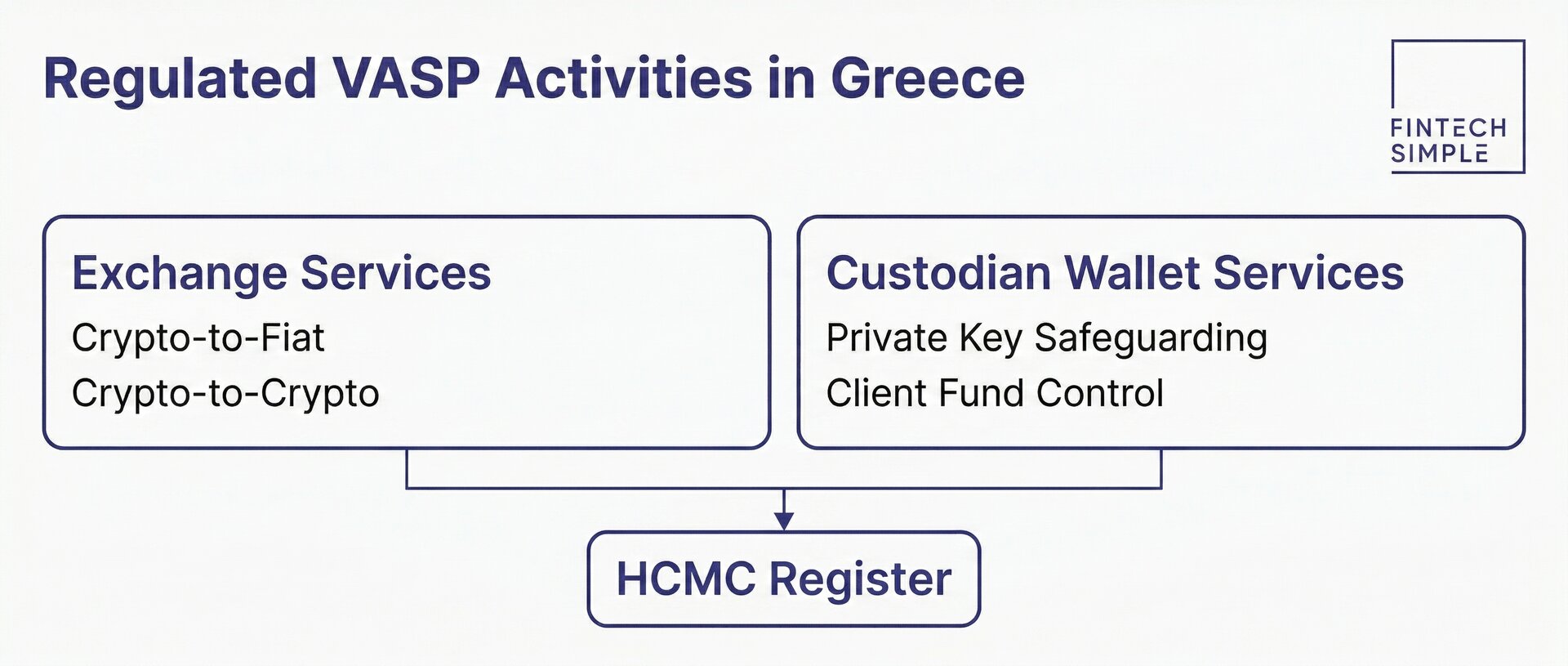
Before MiCA, Greece regulated crypto businesses through VASP registration under Law 4734/2020, which covered only two activity categories: exchange services and custodian wallet services. The HCMC maintained separate public registers for each — the Register of Providers of Exchange Services and the Register of Custodian Wallet Providers. That regime closed on 31 December 2025. All operators must now hold MiCA CASP authorisation.

Overview of crypto-asset service categories regulated under MiCA in Greece, showing the ten CASP activity types requiring HCMC authorisation

Services Outside MiCA’s Scope

MiCA does not cover every crypto-related activity. The following services fall outside the regulation’s current scope and do not require CASP authorisation from the HCMC:

  • Crypto lending and borrowing — providing or facilitating collateralised or uncollateralised crypto loans is not classified as a crypto-asset service under MiCA. There is no specific CASP authorisation requirement for peer-to-peer or institutional crypto lending platforms in Greece.
  • Staking services — operating staking pools, offering delegated staking, or running validator infrastructure for proof-of-stake networks is not listed among the ten CASP service categories. MiCA does not regulate staking as a standalone service.
  • Decentralised Finance (DeFi) — fully decentralised protocols with no identifiable service provider fall outside MiCA’s scope. However, the European Commission is required to assess DeFi regulation by 30 December 2027 under MiCA Article 142, and future legislation may bring certain DeFi activities into scope.
  • NFT platforms — unique, non-fungible tokens are generally excluded from MiCA’s definition of crypto-assets. However, NFTs issued in large series or collections may be reclassified as fungible crypto-assets, bringing them within scope. Each platform requires individual assessment.

Important caveat

“Outside MiCA’s scope” does not mean “obligation-free.” Greek corporate law, consumer protection rules, and general AML obligations under Law 4557/2018 can still apply to businesses operating in these areas. The European Commission’s upcoming reviews (DeFi by December 2027, NFTs and lending by June 2027) may extend regulatory requirements. Any business building on these gaps should structure with future regulatory convergence in mind.

Packages & Pricing for Greece Crypto License

We offer two tailored options for obtaining a crypto license in Greece — choose the one that matches your existing regulatory status and business goals. HCMC administrative fees are included in both tariffs. The figures below are firm quotes, not estimates.

Notification for Licensed Firms €6,500
Company Registration + CASP Licence €18,500
Consultation & regulatory strategy
Documentation and translations (Greek & English)
Submission, RFI handling & continuous regulatory support
HCMC administrative fees included
Post-authorisation passporting support
Review of existing legal status & update of AML/ICT/governance framework
Article 60 notification dossier
Greek SA (Société Anonyme) setup (incorporation, capital deposit, 1-year Athens address)
Full MiCA documentation pack (AML/CFT, ICT/DORA, governance, custody)
Fit-and-proper documentation & interview coordination
Notification for Licensed Firms €6,500
  • Consultation & regulatory strategy
  • Documentation and translations (Greek & English)
  • Submission, RFI handling & continuous regulatory support
  • HCMC administrative fees included
  • Post-authorisation passporting support
  • Review of existing legal status & update of AML/ICT/governance framework
  • Article 60 notification dossier
  • Greek SA (Société Anonyme) setup (incorporation, capital deposit, 1-year Athens address)
  • Full MiCA documentation pack (AML/CFT, ICT/DORA, governance, custody)
  • Fit-and-proper documentation & interview coordination
Company Registration + CASP Licence €18,500
  • Consultation & regulatory strategy
  • Documentation and translations (Greek & English)
  • Submission, RFI handling & continuous regulatory support
  • HCMC administrative fees included
  • Post-authorisation passporting support
  • Review of existing legal status & update of AML/ICT/governance framework
  • Article 60 notification dossier
  • Greek SA (Société Anonyme) setup (incorporation, capital deposit, 1-year Athens address)
  • Full MiCA documentation pack (AML/CFT, ICT/DORA, governance, custody)
  • Fit-and-proper documentation & interview coordination

Not included in either tariff

Minimum capital under MiCA Annex IV (€50,000–€150,000 by CASP class), notary fees (~€800–€1,500), statutory audit fees, certified translations of non-Greek/non-English documents, local director compensation (if needed), professional indemnity insurance (if applicable), and VAT where chargeable.

Tariffs valid for engagements commencing 1 May 2026 – 31 December 2026.

Our Experts

Our team has secured over 500 crypto and fintech licences since 2016, including guiding clients through Greece's HCMC authorisation process under both the transitional VASP framework (Law 4734/2020) and MiCA.

Patrik Asevičius
Patrik Asevičius Lawyer
Marcin Mostowski
Marcin Mostowski Lawyer, MiCA specialist
Anastassia Rumjantseva
Anastassia Rumjantseva Lawyer

Why Greece for Your Crypto Business?

Greece built its crypto regulatory framework through EU-aligned legislation and designated the Hellenic Capital Market Commission (HCMC) as the competent authority for VASP registration and, following Law 5193/2025 (passed by Parliament on 10 April 2025, published in the Government Gazette on 11 April 2025), MiCA CASP authorisation. Under MiCA, capital requirements of €50,000–€150,000 apply uniformly across the EU (including Greece), and the 22% corporate tax rate is competitive within the eurozone, sitting close to the European average of roughly 21.6%.

Key Advantages

Greece offers a combination of low regulatory costs, full EU market access, and an active fintech support structure. Each advantage below translates directly into cost or speed for your business:

  • Low registration fees — HCMC administrative fees are included in both of our service packages (€6,500 notification path or €18,500 full licence). Compared to €5,000–€17,000 in Lithuania depending on activity scope, Greece keeps upfront regulatory costs manageable when you are still building a client base.
  • EU passporting under MiCA — A Greek MiCA authorisation lets you serve clients across all 27 EU member states without a separate licence in each jurisdiction. One approval, one regulatory relationship, one annual compliance cycle.
  • 22% corporate tax — Greece’s headline corporate tax rate is competitive within the eurozone, sitting close to the European average of roughly 21.6%. Cyprus is lower at 12.5%, but Cyprus carries reputational risk with some institutional banking partners. Greece does not.
  • BoG Innovation Hub — The Bank of Greece Innovation Hub provides a formal channel for pre-application dialogue. You can clarify your business model with the regulator before filing, reducing the risk of a revise-and-resubmit cycle.
  • Growing fintech talent pool — Athens has seen fintech startup activity accelerate since 2021, supported by EU structural funds and local accelerator programmes. Hiring compliance officers, AML analysts, and tech staff is increasingly feasible without relocating your entire team from another country.
  • Lean substance requirements — The HCMC requires genuine local substance, but does not impose the same headcount thresholds that some regulators (notably the Central Bank of Ireland) apply. A lean operation with a qualified local director and a compliance function can satisfy the test.

Potential Challenges

No jurisdiction is without friction. Greece has three structural issues you should factor into your planning before committing.

  • Nascent licensing ecosystem — The HCMC only began processing MiCA CASP applications in earnest from mid-2025 following HCMC Decision 8/1059/30.07.2025. Regulatory precedent is thin, processing timelines are not yet battle-tested at scale, and the pool of Greek lawyers with deep MiCA practice experience is smaller than in Lithuania or Germany. Expect more back-and-forth with the regulator during the authorisation phase than you would in a mature jurisdiction.
  • Limited banking options for crypto businesses — Greek domestic banks — Piraeus, Alpha, Eurobank — remain cautious about onboarding crypto CASPs. You will likely need to open a business account with an EMI (Electronic Money Institution) or an international neobank as your primary operating account, and maintain Greek banking as a secondary relationship if at all. This is a workflow inconvenience, not a legal barrier, but it adds setup time.
  • Greek-language regulatory correspondence — The HCMC communicates in Greek. You will need a local legal representative capable of handling Greek-language filings and correspondence — not just translation, but substantive regulatory dialogue.

Our view

The banking challenge is the single most practical obstacle for foreign operators. We have established relationships with EMI partners that onboard Greek-registered crypto businesses. If banking access is your primary concern, speak with us before filing.

Greece vs. Other EU Jurisdictions

All three jurisdictions below grant MiCA authorisation, meaning the end result — an EU passport to serve clients across the bloc — is identical. The differences are in cost, speed, and the maturity of the regulatory environment. Greece wins on price; Lithuania wins on speed and ecosystem depth; Czech Republic sits in between.

Feature Greece Lithuania Czech Republic
Registration Fee Included in service fee €5,000–€17,000 €1,000–€5,000
Processing Time 6–9 months 2–4 months 3–5 months
Corporate Tax 22% 15% 21%
Minimum Capital €50,000–€150,000 €125,000 (full CASP) €50,000

Lithuania’s 15% corporate tax looks attractive on paper, but the minimum capital requirement of €125,000 for a full CASP licence ties up working capital that early-stage operators typically need for operations. Greece’s MiCA capital requirements (€50,000–€150,000 depending on service class) are set at the EU-wide floor, and the 22% corporate tax rate remains competitive against the eurozone average. Once MiCA application volume through the HCMC increases and processing times stabilise, Greece is likely to become more competitive on speed as well.

Regulatory Framework for Crypto in Greece

Greece has built its crypto regulatory framework through six laws enacted between 2018 and 2025. If you are obtaining MiCA CASP authorisation in Greece in 2026, you operate under all six simultaneously, plus the directly applicable EU MiCA regulation.

Key Legislation

The table below maps each law to its year and scope. The two AML laws (4557/2018 and 4734/2020) are the immediate hurdles for most applicants; Law 5193/2025 is the statute that formally designates the HCMC as Greece’s MiCA competent authority and sets the domestic CASP authorisation procedure.

LawYearScope
Law 4557/2018 2018 Transposes the EU 4th AML Directive into Greek law. Establishes the core AML/CFT obligations: customer due diligence, beneficial ownership identification, suspicious transaction reporting, and record-keeping. Applies to all obliged entities, including crypto businesses.
Law 4514/2018 2018 Transposes MiFID II. Governs investment firms and financial instruments. Relevant where crypto-assets qualify as financial instruments (e.g., tokenised securities) and triggers HCMC licensing requirements for related services.
Law 4734/2020 2020 Greece’s dedicated VASP law. Transposes the 5th AML Directive. Created the VASP registration regime administered by the HCMC. All crypto exchanges, custodians, and transfer services were required to register under this law before operating. Now superseded by MiCA CASP authorisation; the transitional period ended 31 December 2025.
Law 4961/2022 2022 Greece’s digital transformation law. Provides the legal basis for blockchain use in public administration, smart contracts, and electronic records. Creates a permissive framework for distributed ledger technology without directly licensing private crypto businesses.
Law 5113/2024 2024 Governs digital securities issued on distributed ledgers. Aligns Greek securities law with the EU DLT Pilot Regime (Regulation 858/2022). Applies to firms tokenising equity, bonds, or fund units — not to utility tokens or stablecoins.
Law 5193/2025 2025 Designates the HCMC as Greece’s competent authority for MiCA CASP authorisation. Requires CASPs to be incorporated as a Société Anonyme (AE). Sets Greece’s 12-month grandfathering period for existing VASPs (expired 31 December 2025). Passed by Parliament on 10 April 2025, published in the Government Gazette on 11 April 2025.

Note on MiCA interaction

MiCA (Regulation 2023/1114) is directly applicable across all EU member states from 30 December 2024. It does not replace the six Greek laws listed above — it sits on top of them. Law 5193/2025 bridges the two frameworks by designating the HCMC as Greece’s competent authority and establishing the domestic application procedure via HCMC Decision 8/1059/30.07.2025.

Regulatory Authorities (HCMC, BoG, FIU)

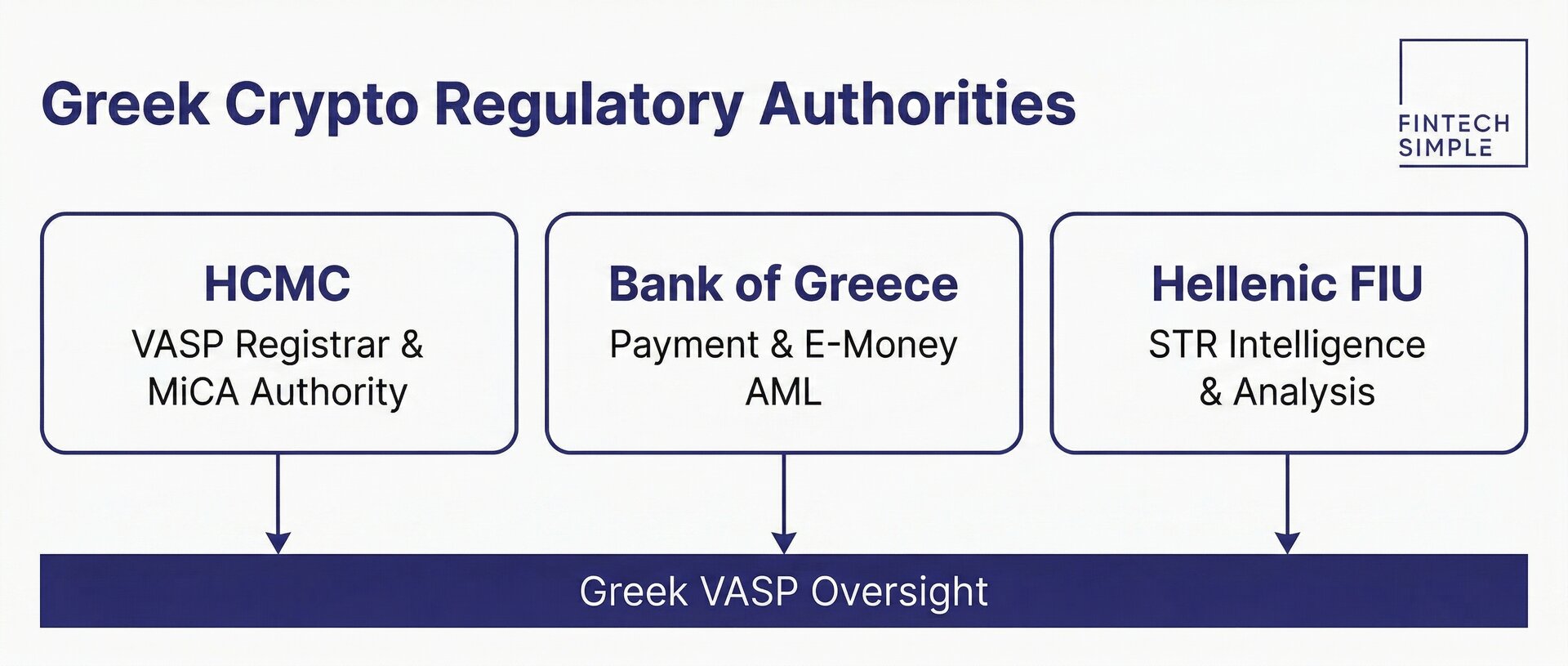
Three distinct authorities share oversight of crypto businesses in Greece. Their roles do not overlap — each covers a defined perimeter. A common error in competitor guides is referring to the “NBG” (National Bank of Greece) as a regulator: NBG is a commercial bank, not a supervisory authority. The relevant central bank body is the Bank of Greece (BoG), which is the country’s central bank and a separate institution.

AuthorityRoleScope
HCMC
Hellenic Capital Market Commission
Primary CASP authorisation body and securities regulator Grants MiCA CASP authorisation under Law 5193/2025 and HCMC Decision 8/1059. Reviews applications, assesses fit-and-proper of UBOs and directors, and conducts ongoing supervision of authorised CASPs. Also supervises investment firms under MiFID II (Law 4514/2018) where crypto-assets are financial instruments. Authorised CASPs are entered on both the HCMC national register and the ESMA Register.
Bank of Greece (BoG)
Central bank
AML/CFT supervision of payment institutions and e-money firms Supervises payment institutions and e-money issuers for AML/CFT compliance under Law 4557/2018. Where a CASP also holds a payment institution licence, BoG supervision applies in parallel. BoG is not involved in CASP authorisation — that authority belongs exclusively to the HCMC.
Hellenic FIU
Anti-Money Laundering Authority
Financial intelligence and STR recipient Receives and analyses suspicious transaction reports (STRs) filed by CASPs under Law 4557/2018. Issues AML guidelines for obliged entities. The FIU does not issue licences; it focuses on intelligence, investigation, and policy. CASPs must maintain a direct reporting channel to the FIU.

In practice, obtaining MiCA CASP authorisation in Greece primarily means satisfying the HCMC. You will submit your application, AML programme, and director documentation to the HCMC. If your business also processes payments, expect parallel engagement with BoG. Ongoing AML compliance involves the FIU through your STR reporting obligations.

Greek crypto regulatory framework showing the relationship between HCMC, Bank of Greece, and the Hellenic FIU under MiCA and national legislation

MiCA Implementation in Greece

MiCA (Regulation EU 2023/1114) became fully applicable on 30 December 2024. As an EU member state, Greece is bound directly — no further transposition law is needed for MiCA itself to apply. Law 5193/2025 designates the HCMC as Greece’s competent authority for CASP authorisation, and HCMC Decision 8/1059/30.07.2025 establishes the domestic application procedure. Greece chose a 12-month grandfathering period (not the EU maximum of 18 months), which expired on 31 December 2025. All crypto-asset service providers must now hold full MiCA CASP authorisation to operate.

A Greek MiCA CASP authorisation gives access to all 27 EU member states via the standard Freedom of Services notification procedure, without separate national registrations in each country. MiCA also introduces explicit minimum own-funds requirements (€50,000 to €150,000 depending on service class) that were absent from the previous Greek VASP regime under Law 4734/2020. The HCMC’s review clock for CASP authorisation is 25 working days for the completeness check, followed by 40 working days for the substantive assessment under MiCA Article 63.

Requirements for MiCA CASP Authorisation in Greece

Since 1 January 2026, all crypto-asset service providers in Greece must hold MiCA CASP authorisation issued by the Hellenic Capital Market Commission (HCMC). The previous VASP registration regime under Law 4734/2020 closed on 31 December 2025, and the 12-month grandfathering period granted by Law 5193/2025 has expired. Any entity providing custody, exchange, transfer, advisory, or portfolio-management services for crypto-assets must now hold full CASP authorisation before operating in or from Greece.

Before the HCMC reviews your application, your business must satisfy four parallel sets of conditions: the right corporate structure, fit-and-proper persons at the helm, a complete documentary file, and a functioning AML/KYC programme. Missing any one of these blocks the authorisation. The sections below detail exactly what Greece expects under MiCA and Law 5193/2025.

Corporate Structure Requirements

Under Law 5193/2025, you can obtain CASP authorisation in Greece through one of two structural routes:

  • Greek Société Anonyme (AE/SA) — a public limited company incorporated and domiciled in Greece. This is the mandatory legal form for MiCA CASP authorisation under Law 5193/2025. No other Greek corporate form (IKE, OE, EE) is accepted. The company must have a registered office in Greece and at least one director with verifiable operational responsibility.
  • EU/EEA branch or subsidiary — an established EU or EEA company that opens a registered branch or subsidiary in Greece with genuine local presence. The branch must have an autonomous operational presence and at least one senior manager physically based in Greece; the HCMC will not accept a mailbox arrangement.

Third-country (non-EU) entities are not eligible to register directly. If your company is incorporated outside the EU/EEA, you must first establish a Greek SA or a qualifying EU holding structure.

The registered office must be located in Greece and function as the actual place of management. A virtual office address alone does not satisfy this requirement. The company objects must explicitly include the provision of crypto-asset services as defined under MiCA (Regulation EU 2023/1114).

Minimum paid-in capital

Under MiCA Annex IV, the minimum own-funds requirement depends on the CASP services you intend to provide. Three tiers apply: €50,000 for reception/transmission of orders, advice, or portfolio management; €125,000 for exchange, order execution, or placing services; and €150,000 for custody and administration or trading platform operation. If you offer services across multiple tiers, the highest applicable threshold applies. The capital must be fully paid in before the HCMC will process your application.

Fit-and-Proper Criteria

Every director, senior manager, and shareholder holding ≥10% of shares or voting rights must pass a fit-and-proper assessment. The HCMC evaluates three dimensions:

  • Honesty and integrity — no criminal convictions for fraud, money laundering, terrorist financing, market abuse, or related financial crime in any jurisdiction. Convictions more than 10 years old for minor offences may be disregarded, but full disclosure is mandatory.
  • Professional competence — at least one senior manager must hold verifiable experience in financial services, compliance, or crypto-asset operations. A minimum of 3 years in a comparable regulated role is the practical benchmark the HCMC applies.
  • Financial soundness — directors and significant shareholders must not be subject to active insolvency proceedings and must not have been disqualified from holding a directorship or controlling a regulated entity in any EEA state.

The HCMC also assesses reputation at the entity level: a company that has had a VASP, CASP, or payment-institution authorisation revoked in another jurisdiction will face heightened scrutiny and may be refused authorisation.

Beneficial owners (ultimate natural persons behind corporate shareholders) are subject to the same fit-and-proper review as direct shareholders. Opaque or multi-layered ownership structures that obscure beneficial ownership are a common ground for rejection.

Required Documents Checklist

Submit all documents in Greek or accompanied by a certified Greek translation. The HCMC expects a complete file at submission under HCMC Decision 8/1059/30.07.2025 — requests for material documents after lodgement extend the review period significantly.

  • Certificate of incorporation & articles of association — current certified copy showing the company name, registered address, share capital, and corporate objects.
  • Register of shareholders — full ownership chain down to the ultimate beneficial owners (UBOs), with percentage stakes and voting rights at each level.
  • UBO declaration — signed statutory declaration by each natural person owning or controlling ≥25% directly or indirectly (per Law 4557/2018), confirming accuracy of beneficial-ownership data.
  • CVs of directors and senior managers — including employment history for the past 10 years, professional qualifications, and relevant regulated-industry experience.
  • Criminal record certificates — issued within the past 3 months by the competent authority of every country of residence or nationality for each director, senior manager, and UBO. Greek criminal record extract plus apostilled equivalents for foreign nationals.
  • Fit-and-proper declarations — signed declarations by each director and senior manager confirming absence of disqualification, insolvency, or regulatory sanction in any jurisdiction.
  • Business plan — minimum 3-year plan covering the CASP services to be provided, target markets, projected transaction volumes, revenue model, and organisational chart.
  • AML/CFT policy & procedures manual — complete written AML programme including risk appetite statement, CDD/EDD procedures, transaction monitoring, and STR escalation.
  • Appointment of AMLCO — written appointment of a dedicated Anti-Money Laundering Compliance Officer (AMLCO), with CV demonstrating relevant AML expertise; the AMLCO must be based in Greece.
  • IT system and cybersecurity description — technical overview of the wallet/exchange infrastructure, custody arrangements, access controls, and incident-response plan per HCMC Decision 8/1059.
  • Third-party custody or safeguarding arrangements — if client crypto-assets are held with a third-party custodian, the relevant agreement and due diligence must be included.
  • Proof of registered office — lease agreement or property ownership document confirming the physical address of the Greek registered office.
  • Financial statements or opening balance sheet — audited accounts for the past 2 years (existing entities) or an auditor-certified opening balance sheet (newly incorporated entities).
  • Evidence of paid-in capital — bank statement or auditor certificate confirming that the required minimum own funds under MiCA Annex IV have been paid in full.
  • Professional indemnity or financial guarantee — where the HCMC requires evidence of financial guarantee, an insurance certificate or bank guarantee letter must be provided.
  • Internal audit framework — description of internal controls, segregation of duties, and (for larger operations) an internal audit function or outsourced equivalent.
  • GDPR and data protection policy — summary of how the entity processes and protects client personal data in line with Regulation (EU) 2016/679.

AML/KYC Program Requirements

Greece implements the EU’s Anti-Money Laundering Directives and MiCA’s conduct-of-business rules via Law 4557/2018 (as amended by Law 4734/2020). Your AML/KYC programme must be written, board-approved, and proportionate to the money-laundering and terrorist-financing risks you face. The HCMC scrutinises five core elements: a documented risk assessment reviewed at least annually, customer due diligence (CDD) and enhanced due diligence (EDD) procedures for all clients at onboarding, automated or manual transaction monitoring with defined thresholds and red-flag indicators specific to crypto-assets, a clear internal escalation path for Suspicious Transaction Reports (STRs) filed with the Hellenic Financial Intelligence Unit, and record retention for a minimum of 5 years.

The AMLCO must have direct access to the board and must submit an annual compliance report. If your CASP operates a hosted wallet or exchange, your transaction monitoring tool must be capable of blockchain analytics — the HCMC expects you to identify transfers from or to high-risk addresses and to flag unhosted wallet counterparts above applicable thresholds in line with the EU Transfer of Funds Regulation (Regulation 2023/1113).

Travel Rule obligation

Since the EU Travel Rule (Regulation 2023/1113) applies directly in Greece, your technical infrastructure must be able to collect, store, and transmit originator and beneficiary data for all transfers of crypto-assets between CASPs — no de minimis threshold applies for crypto-to-crypto transfers. This requirement should be addressed in both your IT system description and your AML/KYC programme before you file with the HCMC.

Step-by-Step: How to Get a Crypto License in Greece

The Hellenic Capital Market Commission (HCMC) authorises Crypto-Asset Service Providers (CASPs) under Law 5193/2025 and HCMC Decision 8/1059/30.07.2025. The full process, from incorporating your entity to receiving CASP authorisation, typically takes 6–9 months. Below is how we structure that timeline for our clients.

Step 1 Weeks 1–3

Establish a Legal Entity in Greece

What we do: We coordinate with a local notary and lawyer to incorporate a Société Anonyme (AE), draft founding documents, and register the entity with the General Commercial Registry (GEMI). Under Law 5193/2025, CASPs in Greece must be incorporated as an AE. The company must have a registered office in Greece and at least one director with verifiable operational responsibility.

  • Corporate form — Société Anonyme (AE) is the mandatory legal form for MiCA CASP authorisation in Greece under Law 5193/2025
  • Share capital — minimum paid-in capital varies by service type; we confirm the applicable figure based on your specific CASP activities
  • GEMI registration — typically completed within 5–10 working days once notarial documents are signed
  • Tax registration (AFM) and VAT number — obtained from the local Tax Office as part of the same incorporation sequence
Step 2 Weeks 2–4

Develop Internal AML/KYC Policies

What we do: We draft a full AML/CFT compliance framework tailored to your business model (exchange, custody, transfer, or a combination). Greece transposes the EU’s 4th and 5th AML Directives (via Laws 4557/2018 and 4734/2020), so the HCMC expects documented policies that meet European-standard requirements, not skeleton templates.

  • Customer due diligence (CDD) procedures — standard, simplified, and enhanced, mapped to your risk matrix
  • Transaction monitoring rules — thresholds, red flags, and escalation paths for suspicious activity reports (SARs) filed with the Financial Intelligence Unit
  • Designated AML Compliance Officer — must be named in the application; we help define the role scope and ensure the appointee meets HCMC’s fitness criteria
  • Record-keeping schedule — 5-year retention minimum, covering all CDD data and transaction records
Step 3 Weeks 3–5

Prepare Authorisation Documents

What we do: We compile and review the full application file against the HCMC CASP application requirements, then coordinate with you to gather the source documents. A single missing item can pause the clock, so we run a pre-submission audit before anything is filed.

  • Corporate documents — articles of association, GEMI certificate, shareholder register, proof of registered address
  • UBO declaration — identifying all beneficial owners holding more than 25% directly or indirectly (per Law 4557/2018)
  • Biographical details and criminal record certificates — for each director, senior manager, and UBO; Greek criminal record extract plus apostilled equivalents for foreign nationals
  • Business plan — describing services offered, target markets, projected transaction volumes, and revenue model for at least 2 years forward
  • IT and security overview — wallet custody approach, private key management, cybersecurity controls, and business continuity arrangements
Step 4 Week 6

Submit Application to HCMC

What we do: We submit the complete CASP authorisation application to the HCMC through the designated submission channel, pay the applicable application fee on your behalf, and obtain confirmation of receipt. We maintain all correspondence with the regulator under our reference.

  • Application fee — payable to HCMC at submission; confirm the current amount with the HCMC before filing
  • Language requirements — all documents must be in Greek or accompanied by a certified Greek translation
  • Submission log — we maintain a timestamped record of every document filed and every communication exchanged
Step 5 Weeks 7–24+

HCMC Review & Authorisation

What we do: We monitor the review actively, respond to any supplementary information requests (RFIs) within 48 hours, and keep you updated at each stage. Under MiCA Article 63, the HCMC has 40 working days for the substantive review from the date of a complete application.

  • RFI management — the HCMC routinely asks follow-up questions on AML procedures, governance arrangements, or capital documentation; we draft responses and coordinate any additional evidence
  • Decision outcome — HCMC issues a formal authorisation or refusal decision; authorised CASPs are entered on both the HCMC’s national register and the ESMA Register of CASPs
  • Authorisation certificate — once issued, your entity is legally permitted to provide the authorised crypto-asset services across the EU via MiCA passporting
Step 6 Ongoing

Post-Authorisation Obligations

What we do: We help you build the compliance calendar so your CASP authorisation remains in good standing. Authorisation is not a one-time event. MiCA Title V imposes ongoing reporting, governance, and change-notification requirements from the moment you begin operating.

  • HCMC periodic reporting — transaction statistics, prudential returns, and AML compliance reports submitted on the schedule set by the regulator
  • Change notifications — any material change to directors, UBOs, services offered, or IT infrastructure must be notified to HCMC before or immediately after the change (per MiCA Article 65)
  • Annual AML risk assessment — internal review of your customer risk profile and policy effectiveness, documented and available for HCMC inspection
  • Ongoing MiCA compliance — prudential requirements, conduct-of-business rules, complaints handling, conflicts of interest, and outsourcing governance as defined under MiCA Title V

Need Help with MiCA CASP Authorisation?

From SA incorporation to HCMC authorisation and ongoing compliance, our team handles the entire process. 500+ licences issued since 2016.

Costs, Fees & Financial Obligations

A Greece cryptocurrency license cost estimate has several layers: regulatory fees paid to the Hellenic Capital Market Commission (HCMC), one-time company formation expenses, ongoing legal and compliance overhead, and physical-presence requirements. The breakdown below covers what you pay before you open and what you pay every year after.

Regulatory Fees

Greece operates under the EU’s Markets in Crypto-Assets Regulation (MiCA), which came into full effect for CASPs (Crypto-Asset Service Providers) in December 2024. The HCMC is the competent authority responsible for authorisation. Two mandatory payments apply directly to the regulator:

  • Application fee — €1,500, payable when you submit your authorisation dossier. This covers the HCMC’s review of your legal documents, business plan, AML framework, and fit-and-proper assessments. The fee is non-refundable whether your application is approved or refused.
  • Annual supervisory fee — €1,000 per year, due each January following authorisation. This covers the HCMC’s ongoing oversight obligations under MiCA Article 82.

These are the lowest direct regulatory fees among EU member states that have published their MiCA fee schedules. By comparison, Malta charges €3,000–€5,000 for comparable VASP applications, and Germany’s BaFin schedule starts at €10,750.

Both fees are included in Fintech Simple’s service packages (€6,500 notification path and €18,500 full licence path), so you do not need to budget for them separately when engaging our team.

Company Setup Costs

To apply for a crypto license in Greece you must first incorporate a Greek legal entity — a Société Anonyme (AE/SA) is the mandatory corporate form under Law 5193/2025. The one-time formation costs depend on your chosen structure and whether you use a local law firm or a specialist licensing provider.

  • Notary and registration fees — €800–€1,500, covering notarial deed preparation, General Commercial Registry (GEMI) registration, and official gazette publication.
  • Share capital deposit — MiCA sets minimum own funds requirements by service type: €50,000 for order execution and portfolio management; €125,000 for operation of a trading platform; €150,000 for custody and administration. Capital must be deposited in a Greek bank account and evidenced at the time of application.
  • Local director / management requirements — Greece does not mandate a resident director as a formal rule, but HCMC expects the management body to exercise genuine control from Greece. If you need to appoint a local senior manager, that cost is typically €12,000–€24,000 annually (reflected in the ongoing costs section below).

Ongoing Compliance Costs

MiCA imposes continuous obligations on all authorised CASPs. Under Greek law, HCMC-authorised entities must maintain a permanent compliance function, an AML officer, and an internal audit function proportionate to the scale of operations. Plan for the following annual expenditure from year one:

  • AML compliance officer (MLRO) — €18,000–€36,000 per year for a qualified local MLRO, or €6,000–€12,000 for an outsourced arrangement. Greek law requires the MLRO to be locally based and to report directly to senior management.
  • Legal and regulatory advisory retainer — €6,000–€18,000 per year, covering regulatory correspondence, policy updates, and HCMC filing support as MiCA implementing measures evolve through 2025–2026.
  • AML transaction monitoring software — €3,000–€12,000 per year depending on transaction volumes and vendor. Blockchain analytics tools (e.g., Chainalysis, Elliptic) are expected but not yet mandated by name under Greek national guidance.
  • External audit — €4,000–€8,000 per year for a statutory audit, mandatory for Greek SAs and for all HCMC-regulated entities regardless of size.
  • Virtual office / registered address — €1,200–€3,600 per year for a compliant Greek registered office with mail handling. HCMC requires a genuine local presence; a bare registered address is acceptable for smaller operations during the first licence period.

Total Cost Estimate

The table below consolidates every cost category. Year 1 totals include both one-time setup expenses and the first full year of ongoing costs. From year 2 onward, you pay only the recurring items. Ranges reflect the difference between a lean remote operation (lower bound) and a locally-staffed compliance setup (upper bound).

Cost CategoryRange (EUR)
HCMC application fee (one-time) €1,500
Company formation (notary, GEMI, gazette) €800 – €1,500
Minimum share capital deposit €50,000 – €150,000
Legal & advisory (setup phase) €8,000 – €20,000
AML compliance setup (policies, procedures, systems) €3,000 – €8,000
Virtual office / registered address (annual) €1,200 – €3,600
Annual ongoing costs (MLRO, audit, advisory, software) €31,000 – €74,000
Annual HCMC supervisory fee €1,000
Total — Year 1 (excl. share capital) €46,500 – €109,600
Total — Year 2+ (annual recurring) €33,200 – €78,600

Share capital is a balance-sheet item — it is not spent, it is held. The figures above exclude it from the cost totals so you can compare operating cash outflows directly. If your intended services require the €150,000 capital threshold, you will need to fund that separately and maintain it throughout the licence period.

Cost planning note

The ranges above assume you are applying for a standard CASP authorisation covering one or two MiCA service categories. Operators seeking to provide custody plus exchange plus advisory services simultaneously should budget toward the upper bound, as the HCMC will assess each service type independently and may request additional own funds evidence or senior management appointments for each category.

Taxation for Crypto Businesses in Greece

Greece applies standard EU tax principles to crypto businesses. The IAPR (Independent Authority for Public Revenue) treats crypto assets as intangible property for tax purposes, and the general corporate and personal tax framework applies. Before you structure your Greek entity, understanding the headline rates and VAT treatment will directly shape your operating costs and dividend strategy.

Corporate & Personal Tax Rates

Greece operates a flat corporate tax rate alongside a progressive personal income tax scale. Crypto trading profits, staking income, and fees earned through a Greek CASP licence are taxed as ordinary business income at entity level. Distributions to individual shareholders are subject to dividend withholding tax on top of the personal rate if the shareholder is a Greek tax resident drawing salary or dividends from the company.

Tax TypeRateNotes
Corporate income tax (CIT) 22% Flat rate on net taxable profits; applies to crypto trading gains, service fees, and staking revenue booked through the Greek entity.
Personal income tax — lower bands 9% / 20% / 26% First €10,000 taxed at 9%; €10,001–€20,000 at 20%; €20,001–€30,000 at 26% (per Law 5246/2025, effective 1 January 2026). Applies to individual founders or employees on Greek payroll.
Personal income tax — upper bands 34% / 39% / 44% €30,001–€40,000 at 34%; €40,001–€60,000 at 39%; above €60,000 at 44%. High-earning founder-directors should model this carefully.
Dividend withholding tax 5% Applied on dividend distributions from a Greek company. Reduced or eliminated under applicable double-tax treaties.
Capital gains — individuals 15% Gains from disposal of crypto assets held personally (not through a company) are taxed at a flat 15% rate.
Social insurance contributions ~26.95% employer / 13.87% employee Combined social contribution burden on Greek-payroll staff. Relevant for businesses hiring locally to meet HCMC substance requirements.

VAT on Crypto Services

VAT treatment for crypto businesses in Greece follows the CJEU Hedqvist ruling (Case C-264/14), which established that exchange of conventional currency into Bitcoin — and by extension, crypto-to-fiat and crypto-to-crypto exchange services — are exempt from VAT as financial transactions under Article 135(1)(e) of the EU VAT Directive. Greece implemented this exemption through Greek VAT law (Law 2859/2000), meaning CASP exchange services are VAT-exempt without the right to deduct input VAT.

  • Exchange services — Converting fiat to crypto, crypto to fiat, or one crypto asset to another: exempt from Greek VAT per the Hedqvist principle.
  • Custody and wallet services — Generally treated as exempt financial services, though the exact scope depends on service contract structure.
  • Consulting and advisory fees — Subject to standard Greek VAT at 24%. If the client is a VAT-registered business in another EU member state, reverse charge applies.
  • Software licensing and SaaS fees — Taxable at 24% in Greece or subject to reverse charge where the B2B client is EU-registered outside Greece.
  • NFT sales — Greek tax authorities treat NFT transactions as taxable supplies of digital services in most cases; 24% VAT applies unless a specific exemption can be justified.

Input VAT caution

Businesses providing exempt financial services (exchange, custody) cannot recover input VAT on their operating costs — office rent, software licences, compliance tools. Businesses with a mixed supply (exempt + taxable) must apply a partial exemption calculation. This is a recurring compliance issue that benefits from specialist VAT advice before the entity starts trading.

Tax Planning Considerations

Greece has signed over 55 double-tax treaties (DTTs), including agreements with the United Kingdom, United States, Germany, Cyprus, Malta, and the UAE. These treaties can reduce or eliminate withholding tax on dividends paid to non-resident shareholders, which is particularly relevant for holding structures.

  • Holding structure — Routing equity through a Cyprus or EU holding company can reduce effective dividend withholding to 0% under the EU Parent-Subsidiary Directive, subject to substance and anti-avoidance rules (ATAD I & II).
  • Transfer pricing — Greek entities transacting with related parties (e.g., a group treasury or IP holding company) must maintain transfer pricing documentation and comply with OECD arm’s-length standards. IAPR audits crypto businesses with cross-border intra-group flows.
  • Crypto regulation Greece 2026 — MiCA alignment — From 30 December 2024, MiCA applies directly in Greece. HCMC-licensed entities operating under MiCA may benefit from EU passporting, which can affect where VAT on B2B services is accounted for.
  • Loss carry-forward — Tax losses in Greece can be carried forward for 5 years. Crypto businesses in early stages with significant setup costs should track deductible losses carefully to offset future profits.
  • Notional interest deduction (NID) — Greece does not currently operate an NID regime (unlike Cyprus or Belgium), so equity financing carries no automatic deduction benefit. Thin-capitalisation rules cap deductible interest at 30% of EBITDA (ATAD alignment).

Professional consultation

Tax law for crypto businesses in Greece continues to develop alongside MiCA implementation and ongoing OECD Pillar Two discussions. The figures above reflect the position as of April 2026. We recommend engaging a Greek tax adviser with CASP-sector experience before finalising your entity structure and compensation arrangements.

AML/KYC Compliance Obligations

Greece’s AML framework is built on Law 4557/2018 (transposing AMLD4, amended by Law 4734/2020 for AMLD5) and the EU Transfer of Funds Regulation (2023/1113). The Bank of Greece supervises AML compliance and publishes binding guidance, while the Hellenic Capital Market Commission (HCMC) reviews your AML programme as part of the CASP authorisation application itself. A weak programme will delay or block your approval.

Customer Due Diligence (CDD)

Law 4557/2018 sets two hard thresholds that trigger mandatory CDD for crypto businesses:

  • Transactions ≥ €15,000 — any single transaction or linked series at or above this value requires full CDD before execution, regardless of whether the customer is already onboarded.
  • All crypto transfers — transfers of virtual assets require verification of both the originator and the beneficiary in line with the FATF Travel Rule, as incorporated into EU law via the Transfer of Funds Regulation (2023/1113).

CDD has three tiers. Standard CDD covers identity verification and beneficial ownership confirmation for all customers. Simplified CDD applies where statute explicitly permits lower risk, which is narrow for crypto. Enhanced Due Diligence (EDD) is mandatory for politically exposed persons (PEPs), high-risk third-country nationals, and any relationship flagged by your risk assessment. EDD requires senior management sign-off before the relationship proceeds.

Your onboarding procedures must document which tier applies and why. The HCMC expects policies to define trigger conditions precisely — phrases like “when appropriate” are not acceptable.

Record-Keeping & Reporting

Every customer record and transaction document must be retained for 5 years from the date of the transaction or the end of the business relationship, whichever is later. This applies to:

  • Identity documents — copies of passports, corporate registrations, and any verification outputs from your KYC provider.
  • Transaction data — blockchain transaction IDs, wallet addresses, timestamps, amounts in both crypto and euro equivalent at the time of execution.
  • CDD assessments — the rationale for tier classification, EDD sign-off records, and risk-scoring outputs.
  • Correspondence — any written communication relevant to a suspicious activity review.

When your compliance team identifies a suspicious transaction, you must file a Suspicious Transaction Report (STR) with the Hellenic Financial Intelligence Unit (FIU). Reporting is mandatory — there is no minimum threshold. Tipping off the customer that an STR has been filed is a separate criminal offence under Greek law. STRs must be filed promptly; deliberate delay is treated as a violation.

Compliance Officer Requirements

Every CASP authorised in Greece must appoint a dedicated Compliance Officer. This is not a role that can be absorbed into another function or outsourced entirely to a third party — the officer must have genuine authority within the organisation and direct access to the board.

The Compliance Officer’s responsibilities under Law 4557/2018 include:

  • Programme ownership — maintaining and updating the written AML/CFT programme, including customer risk assessment methodology and internal controls.
  • STR filing — reviewing internal alerts and determining whether to file with the FIU, documented with clear reasoning either way.
  • Staff training — ensuring all customer-facing and operations staff complete AML training annually and that records of completion are retained.
  • Regulatory liaison — serving as the primary point of contact for HCMC and Bank of Greece AML supervisory requests and examinations.

The HCMC expects the Compliance Officer to hold relevant qualifications — typically a legal or financial background with demonstrated AML experience in regulated financial services. If your appointed officer does not meet this bar, the regulator may require a replacement before finalising your CASP authorisation.

Penalties for Non-Compliance

The HCMC has broad sanctioning powers under MiCA and Law 4557/2018. Administrative sanctions for AML violations include licence suspension, public censure, and personal liability for senior managers. Financial penalties scale with the severity and duration of the breach.

Maximum administrative fine

Operating as an unauthorised CASP or committing serious AML/CFT breaches in Greece carries administrative fines of up to €10,000,000 for legal entities under MiCA and Law 4557/2018. The HCMC can also issue public warnings, suspend services, and refer cases for criminal prosecution, which can result in imprisonment for senior officers. Individual directors and senior managers can be held personally liable alongside the entity. A sound compliance programme is your primary protection against this exposure.

Beyond financial penalties, the reputational consequences of a public sanction are severe in the EU context. Regulators across member states share enforcement information, and a Greek AML finding can affect your ability to obtain licences in other jurisdictions. Greek courts have treated unauthorised crypto operations as money laundering facilitation where AML failures are identified alongside the authorisation breach. Building a robust compliance framework before you apply is far less costly than remediation after the HCMC has opened an investigation.

MiCA Transition: What Greek VASPs Need to Know

Regulation (EU) 2023/1114, the Markets in Crypto-Assets Regulation (MiCA), is now the binding framework for crypto-asset service providers across all 27 EU member states, including Greece. If your business holds a Greek VASP registration issued under the previous national regime, that registration does not automatically convert into a MiCA-compliant CASP (Crypto-Asset Service Provider) authorisation. You need to act before the transitional window closes.

Transitional Deadline

Greece applied the maximum 18-month transitional period permitted under MiCA Article 143(3). Greek VASPs registered before 30 December 2024 may continue operating under national rules until 1 July 2026, provided they submit a complete CASP authorisation application to the Hellenic Capital Market Commission (HCMC) before that date. After 1 July 2026, operating without a MiCA CASP authorisation is unlawful. See guidance from ESMA on crypto-assets and EBA crypto-asset activities for EU-level technical standards.

From Legacy VASP Registration to MiCA CASP Authorisation

The Greek VASP registry, administered by the HCMC under Law 4557/2018 (as amended), was an AML-focused registration. It screened beneficial owners and verified AML/CFT procedures, but it did not impose capital requirements, custody rules, or conduct-of-business obligations comparable to MiCA-level standards.

MiCA authorisation is a different instrument entirely. The HCMC now acts as a full prudential and conduct supervisor. Under MiCA, a CASP authorisation covers one or more of 10 defined crypto-asset services, including:

  • Custody and administration
  • Operating a trading platform
  • Exchange services (crypto-to-fiat and crypto-to-crypto)
  • Execution of orders
  • Reception and transmission of orders
  • Portfolio management
  • Advice

Your CASP authorisation must enumerate the specific services you will provide. The authorisation is service-specific: holding authorisation for exchange does not permit you to offer portfolio management without a separate approval or an amendment to your authorisation.

Once authorised in Greece, MiCA grants your firm an EU passport. You can notify the HCMC to extend services into any other EU member state without a separate licence in each country.

Transitional Provisions

MiCA Article 143 sets out the grandfathering rules. For Greece, the practical timeline is:

  • 30 December 2024 — MiCA Title V (CASP rules) became applicable across the EU
  • 1 July 2026 — end of Greece’s 18-month transitional period; all operating CASPs must hold valid MiCA authorisation
  • Submit before 1 July 2026 — you must file a complete application with the HCMC; an incomplete submission does not preserve your right to operate

The HCMC can reject or revoke the transitional benefit if a registered VASP materially changes its business model, beneficial ownership, or service scope during the transition. Stay within the boundaries of your original VASP registration while your MiCA application is pending.

New entrants, firms that were not registered as VASPs in Greece before 30 December 2024, receive no transitional period. They must obtain full MiCA CASP authorisation before commencing any crypto-asset service.

Preparing for MiCA Compliance

A MiCA CASP application is substantively more demanding than the original VASP registration. The HCMC will assess the following areas, all of which require documented policies, procedures, and in some cases third-party verification:

  • Minimum own funds — €50,000 for advice and RTO services; €125,000 for execution, exchange, and portfolio management; €150,000 for custody and operating a trading platform (exact thresholds depend on the services sought)
  • Governance and fit-and-proper — management body members must meet experience, reputation, and time-commitment criteria; at least two independent directors for larger CASPs
  • Organisational requirements — written internal controls, risk management framework, business continuity plan, and record-keeping for 5 years minimum
  • Client asset protection — segregation of client crypto-assets from proprietary assets; regular reconciliation procedures
  • Prudential safeguarding — liquid assets or insurance cover equal to the higher of minimum capital or one quarter of fixed overheads
  • AML/CFT integration — MiCA does not replace AMLD obligations; Greek CASPs remain subject to Law 4557/2018 in parallel
  • White paper disclosure — if you issue, offer, or seek admission of any crypto-asset to trading, a MiCA-compliant white paper is required (with defined liability for misleading content)

The HCMC has up to 25 working days to declare an application complete, then a further 40 working days to grant or refuse authorisation. The 40-day period may be suspended for up to 20 working days if the HCMC requests additional information. Build these timelines into your planning: a realistic preparation-to-decision window is 6–9 months from the date you begin gap analysis.

If you have not yet started your MiCA readiness review (gap analysis, policy drafting, capital structuring, and management body assessment), the 1 July 2026 deadline leaves roughly 3 months of working time. Enforcement applies from that date without a grace period.

Why Choose Fintech Simple for Greece

Obtaining a crypto license in Greece means navigating HCMC registration requirements, MiCA compliance timelines, and substance rules specific to Greek company law. Fintech Simple has handled every step of this process for clients across Europe, and we apply the same structured approach to every Greek application.

  • 500+ licences obtained since 2016 across crypto, EMI, and fintech sectors
  • Greece-specific expertise — Greek company law, HCMC authorisation procedures, AML compliance under Law 4557/2018, and the MiCA framework
  • End-to-end service — from Greek SA incorporation and HCMC application to post-authorisation compliance and EU passporting
  • Fixed-scope packages — €6,500 or €18,500 quotes with no hidden fees
  • Dedicated point of contact — one licensing lawyer assigned to your project from kickoff to authorisation

Talk to Our Licensing Experts

Get a personalised assessment of your Greece MiCA CASP authorisation. Our team will outline the timeline, costs, and documents specific to your business.

Frequently Asked Questions about Crypto License in Greece

Is crypto legal in Greece?

Yes, cryptocurrency activities are legal in Greece, but businesses that provide crypto-related services must be authorised by the Hellenic Capital Market Commission (HCMC) as Crypto-Asset Service Providers (CASPs) under the EU MiCA regulation and Law 5193/2025. Existing VASPs registered under Law 4734/2020 before 30 December 2024 could continue operating under Greece’s 12-month transitional period until 31 December 2025 (per Law 5193/2025); that period has now expired. Operating without authorisation exposes you to fines and potential criminal liability. Private individuals may hold and trade crypto without authorisation. The obligation applies to businesses offering services to third parties.

Who regulates crypto in Greece?

The Hellenic Capital Market Commission (HCMC) is the primary regulator responsible for MiCA CASP authorisation and ongoing supervision. The Bank of Greece (BoG) plays a complementary role in systemic oversight and monetary stability, while the Financial Intelligence Unit (FIU), operating as Unit A of the independent Hellenic Anti-Money Laundering Authority, monitors compliance with anti-money laundering obligations and receives Suspicious Transaction Reports (STRs). All three authorities can initiate enforcement actions against non-compliant operators.

How much does a crypto license in Greece cost?

Two service options are available: Notification for Licensed Firms (€6,500) for companies that already hold an EU financial services licence, using the simplified MiCA Article 60 notification procedure; and Company Registration + CASP Licence (€18,500) for new companies with no prior EU authorisation, covering Greek SA incorporation, full MiCA documentation, and HCMC authorisation. Both tariffs include HCMC administrative fees. Not included: minimum capital under MiCA Annex IV (€50,000–€150,000 by CASP class), notary fees (~€800–€1,500), statutory audit fees, and local director compensation if needed. Ongoing annual compliance costs (MLRO, audit, advisory, monitoring software) are typically €31,000–€74,000.

How long does CASP authorisation in Greece take?

The HCMC’s substantive review window is 40 working days (approximately 2 months) from the date a complete file is submitted under MiCA Article 63. However, the full process — including company incorporation, document preparation, completeness checks (25 working days), and potential requests for additional information — typically takes 6–9 months from kickoff to authorisation. Delays most often stem from incomplete AML documentation or missing apostilled corporate records. Having these ready before filing is the single most effective way to compress the timeline.

What activities require CASP authorisation in Greece?

Under MiCA (in effect since 30 December 2024), ten categories of crypto-asset services require CASP authorisation from the HCMC: custody and administration, trading platform operation, crypto-to-fiat exchange, crypto-to-crypto exchange, order execution, placing, reception and transmission of orders, advice, portfolio management, and transfer services. The previous VASP regime under Law 4734/2020 (which covered only exchange and custody wallet services) closed on 31 December 2025.

Do I need a Greek company to obtain CASP authorisation?

Yes. Under Law 5193/2025, CASPs in Greece must be incorporated as a Société Anonyme (AE/SA). Alternatively, an EU-based company can open a branch or subsidiary in Greece with genuine local presence. A mailbox address alone does not satisfy the requirement. You need a registered office with a local director or responsible person. Foreign companies outside the EU cannot register directly; they must set up a Greek or EU entity first.

What are the AML requirements for Greek CASPs?

Greek CASPs must implement a full AML/KYC programme under Law 4557/2018 (transposing AMLD4, amended by Law 4734/2020 for AMLD5) and the EU Transfer of Funds Regulation (2023/1113). Specific obligations include: appointing a locally-based dedicated compliance officer, conducting Customer Due Diligence (CDD) on all clients (with enhanced due diligence applied on a risk basis), retaining transaction and identity records for 5 years, and filing Suspicious Transaction Reports (STRs) with the FIU immediately upon suspicion arising. Regular internal audits and staff AML training are also mandatory.

What is MiCA and how does it apply in Greece?

MiCA (Regulation EU 2023/1114) is the EU’s comprehensive crypto-asset regulation, fully applicable since 30 December 2024. In Greece, Law 5193/2025 designates the HCMC as the competent authority for CASP authorisation, and HCMC Decision 8/1059/30.07.2025 establishes the application procedure. The previous VASP registration regime under Law 4734/2020 has been replaced; Greece’s 12-month grandfathering period ended on 31 December 2025. All crypto-asset service providers must now hold MiCA CASP authorisation to operate.

Can I passport a Greek crypto license to other EU countries?

Yes. Under MiCA’s Freedom of Services framework, a CASP authorised in Greece can passport its services into any other EU member state by notifying the HCMC, which then coordinates with the host country’s regulator. A single Greek MiCA authorisation covers operations across all 27 EU member states without separate licences in each jurisdiction.

What are the penalties for operating without authorisation in Greece?

Operating as an unauthorised CASP in Greece carries administrative fines of up to €10,000,000 for legal entities under MiCA and Law 4557/2018. The HCMC can also issue public warnings, suspend services, and refer cases for criminal prosecution, which can result in imprisonment for senior officers. Greek courts have treated unauthorised crypto operations as money laundering facilitation where AML failures are identified alongside the authorisation breach.

Is crypto mining regulated in Greece?

Crypto mining is not classified as a CASP service under MiCA and does not require authorisation from the HCMC. Mining operations are treated as standard commercial activities subject to ordinary business licensing, electricity regulations, and environmental rules. Greek tax authorities (AADE) treat mined coins as income at the point of receipt and as capital assets on disposal. HCMC authorisation is not required, but tax and accounting obligations apply as soon as you begin mining.

What tax rate applies to crypto companies in Greece?

Greek companies pay corporate income tax at a flat rate of 22% on net profits. For individual shareholders or sole traders receiving crypto-derived income, personal income tax applies on a progressive scale of 9%/20%/26%/34%/39%/44%, with thresholds at €10k/€20k/€30k/€40k/€60k respectively (per Law 5246/2025, effective 1 January 2026). Capital gains from crypto disposals are taxed at 15% for individuals. Greece does not currently offer a participation exemption for crypto income, so tax structuring through holding companies or EU parent structures is worth evaluating early.

Your Privacy

By clicking "Accept", you consent to the use of cookies and similar technologies on your device to improve site navigation, analyze usage, provide specific functionalities, and support our marketing initiatives. Cookies that are strictly necessary will always be active with this link.